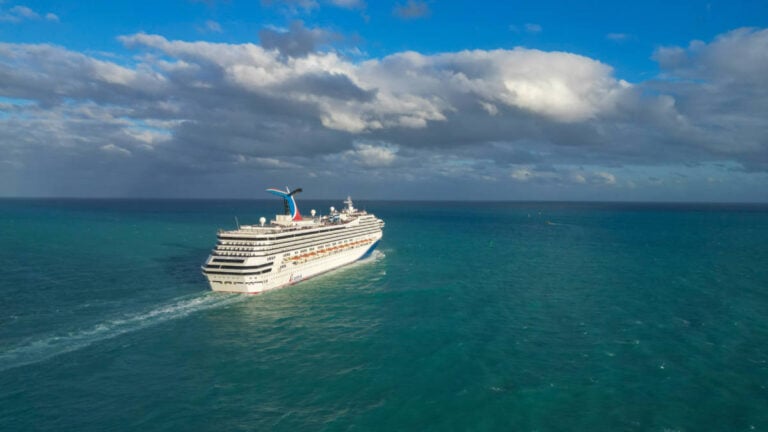
Carnival Sunshine has come perilously close to failing her most recent public health inspection from the US Centers for Disease Control and Prevention (CDC).
While a score of 85 or lower (out of 100) is considered failing the inspection, Carnival Sunshine rated just four points higher – an overall score of 89.
CDC inspections can be notoriously nit-picky and cruise ships can get lower scores for seemingly simple infractions, such as the wattage of light bulbs, a clogged drain, or a spill in the Lido Marketplace buffet.
A total of 26 items of concern were noted in the inspection report, many of which could be corrected immediately.
Some of the simpler items that impacted Carnival Sunshine‘s recent score include such issues as an open ice machine door in the pantry, some debris residue in crew handwashing stations, small drips from equipment creatin puddles on the floor, and a few burned-out lightbulbs in a dishwashing area of the galley.
Of greatest concern may have been the food employee who apparently had “an onset of acute gastroenteritis symptoms” at 1 p.m. on December 13, 2024, but who stayed at their duties until 4:40 p.m. and did not report to the medical center until nearly 6 p.m.
That delay cold have resulted in significant contamination of services, utensils, or even foods, depending on the crew member’s exact duties. Additional training was given to crew members about appropriate protocols when feeling ill or exhibiting any potential symptoms.
Fortunately, no norovirus or other gastrointestinal illness outbreak was reported aboard Carnival Sunshine for December 2024. In fact, the ship has not had any outbreaks reported at all since at least 2019.
The “ickiest” violation of the report to this frequent cruiser is the note that “numerous insects were present throughout multiple food service areas” including the Lido buffet.
Further reading of the details, however, clarifies just two “small” cockroaches (who’s measuring that? There’s no such thing as a small one to me…) and a total of nine fruit flies across five different areas. Maybe I won’t worry too much.
Fortunately, many of the necessary “corrective actions” would be easy to take, such as wiping up spills, discarding broken food trays, closing the ice machine door, and changing light bulbs.
The ship’s crew will take those actions and submit a report on the different tasks, at which point the CDC may either re-inspect the ship or simply monitor for future compliance with health and cleanliness guidelines.
Most Ships Easily Pass CDC Inspections
So far in 2025, Carnival Sunshine‘s score of 89 is the second-lowest of all cruise ship inspection reports.
That ship’s violations included similar issues as those aboard Carnival Sunshine, as well as reporting problems with children in the youth programs exhibiting illness symptoms, broken soap dispensers, and improper food storage.
Most ship inspections score in the 90s, but some vessels do exhibit perfect 100 scores. So far in 2025, those accolades belong to the new Disney Treasure, MSC Cruises’ Explora I, and Norwegian Escape.
For the Carnival Cruise Line fleet, four other ships have so far been inspected in 2025, in addition to Carnival Sunshine. Each one has scored well – Carnival Conquest (96), Carnival Elation (96), Carnival Freedom (99), and Carnival Sunrise (99).
Up-and-coming British cruise line Marella Cruises is looking to expand and create its own unique presence with its first-ever new build ships, coming in 2030 and 2032.
The cruise line signed a Memorandum of Agreement (MoA) with Fincantieri, the Italian shipbuilder also responsible for such amazing vessels as Cunard Line’s Queen Anne, Norwegian Cruise Line’s brand-new Norwegian Aqua, and Princess Cruises’ Sun Princess.
“We are proud to welcome Marella Cruises as a new customer and to support its vision as it enters the newbuild segment,”said Pierroberto Folgiero, CEO and Managing Director of Fincantieri.
TUI Group, parent company of Marella Cruises, is also the parent of German line TUI Cruises, which is a joint venture with Royal Caribbean Group.
In February 2025, Fincantieri delivered Mein Schiff Relax to TUI Cruises from its shipyard in Monfalcone, Italy. The 160,000-gross-ton, 4,100-passenger ship is the largest ever built for TUI Cruises, and the first vessel in the line’s new InTUItion class.
The new Marella Cruises ships will be designed especially for the British market, with refined touches that elevate the premium cruising experience. Further details, including gross tonnage and onboard features, will be announced at a later date.
What is already known is that the two ships will have a strong focus on environmental sustainability. This is a keen goal for many cruise lines with new ships, ensuring not only luxury getaways but responsible stewardship of the seas they sail.
“The project will bring together our expertise in ship design, innovation, and sustainability to deliver vessels that meet the evolving expectations of modern cruise passengers,”said Folgiero.
Furthermore, adding Marella Cruises as a new build client ensures ongoing “capacity saturation” for Fincantieri’s shipyards. This is great news for cruise travelers, as new ships offer new experiences and itineraries to enjoy.
While the new build order with Fincantieri is still subject to financing and other terms and conditions, this is a typical arrangement for new ships and there are no expected difficulties that may cause significant delays as the new ships take shape.
Why New Builds Matter for Marella Cruises
This first order for new builds is a big step for Marella Cruises, as the line’s current fleet is a hodge-podge of older ships purchased from different cruise lines and rebranded over the years.
Many cruise lines begin as rebranded older vessels from bigger lines, and it is only as a cruise line grows more successful and is able to expand that new build ships are ordered.
For example, Carnival Cruise Line’s first three ships – Mardi Gras, Carnivale, and Festivale – were all ships from other cruise lines.
Marella Explorer Cruise Ship (Photo Credit: StudioPortoSabbia)
Marella Cruise’s current fleet of five ships are from a variety of different cruise lines. Marella Discovery was originally Royal Caribbean’s Splendour of the Seas, while Marella Discovery 2 was formerly Legend of the Seas – predecessor and namesake to Royal Caribbean’s third Icon-class ship, due for delivery in 2026.
Marella Explorer was previously Celebrity Galaxy, Marella Explorer 2 was first Celebrity Century, and Marella Voyager was first Celebrity Mercury.
All five ships were built in the mid- to late 1990s, and older ships are not always able to be updated and renovated to meet modern environmental and guest experience expectations.
The two upcoming ships are sure to offer not only Marella Cruises’ premium experiences and services, but will start to forge the cruise line’s own distinctive personality.
This may be seen with unique interior architecture and exclusive spaces, as well as elevated finishes and attention to detail that will be sure to offer an amazing experience for all travelers.
Just a few months after welcoming the life-size “Ducky the Duck” quack-tastic crew member aboard, Carnival Cruise Line has given a new role to the feathery friend cruise guests already love.
Kyndall “Fire” Magyar, Cruise Director aboard Carnival Jubilee, shared a fun photo of the new Ducky and announced his new jobs onboard.
“There’s a new sheriff in town,”she said.“He is quacking down on debbie downers and making sure there is family fun for everyone!”
Ducky is sporting a new sheriff’s outfit, complete with a hat, vest, and his six-pointed badge. This wild west role is especially appropriate for Carnival Jubilee and the ship’s strong connections to Texas and the unique old west culture of the Lone Star State.
“Make sure to grab a picture with our ri-duck-ulously good looking friend onboard,”Magyar added.“As you can see, he knows where to find the Fun as he joined the Fun Squad on Lido for the Head To Head challenge on the Jubilee. To all my duck hunters, have you gotten your picture yet!?!”
Could this be just the first of several new outfits, costumes, and holiday attire Ducky might wear in the months ahead? While he wasn’t spotted dressed up for either Valentine’s Day or St. Patrick’s Day, there are more opportunities coming soon.
Will Ducky have special spring duds to celebrate Easter? What about patriotic attire for July 4th? Or what costume would a duck wear for Halloween later this year? Will Ducky be dressed up as Santa on the ever-popular holiday sailings?
While not an official mascot for the cruise line, Ducky has gotten enthusiastic responses from cruise travelers who love to stop for a selfie, a high-five, or a quick hug.
A fun nod to the wildly popular cruising ducks phenomenon, Ducky’s role aboard Carnival cruise ships is to bring joy to everyone aboard, and he’s excelling at his job.
Ducky has been spotted not only on Carnival Jubilee, but also aboard other ships – though there is no official contract obligation or work schedule for the feathered crew member.
Ducky on Carnival Jubilee
Ducky has been spotted, however, with different attire on different ships. On Carnival Venezia, for example, he wears a traditional gondolier’s blue-and-white striped shirt, red sash, and black shorts, along with an appropriate hat.
Will Ducky be dressed in outback adventure gear aboard the new Carnival Adventure and Carnival Encounter in Australia? What about wearing festive beads aboard Mardi Gras, or a bright tropical shirt for Carnival Paradise?
Of course, guests who aren’t lucky enough to come across Ducky on their next Carnival cruise can still be on the lookout for his smaller cousins – the innumerable small rubber ducks fun-loving guests hide in public spaces across the fleet.
The guest-driven game is a fun and simple one, and remember: “Keep or hide, you decide!”
Carnival Cruise Line has repeatedly noted that duck hiding is welcome aboard its ships, though guests should avoid carrying the game onshore in ports of call. Finding Ducky would be the ultimate in great duck spotting onboard!
Report your Ducky sightings on the Cruise Hive boards – photos or it didn’t happen!
What better way to celebrate your recent graduation than by taking your first-ever cruise?
Recently, a passenger in their 20s decided to do exactly that by booking an exciting Bahamian voyage with Royal Caribbean.
Unfortunately, this first-time cruiser made the mistake of assuming their booking was all-inclusive when it unfortunately it was not.
Once they realized the booking did not include WiFi or drinks as expected, they took to Reddit to seek advice.
“This is my first time sailing with Royal Caribbean. Apparently I picked an old ship (Enchantment of the Seas) and I thought this was an all inclusive but drinks and sodas aren’t included??? I’m shocked,”shared the poster.
She went on to add that the cruise line made her pay for everything upfront, but was then disappointed when the ‘fun stuff’ was all an additional cost.
It was quickly discovered that it was too late to cancel, and that the extras would not be affordable for this individual.
Excited to go on the cruise to the Bahamas and Royal Caribbean’s private island, Perfect Day at CocoCay, this passenger even contacted Royal Caribbean to see if Affirm could be used to pay for packages and passes.
The cruise line quickly responded that it would need to be paid in full, as Affirm’s buy now, pay later option could only be used when paying for the cruise and not for add-ons.
Fellow cruisers took to the comments to offer help, reassuring the poster that the packages and passes were not something needed to fully enjoy the cruise.
“You don’t need a drink package to buy drinks. You don’t need a water park pass to have fun on CocoCay,”replied one person.
“Breathe! You can take a 12 pack of soda on board with you when you board the ship,” another added, even sharing that“internet is optional, and Perfect Day waterpark…. there’s plenty of fun free things to do on CocoCay that won’t cost extra.”
The soon-to-be cruiser shared an update that thanks to the helpful replies, they decided not to buy a drink package and were excited for the cost-effective activities at CocoCay.
At the end of the update, the poster added“Everything is fine now and I can’t wait to go on this journey.”
Sometimes a positive attitude is all you need to have a good time!
Newbie Cruiser Can Still Enjoy a Smaller Royal Caribbean Ship
While this poster was seemingly disappointed with their choice of the 80,700 gross ton Enchantment of the Seas, many cruisers enjoy the smaller size of older ships.
Only 28 modern cruise ships have ever been stretched, and as they continue to be built larger, this process has become rare.
The 2,446 passenger Enchantment of the Seas’ current home port is in Tampa, Florida, and the ship frequently swaps between itineraries in the Caribbean and the Bahamas.
These voyages are usually between 4- and 5-nights long, but occasionally the vessel also does longer 10-night itineraries.
The cruiser who shared their booking experience will be going on a 5-night Bahamian cruise — which is round trip out of Tampa and makes stops in Bimini and CocoCay.
Enchantment of the Seas will only be doing this cruise one more time this spring departing on April 26, 2025 before spending the summer season sailing exclusively to Mexico. It will resume Bahamian voyages on August 2, 2025 for the fall season.
Interior rooms start as low as $572 per person, making it a relatively affordable cruising experience.
While this first-time cruiser thought they were booking something affordable, they were faced with the reality that not everything is all-inclusive on every cruise.
However, the extra packages — as fun as they can be — are not something you always need to have a great cruising experience!
A closed-loop cruise is a voyage that begins and ends at the same US port, allowing travelers to enjoy international stops without the need for a valid passport.
If you’re looking for a convenient and hassle-free vacation experience, a closed-loop cruise can minimize your pre-trip documentation concerns while still offering the excitement of a cruise vacation.
Most still visit international ports of call, but visa and passport requirements are eliminated, allowing you to set sail on a stress-free adventure.
Closed-loop cruises, which are sometimes shortened to “loop cruises,” cater to travelers who prefer simplicity and a more streamlined cruise experience.
When I take a cruise vacation, one of my main goals is to leave my stresses behind me. I’ve always been a fan of closed-loop cruises, but what does it mean?
Basically, the defining feature of a closed-loop cruise is that it departs from and returns to the same port within the United States.
Whether that port is in Miami, Fort Lauderdale, Boston, New York City, or any other American city does not matter—what matters is the fact that this cruise style simplifies the immigration and customs process.
Even though the ship may stop at a select few foreign ports along the way, the cruise is classified as a domestic trip under U.S. regulations.
Sounds pretty straightforward, right? Let’s see what allows a voyage to qualify as a “closed-loop” cruise and why this model is so appealing for passengers.
Key Qualifications for a Closed Loop Cruise
Cruise Ships From Carnival and Royal Caribbean in Miami (Photo Credit: Adam McCullough)
For a cruise to be classified as closed-loop, it is not as simple as setting off and returning to the same US port. Instead, the itinerary must be qualified by the U.S. Federal Government, which does so through agencies like the U.S. Department of State and various border protection agencies.
These government organizations set guidelines that permit these voyages to visit nearby international ports of call that do not necessitate the presentation of international travel documents.
This regulatory compliance allows passengers to board with just a government-issued photo ID or other acceptable form of identification, like a passport card, instead of a complete passport book or a birth certificate.
Because these cruises have been approved for adherence to domestic travel regulations, they only visit international stops that are considered close enough to fall under the Western Hemisphere Travel Initiative (WHTI) umbrella.
The Department of Homeland Security allows more efficient travel to and from these countries, like Canada, Mexico, many Caribbean nations, Bermuda, and the Bahamas.
View of Bermuda Cruise Port from Cruise Ship (Photo Credit: Nazar Skladanyi / Shutterstock)
Even though the cruise might stop at ports of call in these countries, the cruise still has to adhere to the structure and guidelines of U.S. authorities.
To ensure compliance, the cruise lines shape their itineraries to ensure they are in line with all regulations and standards relating to domestic cruising.
What does that mean for you as a passenger? You get to enjoy the fun and excitement of a semi-foreign adventure while still enjoying the convenience of domestic travel.
This also makes them an attractive alternative to a standard cruise for big families and first-time cruisers who might be a little worried about the complexities of international travel documentation.
Plus, closed-loop cruises are an excellent option for those who do not hold a passport, but still want to travel outside of the United States and enjoy everything a cruise vacation can offer.
Do I Need a Passport for a Closed-Loop Cruise?
When it comes to closed-loop cruises, one of the most frequently asked questions I hear is whether or not a passport is required. The short answer is: for the most part, no, a full passport is not needed.
Still, the details are a bit more nuanced, so let’s look at what you need and situations where a passport could be required.
Standard Closed Loop Documentation Requirement
Photo Credit: Evgenia Parajanian / Shutterstock
For most closed-loop cruises, adult American citizens must only present a government-issued photo ID. This might be a driver’s license or a state-issued ID card.
For most situations, this form of identification is all that is needed to board the ship. To play it safe, an enhanced driver’s license (EDL) is the best option, as this confirms your U.S. citizenship and identity.
Some cruise companies even recommend additional items such as voter registration records or social security cards if you cannot produce identification that clearly clarifies your status as a U.S. citizen.
For children, other documents, like the child’s birth certificate, are usually recommended, as this provides proof of citizenship without needing an ID card.
If you don’t have the child’s birth certificate, a certified copy of the child’s birth record, a consular report of birth, or even a certificate of naturalization may be acceptable, provided it is accompanied by an appropriate identification for the adult.
If you’re not a full U.S. citizen but a lawful permanent resident (LPR), a green card or another form of documentation proving your status is often required.
I know, it sounds confusing, but it’s not actually that bad. I always stress that the best way to be sure is to contact your cruise line and confirm the specific requirements before departure.
When a Passport Could Be Required
Even though closed-loop cruises are designed to allow travel without a valid passport, there are certain situations where a passport would be needed.
For starters, certain international ports of call, like those outside the scope of the WHTI, could require visitors to present a passport or other specialized documentation. Technically, closed-loop cruises avoid these types of ports, but it’s still something you should confirm before departure.
Naturally, those who do not hold citizenship or a green card will require a passport to take a closed-loop cruise. Let’s say you’re a British tourist visiting the United States but have booked a closed-loop cruise that departs from and returns to the same American port.
You would still need to bring your British passport with you on the cruise, even if American passengers traveling on the cruise ship do not.
Finally, if you plan on disembarking at a different port than one where the cruise officially ends, you will need a passport to ensure you can get home smoothly.
If you decide you want to stay somewhere like Jamaica, then fly home rather than continue your cruise, you would need a passport to navigate airport customs in Jamaica, as well as customs in the United States when you return.
Benefits of a Closed-Loop Cruise
If you’re not entirely sold on the idea of a closed-loop cruise just yet, here are just a few of the reasons why these more convenient and stress-free getaways are so popular.
The Simplified and Streamlined Travel Process
Embarking on a Cruise Ship (Photo Credit: Joni Hanebutt)
It sounds obvious, but one of the main benefits of booking a closed-loop cruise is the simplicity of the entire travel process. Since your cruise will start and end at the same domestic port, you don’t need to carry or even possess the same travel documents, like a passport or travel visas.
Since you also leave from your own country, you don’t need to worry about dealing with international flights or border crossings before or after your cruise.
For spontaneous getaways, it just makes everything so much easier. Rather than worrying about the stress of border crossings and customs agents, you can just pack your bags and embark on round-trip cruises without the fuss.
I mentioned earlier how this is really appealing for families with small children and first-time cruisers, but it’s worth repeating. While regular cruises aren’t overly difficult to manage or book, you can’t beat the simplicity of a trip that requires minimal travel documentation and a greater sense of simplicity.
Even on departure day itself, closed-loop cruises are so much less stressful. Since there’s no need to pass through customs, mobile check-in services and digital boarding passes help you really cut down on the hassle of travel day logistics.
Cost-Effectiveness and Time Savings
Cruise Booking
Another significant advantage is the financial benefit. You can save time and money by avoiding the expenses associated with obtaining a passport, including application fees, expedited processing costs, and even just getting to and from a passport office.
Again, this is really appealing for those planning a last-minute getaway. If you see a good last-minute deal on a cruise, you don’t have to worry about double checking your passport expiry dates for your group or anything else.
Since this opens you up to more spontaneity, you can also save money on your cruise fares, as these last-minute deals can be extremely cheap, especially on shorter voyages, which are common with closed-loop cruises.
Enhanced Flexibility
Cruise Ships Docked at Miami Cruise Port, Florida (Photo Credit: Francisco Blanco)
Speaking of spontaneity and saving money, one of the main benefits of a closed-loop cruise is the enhanced flexibility when planning your trip.
Since you’re not required to navigate the complexities of international travel, you have more freedom to choose itineraries that best suit your schedule and preferences.
This flexibility extends to the types of excursions available, the range of onboard activities, and even the ability to adjust travel dates on short notice.
As a cruiser who has always loved the sense of freedom I feel when I book a last-second trip, these low-cost, short-duration cruises let me book multiple getaways throughout the year.
Drawbacks of a Closed-Loop Cruise
While closed-loop cruises offer a lot of benefits, especially for those who do not have a passport, they’re not without their drawbacks. To help you determine if closed-loop cruises actually align with your travel preferences, here are the most prominent complaints about them.
Limited International Exposure
View of the Entire Port (Photo Credit: Port Canaveral)
It sounds obvious, but one of the main drawbacks is the limited range of international destinations you can visit on a closed-loop cruise.
Because closed-loop cruises must adhere to strict regulatory guidelines, including beginning and ending at the same US port, the number and types of foreign stops will always be limited.
This could be a bit of a disappointment for travelers seeking a more global adventure. With that said, you can still experience international cultures, as there are a number of exciting countries closed-loop cruises are allowed to visit, but the scope of your journey remains a little bit restricted.
I like to think of a closed-loop cruise as a way to experience a taste of international flavor rather than an opportunity to dive into what these different cultures offer.
Most of these trips have shorter itineraries, which means they visit fewer destinations, and the time in each port is also relatively short.
The focus is on relaxation, convenience, and the sense of getting away, rather than cultural and geographic exploration, which tends to be a more prominent component of traditional multi-destination cruises.
The Potential for Documentation Challenges in Emergencies
Cruise Passenger (Photo Credit: ad-foto)
While simplicity is a major part of the marketing for closed-loop cruises, there is always a bit of risk when traveling outside your home country without a passport. While you hope it never happens, you might need to fly home unexpectedly if an emergency occurs.
This could be an emergency medical issue that impacts you or someone you are traveling with, or an emergency at home that affects a loved one.
Either way, your ability to take an international flight from an airport in a foreign country will always be way more complicated without a passport.
Regulatory and Policy Uncertainties
Princess Cruises and US Flag
If you know anything about government policies at the federal level, you know that things can change quickly and unpredictably. Unfortunately, the rules governing closed-loop cruises can also change based on evolving government policies and security measures.
For example, even initiatives like the WHTI are updated from time to time, which means that what is acceptable one year may not be the next. This uncertainty can add a layer of stress, particularly for travelers who book their trip well ahead of time.
Where Can I Go on a Closed-Loop Cruise?
While closed-loop cruises are limited compared to traditional international cruises, they can still allow you to visit different countries and ports. Let’s look at some of the places you can visit and typical routes and itineraries for closed-loop cruises.
Closed-Loop Cruise Destinations
Cruise Ships Docked in Nassau, Bahamas (Photo Credit: SNEHIT PHOTO)
The Bahamas
Bermuda
Canada
Mexico
The Caribbean (Aruba, Jamaica, US Virgin Islands, Puerto Rico, Dominican Republic, Antigua, Barbados, St. Lucia, Martinique, and Bonaire)
Beyond these international destinations, Alaskan cruises that depart from the continental United States and cruises to the Hawaiian Islands are also popular places to visit on closed-loop cruises.
I wanted to cover a few popular itineraries to help you understand just how exciting these closed-loop trips can be.
Alaska
Cruise Ships in Skagway, Alaska (Photo Credit: Just dance)
A closed-loop Alaskan cruise will often depart and return to either Seattle Cruise Port or the Port of San Francisco.
From there, the cruise will visit ports in Juneau, Skagway, and Ketchikan, allowing you to enjoy Alaska’s coastline and Inside Passage. Some will even offer brief stops in Victoria, British Columbia, Canada.
The Bahamas
Perfect Day at CocoCay (Photo Credit: Darryl Brooks)
Another very popular closed-loop cruise destination is The Bahamas, with numerous US ports in Florida and along the Atlantic Coast offering these types of trips.
As the biggest cruise port in the world, it’s no surprise that PortMiami is the most popular embarkation and disembarkation for closed-loop cruises to destinations like Nassau, Freeport, and Perfect Day at CocoCay.
Bermuda
Bermuda Cruise Port and Terminal Facility (Photo Credit: Viktor Hladchenko / Shutterstock)
Given its proximity to the United States, closed-loop itineraries around Bermuda are also popular. Most will depart from Manhattan Cruise Port or Baltimore Cruise Port, then travel directly to Bermuda’s historic King’s Wharf in Sandy’s Parish on the Western Tip of the tiny island nation.
Typically, itineraries are only two or three days, but that still allows passengers to enjoy time on the ship and explore everything stunning Bermuda has to offer.
New England and Eastern Canada
Cruise Ship Visitors in Bar Harbor (Photo Credit: New England Photo)
If the tropical sun isn’t your thing, plenty of closed-loop cruises explore New England and Eastern Canada. New Jersey’s Cape Liberty and Brooklyn Cruise Port are common departure points.
From either port, the cruise will stop in American cities, like Boston, Massachusetts, and Portland, Maine, before exploring Canadian cities, like Saint John, New Brunswick; Halifax, Nova Scotia; and Newfoundland’s Saint John’s Cruise Port.
The Western Caribbean
International Cruise Terminal, Cozumel (Photo Credit: Solarisys)
If you’re looking for a bit of a lengthier getaway, but still want the benefits of a stress-free closed-loop voyage, a round trip visit to the islands of the Caribbean is an amazing option.
Given the variety of locations within the Caribbean, these trips can visit exciting destinations like Jamaica, Antigua, Grand Cayman, Martinique, and Barbados.
Others, including those departing from Galveston, Texas, focus on visiting Cozumel, Cancun, and other Mexican ports.
The exact itinerary will depend on the length of the voyage, the cruise line you are traveling with, and where you are cruising from, but these trips remain among the most popular types of closed-loop cruises.
Hawaii and the Mexican Riviera
For those on the West Coast of the United States who are looking to soak up the sun rather than visit the rugged landscapes of Alaska, closed-loop cruises departing from Los Angeles and San Francisco include stops at exciting destinations, like Cabo San Lucas or Puerto Vallarta.
There are also fully domestic closed-loop cruises from LA and San Francisco that visit the Hawaiian Islands.
How Much Does a Closed-Loop Cruise Cost?
Like any other type of cruise, the cost of a closed-loop cruise will depend on the length of the voyage, the level of onboard accommodations, the cruise line, and the specifics of the itinerary. Still, it’s worth looking at some pricing examples and the main factors influencing the overall cost.
Pricing Examples from Top Cruise Lines
Passengers Passing Other Docked Cruise Ships in Miami (Photo Credit: gary yim)
Many popular cruise operators, like Royal Caribbean, Carnival Cruise Line, and Disney Cruise Line, offer closed-loop options that are competitively priced.
For example, you might find a 3- to 5-night closed-loop cruise departing from Miami and visiting the Bahamas for as little as $250 to $400 per person.
For an even more budget-friendly trip, 2-night closed-loop trips to the Bahamas from Miami are available between $150 and $250, with MSC, Carnival, and NCL all specializing in these affordable getaways.
Most major cruise lines also offer closed-loop cruises to Bermuda between 4 and 7 nights, with costs ranging between $550 and $800.
These depart from and return to ports in Boston, New Jersey, and New York City, so they’re a good option for those living in the northeastern states.
Longer and more complex voyages, like week-long closed-loop cruises that visit multiple international ports of call in the Western Caribbean, tend to be priced over $550 per person.
That said, they can approach $1,000 per person with more elaborate accommodations.
As you’d expect, closed-loop trips to Alaska are more expensive, as they tend to be at least a week long. While you can shave down the cost by traveling during Alaska’s shoulder seasons, you should anticipate costs between $1,500 and $3,000.
Factors Influencing Cost
Cruise Ships Departing Port Everglades (Photo Credit: Allen Furmanski)
Again, like any cruise, some variables come into play when it comes to the cost of your closed-loop cruise.
One of the main factors you should consider is the season when you’re traveling, as cruises are almost always more expensive when you travel during the busy season. Keep in mind this varies depending on where you are traveling.
For example, Alaska is busier and more expensive in the mid-summer months, while Caribbean cruises are cheaper during the winter.
Your departure port will also factor into the price of your trip, with popular hubs like Fort Lauderdale, PortMiami, and Tampa able to offer more frequent voyages, so prices are more competitive than you’ll find at smaller ports.
The cabin type you select will also play a major role in your fare cost. If you’re looking to keep things cheap, interior cabins can be significantly more affordable than suites and even cabins with ocean views.
If you’re looking for a cheap getaway, book low-cost accommodations and stick to the basic included meals and drinks, rather than premium dining and drinks packages.
When I’m just looking for a low-cost escape, I treat my cabin as a place to sleep and shower, so I’ll book the cheapest accommodations and spend as much time as possible soaking up the sun and enjoying the ship’s amenities.
When you book, it also plays a role in the cost of any trip. This doesn’t necessarily mean when your cruise departs, but when you book your fare.
Many cruise lines offer package deals or special offers that bundle extras with your fare at certain times of the year, including during Wave Season.
If you’re flexible about dates, you can also cut costs by traveling at the last minute, which is nice with a closed-loop cruise because you don’t have to worry as much about travel documentation.
Plan Your Last-Minute Cruise Getaway
Cruise Ships Docked at PortMiami (Photo Credit: Ceri Breeze)
Closed-loop cruises can be a convenient and cost-effective way to enjoy a cruise vacation. Without the complexities of international travel documentation, or the headaches of going through customs, they can be perfect for spontaneous getaways, short vacations, and experiencing different cultures without needing a passport.
If you are someone who does not possess a valid passport, I’d always recommend double-checking your travel documents and what is required for that specific cruise.
Make sure it is actually a closed-loop cruise and the route doesn’t require passengers to carry extra documentation you may not have available, such as a Certificate of Naturalization or a certified copy of your identification.
Once you book, it’s also worth keeping an eye on the latest updates from your cruise line to ensure you’re fully aware of the requirements for all of the stops on your voyage.
While it can sound stressful to first-time cruisers, closed-loop cruises are almost like cruising with training wheels. It will give you a taste for everything a cruise vacation can offer, but with a much less complicated travel experience.
Whether it’s just a couple of days to a single destination or a whole week of traveling around the Caribbean, make the most of your closed-loop cruise vacation and enjoy everything the ship, voyage, and destinations have to offer!
With the newly refreshed and rebranded Carnival Adventure and Carnival Encounter now officially part of the Fun Ship fleet, who is taking the helm to bring Carnival Cruise Line’s signature vibe to each ship?
A ship’s cruise director can make all the difference in guest experiences onboard. An outgoing, energetic cruise director ensures the liveliest parties and best attitudes for all the activities staff.
Of course, Carnival Cruise Line is well known for its fun and engaging atmosphere – they are the Fun Ships, after all!
Now, two brand new Carnival cruise directors have joined the ranks to bring that fun to two new ships: Ben Kitchen and Chelle O’Callaghan.
Carnival Cruise Line’s Brand Ambassador, John Heald, made the official announcement of their promotions and positions on his popular Facebook page.
“I would like to give a wonderful welcome to two new Cruise Directors for the two ships that have recently joined the fleet in Australia. They are: Carnival Encounter Cruise Director, Ben Kitchen [and] Carnival Adventure Cruise Director, Chelle O’Callaghan,”he said.
Both cruise directors offer their own unique personalities and energy to the job, making them well-suited to welcome guests aboard the newly renovated and updated ships with newly renovated and updated experiences.
The exact activities schedules aboard each vessel have not yet been detailed, but they are sure to include sailaway deck parties, thrilling game shows, popular Playlist Productions, trivia contests, dance lessons, scavenger hunts, and so much more.
Carnival Encounter Cruise Director – Ben Kitchen
Ben Kitchen Cruise Director
Ben Kitchen is no stranger to the cruise industry, having worked previously with Princess Cruises (also owned by Carnival Corporation & plc) from 2005-2014 as a cruise director as well as a trainer.
Kitchen moved on to Norwegian Cruise Line from 2014-2016, also as a cruise director coordinating with the entertainment department. Of course, both Princess Cruises and Norwegian Cruise Line have very different vibes than Carnival Cruise Line.
He returned to the Carnival family with Carnival Australia as a cruise director and entertainment director in 2016. Kitchen hosted all the fun Down Under, planning daily schedules and collaborating with all team members to be sure crew members were as happy as the guests.
With his experience already in Australia, Kitchen understands the local personalities and can seamlessly bring Carnival fun to Carnival Encounter, giving every traveler a hearty g’day mate along the way!
Carnival Adventure Cruise Director – Chelle O’Callaghan
Chelle O’Callaghan Cruise Director
Michelle “Chelle” O’Callaghan is likewise no stranger to the unique and quirky Australian vibes, having served as a cruise director with P&O Cruises Australia since 2023.
She will be a familiar face aboard the former P&O Cruises ship, but now bringing Carnival’s signature fun style to every guest with new parties and activities.
While O’Callaghan is a relative newcomer to the cruise industry, she is no stranger to entertainment and guest interaction.
From 2010-2014, she served as an entertainment manager with the Thomas Cooke Group for a variety of hotels and holiday experiences. She has also been a voiceover artist (maybe some quirky voices will be in order?) and a dedicated youth programming officer.
O’Callaghan’s vibrant style and vivacious personality are sure to bring laughs and smiles to everyone aboard Carnival Adventure for every adventure the ship sails.
While the former P&O ships will remain in Australia serving the markets that know and love them, both vessels have also been updated with a unique hybrid hull livery to showcase their personalities and history.
Onboard, guests will find a blend of favorite Carnival Cruise Line venues and activities as well as familiar P&O Cruises options. This will create a fun Down Under vibe found nowhere else in the world, helping passengers make once-in-a-lifetime vacation memories.
Carnival Encounter will now be offering a diverse range of 3-12-night sailings from Brisbane, while Carnival Adventure will be offering similar options from Sydney. Both ships will remain in Australia year-round.
Most memorable, of course, will be the phenomenal hosting and energy of each ship’s new cruise director!
The next time you set sail, should you pick a small or a large cruise ship? Ultimately, that is an answer you will have to determine for yourself as only you know what you hope to get out of your cruise experience.
For example, brands like Silversea Cruises and Seabourn Cruise Line operate ships that accommodate only a few hundred passengers per sailing and provide a luxurious, intimate experience.
However, on the other end of the spectrum, the world’s largest cruise ships – Royal Caribbean’sIcon-class – host up to 7,600 guests every voyage. And of course, there are countless small and medium ships between these two extremes.
While I can’t decide for you, I did the research for you to compare the pros and cons of big ships and small ships to help you decide what’s best for your next cruise vacation.
Most cruise fans have likely already noticed that the majority of the upcoming new builds across different brands would be classified as mega-ships, which are generally defined as vessels that can accommodate more than 3,500 passengers.
Similarly, the recently debuted MSC World America is quite large with a capacity of 6,792 guests.
Disney Destiny will also be able to host 4,000 guests when she enters service at the end of the year, which is the same capacity as the new Disney Treasure, which began cruising at the end of 2024.
Royal Caribbean’s Star of the Seas (Render Courtesy: Royal Caribbean)
Meanwhile, Disney Adventure, which also launches near the end of 2025, will be the largest ship in Disney’s fleet as a 208,000-gross ton vessel with a capacity for around 6,000 guests.
While that doesn’t mean other cruise lines and expedition brands aren’t coming out with smaller new-builds, the more mainstream companies have been skewing larger.
Not only does this make room for more guests to experience each sailing, but it also makes sense financially as filling more cabins equates to greater profits for the cruise lines.
The Number of Passengers
Disney Magic Cruise Ship (Photo Credit: StudioPortoSabbia)
At risk of stating the obvious, smaller ships obviously have room for a lower number of passengers onboard – allowing for a calmer and more personalized, intimate experience while at sea.
When I’ve sailed on ships like Disney Magic, which has a capacity of 2,400 guests, it’s true that the crew members and I began to recognize each other quite quickly and they would work hard to anticipate my every desire.
But for passengers looking for more excitement, smaller ships might feel a tad boring. The hustle and bustle of bigger cruise ships may be preferable – especially with how adding more guests into the mix naturally lends itself to a more active and social atmosphere.
That said, mega-ships often feel like a small city – where you never see the same crew member or fellow passenger more than once. This can take away from that personalized experience a more modest vessel can provide.
More guests onboard can also lead to longer lines and crowds – especially during peak travel seasons like summer break and around the holidays.
These lines don’t just extend to the entertainment and amenities onboard, but also to the embarkation and disembarkation process and to getting on and off the ship in ports of call.
And if you do want that personalized touch on a bigger ship, you’re more likely to need to invest in a concierge suite or luxury accommodations that include butler service– as specific crew members would then be assigned to cater to you and your companions.
New Ships Bring Innovation (and Crowds)
Icon of the Seas in Miami (Photo Credit: Ceri Breeze / Shutterstock)
As part of being the newest vessels to sail the high seas, the recent and upcoming mega-ships of our age offer the most modern and innovative experiences onboard, and it’s highly desirable to be among the first to see what’s new.
When Icon of the Seas launched in 2024, she debuted with new technology to promote sustainability and guest experience – and featured record-breaking attractions like the largest pool at sea and the AquaDome.
Sun Princess, which also launched in 2024, was met with much anticipation because she offers a bit of a different feel as the first in a new category of Sphere-class vessels for Princess Cruises.
As another example, MSC World America introduced new attractions like the Cliffhanger swing – which is a first-of-its-kind thrill ride where guests hang over the side of the ship about 160 feet over the open ocean.
Of course, these are only a few examples – and all of the recent and soon-to-be-sailing ships offer something new and exciting. It’s only natural to want to experience the new offerings.
But as a caveat, the newness is also more likely to draw in bigger crowds and drive up prices – especially in the first few years after a ship enters service.
While the existing smaller ships might not have all the bells and whistles, they usually offer a more peaceful and less crowded alternative.
The Entertainment and Attractions
AquaTheater at the Aft of the Ship
On bigger ships, more space leads to more room to expand the fun. While most cruise ships have at least one main theater onboard for larger-scale performances, bigger cruise ships might have multiple venues for this purpose.
For example, Royal Caribbean’s Oasis-class ships feature a main stage theater – but they also offer figure skating performances in the ice rink and adrenaline-fueled stunt performances in the AquaTheater.
Mega-ships are also more likely to offer bigger attractions for thrill seekers as well. While a smaller ship might have one or two water slides, a bigger vessel may have an entire water park onboard with more daring slides.
Some Royal Caribbean ships and P&O Cruises’ ships also offer their own escape rooms– which is a unique feature and often a very family friendly, team-building endeavor.
But while there are more attractions to enjoy, keep in mind that you may also have to wait in long lines or will need to make advance reservations in order to enjoy these activities.
Although bigger ships have more room for different types of entertainment, that’s not to say smaller ships don’t also have good options. I’ve always been partial to the Broadway-caliber entertainment offered by Disney Cruise Line, for example.
Smaller ships may also focus on low-key types of entertainment that might be interesting for those who would rather learn than spike their blood pressure on a thrill ride, such as onboard lectures, cultural performances that relate to the itinerary, and opportunities to engage with experts on various topics.
Going smaller may also be easier for people who tend to get overwhelmed – as the number of options onboard a larger vessel might feel like too much, or even lead to choice paralysis.
But as a note for casino fans, make sure to research if your cruise ship has a casino onboard. Smaller ships, and especially those that fall into the luxury or river cruise category, often do not.
The Dining
Surfside Eatery on Icon of the Seas
Let me start by saying that the size of the ship does not determine the quality of the food. It does, however, impact the number of specialty restaurants and dining venues that may be available to you during your sailing.
If you’re only onboard for a short time period, the number of restaurants may not matter to you – especially if you wouldn’t get to eat at all of them anyway.
But for longer sailings or foodies who appreciate variety, a bigger ship with more options might seem more tantalizing to your taste buds.
For example, Icon of the Seas has more than 40 dining venues and bars onboard (13 of which are complimentary). This provides unlimited options for every craving, but can also be overwhelming.
Exploring Your Cruise Ship
Elevators on Royal Caribbean’s Odyssey of the Seas (Photo Credit: Melissa Mayntz)
An important question to ask yourself is how much you care about exploring every inch of your cruise ship. Are you okay with scratching the surface, or do you want to do and see everything before you disembark?
The ability to fully explore your cruise ship will be determined by both the length of your sailing, but also the size of the ship. Especially for port heavy itineraries, you might not have enough time to fully take advantage of everything a bigger ship offers.
This includes ships like the new Utopia of the Seas, which is a massive 236,473 gross tons, and has been met with pushback from cruise fans who feel like they don’t have enough time to experience the ships.
In this case, you will need to prioritize the amenities and entertainment you care most about, be open to booking multiple sailings to re-experience the ship again in the future, or choose a smaller ship where it will be easier to get to everything.
For someone like me who was not built with a good sense of direction, I also find smaller ships to be less overwhelming and easier to navigate. And even on smaller ships, I usually still need to stay close to my loved ones to avoid getting lost – especially when we first come onboard.
The Itineraries
St. Maarten Cruise Port (Photo Credit: Multiverse)
Of course, we don’t go on cruises just to explore the ship – well, sometimes I do – but also to see the world.
In my experience, I’ve noticed that bigger cruise ships are often deployed to the same region for longer – or even for several years at a time – and will offer the same few itineraries back-to-back.
That’s not to say these ships don’t sail to cool places, such as popular destinations in the Caribbean and Bahamas, but I do tend to find more variety with smaller ships.
Smaller ships can also fit places bigger ships cannot, so some destinations may not even be reachable on a mega-ship.
And for particularly unique destinations like expeditions to Antarctica, cruisers will definitely be limited to small vessels that are designed for the Polar sailing and typically only carry less than 500 guests – such as Seabourn Venture or Seabourn Quest.
All that said, the cruise lines can update deployments or announce future deployments at pretty much any time, so this is subject to change. As fleets change and maintenance needs pop up, redeployment may become necessary.
The Motion of the Ocean
Cruise Ship Balcony View (Photo Credit: ODIN Daniel / Shutterstock)
If you are someone who is prone to sea sickness or motion sickness, the size of your cruise ship is something to think about – as you are less likely to feel the motion of the waves as the ship size increases.
That said, other factors like where you’re sailing, the location of your cruise cabin, and the weather will also impact how rocky it feels onboard. While bigger ships generally feel more stable, it’s not guaranteed that you won’t still feel the waves beneath you.
I’ve never gotten sea sick sailing on Disney’s more moderately sized ships, Disney Wonder and Disney Magic, or on Carnival Radiance, which has a capacity of just under 3,000 guests.
Your Cruise Vacation Budget
MSC and Viking Cruise Ships (Photo Credit: Rostasedlacek)
There are many factors that play into the cost of your cruise fare, including the length of the sailing, the time of year, the cabin type you select, and the destinations on the itinerary.
However, I have definitely noticed a trend where bigger cruise ships tend to come with a more expensive price tag than the itineraries operated by smaller ships.
This is likely because the bigger ships are newer and offer more amenities. While many of those amenities and entertainment offerings are includedonce you’re onboard, you’ll be paying more of a premium up front in order to get there.
While this varies by the cruise line, it’s also likely that the specialty dining restaurants and at least some of the attractions and/or entertainment will come at an additional cost.
If you’re on a bigger cruise ship with more of these extras, you’re more likely to spend money on them once you’re onboard.
You may also be more inclined to purchase add-ons that allow you to skip the lines on a busier ship – such as Carnival’s Faster to the Fun (FTTF) package that costs $79.95 per cabin.
Once you’ve zeroed in on a cruise ship or two for your next voyage, it may be a good idea to look beyond the cruise fare to research further and calculate what you think you might spend once you’re onboard. This will help ensure you plan a cruise vacation that is financially feasible.
Final Thoughts – Do Your Research
Large Royal Caribbean Ship and Imperial Majesty (Photo Credit: Dennis MacDonald)
Since every cruiser is different, I cannot definitively tell you which size of cruise ship is best for you. What I can say, however, is every cruise ship offers something special – regardless of its size.
But if you have multiple ships to choose from that are sailing in your desired region, do your research to pick the best option for you and your group.
I’ve even made pros and cons list in the past comparing the cruise line, ship size, cost, and amenities onboard. Once I can visualize the information in one place, a clear choice usually reveals itself.
Ultimately, it is up to you to decide what type of adventure you are looking for and what are the elements that will make or break your cruise vacation.
I know, it sounds like a lyric from a Jimmy Buffett song, but cruises to nowhere are a real thing, or at least they used to be. With these types of cruises, the ship leaves port and then returns to the same departure point without stopping at any other destination.
With no port of call stops, they were designed to be cheaper than traditional cruises and allowed passengers to focus on enjoying the full range of amenities onboard the ship, rather than the destination.
Without the logistics of port visits, they were also far less complicated for first-time cruisers. Though they are no longer offered out of the U.S., let’s discover why they were such a fun and affordable type of vacation.
Yes, it’s still possible to take a cruise to nowhere, but there is one big catch—as of 2016, these types of cruises are no longer available in the United States through any of the major cruise lines. This is because of a 2016 ruling from the United States Department of Homeland Security that changed everything.
Prior to this ruling, American travelers could book cruises to nowhere from U.S. ports, with most lasting between two and four nights. However, the 2016 regulations mandated that all foreign-flagged vessels must include at least one foreign port of call in all of their itineraries.
We’ll dive further into these regulations shortly, but the main takeaway is you can no longer take a cruise to nowhere in the United States through any of the major cruise lines.
With that said, cruises to nowhere are still available outside of the United States, as U.S. legislation has no bearing on the policies of other countries.
Celebrity Cruises Ship (Photo Credit: GreenOak)
One major market where cruises to nowhere are still popular is China, with Viking, MSC, Royal Caribbean, and others offering cruises to nowhere in the South China Sea.
Outside of China, cruise lines operating in other parts of Asia, as well as South America still offer voyages that fit the cruise to nowhere itinerary style.
In South America, cruises to nowhere operating out of Chile follow the country’s coastline down to Antarctica before returning back to their original Chilean port.
Seabourn Cruises operates these cruises to nowhere, with the main focus being on viewing Antarctica from the water, and seeing the glaciers that line the country’s coast.
New Zealand is also a popular market for cruises to nowhere, thanks to its stunning coastlines and the fact it is so far away from other countries. Most depart from Auckland Cruise Port in the country’s most populous city, then circle the coast of the North Island before returning to Auckland.
Royal Caribbean also operates a popular three-night cruise to nowhere out of Singapore. These trips venture out into the Indian Ocean before returning to Singapore Cruise Centre.
Why Cruises to Nowhere Are No Longer Allowed in the United States
Icon of the Seas in Miami, Florida (Photo Credit: Felix Mizioznikov)
In 2016, significant changes to the regulations outlined in the Passenger Vessel Safety Act (PVSA) of 1993 meant stricter rules for cruise ships departing from ports within the United States.
This ruling was introduced by the United States Department of Homeland Security because foreign-flagged cruise ships and their non-American crew are not legally permitted to work exclusively within the United States.
By stopping at a foreign port, non-American crew members and the ship itself would technically no longer be working exclusively in the U.S.
On the other hand, cruises that only ever visit the United States, even if they venture into international waters, are fully operating in the country, which brings forward complications regarding work permits, worker rights under the U.S. Department of Labor, and how the ship needs to be registered.
Given that major cruise ships are staffed with crew members from all over the world, and most of the cruise ships are foreign-flagged to avoid U.S. tax regulations, these rules had major implications for cruises to nowhere departing from the United States.
It sounds complicated and a little bit redundant, but the rules are strict when it comes to immigration laws and work regulations for non-citizens.
The main takeaway is that cruises to nowhere were a possibility, and quite an attractive option, but they’re no longer offered in the USA, as almost every cruise ship operating in the United States is registered with a foreign flag, or has at least some non-American crew.
But … Isn’t There a Way Around That?
Pride of America Cruise Ship in Hawaii (Photo Credit: Dennis MacDonald)
You might assume that a simple workaround would be domestically flagging a ship and staffing it with a fully American crew, and you’d be correct in thinking that would allow the ship to offer cruises to nowhere.
However, there is only a single cruise ship operating under a major cruise line that does so—Norwegian Cruise Line’s Pride of America. This ship runs direct Hawaii itineraries from the U.S. mainland, so the ship never visits a foreign port. However, since it makes a stop in a second port in Hawaii, these voyages are not cruises to nowhere.
So, why don’t more American ships just register in the U.S. and only hire U.S. staff so they can offer cruises to nowhere? Well, this just wouldn’t make a lot of sense for the cruise lines from a financial standpoint.
Since traditional cruises are more profitable, and allow for much more flexible staffing rules, the major cruise lines do not bother with cruises to nowhere in the United States anymore.
Plus, the regulations regarding how foreign-flagged vessels can interact with U.S. ports are very strict, with a base penalty of a $798 fine per passenger for violations. So, cruise lines operating non-U.S.-flagged ships never want to risk violating the rules.
Basically, unless you travel on a small ship from a relatively unknown cruise line, like Alaskan Dream Cruises, American Cruise Lines, or UnCruise Adventures, you’re not going to be able to book a cruise to nowhere right now in the USA.
It’s important to note that these fines are not levied against the cruise line if the cruise ship’s itinerary was altered due to severe weather or other dangerous situations. In these cases, the cruise to nowhere occurred spontaneously and was an effort to keep the ship and its passengers safe.
What Makes a Cruise to Nowhere Different From a Regular Cruise?
Deck of a Cruise Ship (Photo Credit: Solarisys)
Basically, a cruise to nowhere is exactly what it sounds like. It’s a voyage where cruise ships set sail from one port, spend time in international waters, and then return to that same harbor without making any intermediate port calls.
Instead of stopping at different ports and allowing passengers to explore other cities or countries, these voyages remain at sea for the entire trip.
Again, this means the cruise ship will not stop at any foreign port in a foreign country, which also means there’s no need to bring a passport or any other type of international travel documentation.
Rather than allowing passengers to explore new places, the focus is entirely on the onboard experience. For many people, the main appeal of these types of voyages is their simplicity.
Without the need to navigate complex immigration laws or worry about border protection and customs protocols, these voyages offer a hassle-free way to experience a mini vacation at sea.
Plus, the shorter duration and lack of stops also means that cruises that don’t visit other ports can be offered much cheaper than cruises with more complex, multi-stop itineraries.
Rather than being a voyage to one or more destinations, these types of cruises were originally designed to act as self-contained, floating resorts.
What’s So Great About a Cruise to Nowhere?
I already touched on some of the main reasons why so many people were drawn to cruises to nowhere, but it’s worth jumping into them in more detail. Here are just a few of the reasons why they were enjoyed by so many and remain fairly popular outside of North America:
The Focus Is on the Onboard Experience
Norwegian Joy Open Deck
While affordability was the main draw for cruises to nowhere, another major benefit was the fact that the cruise ship acted like a floating resort, rather than just a mode of transportation.
While this certainly isn’t unique to cruises to nowhere, and pretty much any cruise ship is packed with exciting amenities and dining venues, the sense that the cruise ship was there specifically to help you unwind and enjoy yourself was certainly enhanced when it was the entire focus of the trip.
When your entire vacation revolves purely upon what the cruise ship itself offers, people tend to be more inclined to take advantage of those amenities.
From spending full days at the waterpark or pool, to focusing on trying every restaurant as there won’t be opportunities to dine at different places in port, the ship is the focus of the trip.
With a cruise to nowhere, there is also no need to worry about booking shore excursions, preparing for outings, or anything else off the ship. Instead, the ship acts as a playground for the entire trip; with the only worry being how to enjoy yourself each day.
Affordability
Cash in Wallet (Photo Credit: brajianni)
Now, you can’t mention cruises to nowhere without highlighting their most appealing feature—their budget-friendly pricing.
Not only were cruises to nowhere from the United States shorter than more traditional cruise itineraries, there were no port fees or expenses related to disembarking and re-embarking at multiple stops, so they were much cheaper.
For example, a typical three-night cruise to nowhere from Miami on a Royal Caribbean cruise ship started at just $174 per person.
While a weekend-long cruise to nowhere aboard a Norwegian Cruise Line ship from New York City was just $249 in January of 2015, which would have been the most expensive time to book all year due to the holidays.
Shorter Duration
Photo Credit: lev radin / Shutterstock
Unsurprisingly, cruises that do not have multiple destinations to build an itinerary around are shorter than those that do. While they were still permitted, cruises to nowhere that departed from the United States would depart from domestic ports, travel into international waters, then return to the same port.
Almost every one of these voyages would have an itinerary that lasted a maximum of four days, with most being two-night cruises. Some were even just single night trips, making them perfect for single weekend getaways. They can be the perfect option if you’re looking for a brief and affordable escape.
Popular cruises to nowhere were two-night trips from New York’s Brooklyn Cruise Terminal. These would venture out into the Atlantic for two nights, then return to the same port.
Disney Magic Cruise Ship (Photo Credit: GlennovitS / Shutterstock)
Disney Magic also offered a popular two-night cruise to nowhere that departed from Miami, while Carnival offered a three-night cruise to nowhere that departed from Norfolk Cruise Terminal in Virginia.
The Bimini SuperFast, a cruise ship that now serves as a ferry connecting the United States to the Bahamas, originally served as a ship that would run cruises to nowhere from Miami into the Gulf of Mexico. These cruises had a major focus on gambling, with the ship being outfitted with a major casino.
While these types of cruises were offered throughout the country, the traits they all shared was the fact they did not stop at foreign ports and they tended to be short in duration, making them easy to book and a low travel commitment that did not require passengers to use too many vacation days to book.
The Overall Simplicity
Celebrity Edge Cruise Ship (Photo Credit: Dans Destinations)
From a logistical standpoint, cruises to nowhere used to be very easy to organize and book. Basically, your fare would be your only expense outside of onboard spending, so you could think of it as a ticket to entertainment and relaxation.
It covered the entire journey, so there was no need for complex arrangements and documentation, like travel visas or customs clearances.
Again, this simplicity made them really attractive for spontaneous getaways and last-minute bookings. Plus, with fewer external factors to worry about, they were a good option for bigger groups.
All you needed to worry about was getting to the port on time and then figuring out how you will get home from that same location.
Downsides to Cruising to Nowhere
Severe Weather Impacting Cruise Ships (Photo Credit: Dee Browning)
Like any cruise, there will always be benefits and drawbacks, so it’s important to remember that cruising to nowhere also has its downsides.
One significant downside is that you don’t get the opportunity to experience different cultures, explore new countries, or see the diverse scenery that comes with stopping at various destinations.
For some travelers, part of the excitement of any cruise will be the opportunity to explore something new, like the numerous exciting port villages and towns scatteredacross the Western Caribbean.
Not only do international port calls allow you to check another country off your list, you can also try the local cuisine, explore famous monuments, and purchase exotic souvenirs. Without these stops, the journey could feel a bit monotonous, as your only view will be the ocean’s endless blue.
Unexpected Cruises to Nowhere
Perfect Day at CocoCay During Hurricane Dorian
While intentionally booking a cruise that doesn’t have any port calls is one thing, there are also times when cruise ships are forced to turn into a cruise to nowhere unexpectedly due to adverse weather conditions. This can be devastating for passengers who had their hearts set on seeing new places.
Even as recently as January 2025, several cruises from the United States were forced to skip calls to ports in the Bahamas due to gale-force winds. Rather than enjoying a visit to Nassau or Perfect Day at CocoCay, these passengers had to spend their entire trip at sea, so you can imagine their disappointment.
Naturally, these types of cruises to nowhere have plenty of downsides. Likewise, in September of 2024, a Carnival cruise ship was forced to abandon its only port of call stop due to a major tropical storm, turning a traditional cruise into an impromptu cruise to nowhere.
Again, this ship departed from Port Canaveral in Florida with the intention of visiting the Bahamas, but poor weather changed that.
Keep in mind that when these last-minute itinerary alterations occur, the decision is not made lightly and is in the best interest of the cruise ship’s crew and passengers. While they’re certainly disappointing, it’s a decision made in the interest of safety.
Alternatives to a Cruise to Nowhere
If the idea of a cruise to nowhere is appealing to you, but you don’t want to travel outside of the United States to take one, there are other alternatives to traditional cruises that you can choose from, including the following:
Repositioning Cruises
Port of Los Angeles (Photo Credit: Ritu Manoj Jethani / Shutterstock)
A repositioning cruise is a popular alternative that can also help you cut down on travel costs and complexities. Basically, with these types of cruise vacations, the cruise ship moves from one region to another without the usual schedule of multiple stops.
Like cruises to nowhere, these itineraries allow you to enjoy many onboard luxuries while experiencing a gradual change in scenery, even if it’s just the transition between one country and another. In a sense, they’re basically just a one-way cruise, that “repositions” the cruise ship.
Let’s say a cruise line wants to relocate a cruise ship from the Mediterranean to the Western Caribbean. They may monetize that journey by offering discounted repositioning cruise fares for those more interested in the voyage than visiting multiple cruise ports.
In fact, repositioning cruises from the Port of Cadiz Bay have spiked in popularity over the past few years.
These types of cruises don’t have to be that dramatic, though; some could involve moving a ship from somewhere like Los Angeles Cruise Port in California up to Canada Place Cruise Ship Terminal in Vancouver, Canada, at the start of the Alaska cruise season.
Themed Cruises
First Comic-Con Cruise (Photo Courtesy: Entertainment Cruise Productions)
Plenty of cruise lines now offer voyages centered around specific themes and interests, including cuisine, sports, live entertainment, or even more obscure interests, like Star Trek.
With these types of cruises, the focus is on the onboard experience, so plenty of passengers choose to remain on the ship for the entirety of the journey, even with port of call stops.
This option is ideal for travelers who want the atmosphere of a cruise to nowhere but with an added layer of excitement brought by specialized activities and programming.
Personally, I’d recommend keeping an eye out for what’s available. From a cruise voyage themed like the TV show “The Love Boat” to themed cruises tailored specifically to Taylor Swift fans, there is pretty much something for every type of interest.
Short Cruises
Royal Caribbean’s Utopia of the Seas (Photo Credit: Justin Kozemchak)
Short cruises from US ports can also serve as a great alternative. These short cruises are always less than seven days, but most only last a few days or for a single weekend. Like cruises to nowhere, a short cruise focuses on providing passengers with a concentrated, hassle-free vacation experience.
For instance, you might find 4-night cruises with itineraries that leave from fun cities like Miami or San Diego. This type of cruise would allow you to explore the city you’re departing from, and you would also get to experience and enjoy the luxury and amenities of the ship without the commitment of a longer journey.
This option is particularly appealing for those with limited time who want a weekend getaway that offers the indulgence of a full onboard experience, but they do have a bit of a reputation for being rowdier, with some people even referring to these types of cruises as “booze cruises.”
This is because many people who book these shorter voyages are just looking to party, but it’s not fair to write them off completely, as they can still offer passengers a fun and relaxing experience.
Closed Loop Cruises
Cruise Ships in Miami, Florida (Photo Credit: MikeDotta)
A closed-loop cruise is pretty similar to a cruise to nowhere in certain respects. For starters, they are designed to ease the need for travel documentation, as the start and finish at the same US port.
However, where they differ is in the sense that they still make port calls, but all of those destinations are within the Western Hemisphere in countries that the United States Government has deemed suitable for short duration visits without a passport.
This means you can still visit foreign ports in places like the Bahamas, Jamaica, Dominican Republic, Canada, and Mexico, but you do not have to worry about the hassle of bringing your passport or securing any travel visa.
These types of cruises are another good option for those who are completely new to cruising, as they make everything just that little bit easier. Plus, they’re offered by most cruise lines, as they don’t have to abide by the foreign-flag regulations outlined in the updated version of the PVSA.
Create Your Own Cruise to Nowhere
MSC Cruise Deck in Miami (Photo Credit: venuswix)
If you have no interest in getting off the ship when it is visiting a port, nobody will force you to do so. In fact, some passengers will choose to stay on the ship during port calls, essentially enjoying the ship as a floating resort.
With most passengers leaving the ship for at least a few hours, this option allows you to enjoy the ship with a more private and almost exclusive atmosphere.
All amenities are significantly less busy when the ship is in port. Lively pool decks can become quiet, while crowded restaurants are considerably less busy.
Personally, I love exploring different ports, but I’ve also chosen to stay on the ship if I’m feeling too tired or visiting a port I’ve seen many times before.
Again, for those seeking a more intimate and uninterrupted experience, this alternative can feel like having the ship entirely to yourself, so I totally get the appeal.
Are You Ready to Cruise to Nowhere?
Cruises to nowhere may no longer be a thing in the United States due to regulatory changes, but they are still available in other parts of the world. If you would like to book one, explore your options.
On the flip side, if you love exploring vibrant cultures, visiting new places, and trying new things, a multi-stop itinerary might be more your speed.
It’s rare that an employee remains with the same company for decades, but with Carnival Cruise Line, employees truly are family, and families stick together.
Adolfo M. Perez, the cruise line’s senior vice president of global sales and trade marketing, is a family member many years over and has finally announced his plans to retire after 43 years with the company.
Perez joined Carnival Cruise Line in 1982 while still in high school (oh, if only I’d known how much I would love cruising back then!), serving first as a ticket agent in Miami when the cruise line was itself only 10 years old.
“Adolfo has been a valuable leader at Carnival for over four decades, and it’s hard to imagine Carnival without Adolfo,”said Christine Duffy, president of Carnival Cruise Line.
Through his career, Perez has served in many different roles as he’s moved up the ranks in the Carnival family hierarchy. From vice president of Carnival’s contact center to vice president of Carnival UK & Ireland, he has played pivotal roles in the cruise line’s growth and global expansion, even opening Carnival’s London office.
In 2018, Perez reached his current role to lead the sales and trade team, strengthening and expanding relationships around the world with travel advisors and travel retailers.
“I’ve had the privilege of holding many different roles during my career with Carnival, but these last few years working with both the sales team and the travel advisor community has been a highlight,”Perez said.
“The passion of selling travel and giving guests and clients amazing vacations and experiences is really an invigorating way to spend your work day, and I’m thankful for all the terrific people that have made this job such a great way to finish my career with Carnival.”
Perez even shows that passion for working with travel agents by his “Travel Agents Rock” tattoo, not to mention his vivacious personality and dedication to ensuring every guest enjoys their Carnival cruise.
An Honored Family Member
Throughout his career, Perez has received numerous awards, honors, and accolades. Some notable awards have been directly to him – such as the Cruise Lines International Association’s Lifetime Achievement Award in 2022 – while others are a testament to his hard work and dedication.
Adolfo Perez to Retire (Photos Courtesy: Carnival)
For example, travel advisors consistently rate Carnival Cruise Line as the best domestic US cruise line, and the company has won Cruise Hive’s own “Best Cruise Line” award for several years as well as “Best Booking Experience” (2023) and innumerable other awards.
Perez coordinated several unique and engaging programs with travel advisors, including the Agentpalooza summer bus tours as well as business education initiatives and website tools to help agents grow their businesses to greater success, always with the guests’ best experiences in mind.
Even more important, however, are the relationships Perez has built among the travel community and while he may be retiring from Carnival Cruise Line, he will always be a part of the family.
“He retires from Carnival with many friends and admirers who wish him well, including myself,”said Micky Arison, chairman of Carnival Corporation.
“We know this was a difficult decision for him to make but we are supportive of his personal plans and wish him only the best as he moves to a very well-deserved retirement,”added Duffy.
Carnival Cruise Line has not yet announced any replacements or promotions among the sales and leadership team in light of Perez’s departure, but plans to do so at a later time.