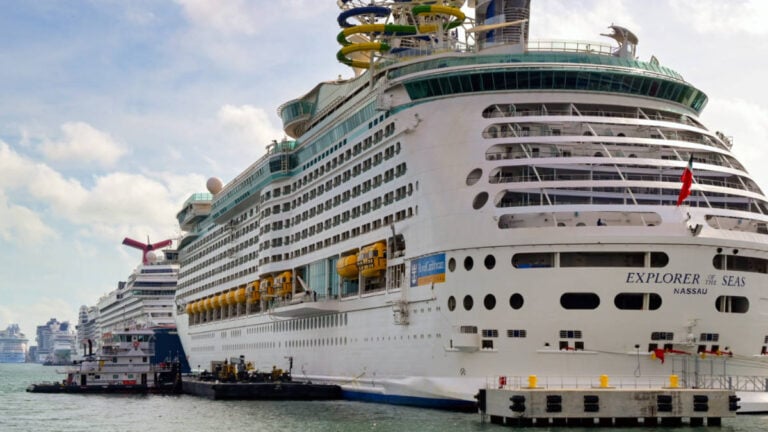
Symphony of the Seas will be setting sail on a 7-night Eastern Caribbean voyage on December 1, 2024 – but it won’t be the itinerary that her up to 5,518 guests originally booked.
The round trip sailing – which is based out of Miami, Florida – was supposed to call on San Juan, Puerto Rico; Philipsburg, St. Maarten; and CocoCay, Bahamas. But, due to an ongoing problem at the San Juan Cruise Port, this itinerary is no longer possible.
“We’ve recently been advised by the port authority in San Juan, Puerto Rico, that due to technical issues with the pier and the work that must be done and cleared by the USCG for accepting a ship of our size, we’ll have to adjust our itinerary for our sailing,”Royal Caribbean wrote to impacted guests.
While guests will still get to experiencePerfect Day at CocoCay – the cruise line’s private island destination in the Bahamas – the visits to San Juan and Philipsburg have been replaced.
The Oasis-class vessel will now call on Falmouth, Jamaica, and Labadee, Haiti, instead – where Royal Caribbean has another exclusive resort-style destination.
“We’re sorry for any inconvenience caused by these changes. Nevertheless, we’re excited to visit our private destination and a new port with you!”,continued the letter.
Falmouth, Jamaica, is known for its history, culture, and natural beauty – from waterfalls and swimming holes to pristine beaches.
The newly scheduled visit to Labadee is perhaps extra exciting – and maybe controversial – as Royal Caribbean only recently returned to its private destination in October after a months-long hiatus due to safety concerns.
That said, the cruise line has reassured guests that the destination is safe – as Labadee is far removed from the civil unrest occurring elsewhere in Haiti and is heavily guarded by private security.
When Will San Juan Resume Full Operations?
Neither authorities from San Juan nor Royal Caribbean have confirmed exactly what is wrong with the cruise port or how long it will take to resolve.
That said, appropriate personnel within San Juan are certainly working hard to get the issue fixed – as the cruise port has big goals to grow its cruise ship operations. But without knowing specifics, it’s impossible to estimate exactly how long repairs will take.
Symphony of the Seas isn’t due to return to San Juan until Christmas Day, so hopefully, everything will be fixed, inspected, and approved by the appropriate officials by then.
However, it’s also quite possible that other large vessels sailing to the popular Caribbean port sooner could be impacted.
Moderate to large cruise ships – such as Serenade of the Seas, Celebrity Apex, and Celebrity Summit – are currently scheduled to visit the port before the end of November.
This also isn’t the first itinerary to be disrupted for the 228,081-gross ton Symphony of the Seas due to the unresolved issues in San Juan.
An earlier Eastern Caribbean sailing, which embarked from Miami on Sunday, November 17, also had an itinerary change due to not being able to visit Puerto Rico.
In this case, the calls on San Juan and Philipsburg were swapped out with visits to Labadee and Puerto Plata, Dominican Republic.
Royal Caribbean has not publicly offered any compensation for the changes to both the November 17 and December 1 sailings – although the cruise line said their official letter could be used to make a claim with travel insurance if necessary.
Usually, Royal Caribbean would cancel and refund any shore excursions booked through the cruise line in these cases – but guests who booked with other companies or tour providers will have to adhere to their specific vendor’s cancellation policies.
Just days after officially adding Bluetooth speakers to its prohibited items list, Carnival Cruise Line has continued to clarify the policy and note that there are no exceptions to the ban, even when the exact banned items are available in onboard shops.
The speaker ban, which includes all Bluetooth, portable, and wireless speakers, was quietly instituted several days ago and confirmed by the cruise line’s official Brand Ambassador, John Heald.
“Bluetooth speakers will be collected and returned at the end of the cruise as they are not allowed anywhere on the ship,”Heald said in response to initial guest inquiries.
Over the last few days, Heald has continued to field comments and questions about the ban. His responses have clarified that the prohibition is a total one, with no exceptions even for innocuous speaker uses intended just for one’s stateroom.
“I have a question regarding sound machines used for sleeping in the cabin. I know the [Bluetooth] speakers are prohibited (which I am glad to hear) but I’ve seen sound machines grouped in with that,”one commenter said.“My children use a white noise/sound machine to sleep. This is especially useful when cruising due to all the traffic and hall noise. Will we have any trouble bringing this onboard?”
The commenter did note that the sound machine they use is incapable of playing music and only supplies white noise. Many cruise travelers use similar devices for more restful sleep, especially in an unfamiliar cruise ship cabin when noise from passersby in the hall or ship operations could cause nighttime disturbances.
Unfortunately, Heald’s answer is not one the guest would be happy to hear, but it may not be the final answer.
“I am looking into this now to see if we can do anything. At the moment, I think it would probably be collected,”Heald said.
He notes that white noise machines may be difficult to tell from other portable speakers. Because security personnel must process guests’ luggage quickly and efficiently, at this time it is best to err on the side of caution and not bring along any sound machines.
Other options could be for travelers to bring along a small fan – which is not prohibited by the cruise line – for white noise, or to download a white noise app on their phone for use overnight or at children’s naptimes.
Carnival-Branded Speakers Also Banned
In an interesting twist to the speaker ban, what about speakers that happen to be sold as souvenirs in the retail shops onboard Carnival’s ships? This has caused confusion to some travelers.
“Folks have been discussing about speakers not being allowed, they are confiscated and guests get them back on land. What are they doing with the ones being sold in the gift shops of the Carnival ship?”one commenter asked.
Speakers would not be the only technically prohibited item sold in Carnival’s Fun Shops. For example, guests can buy large bottles of alcohol onboard, but are not permitted to take those purchases to their cabins. Instead, the alcohol is held until the last night of the sailing, when guests need to pack for debarkation.
Carnival Fun Shops
Heald confirmed that the speakers sold in the gift shops will be handled in the same way.
“They will still sell [speakers], but they will hold onto them and return them to the cabin on the last day of the cruise,”he said.
At this time, it is not known whether or not the cruise line will gradually phase out selling the speakers altogether. This would certainly be a possibility and would help eliminate any confusion.
It is not uncommon for cruise lines to adjust souvenir offerings based on popularity, supply options, and other factors. Just recently, for example, Carnival Cruise Line discontinued porthole picture frames as they weren’t the most popular option for souvenir photos.
While the Bluetooth speaker ban is still new, the exact application of the prohibition will certainly continue to be refined in the weeks to come.
Travelers should not expect the ban to be lifted, however, as it has been widely welcomed by many cruisers and makes it easier for crew members to maintain a safe and family-friendly atmosphere for everyone aboard.
While the differences between cargo ships and cruise ships may seem obvious, they go far beyond their differing primary functions of transporting goods versus providing luxury travel experiences.
Although they may be similar in physical scale, these vessels have very different designs, onboard amenities, and safety features. Plus, the challenges they face at sea differ drastically. Read this guide to see what sets these two types of mega-ships apart.
One of the most apparent differences between the two types of vessels is that they were designed for very different purposes. Where cruise ships are a type of luxury passenger ship or ocean liner that ferries passengers in comfort, a cargo ship’s primary function is to transport goods and materials from one destination to another.
For a more detailed breakdown of how the two types of vessels differ in purpose and function, let’s look at each individually.
Cargo Ships
MSC Mara Cargo Ship in Hamburg (Photo Credit: nitpicker)
Cargo ships, often referred to as freighters or container ships, are large-scale ships that transport manufactured goods, raw materials, and even fuels across waterways. Given their essential role in transporting materials worldwide, they are considered the real backbone of global trade.
Their primary purpose is relatively simple: to transport large volumes of goods and raw materials across the world’s oceans and seas. Depending on the demands of a specific assignment, cargo ships can handle a near-limitless variety of items.
Where container ships tend to transport manufactured goods in standardized metal containers, bulk carriers move large quantities of raw materials like grains, coal, timber, chemicals, plastics, and metal ores.
Like transport trucks on the world’s highways, most cargo ships operate on rigid schedules. By transporting goods quickly and efficiently around the globe, they are a critical component of the international supply chain system. Their schedules are meticulously planned, and each cargo ship’s crew must be trained to handle challenges.
Not only are the ships themselves designed for durability and efficiency, but everything must be coordinated with the ports they depart from and arrive at to optimize the loading and unloading of their cargo.
In contrast to cargo ships, cruise ships serve a far less utilitarian purpose. This is because their main focus is the leisure and tourism industry, offering their paying guests an immersive vacation experience at sea.
Instead of transporting goods as quickly and efficiently as possible, they are leisure vessels that carry passengers, sometimes in the thousands, in a way that delivers comfort, relaxation, entertainment, and indulgence.
In a way, a cruise ship should almost provide a similar experience as a land-based resort, but it has the advantage of offering its guests ever-changing views and the opportunity to visit multiple locations during port-of-call visits.
Basically, passengers book travel on modern cruise ships in order to explore exciting destinations and enjoy onboard amenities, like restaurants, theaters, casinos, gyms, spas, swimming pools, and other venues that cater to leisure activities.
To accomplish their dual purpose of combining scenic travel with a luxury onboard experience, cruise itineraries are planned with scenic routes that allow guests to visit multiple locations. The ships themselves are outfitted with a variety of luxurious passenger accommodations and an incredible array of entertainment amenities and dining establishments.
As for the crew, the onboard experience is far more simplistic. With shared cabins that feature bunk beds, break areas with TVs and lounging space, plus a dedicated area, it certainly feels more like work than pleasure.
With that said, crew members can now access Wi-Fi on most ships and enjoy some of the amenities, like the gyms and pools when they are not working, so the experience tends to be far more enjoyable than it is for cargo ship crews.
Design and Structure
To fulfill their differing functions, the two types of ships need to have different designs. To make things easy, let’s look at the two separately, starting with cargo ships.
Since cargo ships need to be engineered for utility and durability, they tend to have a far more boxy profile than cruise ships.
With extremely wide hulls and a flat top deck, they are designed to maximize storage space while maintaining their stability while carrying extremely heavy loads. This immense width also helps them secure their cargo as they traverse through heavy seas and high waves.
To give them the flexibility to traverse through some of the world’s roughest waters and even remain safe in the event of a storm, their thick steel reinforced hulls are incredibly strong.
Cargo ships are also designed with a bulbous bow, which is necessary to reduce water resistance, given their wide profile. Doing so allows their propulsion system to work more efficiently, helping to reduce fuel consumption by as much as 15% to 20%.
The navigation bridge is elevated and often located at the stern of the ship to guarantee visibility for the ship’s navigation and communications crew.
This placement also helps maximize space for the cargo and ensure visibility for the crew manning the ship’s controls and navigation equipment. Positioning the bridge towards the back of the ship also provides the crew with a good view of the cargo being stored on the deck.
Cargo ship design can also vary drastically in terms of size, with cargo ships ranging from small coastal ships and vessels designed to navigate small seas to mega ships, often classed as ultra-large container ships (ULCS), like the world’s largest, the MSC Irina.
With MSC Irina having a gross tonnage of 236,184 GT and the world’s largest cruise ship, Icon of the Seas, having a gross tonnage of 248,663 GT, you can see they’re actually not too far apart when you talk about the giants of either type of ship.
Most cargo ships are constructed in Asia, with China, Korea, and Japan alone being responsible for over 90% of the world’s ships. While the United States and the United Kingdom used to make the vast majority of cargo ships in their shipyards, this changed in the 1970s, with the two countries now making less than 8% between them.
Regardless of size, a cargo ship’s design prioritizes space efficiency and reduces operational costs through fuel efficiency. Typically, they travel at a relatively slow speed of around 15 to 25 knots, which helps them find a balance between stability, fuel efficiency, and meeting reasonable delivery deadlines for their goods.
Cruise Ship Designs
Entire Cruise Ship in Dry Dock (Photo Credit: dani3315)
Since cruise ships must prioritize passenger comfort and safety, they have a very different design from typical cargo ships. For starters, they feature multi-deck profiles with plenty of open areas, window and balcony-lined outer walls, sun decks, and open-air amenities like water parks and pools.
Modern cruise ships are built with sleek, hydrodynamic hulls that reduce drag to provide passengers with a comfortable experience and complete their itineraries in a timely manner. This narrowing profile allows them to fit all of the passenger accommodations and amenities while also enabling efficient and stable voyages.
To help improve passenger comfort and minimize the noticeable effects of roll, the side to side motion caused as ships navigate the water, cruise ships tend to have propulsion systems that can sustain a standard speed of 21 to 23 knots. As well as additional features, like active stabilizers.
While the exact size and layout of a cruise ship will depend on the demands of the destinations it will travel to, the desired passenger capacity, and the specific cruise line’s preferences for amenities, they tend to have a standard profile, with the bridge located at the front of the ship.
The amenities that a cruise ship will be outfitted with are usually decided early in the design phase, as fitting all of the accommodations, expansive public areas, and luxury features, like roller coasters and restaurants, takes significant planning.
Since cruise ships have so many variations in design, they can weigh anywhere from a few hundred gross tons, such as the Celebrity Xploration, to nearly 250,000 gross tons, like the world’s largest cruise ship, the Royal Caribbean Icon of the Seas.
The Onboard Experience
As you can probably imagine, the onboard experience differs substantially between cargo and cruise ships. While one type of vessel can carry thousands of paying passengers, it must prioritize the onboard experience above all else; the other only has to consider a limited crew who are there to do a job. Here’s a basic overview of the onboard experience for either type of vessel.
Onboard Experience for Cargo Ship Crews
Life aboard a cargo ship is unglamorous for the crew, as the ships themselves are extremely utilitarian and purpose-driven. That said, crew accommodations and shared spaces tend to be reasonable, especially for long-haul cargo ships, which can be at sea for up to 50 days at a time.
The average crew size on a cargo ship is 20 to 30 people, although the smaller vessels can have less than ten crew members.
When crew members aren’t working, they can spend time in their private or shared cabins, which tend to be located beneath the bridge, or in the galley or mess room, which is a shared space.
Larger cargo ships also have laundry rooms, a hospital room, and even a day room, which could feature gym equipment, movie theater-like viewing areas, and other things that help pass the time, like ping pong and foosball tables.
With that said, dining rooms and recreation areas are minimal, with only a small section of the ship dedicated to crew comforts. Life on a cargo ship can be repetitive and somewhat isolating, which is why most crew members tend to work split shifts, where they will take time off between voyages.
Still, conditions on cargo ships are improving, with satellite internet connections allowing crew members to stay connected to loved ones by accessing Wi-Fi in shared spaces.
The majority of the onboard experience revolves around work, with the crew meeting the demands of keeping a major shipping vessel on schedule.
Cruise Ship Passenger Onboard Experience
In stark contrast, those traveling on a cruise ship tend to enjoy a far more comfortable and luxurious onboard experience. Like visiting a high-end resort, passengers can enjoy a wide range of entertainment venues, from spas and casinos to concert venues and restaurants.
While each cruise ship is different, most offer a diverse range of entertainment and dining options designed to keep passengers entertained and relaxed throughout the journey.
Regarding accommodations, passenger quarters can range from modest cabins to opulent penthouse-style suites that feature balconies, wraparound views, hot tubs, and more.
Most cruise lines also pack their daily schedules with fun activities, like live performances, group cooking classes, co-ed sports, and more. Plus, passengers can explore the ship and enjoy amenities and dining venues at their leisure. This helps to create an immersive environment for all guests, which can be personalized to the exact tastes of the individual.
Safety Features
While the two types of ships face different challenges, both are designed to be incredibly safe for everyone and everything being transported. Let’s examine the different safety features each type of ship uses to protect itself from potential dangers.
Safety is a priority for all vessels, but cargo ships face unique challenges due to their immense weight, the cost of the ships, and the high value of goods they carry.
Since they must be capable of traveling around the world, they must be constructed to withstand exposure to rough seas, potential collisions with ice and other objects, and, in some regions, even piracy and hijacking attempts.
To ensure stability in rough seas, cargo ships are designed to be wide, which stops them from being overly top-heavy and rolling dangerously in high winds and waves. Reinforced hulls also prevent collision-related capsizing events.
Modern cargo ships are also outfitted with advanced navigation and communication technology, including radar, GPS, satellite communications systems, and automatic identification systems (AIS).
For cargo ships that are required to travel through dangerous regions, security teams that are given anti-piracy training, barbed wire, and even weaponry keep the crew and cargo safe.
Cargo ships also have lifeboats and other life-preserving features to ensure the crew can evacuate safely in an emergency. An average cargo ship will carry two lifeboats on the side of the ship, as well as additional life rafts within the vessel. More inflatable life rafts can be added for journeys that require a larger crew.
All crew are also given standard training, which must be updated regularly with various drills and courses.
Cruise Ship Safety Features
Oasis of the Seas Docked at Cape Liberty (Photo Credit: quiggyt4)
Since it is essential to the entire cruise industry that cruise travel be perceived as being incredibly safe, cruise ships follow strict safety protocols, which can be mandated by external bodies as well as the cruise line itself.
Like cargo ships, modern cruise ships are also equipped with enough quick-deploy lifeboats for everyone on the ship to evacuate safely in an emergency. Each passenger is also required to participate in muster drills, where they are taught evacuation routes and procedures, as well as the location of life jackets, lifeboats, and more.
Life rafts and lifeboats need to be adequate for the number of passengers and crew members traveling on the ship. Naturally, this will vary according to the size of a cruise ship and its capacity, but as an example, Royal Caribbean’s Oasis Class ships, like Oasis of the Seas, have 18 lifeboats that can carry 370 people, along with over 100 inflatable life rafts, which can be deployed when necessary.
Other safety features include onboard medical facilities, which feature full-time doctors and other medical professionals, extensive fire detection and suppression systems throughout the entire ship, and CCTV monitoring for added security and the prevention of overboard situations.
Every single member of the crew is also extensively trained to handle emergency situations. To guarantee these high safety standards, international organizations, including the International Maritime Organization (IMO), regulate the industry to ensure that every cruise line and cruise ship adheres to strict passenger and crew safety protocols.
Challenges
While all large-scale vessels that navigate the world’s oceans and seas face similar challenges, cruise ships and cargo ships face their own unique sets of obstacles. Here’s a basic breakdown.
Cargo Ship Challenges
Cargo Ship in Storm (Photo Credit: Zacarias da Mata)
As mentioned earlier, piracy is a unique and serious concern for cargo ships voyaging through troubled regions, like the Gulf of Aden, Red Sea, South China Sea, Gulf of Oman, and more. This requires cargo shipping companies to take unique preventative measures to keep their cargo and crew safe.
Severe weather conditions can also present significant risks, with storms and rough seas potentially endangering the crew and unsecured cargo and delaying schedules, which can impact a voyage’s profitability. This is why cargo shipping companies invest so heavily in the latest weather detection and communications systems.
In addition, cargo ships can face unique challenges when they arrive at crowded ports. From navigating local customs procedures to arriving on time to avoid delayed unloading and loading procedures, the entire industry needs to function like clockwork to remain viable.
Cruise Ship Challenges
Cruise Ships Docked in Miami, Florida (Photo Credit: Ihor Koptilin)
For cruise ships, ensuring that thousands of guests are satisfied while also remaining safe and comfortable is incredibly challenging. Even the basic logistics of providing that many passengers with enough food and other perishables are incredibly challenging, especially when you also consider the need to balance out less glamorous concerns, like waste disposal and carrying enough fuel.
Just as an example of the logistical complexities, even a small cruise ship, like the Viking Orion, which only carries 930 passengers, goes through 5,000 eggs and 4,000 cups of coffee per day! For larger ships, with over 6,000 passengers, each needing three meals per day, the food and drink supplies are enormous. Roughly 30,000 meals are made per day just on Symphony of the Seas.
In addition, complex itineraries that involve visiting numerous ports in different countries require exact timing and careful planning. Essentially, the cruise ship’s crew has to ensure that all passengers enjoy a comfortable and memorable vacation while also ensuring that they get where they need to be on time and safely.
Recently, stricter environmental regulations have posed unique challenges to the industry, where cruise lines must constantly innovate to minimize waste, emissions, and other issues that could impact the carbon footprint an enormous cruise ship could generate.
Plus, having thousands of people in one self-contained space also has health consequences, which we saw play out publicly during the COVID-19 pandemic.
Cruising on a Cargo Ship
Cargo Ship and Carnival Ship in Charleston (Photo Credit: Daniel Wright98)
While taking a cruise on a cargo ship might sound far-fetched, there has been a recent increase in the popularity of this niche form of travel. To access untapped revenue streams, certain cargo ships have begun adding more elaborate passenger quarters and amenities to attract leisure passengers hoping to enjoy a scaled-down version of a cruise experience on a tighter budget.
Sometimes called “freighter travel” or “cargo ship voyaging,” it is a unique and budget-friendly way to explore the world. Guests are usually given small and very basic cabins, which are sometimes shared, and meals are taken in a single mess hall that is shared with the ship’s crew.
Some ships that have begun allowing this even have basic passenger facilities, like rec rooms and sun decks, but this varies from ship to ship.
Not only does this form of cruising appeal to those looking to travel the world’s waterways more affordable but it is also seen as an eco-friendly alternative to a standard cruise, as the ships are already traveling along those same routes.
If you are interested in this type of travel, just be aware that you will be experiencing a more simplified form of travel, where simplicity and utility are the themes rather than luxury and entertainment. Still, they can offer a unique and affordable way to see the world.
Conclusion
Cargo ships and cruise ships may serve very different purposes and be designed differently, but they are both essential components of the global maritime world.
Where cargo ships are dedicated to transporting goods in a stable and efficient way, cruise ships provide leisure passengers with more of a vacation-style experience. Each type of ship has grown to meet the unique demands of its own industry, reflecting how far passenger and transport ships have come since the days of their humble beginnings.
Cruise ships aren’t always known for their solemn atmospheres and testaments to personal faith, reflection, and communing with one’s beliefs. This may be particularly true of Carnival Cruise Line, which has a party-vibe reputation and has more than once been cited for passengers showing their wild side.
But, should cruise ships offer a dedicated chapel space for travelers who do want to have faith and fellowship onboard?
“I am shocked that Carnival Cruise Line has taken away the chapel from their ships. You have taken away time spent with God and replaced it with games in the arcade. Every new ship you are building now should have a chapel,”one commenter wrote to John Heald, Carnival’s official Brand Ambassador.
It is true that some Carnival cruise ships used to have chapels, but no longer do. For example, the Spirit-class vessels, including Carnival Spirit, Carnival Pride, Carnival Legend, and Carnival Miracle used to have dedicated chapels on Deck 3, Atlantic Deck.
The small chapel was originally located mid-ship portside, between the piano bar and the ship’s library. The space offered a quiet, reserved space for personal reflection or faith-based gatherings as guests wished. The chapel was also an option for onboard weddings and vow renewals.
As the ships have been updated and renovated, however, the seldom-used space has been turned into the ship’s Warehouse Arcade with a much noisier and far less faith-based atmosphere. At the same time, the libraries have also been removed, also for arcade space.
It is not uncommon for cruise ships to be updated and spaces repurposed to meet guests’ changing preferences over the years. Another example is the new additions of smoke-free casino spaces, which are proving to be very popular with travelers.
Larger spa facilities, more onboard retail areas, and new specialty dining options are also changes that have come to the Carnival cruise ship fleet over the years.
Heald, however, is always respectful of guests’ inquiries and does give attention to the mention of chapels with a poll question posed to his more than 591,000 Facebook followers. This is the very best way to gauge interest in the space from avid Carnival cruisers.
Of more than 53,700 votes cast in the poll, 21% – roughly 11,280 responses – believe that new Carnival ships should not feature a dedicated chapel space. Just 7% – approximately 3,760 votes – agree that new vessels should have such a quiet space for faithful reflection.
Interestingly, 34% of votes – roughly 18,260 – are cast, noting that travelers “do not use the arcade” when sailing. To be fair, the arcade space is typically most popular with young cruisers and teens, not the same sort of responders who would be reading Heald’s Facebook page and responding to his questions.
Carnival Valor Promenade Deck (Photo Credit: gary yim / Shutterstock)
The onboard arcades are not, however, exclusively youth spaces and cruisers of all ages are welcome. In addition to video games, the arcades usually offer some prize-oriented games as well as popular favorites like air hockey and skeeball.
Just 4% of voters – 2,150 responses – enjoy visiting the onboard arcades and playing the various games.
What About Worship Onboard Carnival Ships?
Many different commentors chimed in on the issue of onboard chapels, noting that the dedicated space is not required for interested individuals.
“I honestly do not need the chapel in order to pray and spend time with God, I can do that in any location,”one commenter said.
“I don’t think a chapel is necessary to spend time with God. Find yourself a quiet place, whether it be in your stateroom, or out on the balcony, looking at the blue water, and enjoy your time there,”another commenter agreed.
Similar sentiments have been expressed by many Carnival fans, though some do suggest that a “meditation room” useful for all faiths might be a welcome space. At the same time, there are plenty of quieter places onboard at different times of day where anyone could practice whatever type of personal reflection they prefer.
Guests also note that there are many amazing churches in different ports of call, giving faithful travelers beautiful and diverse options to practice their faith.
Would you use a chapel space onboard your Carnival cruise? Share your thoughts on the Cruise Hive boards!
Long road trips and big expectations can make tempers flare, especially when things don’t go as planned.
In a heated letter posted on social media, a Platinum level Carnival guest accused the cruise line of reneging on its promise of early cabin access.
“If we are Platinum, you said we can go straight to our room. That is a LIE,”wrote the passenger.“This is another perk pulled from under our feet.”
Citing exhaustion after a 14-hour drive, the guest on an unidentified Carnival voyage expressed outrage that the stateroom steward “bluntly told” her and her husband to leave after they attempted to use the cabin to take a nap before it was officially ready.
John Heald, Carnival’s charismatic brand ambassador, responded with his trademark humor but also clarified the cruise line’s policy.
“Diamond, Platinum, Faster to the Fun Guests, those in suites, and anyone from Cleveland, Ohio (kidding), can go to their cabins as soon as they go on board,” he stated.
But he also expressed the access was simply to drop off items.
“They can drop off their luggage, but please, leave straight away. The cabins will not be ready to the high standard you will all expect until approximately 1:30 p.m.,” he continued, shining a light on the demanding schedules faced by stewards.
For Carnival Cruise Line’s hardworking stateroom stewards, the time between disembarkation of one cruise and embarkation of the subsequent cruise is a whirlwind of activity.
After passengers from the previous voyage leave, crew members have just a few short hours to prepare the ship for hundreds, if not thousands, of new arrivals.
This includes cleaning, restocking, and ensuring staterooms meet cruise line – and passenger – standards.
Balancing Efficiency and Guest Enjoyment
But even with those tight turnarounds, the cruise line does offer a range of boarding perks for its loyalty members, particularly those in the VIFP (Very Important Fun Person) Club.
Platinum and Diamond members receive expedited boarding that allows them to skip long lines and board the ship early with a dedicated check-in line and priority luggage delivery that gets their belongings to their staterooms earlier in the day.
These guests, along with those who purchase the Faster to the Fun (FTTF) program or stay in suites, can access their cabins earlier than other guests. However, as Heald clarified, this is limited to dropping off luggage if arrival is before 1:30 p.m.
However, that doesn’t mean the perk isn’t worth it, as guests can begin enjoying and exploring a ship as soon as they embark.
Carnival Cruise Line Cabin Sheets (Photo Copyright: Cruise Hive)
For example, passengers can head to the pool deck to soak up the sun, grab a bite at popular spots like Guy’s Burger Join or the Blue Iguana Cantina, or enjoy a cocktail at one of the ship’s bars to toast the start of a vacation.
Many ships also host welcome events, with Diamond and Platinum members typically invited to exclusive receptions where they can mingle with other cruisers and ship officers.
All guests will always find live music and entertainment as they settle into vacation mode, and many use embarkation time to get familiar with the ship’s layout and to book shore excursions, dinner reservations, and spa treatments.
For families, kids’ clubs like Camp Ocean provide activities for younger passengers, while sports courts and fun areas are also open to entertain and give everyone something to do while waiting for their staterooms.
So, while guests may not have full access to their cabins after boarding a ship, they can give the tireless crew time to make everything perfect by taking advantage of all the fun to be had even before unpacking.
Change is on the horizon for three of Carnival Corporation’s most celebrated cruise lines.
In a bold leadership shuffle announced on November 25, 2025, the world’s largest cruise company revealed new presidents for Princess Cruises, Holland America Line, and Seabourn.
Starting December 2, 2025, Gus Antorcha will leave his post as president of Holland America Line to take the helm at Princess Cruises, succeeding John Padgett, who is stepping away in February 2025.
At the same time, Beth Bodensteiner, a 20-year veteran of Holland America, will become its new president while also assuming responsibility for the luxury Seabourn brand.
Seabourn will additionally welcome Mark Tamis, a seasoned hospitality leader, as its new president, replacing Natalya Leahy.
Carnival Corporation CEO Josh Weinstein expressed confidence in the appointments, highlighting their expertise and commitment to the industry.
“Gus and Beth are proven leaders who reflect the talent and capabilities of our organization and who have a deep knowledge of our industry, our business, and what drives our success,” said Weinstein.
He continued, “Under their leadership, I have no doubt that Princess, Holland America, and Seabourn will remain well-positioned for a bright future.”
Experienced Leaders at the Helm
Antorcha, who will take over Princess Cruises’ fleet of 16 ships that sail to more than 330 destinations around the world, brings a proven track record from Holland America Line.
During his tenure, he guided the brand’s return to operations post-pandemic, led the company to its strongest financial performance in 16 years, and achieved record-breaking booking milestones.
“I look forward to working with the talented team and their travel partners, and to continue delivering the distinctly effortless, personalized Princess MedallionClass vacation experience that has made Princess so popular,”Antorcha stated.
Before joining Holland America, he held leadership roles at Carnival Cruise Line and worked as a managing director at Boston Consulting Group.
Princess Cruises will be delivering a new ship to its lineup in 2025 when the Sphere-class Star Princess completes construction at Fincantieri shipyard in Italy.
Bodensteiner, stepping into the top role at Holland America, is also no stranger to Carnival. She has spent two decades shaping the cruise line’s commercial and guest experience strategies, from deploying advanced revenue systems to forging high-profile partnerships with brands like Audible and Top Chef.
Beth Bodensteiner & Gus Antorcha
She will now oversee 11 ships and a network of itineraries reaching more than 450 destinations worldwide.
“I could not be prouder to take on the role of president,”Bodensteiner said.“This is a tremendous opportunity to work together with my trusted leadership team and to continue building on our rich history.”
Meanwhile, Seabourn is bringing Tamis back to the Carnival fold. With a background that spans cruising and boutique hospitality, including leadership roles at Royal Caribbean and Four Seasons Hotels, he most recently served as the global president of Aimbridge Hospitality, leading operations for 1,500 hotels.
Tamis stated,“The most rewarding work in my career has been my time in cruise. Combining that with my passion for creating the best vacation experiences in the world is a dream come true.”
Carnival Corporation also operates Carnival Cruise Line, AIDA Cruises, Cunard Line, Costa Cruises, and P&O Cruises and P&O Cruises Australia.
Christine Duffy continues to lead Carnival Cruise Line, while Peter Little serves as the interim leader of Carnival Australia and Paul Ludlow manages Carnival UK and P&O Cruises.
Felix Eichhorn oversees AIDA Cruises, Mario Zanetti leads Costa Cruises, and Katie McAlister is president of Cunard.
It’s a “go” for a big makeover on Jersey Island in the English Channel.
The island’s government has officially greenlit a £150-million revitalization project for the harbor, which is adjacent to Jersey’s main town, St. Helier. First introduced in 2022, this proposal’s final signoff on funds gives Ports of Jersey the “A-okay” to begin in late 2025.
“The proposals, centered on Elizabeth Harbour, include a passenger terminal, customs and inspections facilities, and freight distribution centre within a significant area of waterside public realm, connected to St. Helier via a network of landscaped routes that will extend the town’s green infrastructure,”announced the port.
At the heart of the project, spearheaded by Ports of Jersey, is the development of a brand-new, state-of-the-art passenger terminal near Elizabeth Marina, designed to offer sweeping views of the Jersey coastline and Elizabeth Castle.
Its curved shape will mirror the natural lines of the shoreline with an exterior featuring sleek solar-controlled windows and fins that keep things cool while showing off the view, replacing the Elizabeth Terminal building that first opened in 1989.
Outside, the overhaul aims to reconnect the harbor with St. Helier’s town center. Gone will be the towering concrete walls that boxed in the area for 35 years. Instead, the designs call for open, landscaped routes that make it easy for people to walk or bike between the town and the waterfront.
This includes a new linear park that will stretch along the marina, offering green spaces where people can relax or play. Public spaces across the project will include art installations made from maritime relics, like old ship parts and buoys, guiding visitors along a trail that will end at a new observation pier.
The design, crafted by global architecture firm Broadway Malyan of London, promises to mix modern upgrades with a nod to the port’s 250-year history.
Building a Greener and Busier Future
Sustainability will play a huge role in the plans for Elizabeth Harbour, with every building in the project being outfitted with green roofs that double as homes for plants and renewable energy generators, thanks to built-in solar panels.
Many of the materials from the demolished concrete walls will even be reused to create berms and retaining walls, keeping waste to a minimum.
Plus, the harbor will tap into a new energy system powered by seawater heat pumps, which will cut down on carbon emissions and help Jersey reach its goal of net-zero harbor operations by 2030.
That goal aligns with broader European sustainability targets, including the European Union’s commitment to achieving a 55 percent reduction in greenhouse emissions by 2030 and reaching full climate neutrality by 2050.
New Jersey Passenger Cruise Terminal (Render Credit: Ports of Jersey)
St. Helier Harbour is predominantly a hub for freight and passenger ferries, but with a surge in cruise ships exploring the Channel Islands, particularly nearby Guernsey Island, the Port of Jersey is hoping its revitalization, which includes dredging the harbor to make space for larger vessels, will attract more cruise ships.
In 2025, the port is set to welcome several ships, including Oceania Cruise’s 1,200-guest Oceania Vista,kicking off the season on May 21, arriving from an extended voyage from the Caribbean to Southampton, England.
That call will be followed by Seabourn’s Seabourn Sojourn, carrying up to 458 passengers, Azamara Cruises’ 670-passenger Azamara Onward, and Silversea’s 392-guest Silver Shadow, bringing a slew of visitors to the island of just 9 miles by 5 miles in size.
Anticipation is growing for the new 6,762-passenger MSC World America, which is currently in the final stages of construction at the popular Chantiers de l’Atlantique shipyard in Saint-Nazaire, France.
Cruise Hive got a sneak peek onboard the vessel during the outfitting phase in mid-November, and there is so much to look forward to, especially for those in the US!
Before we get into how the outfitting is coming along, the cruise line and shipyard are doing a mammoth task in ensuring that one of the world’s largest cruise ships, at roughly 215,000 gross tons, is ready for guests. Workers are onboard night and day, bringing all the venues (some new just to the ship) to reality.
MSC World America Promenade (Photo Credit: Emrys Thakkar)
Let’s start with one of the main central hubs of the giant MSC cruise ship, the Galleria. This space, located on decks six and seven, is just one of seven districts onboard and will offer guests all kinds of dining and shopping options, with the mood and tone changing through the day and night using its LED and kinetic light ceiling.
From the Galleria, there’s also access to the Jean Philippe Chocolat & Café and Dolce Vita Bar. Further up, guests can also enjoy The Terraces district, which features nine dining venues and four stores.
MSC World America World Theater (Photo Credit: Emrys Thakkar)
I got a sneak peek at the World Theater, which has yet to install all the seating at the time I was there. The venue will host different shows throughout each cruise and will be able to seat 1,600 guests, located on decks six and seven forward.
MSC World America Promenade (Photo Credit: Emrys Thakkar)
The Promenade district might look slightly familiar, as it’s the same kind of concept as Royal Caribbean’s popular Boardwalk neighborhood on the Oasis class ships or even the Surf Side neighborhood on the Icon class.
This district, which is located on deck eight, is large and is mainly overlooked by Deluxe balcony cabins. Guests will also be able to get to the new Paxos Greek restaurant, a new multi-service dining venue for MSC Cruises that will also include a new “Paxos on the Go” option and a Promenade Bites venue.
MSC Cruises also confirmed that it will feature a new All-Stars Sports Bar, with a large bar area and screen, along with an interactive darts board area. This will be the largest sports bar found on an MSC Cruises ship so far!
MSC World America Dry Slide (Photo Credit: Emrys Thakkar)
Towards the aft of the Promenade district is the hard-to-miss dry slide called Jaw Drop @ The Spiral. The slide actually begins high up from The Harbour area and twists down onto the Promenade, spanning 11 decks. Guests will begin the thrilling ride from the mouth of the shark as seen in the photo above.
MSC World America The Harbour (Photo Credit: Emrys Thakkar)
During our sneak peak of the ship while at the shipyard, we also got a look at the new The Harbour outdoor space, located within the Family Aventura district on deck 20.
At the time of my visit, many of the slides that are part of the Aquapark were installed, with just a few elements still to go. One of the main features in this space is also the 90-degree vertical drop slide, along with a dual raft slide.
The Lighthouse (inspired by the lighthouse at MSC’s private island of Ocean Cay) was not yet installed, but this will be a fun area for the kids, also as part of The Harbour. Guests will also be able to enjoy a rock climbing wall and a 577 square meter two-level ropes course, which you can see in my photo above.
MSC World America Cliffhanger (Photo Credit: Emrys Thakkar)
One of the most anticipated features of MSC World America, and unique to the entire cruise industry, is the Cliffhanger. At the time, this feature was not yet completed, and setting the stone is the platform where the four-seat attraction will swing out over the side of the ship 50 meters above the ocean.
William Monts de Oca Rivera, Head of Guest Experience Innovation said:“one of the biggest innovations for MSC World America is The Harbour, part of the Family Aventura district, a brand-new revolutionary outdoor venue specially designed for kids and families to gather, play and relax together. It’s home to Cliffhanger – a state-of-the-art swing attraction 50m above the ocean that is going to bring a totally new dimension to the cruise experience.”
MSC World America Aqua Deck (Photo Credit: Emrys Thakkar)
Mid-ship on the open deck is one of the most popular areas of any cruise ship: the main pool! The main central pool is part of the Aqua Deck district, where you can relax and enjoy the sunshine or even party at night.
In fact, MSC World America has a total of six pools and 14 hot tubs. These also include twin adult-only pools at the aft of the ship within the Zen Area district.
Zen Area, MSC World America (Photo Credit: Emrys Thakkar)
Another district that MSC World America will feature is the MSC Yacht Club, which I was also lucky enough to take a look at. The ship-within-a-ship experience concept will be the largest in the fleet and will even feature a Top Sail Lounge, an exclusive dining area, and a pool. Guests booked on a Yacht Club cabin will even get a 24/7 butler service.
MSC World America Yacht Club Restaurant (Photo Credit: Emrys Thakkar)
I also got to see several other specific venues and locations onboard, includingthe new Eataly venue, the first ever at sea. This Italian-inspired restaurant will have dishes sourced from Italian supplies and also even feature an outdoor seating area.
There was also a visit to the Gin Project and even one of the 150 square meters Owners Suites that features a walk-in closet. The new flagship will have 19 different types of cabins, which Cruise Hive has detailed here.
With MSC World America being designed to sail for the US market, it was confirmed that 40% of the ship was different compared to sister ship MSC World Europa.
Sustainability was a huge factor that came across for the new ship. When MSC World America debuts, it will be the most energy-efficient in the world until its sister ship, MSC World Asia, arrives in 2026.
The vessel will be powered by liquefied natural gas (LNG) and will also be shore-power-ready and able to connect to ports that have that infrastructure in place.
What’s Next for MSC World America?
It has taken three years to construct the ship, ever since the first steel cutting in March 2022. However, the MSC World America is now approaching the end of its time at the shipyard in France.
MSC World America at the Shipyard (Photo Credit: Emrys Thakkar)
The first sea trials for the vessel are planned for December 2024, where the ship’s propulsion systems will be tested to make sure MSC World America is seaworthy. Outfitting will still continue, but by March 27, 2025, the giant new MSC cruise ship will be completed, marked with an official delivery ceremony from Chantiers de l’Atlantique to MSC Cruises.
The cruise line confirmed that the vessel will set sail that very same day of delivery and will waste no time in heading to the US.
MSC’s giant new flagship will debut for guests on April 12 out of PortMiami in Florida. The vessel will sail a 7-day voyage, visiting Puerto Plata in the Dominican Republic, San Juan in Puerto Rico, and the cruise line’s own MSC Ocean Cay private island in the Bahamas.
MSC World America will be based out of the cruise capital of the world year-round, offering Eastern and Western Caribbean itineraries.
There is no doubt that a Christmas cruise is something special, a wonderful way for friends and family members to share special days and make fantastic holiday memories. But these seasonal sailings go far beyond just the fun of a cruise vacation with the extra glitter and sparkle of themed decorations.
Carnival Cruise Line has detailed just what limited time activities and events will be found onboard, giving every Christmas traveler something fun to look forward to as they set sail into the season, no matter how they choose to celebrate.
Embarkation day will be extra special with the “Spirit of the Season” celebration, a great way to begin a Christmas cruise. This embarkation evening event will feature each Carnival ship’s Cruise Director hosting an official tree lighting ceremony to begin the cruise, with festive music to set the mood.
Each cruise will also welcome a very special guest as Santa Claus arrives in the atrium to bring his own special seasonal magic onboard. This will happen during the “‘Tis the Season” event with the Fun Squad also joining in, and some ships also getting an extra special surprise.
While every Carnival ship will continue to offer the scheduled production shows and evening entertainment through the season, also on the playlist will be the Christmas Show with the full cast of singers and dancers.
By special appearance, that nasty wasty skunk with a heart full of unwashed socks and a soul full of gunk, the Grinch himself, will also join the show.
Guests will want to be prepared for the onboard Ugly Sweater Contest with their most funky festive attire, and they just might be crowned the winner with the worst wardrobe. Whether a Fun Ship medallion, a coveted ship-on-a-stick, or another great prize, be sure to flaunt all your best (or worst) duds for your chance to win!
For classic holiday nostalgia, the special performance of “‘T’was the Night Before Christmas” can’t be beat. Each ship’s Cruise Director will read the sweet poem – first published in 1823 – accompanied by the string trio for an elegant remembrance of the delight of the season.
For even sweeter celebrations, all guests of all ages are welcome to join in the “Holly Jolly Family Party” with the Fun Squad, Cruise Director, and delicious milk and cookies for everyone to enjoy.
Carnival Cruise Line is not unmindful of the special season of Hannukah as well. From December 25 through January 2, each ship will hold a Menorah lighting in the atrium, with traditional Jewish treats served to mark the event and share fellowship.
In addition to these special events throughout each sailing, extra seasonal activities such as holiday carols, themed bingo and trivia games, and even a Christmas dance class will also be held.
Photo Courtesy: Carnival Cruise Line
The exact schedule of activities will vary on each ship based on cruise length, available spaces, and general itinerary, but travelers can get an updated activity list via the Carnival Hub app throughout their Christmas cruise.
Other Carnival Events Not Cancelled
While every cruise traveler celebrates the season differently, it is also important to note that each Carnival ship will also be offering the classic onboard fun guests know and love.
This includes the regular schedule of onboard parties and activities, such as the 80’s Rock and Glow Party, the Sail Away Party, trivia games, plentiful bingo, the Love and Marriage show, and other favorites.
As with any Carnival cruise, guests can choose exactly what fun they want to enjoy and there are always great options for everyone. Furthermore, travelers could just choose to relax by the pool, try their hand in the casino, or get pampered in the spa – whatever makes their cruise vacation the best!