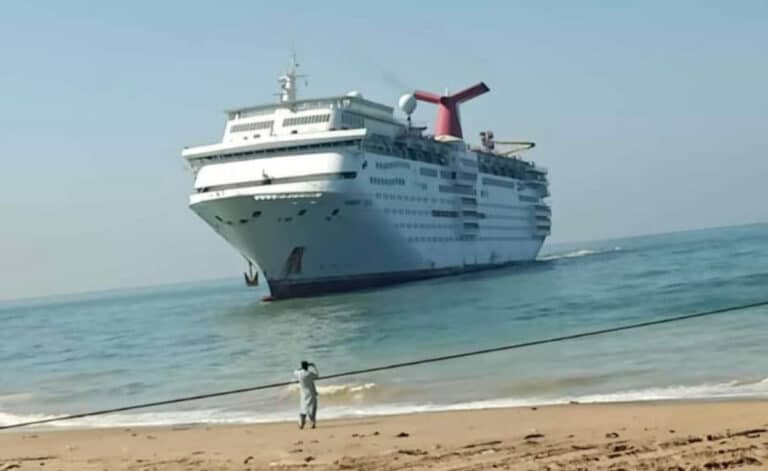
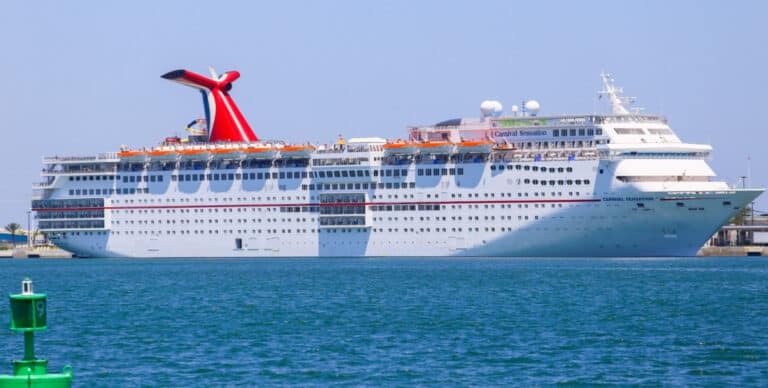
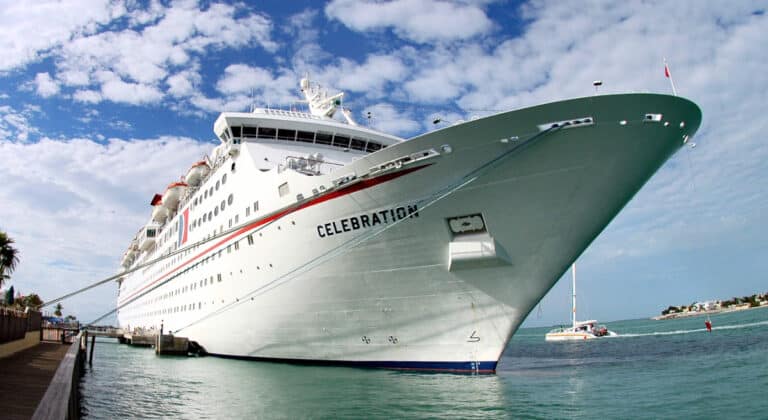
Carnival Fascination, formerly known as Fascination and under her current name Century Harmony, has reached her final destination on a beach in Pakistan. The vessel will be broken up into scrap metal in the upcoming months at the ship-breaking yard in Gadani.
It’s a sad end for the Fantasy-class cruise ship, which, until recently, was due to start a new career sailing in China for Century Cruises. Century Harmony arrived in Pakistan on February 9 and was beached today, February 18.
25 Years of Fun
The beaching of Century Harmony on February 18 means the end of an illustrious career at sea. For 25 years, she sailed the seven seas offering guests fun at sea and many happy memories of vacations at sea. Now, all that awaits her is a few months on a beach in Pakistan, where workers will slowly start stripping her down until there is nothing left.
Photo Credit: Century Cruises
The Fantasy-class cruise ship is 70,367 gross tons with a guest capacity of over 2,000 and 920 crew members. Built at the Helsinki New Shipyard, she was floated out in 1994. Initially named Fascination, the Carnival prefix was only added later to the Fantasy-class as a part of a Carnival Cruise Line rebranding program.
As Carnival Corporation developed plans to rejuvenate the fleet, it meant the end for the Fantasy class cruise ship. She was laid up in Cadiz, Spain, during the pandemic.
In November 2020, Carnival Fascination was sold to Chinese cruise operator Century Cruises, which renamed her Century Harmony, and intended to use her in addition to the various river vessels the company has sailing the Yangtze River in China. The strict measures in place in China prevented those plans.
Photo Credit: Tony Davis (Flickr)
Following a short period where the plans changed to make the vessel a floating hotel, she was sold off to a Singaporean trading company which sold her off as scrap metal. She arrived at the Gadani ship-breaking yard on February 9 and was beached today, February 18.
Only Three Fantasy Class Ships Left
With Carnival Fascination being scrapped, there are only three Fantasy-class ships left of the original eight. Carnival Inspiration, Carnival Imagination, and Carnival Fantasy have all been scrapped during the pandemic.
Carnival Sensation will not be returning to sea, and this week it became clear she is also heading for the scrapyard. She is heading for the shipbreaking yard in Aliaga, Turkey, where the three other Fantasy-class ships have also been scrapped.
That leaves Carnival Elation, currently sailing out of Port Canaveral; Carnival Paradise, sailing out of Tampa, Florida; and Carnival Ecstacy, currently sailing out of Mobile, Alabama. However, for Carnival Ecstacy, the end is also near. Carnival Cruise Line announced she would be retiring in October of this year.
All this has to do with the rejuvenation efforts underway at Carnival Corporation. The company wants to be carbon-neutral by 2050 and has started the transition to more effective and more environmentally friendly LNG-powered cruise ships.
Several main islands make up this region, with three being the US Virgin Islands and four being the British Virgin Islands. What’s the best one to visit? Well, they are all good in their own way, and some are less secluded than others. Take a look at the list below to see which one may fit you best.
The US Virgin Islands consist of St. Thomas, St. John, and St. Croix. These islands have plenty of culture and activities, making them perfect for families, couples, and singles. People can relax and work on their tan while listening to the waves crash on the beach or they can zipline at breakneck speed through the forest for a taste of adventure.
St. John
St. John is the smallest of the three US Virgin Islands. But despite its size, there is no lack of activities to engage in. Tourists can explore dozens of beaches, coves, and trails. If you enjoy nature, you can visit the Virgin Islands National Park. There, you’ll be able to enjoy wildlife and protected marine life. The island is home to dolphins, green turtles, and migratory birds.
Rams Head, St. John (Photo Credit: pics721 / Shutterstock)
Those who love hiking will fall in love with the Ram Head Trail. This is a 2.5-mile hike found within the national park. The trail itself is not exceptionally strenuous, but the views are spectacular. After your day at the park, you can visit Salt Pond Bay, found at the end of the trek.
St. John boasts superior snorkeling locations, including the clear blue waters of Honeymoon Bay. For more adventure, visit Trunk Bay, which has an unusual underwater nature trail.
St. Thomas
The island of St. Thomas is always a popular destination for cruise ships. St. Thomas is known for its bountiful shopping, crystal clear blue waters, and white sandy beaches. Ships tend to dock in Charlotte Amalie – the city’s capital – which is nestled between beautiful, forested mountain tops. Attractions and shopping are available right at the port.
The impressive array of boutiques includes shops and a wide selection of fine jewelers.
St. Thomas contains one of the world’s most spectacular beaches: Magens Bay. This beach has soft white sand that feels like sugar between your toes. Stunning mountains encircle the beach as it is found in a crescent-shaped area on the island. Since it is tucked away and sheltered, this area has a calm tide that’s perfect for relaxing and swimming.
Charlotte Amalie, St. Thomas (Photo Credit: NAPA / Shutterstock)
If it’s an adventure you seek, you will appreciate the hiking trail close to Magens Bay. It has 75 miles of hiking found on top of the hillside. You can also go kayaking in Cos Cay, where you can paddle while observing sea turtles and other wildlife. You can also jet ski to St. John’s Bay and swim with sea lions or dolphins.
If you love history, you’ll want to explore Charlotte Amalie, the capital city. There are 17th-century relics from colonial life combined with a bit of island charm and modernity. You can also walk up the historic 99 steps to take in a panoramic view of the city.
When you get hungry, the island offers numerous beach bars and restaurants filled with local cuisine. Waterfront cuisine makes dining extra memorable.
St. Croix
St. Croix is the largest US Virgin Island. It contains the most spectacular snorkeling and diving found in the Caribbean. If you enjoy these activities, you will want to go to Buck Island Reef National Park. St. Croix contains acres of underwater trails where you can explore the sea floor and view the colorful coral reefs.
For snorkeling, you can also visit Cane Bay found on the northern point of the island. There you will find seahorses, eels, and turtles. Cane Bay is popular for cruisers who are looking for a slow-paced, relaxing vacation.
St. Croix, US Virgin Islands (Photo Credit: NAPA / Shutterstock)
Sandy Point National Wildlife Refuge will allow you to view endangered species, such as leatherback sea turtles. Between April to September, the area offers a nesting ground for hatchlings and turtles. This area remains completely untouched by humans.
If you enjoy history, you will want to visit Christiansted. Christiansted is a Danish-influenced location on the island featuring an 18th-century fort called Fort Christiansvaern. It is a very popular island destination.
Visitors can also go to the historical location of Frederiksted, which has the Museum Center for the Arts.
If sitting on the sand and soaking up rays is your thing, then Rainbow Beach is a must-visit. Here you can enjoy local music, incredible food, and a beautiful beach to relax on.
The British Virgin Islands
On the British side of the islands, there are incredible beaches with white sand and a relaxing atmosphere. Each island has something unique to offer.
Virgin Gorda
Virgin Gorda is another area that visitors can use for a quick day trip from Tortola. This island can be reached by a brief 30-minute ferry ride. The legend of this area is that Christopher Columbus named the island Virgin Gorda because its shape resembled a woman.
Virgin Gorda, UK Virgin Islands (Photo Credit: BlueOrange Studio / Shutterstock)
This tiny island contains breathtaking secluded beaches accompanied by sugar-like sand. It also is home to Virgin Gorda Baths, which are granite stones that are more than 1,000 years old. They surround the beach, where tourists can snorkel in transcendent waters and take in the beautiful scenery.
Jost Van Dyke
This island is a brief boat ride away from Tortola. Despite the location only being three square miles in length, it is packed with activities, beaches, and restaurants. The Great Harbor contains beach bars and local seafood restaurants.
Jost Van Dyke, UK Virgin Islands (Photo Credit: tomtomdotcom / Shutterstock)
This area has a more relaxed and chill atmosphere. This makes it a wonderful day trip from the island of Tortola. Visitors will see many yachts resting out at sea as this is a popular area for this activity.
The most impressive location is White Bay, which is a stretch of white sandy beach shaded by coconut palm trees. It offers an incredible, scenic walk that you will never forget.
Anegada
Anegada is a small volcanic island. Since it is very low-lying, it is known for its impressive coral reefs. Known for being quaint and containing an old charm, visitors will enjoy this area for its quiet retreat.
While this area is not as well-known, it is famous for its secluded beaches like Cow Wreck Beach and Loblolly Bay.
Anegada Island, British Virgin Islands (Photo Credit: EQRoy / Shutterstock)
With no elevation, clear springs bubble out of its coral beds. In terms of animal nature, visitors will love the pink flamingoes, abundant wildlife, and extensive marine life. The best nature trail on the island is Bones Bight.
Tortola
Tortola is the largest of these four islands. It contains several incredible beaches, but the top spot is Smuggler’s Cove, famous for its white sand. If you are into surfing, you may want to visit Apple Bay, which is one of the best spots in the Caribbean for this activity.
Cruisers will love Tortola’s distillery history found at Cane Garden Bay. This is the location for Callwood Rum Distillery, which dates back 400 years. It is the oldest rum distillery in the Caribbean. Meanwhile, Cane Garden Bay offers lounging on the beach with a drink in hand and plenty of beautiful views.
Tortola, British Virgin Islands (Photo Credit: i7pu3pak / Shutterstock)
In terms of diving, Tortola is the launching point if you want to visit the RMS Rhone shipwreck. The RMS Rhone sank during the 19th century from a powerful hurricane. This left the ship resting on the ocean floor. Visitors can also go to Mount Sage to take in its panoramic island views or experience nature while zip-lining through the trees.
Visitors can also go to the capital of the British Virgin Islands, Road Town, for swimming, diving, and windsurfing. You can go up Mount Sage for a panorama of the expansive, lush islands accompanied by sweeping ocean views.
What activities you enjoy doing will determine what is, for you, the best Virgin Island to visit. Most of the activities range from relaxing on the beach, swimming in the ocean, outdoor adventures, nature hikes, visiting wildlife, and enjoying historic sites. There is certainly no lack of things to do in the Virgin Islands.
When you are done exploring or chilling on the sandy beaches, you can enjoy a culture rich in heritage and abundant in island food. The cuisine has a local flair surrounded by scenic views no matter where you are on the islands. Going to this destination will offer you anything you desire accompanied by an experience you will never forget.
The end has come for another Fantasy-class Carnival Cruise Line ship, as Carnival Sensation has set sail for the ship-breaking facility in Aliaga, Turkey. Satellite tracking data has confirmed the ship is en route for the same scrapyard that has been instrumental in the ends of three of her sister ships, Carnival Fantasy, Carnival Inspiration, and Carnival Imagination.
Carnival Sensation on Her Final Journey
The news of Carnival Sensation‘s retirement first broke in early February when it was announced that the vessel would not restart passenger operations. The ship had previously been scheduled to begin cruising from Mobile, Alabama, on March 7, 2022, but those sailings were reassigned to Carnival Ecstasy.
Carnival Sensation departed from her holding position in The Bahamas on March 18, and is currently sailing across the Atlantic Ocean for the final time. She is scheduled to arrive in Aliaga, Turkey, on April 4, 2022.
Last Days of Carnival Sensation
While the ship has not hosted passengers since the industry-wide pandemic shutdown began more than two years ago, Carnival Sensation has still served the cruise line well in recent months. Instead of sailing commercial voyages, the ship has been used to house crew members transitioning in and out of quarantine and isolation periods.
This has helped crew members stay safe and has allowed for better social distancing and health and safety protocols aboard active vessels. This tactic has been instrumental in maintaining safe cruising environments, which has enabled vessels to continue sailing without being denied at ports or forcing cruise cancelations.
As the ship now heads for the ship-breaking facility, she will continue Carnival Cruise Line’s commitment to responsible environmental practices until her very end. The Aliaga yard, located on the Aegean coast in western Turkey, uses stricter environmental protocols than similar ship-breaking yards in Bangladesh, India, and Pakistan.
For example, while ships are beached at the Aliaga yard, demolition crews take steps to control how toxins are exposed as ships are broken, such as oil booms to contain potential spills, concrete cutting floors to minimize seepage into the beach, and improved asbestos removal techniques to minimize contamination. Old cruise ships can potentially contain many toxins in insulation, pipes, conduits, sewage tanks, and more.
These facilities also have improved safety measures to safeguard workers during the demolition of massive cruise ships.
29 Years of Distinguished Service
Carnival Sensation first entered service in 1993 as the third of the Fantasy-class vessels. The vessel was built at the Kvaerner Masa-yards in Helsinki, Finland, weighing in at 70,367 gross tons and stretching 855 feet in length. During her heyday, Carnival Sensation had a guest capacity of 2,052 passengers, with 920 crew members providing sensational service.
Millions of passengers sailed aboard the vessel in nearly three decades, visiting popular ports of call throughout the Caribbean, The Bahamas, and Cuba. In August 2005, the ship was chartered as housing for Gulf Coast residents impacted by Hurricane Katrina, as well as relief workers in the region devastated by the Category 5 hurricane.
Now, the vessel’s days have ended, but she will always be fondly remembered by those who enjoyed her intimacy, amenities, neon-adorned Grand Atrium, three daring waterslides, and fun activities in sensational ways.
Often, the words cruise ship and ocean liner are used interchangeably. Most people don’t realize that there are significant differences between the two types of ships. Some are fundamental, while others are measurable. We delve deeper into what constitutes an ocean liner as opposed to a cruise ship.
Ocean liners are used to go from one destination to another. There tend not to be arrivals at multiple ports as they usually run across larger spans of ocean, including from the U.S. to Europe. Since they can experience various changes in weather, they need to be strongly built by using large amounts of steel in the hull.
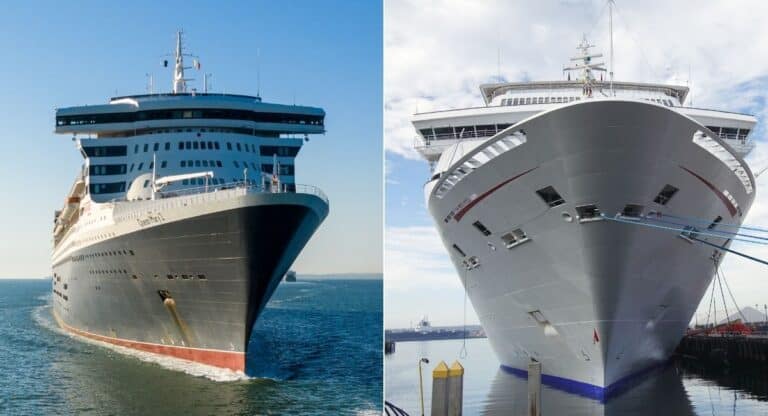
Bows on these ships are tapered and long, allowing them to cut through waves. Deep drafts allow them to be more stable while still being designed for speed.
Cruise Ship Wake (Photo Credit: atm2003 / Shutterstock)
Ocean liners can be used as passenger ships or carry cargo overseas. Cargo ships are often referred to as ocean liners. They carry cargo, pallets, and containers to various destinations. Ocean liners will sit lower in the water than cruise ships, making them more capable of handling poor weather conditions.
Cruise ships, on the other hand, make several stops at various ports. They have multiple destinations, and the purpose is recreational rather than business. Cruise ships also tend to embark on shorter voyages.
Physical Differences
Since both ships have different purposes, they are designed very differently.
Primary Function – Cruise ships were built for leisure activities, whereas ocean liners were created for multiple purposes like transporting passengers, goods, containers, pallets, and large quantities of items from port to port.
Shape – A cruise ship will sit higher in the water and be more subject to differences in weather. An ocean liner rests lower in the water with a pointed bow. This makes it better able to withstand inclement weather. The bow tends to be longer to protect the vessel against the waves.
Thickness of the Hull – A cruise ship will have a standard thickness, whereas an ocean liner is designed to be extra thick to improve its durability and support the weight it is carrying. The steel tends to be several inches thicker than that found on a cruise ship.
Speed – Cruise ships move at a standard speed due to the passengers on board. There are detriments to it moving quickly through the water. An ocean liner moves quickly through water. Ocean liners go on scheduled voyages, which require more speed. Schedules on an ocean liner need to be maintained despite changes in weather.
Experience Onboard – Since a cruise ship is designed for leisure and carries thousands of guests, the onboard experience is luxurious, fun, and elegant. On an ocean liner carrying cargo, the atmosphere is varied.
Bridge is Higher on the Ship – Navigation bridges on an ocean liner rest on the top of most decks. This provides a good view and acts to protect the navigation equipment in the event of a storm.
Location of Lifeboats – Since ocean liners experience heavy seas – especially when crossing during the winter months – the boat deck is closer to the top of the ship, allowing the boats to be better protected from moisture.
Design Difference
As mentioned, ocean liners sit lower in the water and have a pointed bow. They are better equipped to handle bad weather and minimize the sensation of movement aboard the ship. Cruise ships, on the other hand, are more raised and are not as aerodynamic.
Photo Credit: shaineast / Shutterstock
They are not well-equipped to handle bad weather at all. The captain of an ocean liner will be able to successfully navigate through a storm due to the ship’s build. A cruise ship captain will need to be able to change the course and navigate around a storm because the ship will not be able to withstand the force against the boat.
When confronted with bad weather, a cruise ship will slow down, whereas ocean liners will go full steam ahead.
When it comes to materials, ocean liners contain stronger hulls comprised of a durable steel. Cruise liners are generally made of steel; however, they aren’t as strong or as thick as ocean liners. A cruise ship, because of its destinations, doesn’t need to be made as durably as a vessel crossing the ocean.
Speed Differences
Ocean liners are designed to go faster than a cruise ship. The quickest ocean liner, the SS United States, traveled at 39 knots, or 45 miles per hour. Currently, the fastest ocean liner is the Queen Mary 2, which goes at 30 knots (35 miles per hour).
Photo Credit: Felix Mizioznikov / Shutterstock
Recently, cruise ships have been increasing in speed. Some cruise lines conduct repositioning cruises that begin and end in different ports. Royal Caribbean’s Harmony of the Seas travels at 22 knots at full speed.
Norwegian Cruise Line’s Jade, Pearl, Dawn, and Gem can cruise at 25 knots (29 miles per hour). Its fastest ship to date is the Norwegian Jewel, which has a maximum speed of 26 knots.
Variations in Atmosphere
Cruising on an ocean liner is like traveling on a modern cruise ship. The luxury cruise line Cunard Line strictly enforces dress codes and has established times for dining. The overall ambiance includes touches of elegance.
Cruise ships are designed specifically with onboard activities in mind. Their goal is to create an overall experience for guests. This is what is detailed in their design. Cruise ships contain several bars, restaurants, swimming pools, choice in cabins, casinos, theaters, gyms, and spas.
When going on a cruise, passengers look forward to the experience, which is equally important as the destination.
Ocean Liners
Today, there aren’t many ocean liners still in service. The only one still in operation is the Queen Mary 2, which is owned by Cunard Line. Queen Mary 2 frequently makes trans-atlantic cruises, along with smaller travels from South Hampton and New York.
As a hotel, guests can choose from the Queen Mary, SS Rotterdam, and Queen Elizabeth 2, which are all floating hotels.
Queen Mary 2 (Photo Credit: Stephan Backensfeld / Shutterstock)
Traditional ocean liners are used in a similar manner that one would use a bus, train, or airplane. The overall experience is dependent on cost to board the ship. For those who paid more to be in a higher class, the experience is like that of a cruise ship.
Passengers experience fine dining, and they can also work out in gyms, relax in a spa, go to a swimming pool, and enjoy space on the top deck. If the passenger paid for tickets that were budget-friendly, the voyage will not include many extras.
Why Aren’t More Ocean Liners Being Built?
The last ocean liner designed was the Queen Mary 2 in 2003. These vessels are no longer created because cruise ships can do similar things. Modern cruises are capable of going long distances and going through poor weather conditions.
Photo Credit: Wayleebird / Shutterstock.com
Changes in Cruise Ship Designs
The recent decline in ocean liners may be because cruise ships are now pushing the limits of ship design. Ships that are faster and larger than ever are now being built.
The cruise line industry discovered the opportunity to increase its revenue by charging for repositioning cruises. This forced them to make experiences onboard more pleasant in poor weather.
When you compare ocean liners and cruise lines, you will note that there are stark differences. In years to come, there may not be cause for distinction as the fate of the ocean liner is still unknown. Perhaps instead of being a passenger ship, the focus will be more on transporting cargo.
While there are few still in service, ocean liners have been around for a long time. Their gradual decline has been due to the emergence of cruise lines that offer a more relaxed atmosphere, with a focus on activities onboard accompanied by port excursions. For a cruise line, it is as much about the experience as the destination.
For an ocean liner, there is comfort, but it sails more with the destination in mind as activities tend to be more scaled back.
Royal Caribbean International’s newest, largest ship, Wonder of the Seas, is currently sailing her maiden voyage, but it hasn’t been without one notable glitch. According to reports from passengers aboard the vessel, a sprinkler malfunction occurred at approximately 12-1 p.m. on Sunday, March 6, 2022.
Sprinkler System Malfunctions
The sprinkler malfunction happened on the Royal Promenade, which stretches down the center of the vessel on deck 5, from the Royal Theater at the ship’s bow to the Main Dining Room toward the aft. The Royal Promenade has a high, open ceiling, with staterooms overlooking the interior from higher decks.
According to eyewitness reports and videos posted to social media accounts, the sprinklers soaked center portions of deck 5. Crew members acted quickly and efficiently to cordon off the area and the promenade was quickly closed for cleanup, including lowering the fire doors in adjacent sections to contain the water and keep guests safe from slippery floors and other possible hazards.
Parts of deck 4 and 6 were also closed, likely to check for any potential leaks or other necessary cleanup adjacent to the impacted sections of the Royal Promenade.
The incident appears to have been a malfunction, and there were no alarm calls made and no fire reported on board. Within a few hours, the area was cleaned up, dried out, and reopened for guests to enjoy.
Guests who witnessed the incident were quick to commend crew members from different departments who pitched in right away to facilitate the cleanup effort, noting how quickly the cleanup happened and the Royal Promenade was reopened.
Maiden Voyage Underway
Wonder of the Seas is currently on her maiden voyage, a 7-day Eastern Caribbean itinerary that departed Fort Lauderdale on Friday, March 4. Today, the ship was calling in Labadee, Haiti, when the sprinkler malfunction occurred. Because the incident happened in the afternoon, many guests were likely off the ship enjoying the private port of call or participating in shore tours at the time.
The ship is scheduled to call on San Juan on Monday, followed by a day at sea, Nassau on Wednesday, and CocoCay on Thursday, before returning to Fort Lauderdale on Friday, March 11.
Fire Suppression on Cruise Ships
Fire is the gravest risk on any cruise ship, and fire safety protocols are part of every safety briefing before a cruise sets sail. Cruise ships include advanced fire suppression equipment, including sprinkler systems, alarms, isolation doors, and specially trained crews to respond to any risk of fire.
Guests are warned about the risk of fire, and are forbidden from tossing cigarette butts overboard. Even a small bit of hot ash blowing back onto a ship’s deck could cause a fire.
Crew members are routinely trained and drilled to respond to fires, and protocols are updated frequently as new equipment is developed to combat any possibility of fire on a cruise ship.
Maiden Voyage Mishaps
It is not unusual for a brand new ship to have unintended mishaps on a maiden voyage, the first time the ship is fully under sail with a full crew and passengers.
Past Royal Caribbean guests have reported previous sprinkler system mishaps on other vessels, including on an early voyage of Quantum of the Seas, though that sprinkler malfunction was confined to the Sorrento’s pizzeria. Accidental sprinkler activations have also been reported on Anthem of the Seas.
Photo By: René Beauchamp (Wikipedia)
One of the most notable maiden voyage mishaps for modern cruise ships occurred with Carnival Cruise Line’s very first vessel, Mardi Gras, on her very first voyage in March 1972. The ship ran aground on a sandbar shortly after departing Miami, with 530 passengers aboard. No injuries were reported (and no sprinklers were activated), and the “Fun Ship” image was born as drinks kept flowing while the ship was freed.
Cruise Hive wishes Wonder of the Seas all the best to complete her maiden voyage without further mishaps, and may she enjoy many years of incident-free sailings to bring a sense of oceangoing wonder to many cruise travelers.
The lure of the freedom of sailing the open seas and the glamour of traveling to exotic destinations all over the globe tend to be what draws people to the vocation of cruise ship captain. However, what many people don’t fully understand is that being a cruise ship captain is a great deal of work and responsibility. Becoming the captain of a cruise ship takes years of school and experience.
Before we delve into the schooling involved, the duties and responsibilities of this job should be thoroughly explored. As mentioned, while the position appears to be glamorous on the surface, the reality is a stark contrast.
“Master of the ship” is what defines this role. It sounds exciting to oversee an entire ship that sails to far away destinations that most people only dream of visiting. It is alluring to be in an environment where there is fun, romance, and excitement lurking around every corner. Plus, to get paid for it … It seems like a dream come true!
However, reality soon sets in because this job is a great deal of work and responsibility. To truly be successful as a cruise ship captain, you must genuinely love the work you are doing.
The Skills Required to be a Cruise Ship Captain
While not easy, being the captain of a cruise ship is indeed rewarding. They oversee a crew of thousands of individuals to ensure everything gets done and every need gets met. A captain needs to ensure that both local and international laws are met.
Captains use and maintain complex navigational systems, as well as the ship’s engines. They supervise as passengers enter and exit the ship. They need to ensure every person is accounted for and that no passenger is left behind or goes missing.
Safety of both crew and passengers is of the utmost importance in this position. The ship’s captain is responsible to be well-acquainted with the safety equipment and to ensure that it works properly in the event of an emergency. After all, everyone’s lives may be at stake if they don’t.
They need to be able to enforce proper safety protocols, navigate the ship through weather changes, and communicate with nearby ships and ports.
They also must be communicative and social. Captains are often required to socialize with passengers, including hosting dinners and making small talk. Since captains oversee the vessel, there are many people that report to them, like the cruise director, head engineer, and hotel manager.
Captains are the go-to person in all aspects of the ship and are responsible for its safety in addition to the guests. It is easy to see why this position is a huge responsibility, and it can be a weighty one.
Are You Ready for This?
While all of this sounds great, there are things that some people don’t consider with this job. The main thing is that cruise ship captains work long, tiring hours. They work 10 weeks in a row, then have 10 weeks off. However, in those 10 weeks of work, they are required to be on-call 24/7 and function with as little as five hours of sleep, depending on how smoothly things go.
Additionally, there are often emergencies that arise that passengers are completely unaware of. Captains need to be able to read the weather and know what is coming. This may mean changing course to bypass extreme weather. You need to avoid rough seas that can endanger guests.
Then there is the stress of arriving on time at various ports. Sometimes weather can make it challenging to arrive on time when a different course had to be plotted. In this case, the captain must determine whether they’ll speed up the vessel or try to make up for lost time another way.
Ultimately, they are responsible for ensuring that guests are happy. This means that the ship arrives and departs on time. However, not everything may run smoothly. Sometimes people are late, which pushes back departure. Other times, there may be mechanical issues.
Cruise ship captains must remain calm in all circumstances. This job can be highly stressful. Yet if the captain appears stressed, the guests will be uneasy. Guests can never know there is a problem unless they need to be aware of it. Captains try to navigate situations as best as they can, knowing that lives depend on them.
Plus, they often do this on very little sleep. So, when they do have 10 weeks off, they thoroughly enjoy the time to relax. While they are working, the ship truly becomes their mistress.
The responsibilities of a cruise ship captain are as follows:
Oversee navigation and operation of the ship
Work with crew members and senior officers
Oversee the ship’s position
Determine and establish the speed of the ship
Avoid potential and real safety hazards
Upkeep and maintain a vessel’s equipment and engines
Make sure all safety protocol is observed and followed
Comply with international and local laws
Comply with immigration and Customs laws
What Kind of Education is Required?
The very first step is obtaining a high school diploma or equivalent. Once that has been achieved, the person must have either a bachelor’s or master’s degree in marine science/marine engineering. It is preferrable that the degree is received through a reputable maritime academy or college.
If you are in high school and know that you want to enter this career, it is advisable to get into a maritime high school for a more specialized education. This type of school focuses on maritime knowledge and skills.
Good grades are needed to have a better chance to get admitted to a maritime college or academy. Competition for entrance is very tough, so above-average grades are necessary for admission.
To gain good experience, you can try obtaining summer jobs or part-time employment in a maritime industry, like on a ship or in a shipyard. This allows learning to go beyond school. It will also prepare you for ship repairs, the chain of command on a vessel, and how a ship works.
Once admitted, specialized courses like Marine Engineering, Marine Science, Marine Transportation, and Ocean Science can be selected. In order to be considered for employment, a master’s degree isn’t always needed. However, it does provide an advantage. Additionally, you need to have excellent grades, since most cruise ships hire captains who rank in the top five to 10% of their class.
A bachelor’s degree will take three to four years to complete. A master’s will take an additional two to three years. If you want to receive the maximum education, a doctorate will take another two to three years.
Bridge of Radiance of the Seas (Photo Credit: Philip Schubert / Shutterstock)
After you graduate, most people begin as a third mate or deck officer. This is an entry-level position, and most captains begin within these ranks. You can also work in the Navy Reserve and the Coast Guard Reserve to gain years of experience.
Individuals must possess an in-depth knowledge of navigation, logistics, maritime/safety laws, and management. They also require a great deal of training to be a cruise ship captain. A captain’s license obtained by a federal maritime authority is required for the position. Obtaining this license may take 10 years.
To put it in perspective, it takes longer to become a cruise ship captain than a brain surgeon. Most captains earn their bars in 18 to 22 years.
Certifications and Exams
Captains of ships are trained by maritime academies. This is the quickest way to receive proper training. There are some academies that require people to serve in the armed forces. After completing a four-year program, potential candidates receive a Bachelor of Science degree, in addition to a Coast Guard license as a third mate.
Photo Credit: Philomena Venturini / Shutterstock
For certification, they require a Transportation Work Identification Credential. This is given by the Transportation Security Administration which aids in locating cruise ship captains. A Merchant Mariner Credential is required by the Department of Homeland Security. This entails passing physical exams, written exams, a vision test, and a drug test. Captains additionally need to complete the captain licensure exam after 10 years of work experience.
The road to how to become a cruise ship captain is not easy. It requires many years of education, good grades, and experience before you take your final testing for your license. You must work your way up after graduation, and you spend a great deal of time at sea.
Many captains love what they do and find it very rewarding. This can be an extremely satisfying career for those who love the sea and have the proper skill set.
San Diego Cruise Terminals are kept busy handling cruises all year round, thanks to the balmy winter climate and excellent connections by road and air. In fact, San Diego is the third busiest cruise port in California after LA and San Francisco.
In 2019, San Diego cruise terminals handled over 200,000 passengers on 93 ships. The port is one of the busiest in the USA for container cargo. The U.S. Navy also uses the harbor as a home base and has three shipyards for building and maintaining its fleet of support vessels.
San Diego Port has two dedicated cruise ship terminals located on the Embarcadero waterfront in the heart of downtown. It operates a state-of-the-art, shore-to-ship power connection, reducing pollution while the cruise ships are in port. The two-mile stretch of downtown real estate offers waterfront restaurants, boutique shopping, hotels, museums and attractions as well as the busy port.
As California’s second largest city, San Diego has many attractions, museums, beaches, boat trips and theme parks as well as beautiful Balboa Park, the world-famous Zoo, Horton Plaza Shopping Mall and the historic Gaslamp Quarter.
As well as a marina, the waterfront offers shopping, dining and entertainment. Not surprisingly, many cruisers stay a few days in San Diego either before or after their luxury cruise. Getting around is easy on foot, by taxi or light rail.
Where better than San Diego Cruise Terminals to embark on your next luxury cruise? Here’s everything you need to know:
San Diego Cruise Terminal is located in the historic downtown district, just a short walk from many popular attractions. San Diego Airport (SAN) is just 2.4 miles from the cruise port and the journey takes about 10 minutes by taxi. Known as “The Port of Land and See”, San Diego Port has two cruise terminals:
The main San Diego Cruise Terminal is located at B Street Pier, 1140 N. Harbor Drive, San Diego, CA92101. The second cruise terminal, known as Port Pavilion, is located on Broadway Pier at 1000 N. Harbor Drive, San Diego, CA92101.
San Diego Cruise Terminal at B Street Pier
The B Street Pier is San Diego’s largest cruise terminal and handles the majority of cruises arriving and departing from the port. It can accommodate two cruise ships simultaneously.
Port Pavilion
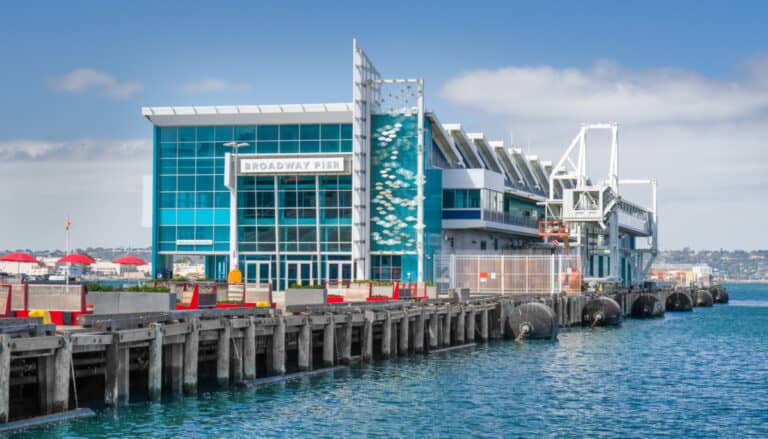
Port Pavilion is located on Broadway Pier, just south of B Street Pier. It is the second cruise terminal at San Diego Port. It was redeveloped to accommodate cruise ships in 2010 and is used when a third cruise ship is in port.
As well as handling cruise arrivals and departures, Port Pavilion also hosts many waterfront events, weddings and festivals. It provides public access to the waterfront and includes a Visitor Center, restaurant and a public plaza.
Port Pavilion has a modern 52,000 sq.ft. terminal and events building “Tidal Radiance” on the 1000-feet-long Broadway Pier. It was the first green building at the port. It features a wall of artistic glass and metal sculptures and projected colored lights.
The Pavilion received LEED Gold Certification for its environmentally friendly features including solar panels, shore power, water efficient fixtures and clever use of glass to reduce the need for indoor lighting.
Broadway Pier is the perfect place for sitting in the sunshine watching ships and boats coming and going against the stunning backdrop at sunset.
Getting to San Diego Cruise Terminals
By car
From Los Angeles and the north
Follow Interstate 5 South (tolls) to Exit 17 (Front Street) San Diego. Head south and turn right on Broadway. Turn right into N. Harbor Drive and follow the signs to San Diego cruise terminals at B Street Pier and Port Pavilion.
From the south
Follow the I-5 north to Exit 17 (Front Street). Stay in the right hand lane and follow the signs to Harbor Drive. The cruise terminals will be on the right.
Cruise Ship in San Diego (Photo Credit: Darryl Brooks / Shutterstock)
By air
Getting to San Diego Cruise Terminal by air is very easy and convenient as the airport is 2.4 miles from the port. Just outside Baggage Claim at either of the airport’s terminals there is a taxi rank managed by a coordinator. Allow 10 minutes for the short drive from the airport to San Diego Cruise Port. Cost is around $20 for the trip.
Alternatively, book a seat with SuperShuttle in a shared van. The cost is around $6 per person, so it may work out cheaper to take a taxi or Uber if there are 3 or more in your group.
Uber and Lyft also offer a pre-booked private car service between the airport and San Diego Cruise Terminals.
Airport-Cruise Port Baggage Transfer Service
Another benefit of arriving by air is the new baggage transfer system operated by the airport. Cruise line staff collect guests’ checked luggage and deliver it directly to the ship. It avoids any delay in waiting for bags to be unloaded from the aircraft and allows cruisers to head straight to the port without having to struggle with heavy luggage. Cruisers should pre-arrange this service through their cruise line or travel agent.
Parking at San Diego Cruise Terminal
There are plenty of options for parking near the cruise terminals on the Embarcadero. Long-term cruise parking is offered by several companies, some within walking distance of San Diego cruise terminals. Full details are available in our article San Diego Cruise Parking: All You Need to Know
Photo Credit: CK Foto / Shutterstock
Tips for Luggage and Passenger Drop-off
Both San Diego cruise terminals have drop-off points close to the ship and there are wheelchair accessible elevators and a passenger gangway. Customer service staff are available to help with any special needs.
Most car rental companies have offices just a short walk from B Street Pier. Most companies offer free transfers to and from the cruise terminals.
Cruise Check-in
However you choose to arrive at the cruise terminals, you can drop off your heavy luggage at the drop-off point and join the line for security and check-in. Porters wearing red caps are available to assist with heavy luggage at the entrance to the terminal; tips are appreciated.
Keep your hand luggage, passport and paperwork with you. You might also want to pack shorts and casual clothing, medication and other essentials and carry them on-board yourself. Your checked-in baggage will be screened and then delivered to your stateroom, but it can take several hours to process the thousands of bags, hence the need to keep some items with you.
San Diego Cruise Terminal (Photo Credit: Eleni Mavrandoni / Shutterstock)
After proceeding through security, cruise passengers proceed to the line of check-in desks where passports, tickets and any necessary visas are checked. Photographs and credit card details are taken and stateroom keys are issued to each passenger.
These plastic “Sail and sign” cards provide keyless access to your stateroom. They are also used to charge any additional fees to your account so you should carry them with you at all times. You will need them for drinks, specialty dining, shopping, booking shore excursions, and more.
These charges will be added to your onboard account along with a daily amount for tips. The total is usually charged to your credit card at the end of your voyage.
San Diego Cruise Terminal Amenities
B Street Cruise Terminal
This busy cruise terminal has ample seating for passengers waiting to board the ship. Porters are available to assist with heavy luggage at the entrance to the terminal. There are restrooms inside the terminal building but no cafes.
B Street Cruise Terminal (Photo Credit: Sherry V Smith / Shutterstock)
The nearest place for food and drinks is on N. Harbor Drive about two blocks away. The terminal has free Wi-Fi (up to 4 hours) and the option for faster bandwidth at $5 per day.
Port Pavilion Cruise Terminal
Port Pavilion cruise terminal has a flexible pavilion that is used for passengers when cruise ships are berthed at the pier. It includes a forecourt with food and drinks stands, escalators and restrooms as well as a waiting area. Free Wi-Fi is available in the Foyer and Broadway View Room.
Disabled Service for Wheelchair Users
Elevators and gangways are wheelchair friendly making it easy to get through the check-in and security process. However, the port does not provide wheelchairs for those with limited mobility.
Passengers are required to provide their own mobility scooters or wheelchairs, or rent one from a specialist company for the duration of the cruise. Staff are always available to assist and you should request this through the cruise company before your arrival at the cruise terminal.
Cruise Lines Operating from San Diego Cruise Terminals
Holland America operates many cruises out of San Diego from October to April. Other cruise lines that home port from San Diego include Disney Cruises, Norwegian Cruise Line (NCL), Celebrity and Windstar.
In addition, the port serves visiting cruise ships from Oceania Cruises, Crystal Cruises, Hurtigruten, Royal Caribbean, Princess, Silversea, MSC and Viking Cruises. Destinations include Hawaii and the South Pacific, Mexico, South America, Panama Canal and the Pacific Coast
Cruise Ships at Port of San Diego (Photo Credit: meunierd / Shutterstock)
Attractions and Things to do at San Diego Port
There are so many amazing things to see and do just a short walk from San Diego cruise terminals.
San Diego Tours
Join a hop-on, hop-off tour of this waterfront city to get acquainted with the historic neighborhoods. Harbor cruises are ideal for spotting birds, seals and dolphins. You can rent paddleboards, kayaks and surf boards and enjoy one of the beautiful sandy beaches.
San Diego Zoo
San Diego Zoo is one of the city’s oldest and best loved attractions. Located within Balboa Park, it’s less than four miles from San Diego Cruise Terminals. It has an emphasis on conservation and education.
San Diego Zoo (Photo Credit: HannaTor / Shutterstock)
Get up close to wildlife on one of the behind-the-scenes experiences or hop aboard the exciting trolley cart, mini trail or open-topped bus tours with an onboard guide. See polar bears, cute koalas and other exotic wildlife from around the world. Rest weary feet and enjoy the specialist talks and keeper presentations.
San Diego Safari Park
San Diego Safari Park is much larger than the downtown zoo. Located 33 miles northeast of the city near Escondido, this drive-through safari provides a thrilling experience among Africa’s wildlife. Drive through the Savannah in an open-air safari truck or join a safari cart guided tour.
Ride the zipline and keep your eyes open for giraffes, antelope, ostriches, rhinos, storks, cheetahs, coatis, camels, kangaroos, gorillas and many cute babies. Tour Elephant Valley with its herd of elephants and learn how this remarkable herd of giants lives. It’s a day you’ll never forget!
Balboa Park
Balboa Park is a green urban space just two miles from the cruise port. It frequently hosts events, free concerts and family-friendly activities. The 1,200-acre park has walking trails, natural vegetation zones, shops and cafes within its boundaries. Created in 1868, it has hosted several national expositions and the surviving buildings are now a National Historic Landmark.
Balboa Park in San Diego (Photo Credit: Vlad G / Shutterstock)
There are no less than 16 museums in the park, including the San Diego Air and Space Museum, San Diego History Center, the Art Institute and the Timken Museum of Art. There is a beautiful Botanical Building, Lily Pond, Desert Garden, Palm Canyon and many other arid themed gardens.
Activities in Balboa Park include archery, bowling, golf, disc golf, a dog park, gym, Old Globe Theatre and the awesome Spreckels Organ Pavilion.
Further afield…
If you’re staying a few days in San Diego, it’s well worth taking a trip along the coast to some of the charming neighborhoods and mission towns north of the city. These include Little Italy, Encinitas, Mission Hills and La Jolla.
As well as providing a pleasant promenade for walking and skating, there are many neighborhood cafes and restaurants serving tasty food and fruity shakes with scenic views.
FAQs on San Diego Cruise Terminal
How far is it from San Diego airport to the cruise ship terminal?
San Diego Airport is just 2.4 miles from the cruise ship terminal on B Street Pier. Allow 10 minutes by taxi to make the short journey along N. Harbor Drive.
How far from San Diego cruise terminal to Safari Park?
San Diego Safari Park is 33 miles north of downtown San Diego in the San Pasqual Valley near Escondido. The journey takes about 30 minutes by car.
Carnival is one of the largest and most popular cruise lines in the world. More than 20 ships in its fleet sail 365 days a year all over the world, with new ships always being developed and new itineraries being explored.
Yet even while Carnival Cruise Line adds newer, larger, and more advanced ships to its fleet, older ships are quietly transferred, sold, or scrapped when they can no longer be sufficiently upgraded or updated for today’s Fun Ship experience. So which vessels are the former Carnival Cruise ships, and where are they now?
Carnival’s very first ship was originally built in 1961 as RMS Empress of Canada for Canadian Pacific Steamships Ltd. In 1972, she was purchased by Carnival Cruise Line and renamed Mardi Gras, serving loyally until 1993. At that time, the ship was sold to Eprotiki Line and renamed Olympic.
Photo By: René Beauchamp (Wikipedia)
Over the years, she was renovated and renamed repeatedly, being called Star of Texas, Lucky Star, and Apollon at different times in her career. In 2000 she was laid up in Greece, and in 2001 reentered service for 3-4 night sailings throughout the Greek Isles. In 2003, the ship was finally sold for scrap.
The name of the ship does live on with Carnival’s first Excel-class LNG-powered Mardi Gras cruise ship, which was delivered to the cruise line at the end of 2020.
Carnivale
Built in 1956, this ship was originally RMS Empress of Britain for Canadian Pacific Steamships Ltd. In 1964, she became SS Queen Anna Maria of the Greek Line, and in 1976 she was sold to Carnival and rebranded as the second Fun Ship.
In 1993, as newer ships were being built exclusively for Carnival Cruise Line, Carnivale was transferred to Fiesta Marina Cruises, then a subsidiary line of Carnival Cruise Line intended to service a Spanish-speaking market.
Rich Turnwald/Wikipedia/CC BY-SA 4.0
She served as the line’s only ship under the name SS Fiesta Marina, but was sold in 1994 to Epirotiki Line when Fiesta Marina Cruises was discontinued. When she joined Epirotiki Line, she was renamed Olympic, and in 1996, she was transferred to Royal Olympic Cruises.
In 1997, the ship was sold to Thomson Holidays and renamed The Topaz, then in 2008 it became the Peace Boat of Topaz International. In 2008 the ship was laid up, and while it was at anchor it suffered significant damage and was eventually scrapped in India.
Festivale
Originally built as RMS Transvaal Castle in 1961, this ship had several names with sales and transfers to different lines until it was eventually sold to Carnival Cruise Line in 1977. She was rebranded, updated, and entered service as Festivale in 1978, after being converted from serving primarily as a cargo vessel with only very limited passenger capacity.
Photo Credit: Krdort / Creative Commons
In 1998, Festivale was purchased by Premier Cruise Line and became Big Red Boat III. The line, however, went bankrupt in 2000, and the ship had become dilapidated and was not considered worth additional upgrades or renovations. She was sold for scrap in 2003.
Tropicale
The first ship ordered specifically for Carnival Cruise Line, Tropicale was under construction in 1981 and entered service with the fleet in 1982, the first vessel to bear the line’s distinctive “whale tale” funnel.
In 2001, the ship was transferred to Costa Cruises and renamed Costa Tropicale until 2005, when she was transferred again, this time to P&O Cruises and renamed yet again to become Pacific Star.
In 2008 the ship was sold to Pullmantur Cruises to become Ocean Dream, and in 2012 she was chartered by Peace Boat for their mission of raising awareness internationally for human rights, sustainability, environmental protection, and other global causes.
In late 2020, it was announced that the ship, along with another vessel in the Peace Boat fleet, was to be replaced with a larger ship, and Ocean Dreamwas sold for scrap in early 2021.
Holiday
Built in 1985, Holiday underwent several major renovations during her service in the Carnival fleet. One of the largest was in 2003 and again in 2005, after she was used as temporary housing for victims of Hurricane Katrina.
In November 2009 the ship was officially retired from Carnival Cruise Line and transferred to Ibero Cruises as MS Grand Holiday, receiving a new paint job and entering service with her new parent line in 2010.
Photo Credit: Carl Carpenter (Creative Commons/Flickr)
In 2014 the ship was sold to Cruise & Maritime Voyages and renamed Magellan, entering her new family in spring 2015 as the line’s flagship.
Though she was replaced as flagship in 2017, she served the line proudly until the global shutdown of operations in March 2020 due to the COVID-19 pandemic. In early 2021, the ship was auctioned off and scrapped at the Alang Ship Breaking Yard in India.
Jubilee
This ship debuted for Carnival Cruise Line in 1986 and served well until 2004, when she was transferred to P&O Cruises Australia and renamed Pacific Sun. At that time, the wings were removed from her iconic funnel and she was repainted.
Photo By: Danzil Vally D’souza
In the summer of 2012 the ship was sold to the Asian line HNA Cruises and renamed Henna. That line shut down in November 2015, and the former Jubilee was laid up as a buyer was sought. None was found, however, and the ship was scrapped in the spring of 2017.
Celebration
Built in 2015, this ship was part of the Carnival fleet until 2008 when she was retired to Ibero Cruises and renamed Grand Celebration. In 2014 she was transferred again, this time moving to Costa Cruises to become Costa Celebration.
Before her inaugural voyage with that line, however, she was purchased by Bahamas Paradise Cruise Line and instead retained her name of Grand Celebration. She kept her iconic funnel, but was repainted.
Photo Credit: Jon Worth (Creative Commons)
She debuted with that line in early 2015 and sailed two-night cruises to the Bahamas year-round, until the cruise line suspended operations in March 2020 due to the COVID-19 pandemic. As the cruise line struggled with debt during the shutdown, Grand Celebration was sold for scrap, and she was officially broken up in March 2021.
Carnival Destiny
Carnival Destiny is relatively unique among Carnival’s former fleet. The ship was launched as Carnival Destiny in 1996. In 2013, she underwent the line’s largest ever refit that renewed nearly every guest area onboard, for a cost of $155 million.
Photo Credit: FloridaStock / Shutterstock
Decks were expanded, more than 150 additional cabins were added and much of the ship’s layout was altered to incorporate new lounges, bars, and dining venues. Because of the scope of the redesign and renovations, the decision was made to completely rename the ship to Carnival Sunshine. Today, the ship still sails with the Carnival fleet, but as Carnival Sunshine rather than Carnival Destiny.
Carnival Triumph
Similar to Carnival Destiny, Carnival Triumph has ceased to exist as an original ship after being refit to join the Sunshine class of vessels. Carnival Triumph was originally in the Destiny class, and first set sail in October 1999.
Photo: Copyright Cruise Hive
Her most notorious moment in the spotlight was in February 2013, when an engine room fire resulted in power and propulsion losses, and the ship was adrift for several days before being towed to Mobile, Alabama. Despite that incident, the ship served the cruise line well until her renovation and rebirth in 2019.
That $200 refurbishment included the addition of new dining, bars, and entertainment options, the adults-only Serenity area, the WaterWorks aqua park, and the energetic SportSquare facilities. Because the renovation was so extensive, the ship was renamed Carnival Sunrise, and continues to sail today under that new name and identity.
Carnival Victory
The third and final vessel to undergo the Sunshine-class upgrade, Carnival Victory first entered the fleet in October 2000. Like Carnival Destiny and Carnival Triumph before her, Carnival Victory was treated to an extensive upgrade and refurbishment.
The renovations had initially been scheduled for April 2020, but work was delayed due to the COVID-19 pandemic that not only ceased worldwide cruise operations, but also paused shipyard work. The $200 million upgrade was finally completed in Cadiz, Spain, in December 2021.
While the ship was out of service, there were unfounded rumors that she was to be scrapped, but instead the renovated ship – now Carnival Radiance – was the first of her class to receive the updated red, white, and blue livery that debuted with Mardi Gras in June 2021. Today, Carnival Radiance continues to delight guests as part of the Fun Ship fleet, though Carnival Victory has passed into history.
Carnival Fantasy
The first of the new class built exclusively for Carnival Cruise Line, Carnival Fantasy debuted in 1990 and would spend 30 years happily sailing for the Fun Ship fleet. During her three decades of sailing, the ship was updated and renovated several times, bringing new features to eager passengers, and always offering amazing voyages for passengers who grew to love all the Fantasy-class vessels.
In March 2020, when the COVID-19 pandemic forced a pause on global cruise operations, Carnival Fantasy was removed from service, and in July 2020 it was announced that the ship would be sold as part of fleet modernization plans.
Those plans had already been in place before the pandemic, but the operational shutdown accelerated the timeline for retiring older, less efficient ships. At that time, Carnival Fantasy was the oldest ship in the Carnival fleet. She was sold for scrap in August 2020, and eventually taken to the Aliaga Ship Breaking Facility in Turkey for dismantling.
Carnival Fascination
The fourth of the Fantasy-class vessels, Carnival Fascination – originally named simply Fascination before all ships had the Carnival prefix added to their names in 2007 – joined the fleet in July 1994. She underwent multiple upgrades and refurbishments during her time with Carnival.
Her most notable achievement was in 2017, when Carnival Fantasy housed relief workers offering aid in the U.S. Virgin Islands after the region was devastated by Hurricanes Irma and Maria in 2017. After that service, Carnival Fantasy received what would be her final upgrade with Carnival in early 2018.
Photo Credit: SeregaSibTravel / Shutterstock
During the COVID-19 pandemic shutdown, it was announced that the ship would be retired and would not return to service. Unlike other Fantasy-class vessels, however, Carnival Fascination was sold to another cruise line when Century Cruises acquired the ship in November 2020.
At first it was rumored that she might be converted to a floating hotel, but it was later announced that she would be renamed Century Harmony to set sail in the Asian market.
The ship entered dry dock for refurbishment, but that renovation was incomplete as the local cruise industry restart continued to be delayed in 2021. Eventually, the ship was sold for scrap, and was beached in February 2022 to be dismantled.
Carnival Imagination
Another Fantasy-class vessel, Carnival Imagination first sparked the imagination of guests when she debuted in 1995. She was the fifth of the sister ships in the class, and served the crise line well throughout the years.
Photo: Benson Truong / Shutterstock.com
In July 2011, Carnival Imagination had a minor incident with her sister ship, Carnival Fantasy, when the two ships collided in Key West while Carnival Imagination was berthed, resulting in stern damage but no injuries.
During her service life, the ship typically sailed short itineraries to Mexico, Catalina, Ensenada, and The Bahamas, depending on where she was homeported at the time, and she was upgraded several times with new and popular features. In August 2020, the ship was sold as part of the fleet’s modernization plans, and she was scrapped in Aliaga, Turkey.
Carnival Inspiration
Carnival Inspiration inspired many cruisers to love the Fun Ship fleet when she first set sail in 1996. She served the fleet well, offering a wide range of itineraries through the years, but ultimately the Fantasy-class vessel was part of the cruise line’s modernization plans during the COVID-19 pandemic shutdown.
Photo Credit: Stories In Light / Shutterstock.com
She was listed for sale and became the second of the line’s vessels to be sold for scrap in July 2020, after Carnival Fantasy. Like her sister ships undergoing the same sudden retirement, Carnival Inspiration was first stripped of valuable materials while in Curacao in early July 2020, then sent along to be sustainably recycled and scrapped in Aliaga, Turkey.
When each of the ships is scrapped, materials may be reused in new ships – such as the new designs in Carnival Celebration – used for repairs to other vessels, or refined to be used in other projects.
Carnival Sensation
The third of the Fantasy-class vessels, Carnival Sensation debuted in 1993, serving well over the years from a variety of homeports, sailing to the Caribbean, The Bahamas, and Cuba.
In late August 2005, the ship was chartered to house residents impacted by Hurricane Katrina, as well as relief workers in the region devastated by the Category 5 hurricane.
Photo Courtesy: Carnival Cruise Line
During the global pandemic pause and even after some Carnival ships began to sail again, Carnival Sensation remained out of passenger service and instead served as housing for crew members transitioning in and out of isolation periods and quarantine.
It was planned that she would return to service in Mobile, Alabama, but in February 2022 it was decided that the ship would be retired instead, and she was likely quickly sold for scrap.
Carnival Ecstasy
From her debut in her 1991, Carnival Ecstasy, another of the Fantasy-class vessels, delighted millions of passengers, and will continue to do so until she is retired in October 2022, an announcement that was made in February as different Carnival ships were redeployed to cover different itineraries as other ships were scrapped
At the time of her retirement she will be the oldest in the Carnival fleet, and enjoyed various refits and updates throughout her lifespan, the most recent of which was in October 2019.
Photo Credit: Paul Brady Photography / Shutterstock
She is the only Fantasy-class vessel to have the honor of a final sailing season, offering guests the opportunity to revisit the ship if they have fond memories of her, or to sail on her for the first time and make memories before she leaves the fleet.
Carnival Ecstasy’s final voyage is planned to be a 5-day sailing departing from Mobile, Alabama on October 10, visiting Cozumel and Progreso in Mexico, with one day at sea to begin the voyage and another to end the trip. While Carnival Ecstasy is not yet a “former” ship, her end is confirmed and she will undoubtedly be given good treatment in her final days before her retirement.
What Ships May Become Former Ships Next?
Today, the oldest ships still happily sailing in the Carnival fleet with no retirement plans are the remaining Fantasy-class vessels, two of the original eight sister ships that were built for the line from 1990-1998.
Both Carnival Paradise and Carnival Elation have been updated and feature the line’s new Fun Ship 2.0 upgrades, and they sail a variety of itineraries in different seasons.
With the extensive renovations these ships have undergone in recent years, plus their unique position capitalizing on shorter itineraries, it is unlikely that they may will be retired or transferred in the near future, though any changes or redeployments are always possible.
The cruise market continues to evolve into a post-pandemic structure, and Carnival Cruise Line is at the forefront of that evolution as it debuts new itineraries, new features, and new ships for passengers to enjoy.
Undoubtedly more ships will be retired in the years to come, but they will always sail merrily on in the memories of the millions of passengers who have enjoyed their long service.
Currently, Royal Caribbean’s Wonder of the Seas is the world’s largest cruise ship, and it is packed with a multitude of activities. With great ships appearing throughout generations, it’s time to cover Wonder of the Seas vs. Titanic. The Titanic is a world-famous ship that was legendary for its generation, yet it is best known today for its tragic demise. So, how do the two vessels compare?
In its day, Titanic was the largest, safest, most luxurious ship ever built, with the reputation of being unsinkable – which tragically proved untrue on the ship’s maiden voyage.
We have learned a great deal since the sinking of Titanic. It was once known as the world’s largest ship, but more than 100 years later Wonder of the Seas has emerged as the most recent ship to take that title. Will this modern Oasis-class Royal Caribbean cruise ship give Titanic a run for its money? How do the two match up against each other?
In this comparison, we will examine both cruise ships. We will compare not just size, but also the accommodations, cost, and facilities of each ship.
Does size really matter? It does when you are looking at the number of guests and activities. Larger cruise ships can cater to a wider demographic cross-section of individuals. Most passengers on these types of ships are young couples or families. Therefore, they must have a broad appeal in terms of activities.
Since they require a larger appeal due to the demographic, more activities need to be incorporated aboard the ship. Thus, they require a larger ship.
When we compare Wonder of the Seas to Titanic, in terms of sheer volume, Wonder of the Seas is 36% taller and 34% wider than Titanic. It can accommodate 5,518-6,988 passengers per voyage compared to Titanic’s 2,435 passengers.
In a side-by-side comparison:
Wonder of the Seas
Titanic
Gross Tonnage
236,857
46,328
Passenger Capacity
5,734
2,435
Crew Capacity
2,300
892
Length in Feet
1,188
882
Top Speed
22 Knots
23 Knots
Passenger Decks
16
9
Wonder of the Seas vs Titanic
In terms of safety, Titanic had only 20 lifeboats onboard, which is only enough to evacuate 1,178 people. The ship required double that amount to ensure space for all its passengers. Wonder of the Seas contains 18 lifeboats. While this seems inadequate, these lifeboats can accommodate 370 people per boat, making the total capacity 6,660.
Courtesy: Royal Caribbean
Which Ship Is Faster?
Speed is less important today than it was more than a century ago. Guests today care more about the experience rather than getting to the destination quickly. Comparatively, Titanic was faster than Wonder of the Seas, but by a marginal amount. Titanic’s maximum speed was 23 knots, which is only one knot per hour faster than Wonder of the Seas.
Is Wonder of the Seas Indestructible?
Most people learned from the tragic example of Titanic that no ship is indestructible. It would be foolish to believe otherwise. Thinking that any ship is incapable of sinking can lead to reckless decisions based on overestimating what the ship is capable of withstanding.
Technically, there is the possibility that Wonder of the Seas could sink. The likelihood isn’t high, though, due to the security measures put in place to ensure the safety of those on board. Technology has considerably advanced since the sinking of Titanic to ensure that the safety of passengers and crew members. Safety is always the top priority.
Photo Courtesy: Royal Caribbean
Weather may attempt or even succeed in capsizing the ship, resulting in its sinking. However, the ship is designed to sink slowly so guests and crew have time to escape. Also, learning from Titanic’s example, all cruise ships are equipped with enough lifeboats to accommodate every passenger on the modern cruise ship.
Accommodations
While it almost seems unfair to compare rooms, if put in its proper context, we can use that to examine the luxury contained within the two ships. Titanic’s best suites were Deluxe Parlor Suites. These suites contained two oversized bedrooms, a private bathroom, dual walk-in wardrobes, and a spacious sitting room with writing desks and a false fireplace.
The look of the suites was very opulent for the times, with four-poster beds elaborately decorated with thick drapes, wood wainscots, and ornate decorations. Third-class rooms weren’t as spacious, as only bunk beds and shared bathrooms were present. This deck only had two bathtubs to serve 710 passengers.
However, most guests felt like royalty to even be aboard such a magnificent ship on its maiden voyage. Accommodations mattered less than the simple privilege of being there if you were in third class.
This is an example of luxury at the time. How does it compare to our present-day image of opulence?
Fast-forward over 100 years, and the look of a suite has drastically changed. When going aboard a cruise ship, it is less about making a statement than it is about having fun.
Wonder of the Seas’ best room is the Ultimate Family Suite. It has a private game room, an air hockey table, table tennis, and a private jacuzzi on the balcony. If that isn’t enough, there is a slide that goes from the bedrooms to the living area. The rooms are bright, colorful, and are designed with comfort and fun in mind.
Staterooms and cabins on this cruise ship contain modern standards expected on a cruise ship. Wonder of the Seas has 34 categories of cabins available, ranging from inside rooms with no windows to large rooms capable of sleeping 14 people.
Laundry
On Titanic, bedding was changed daily. This was done despite the fact that there was not a laundry room aboard the ship because of limited supplies of freshwater. Interestingly, Royal Caribbean changes bed linens during the cruise but how frequently depends on the length of sailing and guests’ preferences.
Amenities Compared
While the size of the two ships is impressive, we must also compare the activities on board each ship. It is a wonderful way to illustrate the progression of cruise ships over the past century.
As expected, there were fewer activities available on Titanic. At the time, Titanic was impressive because it had many activities that other ships did not include. Passengers were able to listen to live music, exercise in a gym or play squash, trade tales in the smoking room, and read in the library.
Wonder of the Seas was designed for activities for the entire family. It is known for treating kids like royalty, which would never have been considered on Titanic, which had no youth facilities at all.
Fitness
Titanic’s gyms contained rowing machines, punching bags, exercise bikes, an electric horse, and two electric camels. Wonder of the Seas contains a variety of exercise machines and weights, yet no electric animals are available on board. However, many ships do have outdoor tracks and sports that guests can play outdoors.
Photo Courtesy: Royal Caribbean
Titanic boasted a prestigious 30’ long squash court, which allowed passengers to play racquet sports. The promenade deck allowed people to engage in dominoes, shuffleboard, and a cerebral game of chess.
Wonder of the Seas contains a sports court designed for volleyball and basketball. Throughout the ship, there are areas for rock climbing, mini golf, surfing, zip lining, ice skating, and laser tag. Guests can even take in a fitness class or go swimming in the solarium. The list seems very impressive in comparison, as do the differences in popular activities of the times.
Swimming Pools
Everyone loves to lounge by a pool or take a quick, relaxing dip to cool off on a hot day. Titanic’s swimming pool was only available to first-class passengers, and there was only one available.
In comparison, Wonder of the Seas has three water slides (Ultimate Abyss, The Perfect Storm, and SplashAway Bay), 10 hot tubs, and four swimming pools available to everyone.
Spas
The preferred method for relaxation on Titanic was a Turkish bath, tanning bed, steam room, trips to the barber, and massages. Fast-forward to the present, and guests can enjoy heated stone loungers, fog showers, and saunas on the Wonder of the Seas.
Furthermore, many of these activities were only available to men aboard Titanic. Now, both genders can enjoy relaxation methods incorporated today.
Culinary Experiences
Titanic boasted four restaurants: the A la Carte Restaurant, the Verandah Café, the Dining Saloon, and the Café Parisien. The rooms contained detailed lattice work and wicker seating.
Wonder of the Seas contains 21 restaurants guests can select from, including nine complementary venues, three main dining areas, and 11 specialty dining places. The decor depends on the flavor and type of cuisine being served.
Rendering Courtesy: Royal Caribbean
When you consider dining options, the two menus and restaurant varieties cannot compare. Titanic had a very scaled-back menu when compared to today’s standards, whereas most modern cruise ships have a variety of culinary delights on board.
However, when you compare what was on the menu, the items on Titanic would be considered more fine dining. However, many of us would not consider eating a lot of these delicacies anymore.
The Costs?
Titanic cost $7.5 million to create, or $200 million today. Meanwhile, Wonder of the Seas cost $1.35 billion to build, which is over six times the price of Titanic.
Tickets
According to Lisbnet, the least expensive ticket on Titanic was £7 UK pounds (approximately £800 or $1075 USD today). The cheapest ticket on the Wonder of the Seas is currently $423 (£315).
If you were to book the Ultimate Family Suite over Christmas break on Wonder of the Seas, it would cost you $85,000. It is cheaper when compared to first-class suites on Titanic. The cost to stay in these suites was upward of £870, or $100,000 using today’s currency. The cost of tickets per class was as follows between Titanic and Wonder of the Seas:
First class on Titanic was £870 ($100,000 today) compared to $3,000 for a suite on the Royal Caribbean’s Wonder of the Seas
The cheapest first-class cost was $150 ($3,500 by today’s standards); a balcony stateroom on Wonder of the Seas is $1,700, and an oceanview room will cost $1,400
Third-class accommodations onboard Titanic were only from £7 (£800 today) whereas Wonder of the Seas has interior cabins that cost $900 USD
These prices offer a generalization on what to expect. Actual ticket fares depend on season, length of trip, destinations, and the ship’s popularity.
Comparing these two luxury liners reminds us about how much time has changed society. Once, it was all about the destination and reaching it quicker. Traveling by boat was the main method of transportation, which has now been replaced by air travel.
With Wonder of the Seas vs. Titanic, you really can’t define whether one ship is superior to the other. They were both the best of their generation. What becomes evident in their comparison is what aspects of luxury are now emphasized, the advancements in technology, and the demographics that are drawn to cruise line travel.
Both ships are glorious for their time. While Wonder of the Seas may not be considered as elegant or opulent by today’s standards as Titanic was in her time, it does attract a lot of attention from families who want to engage on an exciting cruise.