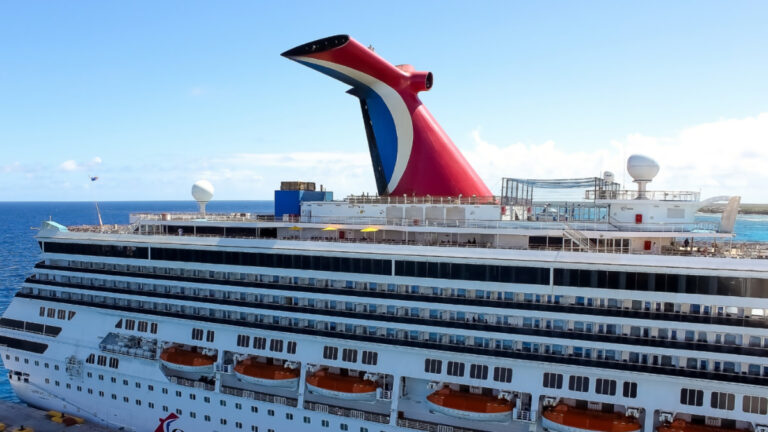
In response to guest comments, Carnival Cruise Line brand ambassador John Heald has offered some guidance on service dogs onboard, including where the dogs are permitted and what types of service dogs can set sail on the Fun Ships.
Guest Questions Service Dog
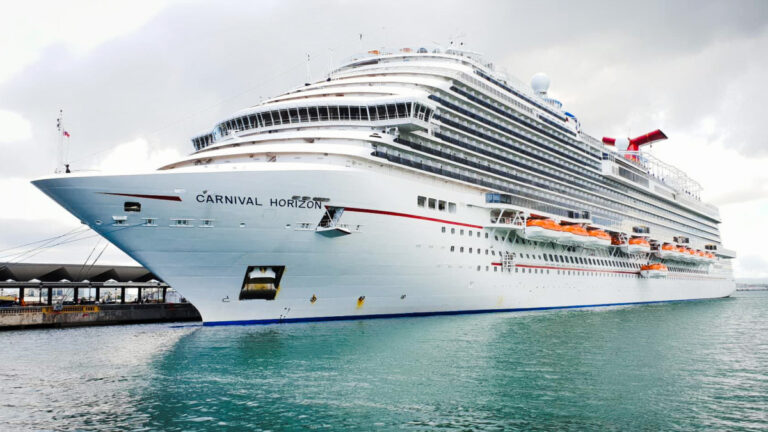
On a recent sailing of Carnival Horizon, currently based out of Miami and offering a range of Caribbean itineraries, a service dog was aboard that raised some questions from a concerned guest about the dog’s breed and whether it was legitimately a service dog.
“There was a visually impaired man on our Horizon cruise with a service dog. I have never seen a Giant Poodle dog. I have never heard of these being used as seeing eye dogs,”the guest explained.
“The man was seen playing slot machines in the casino,”the inquiry continued.“My point is dogs should not be allowed to be on board especially in public places like the casino and main dining hall. What checks does Carnival do to make sure this was a real seeing eye dog?”
Fortunately, Carnival Cruise Line brand ambassador John Heald was able to quickly and firmly address these concerns. He first noted that the cruise line does check into service dog requests very thoroughly.
“The only dogs Carnival permits aboard our ships are working service dogs, which are legally defined and individually trained to meet disability-related needs by performing tasks like guiding a blind person, alerting a deaf person, pulling wheelchairs, alerting and protecting a person who is having a seizure, or performing other special tasks,”Heald explained.“Working service dogs are not pets.”
Dog on Cruise Ship (Photo Credit: Zivica Kerkez)
Any breed of dog can be trained as a service dog, and there are different sizes of poodles recognized by dog breeding and kennel club organizations around the world. All poodles are highly intelligent, affectionate, and easy to train, making them an ideal choice as service dogs.
All service dogs are highly trained for individual tasks, as Heald explained. Each individual’s needs will vary, and it may not be immediately apparent what tasks a dog is trained to assist with. There is no single organization that “certifies” service dogs, nor is there any standardized paperwork for any type of service animal.
Carnival’s website does distinguish that “Emotional support dogs, which are not recognized by the US Department of Justice, are also not permitted on Carnival ships.”
Where Can Service Dogs Go Onboard?
Heald also addressed where service dogs are permitted onboard Carnival ships. In short, a service dog will be permitted anywhere guests are permitted.
“We are proud to be able to say that along with following ADA requirements that we love having these guests on board, because they deserve to have Fun as much as anyone… Even more perhaps,” Heald commented. “The dogs are allowed in the dining room. They are allowed in the casino.”
Carnival Cruise Line’s Guests With Disabilities website does cover service dogs, noting that service dogs that are still in training are not permitted.
Photo Courtesy: Carnival Cruise Line
Different ports of call may also have strict entry requirements or limitations for animals, including service dogs, and guests are responsible to meet the requirements of any port if they will want to debark the ship with their service dog.
Onboard, a relief area will be set up for service dogs in an out-of-the-way area using dog litter. Guests can also bring along a different type of litter material if preferred.
When a Service Dog Is Onboard
When travelers realize their cruise includes a four-legged guest, it is important to note that disabilities come in many different forms and degrees, and it is always inappropriate to question whether or not a service dog is necessary or permitted.
The cruise line has done the work to ensure the animal is permitted, and has made the necessary accommodations as needed. If there are any concerns, they should be politely and discreetly addressed with the Guest Services team.
At all times, it is important to treat everyone onboard – guests, crew members, and service animals alike – with respect and dignity, on every cruise.
The sinking of the Titanic continues to fascinate people from all over the world. Everything about the world’s most famous ocean liner is studied with enthusiasm, from its iconic scale and luxury to the details of its tragic maiden voyage.
Today, we will take a deep dive into the story of the Titanic’s demise. Not only will we uncover just how deep the RMS Titanic is, but we will also explore where it sank, the challenges of reaching its wreckage, and the types of efforts that go into exploring the remains of this famous ship.
So, if you are ready to expand your knowledge of the Titanic and its tragic demise, let’s get started!
Today, the Titanic remains deep beneath the surface of the North Atlantic Ocean. To be more exact, it is resting at a depth of roughly 12,500 feet or 3,800 meters below the surface. Given that the average depth of the Atlantic Ocean is approximately 12,100 feet, the Titanic sits at a particularly deep location.
For perspective, this is approximately the equivalent of a 1,155-story building. Currently, the world’s tallest building is the Burj Khalifa in Dubai, UAE, and it rises to a height equivalent to 163 stories.
As you can imagine, this incredible depth makes reaching the Titanic’s wreckage site extremely difficult and dangerous.
When and Where Did the Titanic Sink?
The Titanic sank on April 15, 1912, less than four days after it began its maiden voyage. The tragic event started when the ship struck an iceberg in the North Atlantic Ocean at 11:40 PM. This collision caused significant damage to the ship’s hull, causing ice-cold ocean water to flood into the ship and weigh it down.
When it finally sank, the Titanic was roughly 350 miles off the coast of Newfoundland, Canada. The exact coordinates of the Titanic when it sank were 41° 43’57” N 49° 56.8’49” W.
Why Is it Difficult to Reach the Titanic Wreckage?
Given the immense depth of the Titanic’s wreckage, as well as its remote location, there are numerous challenges that any researchers and explorers must overcome if they plan to visit the remains of the ship.
Intense Water Pressure at Wreckage Site
Colossal water pressure will always be an issue when discussing any object that sits 12,500 feet under the water. At such a tremendous depth, the pressure is nearly 400 times more intense than you would experience at the surface.
This type of water pressure can instantly crush metal and destroy research submarines not specially designed to withstand these forces.
Extremely Cold Water Temperatures
Aside from the intense pressure at the Titanic’s depth, water temperatures in the North Atlantic Ocean are frigid, even at the surface. The deeper you go, the colder the water temperature becomes. Naturally, these freezing cold conditions pose a significant risk to the explorers but can also present a series of challenges to the equipment.
Titanic Sailing Near Icebergs (Image Credit: Elenarts)
To safely operate a manned exploration submersible, the submarine needs to be designed to function in extreme cold and keep occupants warm enough to survive.
Total Darkness and Visibility Limitations
At the type of depths where the Titanic rests, natural light can’t reach. This means the Titanic’s wreckage sits in total darkness throughout the entire year; any exploration effort needs to involve powerful underwater lighting systems that can improve visibility. The illumination systems must do everything with a complete lack of natural light, so they need a significant power supply.
Beyond the lack of light, there is also the fact that sediment from the ocean floor can make it even more challenging to locate and see the Titanic’s wreckage. Even slight movements along the ocean floor can disturb the sediment and silt, making studying and exploring the shipwreck nearly impossible.
What Is the Condition of the Titanic Wreckage?
Given that the Titanic has been sitting at the bottom of the North Atlantic Ocean for over 100 years, it is in a very fragile and deteriorated state. Again, this complicates any effort to explore the wreckage or retrieve artifacts from the shipwreck site.
Metal components of the Titanic, such as its enormous hull, have undergone extensive corrosion. Constant exposure to saltwater and the immense water pressure has seriously deteriorated the ship’s metal structures. Organic materials, like the Titanic’s renowned wooden interiors, have decayed over the years.
The exterior of the ship itself underwent significant damage during the sinking. In fact, the Titanic is split into two main sections, which fell apart from each other during the ship’s final descent to the ocean floor.
The Titanic Wreckage in the Deep Atlantic Ocean (Photo Credit: NOAA)
The bow section, where most of the Titanic’s passengers would have been, actually sits roughly 2,000 feet away from the stern area of the ship.
When the Titanic was sinking, the ship broke apart, but it was during the descent that the two pieces really separated. When they eventually hit the ocean floor, it is believed that they hit at different angles, which forced them even farther apart.
Furthermore, numerous attempts to explore the ship’s remains and retrieve artifacts have damaged the Titanic’s wreckage even more. While most research expeditions have preservation as one of the primary goals, the remains of the Titanic are incredibly fragile due to corrosion and decay.
What Is the Condition of the Interior of the Titanic?
The interior of the Titanic is in even worse shape than its exterior. This is due to significant deterioration. While corrosion is eating away at the ship’s metal hull, the wooden components featured so heavily in the design of the ship’s lavish interior have decayed heavily.
That said, exploring the ship’s interior is even more difficult than visiting its exterior, so much of it remains a mystery. Naturally, the tight spaces make manned missions extremely difficult. Even unmanned submersibles struggle to reach the ship’s interior without damaging it.
While many assume that the Titanic is enormous and exploring the interior would be relatively simple, the ship was not as big as you may think. It was indeed a marvel of engineering for its time, but cruise ships of the modern day would dwarf it.
When Was the Titanic Wreckage First Reached?
In September of 1985, a joint French and American research expedition launched by Dr. Robert Ballard became the first successful attempt to locate and visit the Titanic wreckage site. This groundbreaking discovery involved the use of a remotely operated submarine called Argo.
While it was an uncrewed expedition, it was considered a major scientific breakthrough due to the incredible depths of the Titanic wreckage. It also resulted in the first images of the Titanic since its tragic sinking, which reignited global interest in the Titanic and its tragic maiden voyage.
Titanic at Sea (Photo Credit: meunierd)
In 1986, just one year after the Argo expedition, Dr. Robert Ballard launched the first successful crewed expedition to visit and explore the Titanic. As you would expect, safety was a significant concern due to the immense depth of the wreckage. To reach the Titanic, the team of oceanographers and underwater archeologists relied on a deep-sea submersible named Alvin, which was created and operated by the Woods Hole Oceanographic Institution.
This expedition marked another critical moment in Titanic exploration. It also resulted in the capture of detailed imagery and video footage of the shipwreck. This information proved incredibly useful for later manned and unmanned exploration attempts. More importantly, it gave researchers an accurate picture of the shipwreck’s condition, location, and exact depth.
What Types of Technology Are Used to Reach and Explore the Titanic Wreckage?
Given its immense depth, specialized deep-sea technology must be used to explore the Titanic wreckage site.
As was evidenced by the very first successful mission, unmanned submersibles, known as remotely operated vehicles (ROVs), continue to play an essential role.
These specialized vehicles are designed to withstand immense water pressure while eliminating the dangers of sending people down to the bottom of the ocean. They can capture images and video footage and retrieve and manipulate artifacts with remote-controlled arms.
Crewed submersibles, like Alvin and DeepSea Challenger, allow human observers to visit the site. These specialized miniature submarines need incredibly durable outer hulls that can withstand the metal-crushing pressure of the ocean floor.
DeepSea Challenger (Image Credit: Jacques Dayan)
They also need to be capable of keeping occupants warm and provided with breathable air. Like unmanned submersibles, they feature high-resolution cameras, powerful lighting systems, and telescopic arms that can retrieve artifacts from the wreckage site.
Sonar mapping systems were also used heavily during the attempts to locate the wreckage. Today, these systems continue to play a role during expeditions, allowing researchers to map the ocean floor surrounding the Titanic.
Modern submersibles are also equipped with more advanced side-scanning sonar systems that can be used to create detailed 3D images of the Titanic and the seabed surrounding it.
These advanced technologies make research expeditions possible and enable researchers to study the wreckage site without disturbing it. Given the fragile state of the Titanic wreckage, preservation is now one of the most important concerns whenever any expedition is launched.
Frequently Asked Questions (FAQs)
How long did it take for the Titanic to sink to the bottom of the ocean?
While it is impossible to say for sure, researchers can use the depth of the wreckage and the Titanic’s weight to come up with reasonable estimates of how long it would have taken for the doomed ship to reach the ocean floor. These estimates must also consider other factors, such as ocean currents and the ship’s angle.
According to these calculations, most researchers agree that the Titanic would have taken five to ten minutes to reach the bottom of the North Atlantic Ocean. This means that the two sections of the wreckage would have traveled at an average speed of approximately 70 kilometers per hour during their descent!
Will the Titanic continue to sink even deeper into the ocean floor over time?
While the wreckage does shift over time, it will not sink any deeper into the ocean floor. According to researchers and experts, the Titanic’s remains have remained relatively stable since they first settled on the ocean floor.
With that said, sediment and marine life are building up on the surface of the Titanic, which will continue to give the appearance that the Titanic is continuing to sink to further depths.
How long does it take to reach the depth of the Titanic in a research submarine?
While the amount of time it takes to reach the Titanic’s depth will depend on the submersible being used, most expeditions tend to take between two and four hours to reach their final depth.
This can make the descent a lengthy and stressful event for crewed missions. As you may know, these types of expeditions can be incredibly dangerous. In fact, the recent OceanGate Titan expedition failed during the descent, as the submersible could not withstand the immense water pressure at that depth. Sadly, this doomed expedition resulted in the loss of five lives.
Final Words
Everything about the Titanic and its doomed voyage is fascinating. Part of what makes it such an alluring story is that its final depth of 12,500 feet is challenging to visit. In many ways, its final resting place at the bottom of the Atlantic Ocean means it almost feels otherworldly.
Despite the difficulties posed by visiting a wreckage site approximately 12,500 feet below the surface, researchers and adventurers from around the world continue to take risks to explore the wreckage site and uncover the secrets of this legendary ocean liner.
While the bottom of the North Atlantic Ocean may hold many mysteries, the wreckage site of the Titanic continues to be amongst the most captivating. If interested, you can learn more about the Titanic and how it compares to modern-day cruise ships.
At least one cruise line has cancelled all shore excursions to Blue Lagoon Island in the Bahamas following the sinking of a ferry boat and the death of a cruise passenger on Tuesday, November 14.
Royal Caribbean International has temporarily suspended all tours to the island at least through Thursday, November 23, 2023.
Royal Caribbean Cancels Shore Tours
Royal Caribbean has sent notices to all guests with pre-booked shore excursions for Blue Lagoon Island for the next week that their tours have now been cancelled. This includes tours such as beach breaks, dolphin swims, stingray encounters, and similar excursions.
“We’re currently working with authorities to evaluate a boat incident that took place during a shore excursion,”the notification to guests read.“In light of this incident, we have decided to cancel all Blue Lagoon tours through November 23.”
During the next week, Royal Caribbean has 11 ship calls scheduled for Nassau, and guests booked on all those vessels will have their Blue Lagoon Island excursions cancelled and fully refunded. No other shore tours are affected.
Cruise Passengers on Sinking Boat in Nassau, Bahamas
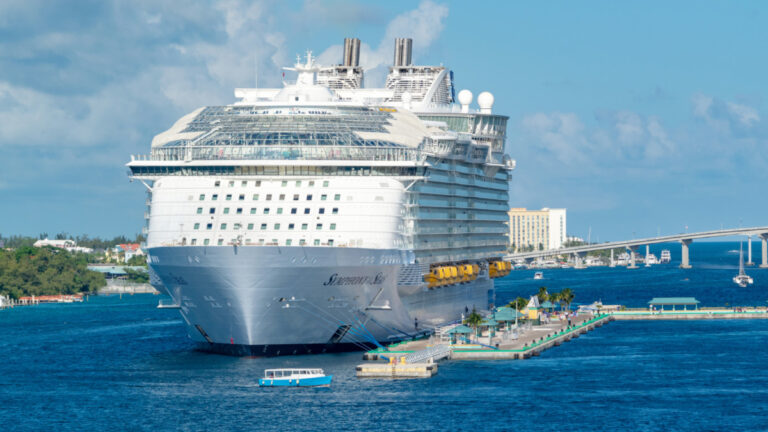
The impacted ships include the cruise line’s Symphony, Mariner, Liberty, Allure, Adventure, Independence, Vision, Freedom, and Anthem “of the Seas” ships.
Two vessels – Allure of the Seas and Liberty of the Seas – both have two visits to Nassau in that time period – on Saturday, November 18 and Wednesday, November 22 for Allure of the Seas, and on Saturday, November 18 and Thursday, November 23 for Liberty of the Seas.
“We’re sorry for any inconvenience caused by this. Please know your safety is our top priority,”the notification concludes.
While the suspension is only through November 23 at this time, it is possible the cancellations will be extended further and additional cruises will be impacted, depending on how long the incident investigation takes and what its conclusions may be.
Renewed safety inspections of Blue Lagoon ferries or updated certifications may also be necessary before the cruise line will resume offering the tours.
Will Other Cruise Lines Cancel as Well?
It is likely that other cruise lines may similarly cancel Blue Lagoon Island excursions for the time being, depending on their own tour offerings and safety considerations. How long such excursions may be cancelled will be up to each individual cruise line.
Through the end of the month, ships from Carnival Cruise Line, Celebrity Cruises, MSC Cruises, Disney Cruise Line, and Norwegian Cruise Line are all scheduled to visit Nassau and may have their shore tour options impacted.
Photo Credit: YULIYAPHOTO / Shutterstock
A Royal Caribbean spokesperson has confirmed that the 74-year-old female cruise guest who died in the incident was a guest aboard Independence of the Seas, the only Royal Caribbean ship visiting Nassau the day of the accident.
Tour companies, which are independent contractors and not affiliated with any cruise line, often combine tour offerings from multiple vessels, particularly for transportation to tour sites. It is possible that guests from different cruise lines were also aboard the stricken boat.
According to guests on the ship as well as video of the incident, large waves hit the double-decker ferry which then began taking on water. The boat listed severely and eventually sank in the relatively shallow water close to Blue Lagoon Island, eventually stabilizing with the top deck still above water.
Cruise lines occasionally cancel shore excursions due to bad weather or other reasons, such as lack of adequate transportation or staffing on the part of the tour company to accommodate all interested guests.
In the meantime, guests can enjoy a wide range of great activities when visiting Nassau, including visiting the Atlantis resort and waterpark, snorkeling, the famous “swimming with the pigs” tours, beach breaks at different local resorts, jeep adventures, cooking classes, historical tours, the dancing flamingos of Ardastra Gardens, glass bottom boat tours, and more.
The US Coast Guard has officially suspended search efforts in the Gulf of Mexico for the missing guest from Carnival Glory.
The guest was reported missing on Monday, November 13 and later confirmed overboard, but despite an exhaustive search and rescue effort with multiple air assets, crews were unsuccessful in locating the passenger.
Search Suspended for Carnival Glory Guest
A 28-year-old male guest from Carnival Glory, identified as Tyler Barnett of Houma, Louisiana, was reported missing on the afternoon of November 13, and after emergency operations failed to locate him onboard the cruise ship, the US Coast Guard (USCG) was alerted to begin a search. That notification was received at approximately 12:40 p.m. on Monday afternoon.
That search has now ended as the USCG has suspended efforts without success, despite covering approximately 5,625 square miles (14,570 square kilometers) of search area, an extraordinarily broad search zone roughly larger than the state of Connecticut.
#UPDATE The Coast Guard suspends search for missing cruise ship passenger.
Coast Guard crews searched approximately 5,625 square miles, roughly larger than the size of Connecticut.
“The Coast Guard launched multiple search and rescue assets as soon as we were notified of a missing passenger from the Carnival Glory,”said Lt. Cmdr. Sean DiGeorge, Coast Guard District Eight search and rescue mission coordinator.
“Our crews battled severe weather conditions for multiple days and made every effort to find Mr. Barnett. Suspending an active search is never a decision we make lightly, and we offer our most sincere condolences to Mr. Barnett’s family and friends.”
The search area was so large, covering roughly 200 miles of the ship’s route, because initially it was not known what area to search, as the time of Barnett’s disappearance was not immediately clear.
US Coast Guard Search of Missing Carnival Passenger
A review of security footage from the cruise ship did finally determine that Barnett had gone overboard at approximately midnight between Sunday and Monday, which allowed the search area to become more focused.
Search assets involved in the operation included HC-130 Hercules aircrews from Air Station Clearwater, Florida; HC-144 Ocean Sentry aircrews from Aviation Training Center Mobile, Alabama; and a MH-60 Jayhawk helicopter aircrew from Air Station New Orleans.
An alert was also issued to all marine craft near the search area to keep a lookout for the missing passenger, ultimately to no avail.
Weather Hampered Search Efforts
Rough weather in the search area, including gale force winds and significant waves, forced search efforts to be paused overnight Monday and again overnight Tuesday when visibility became inadequate for efficient searching and too hazardous for the aircraft to continue. The search was resumed as soon as crews could safely do so.
The poor weather would also impact the probable survivability of an individual in the water, which can contribute to the decision to suspend search efforts.
Carnival Glory is currently sailing a 7-night Western Caribbean cruise, having departed New Orleans on Sunday, November 12, with port visits to Montego Bay, Jamaica; George Town, Grand Cayman; and Cozumel, Mexico.
The 110,000-gross-ton, Conquest-class ship’s itinerary has not been affected by this incident, and the vessel will return to New Orleans on Sunday, November 19, as scheduled.
Overboards Rarely End With Good Results
Unfortunately, while search efforts are always made in earnest, they are not always successful.
In incidents when an overboard is noted quickly and a response can be immediate, it is must more likely that an individual in danger can be found with a positive result.
In the realm of cruise vacations, internet speeds have always been the one thing that has disappointed guests. A significant leap forward has been the introduction of Starlink Internet onboard cruise ships in the last year or so.
However, Carnival Cruise Line is taking this a step further with the introduction of 5G mobile connectivity on Carnival Jubilee, signaling a new era of hyper-connected cruise travel.
Carnival Jubilee Pioneers 5G Connectivity at Sea
Carnival Cruise Line announced a groundbreaking development for its upcoming cruise ship, Carnival Jubilee, on November 16. The cruise ship will be the first in North America to offer guests the luxury of 5G mobile phone service. This industry-first initiative is a result of a collaboration with Wireless Maritime Service (WMS), a leading cellular provider.
Luis Terife, Vice President of Onboard Guest Commerce at Carnival Cruise Line, emphasizes the significance of this advancement.
“Carnival Jubilee will be the fleet’s most-connected ship – literally raising the connectivity bar for our guests and serving as another big step in a period of vigorous advancement of our onboard connectivity,”Terife said.
Scheduled to launch in December, the 5G-enabled Carnival Jubilee represents a new chapter in cruise ship connectivity. Guests will be able to access this service early in 2024 through various service plans offered by their wireless carriers.
John Harshaw, Vice President of Global Infrastructure at Carnival Cruise Line: “We’ve received very positive feedback from our guests who are enjoying the more reliable Wi-Fi across the fleet as we continue to increase our capacity through Starlink and other service providers.”
This initiative not only upgrades the guest experience on Carnival Jubilee but also sets a precedent for the rest of the fleet, with plans to extend 5G capabilities to other ships.
However, guests might have some issues finding a carrier that is capable of offering the type of data sets that 5g requires. Major wireless carriers have yet to align their current cruise ship service plans with this new technology.
The existing cruise plans from AT&T, Verizon, and T-Mobile primarily focus on providing traditional cellular services, like talk and text, with limited data options, and do not specifically cater to 5G connectivity.
Carnival Cruise Line Onboard Connectivity
The introduction of 5G on Carnival Jubilee is part of a broader strategy to enhance internet accessibility on all Carnival ships. The cruise line has completed upgrades across its 25-ship fleet, installing the infrastructure needed for SpaceX’s Starlink Satellite service.
“The ongoing enhancements we’re rolling out on all of our ships, such as SpaceX’s Starlink satellite internet service, make it significantly easier for guests to share the memorable experiences of their cruise with friends and family.” Terife added.
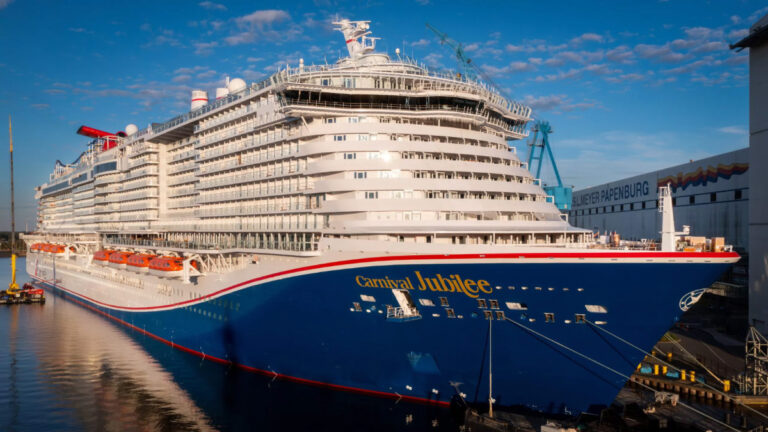
Carnival Jubilee Conveyance on the Ems (Photo Credit: Carnival Cruise Line)
This comprehensive approach ensures that guests have access to the most robust and reliable service available, backed by partnerships with multiple internet vendors.
“Our multi-provider, multi-orbit strategy minimizes single-provider supply chain constraints and improves overall connectivity in support of our operations and the enhanced experience for our guests and team members,” according to Harshaw.
Carnival Jubileerecently completed her sea trials and is set to make its debut voyage from Galveston on December 23, 2023. She will offer week-long Western Caribbean cruises, including visits to popular destinations like Cozumel and Costa Maya in Mexico, and Mahogany Bay in Roatan, Honduras.
The search for a missing crew member from the MSC Seascape has come to a solemn conclusion. The US Coast Guard announced the suspension of their efforts on Wednesday evening, after an exhaustive search north of Aguadilla, Puerto Rico.
Search Efforts Conclude Without Result
Search efforts for a crew member who went missing from MSC Seascape by multiple assets from the US Coast Guard concluded without a result on Wednesday, November 15.
The incident occurred as MSC Seascape, a 169,400 gross-tons cruise ship, was navigating the waters between San Juan, Puerto Rico, and Puerto Plata, Dominican Republic. A 30-year-old crew member of Indian nationality tragically went overboard, initiating an intensive search and rescue operation.
Despite the deployment of MH-60T Jayhawk helicopters, Coast Guard Cutters, and exhaustive efforts covering over 887 square nautical miles, the crew member remained unfound.
Capt. Jose E. Díaz, Sector San Juan commander, expressed his heartfelt sympathies, emphasizing the emotional toll of such incidents at sea.
“My thoughts and prayers are with the family, friends and fellow crewmembers of this young man,”said Capt. Jose E. Díaz, Sector San Juan commander.
The Coast Guard aircrew deployed a self-locating datum marker buoy, an instrument used to measure sea currents, to aid in coordinating the search efforts.
During the operation, rescue teams located three MSC Seascape life rings on Wednesday morning, two of which were successfully recovered. However, these efforts did not result in finding any signs of the missing individual. The search efforts extended over a total of 34 hours.
The crew member fell from the vessel from a height of about 32 feet, some 80 feet from the bow of the ship.
“Losing a loved one or a fellow shipmate at sea is very difficult, may they find strength and closure during this most difficult time. I commend the efforts of all the rescue units involved in the search efforts and truly appreciate the collaboration of our fellow partner agencies for their prompt response and assistance,” Díaz continued.
MSC Seascape Continues Voyage
The events onboard MSC Seascape serve as a reminder of the dangers that crew members face onboard cruise ships. Despite the deployment of state-of-the-art technology and extensive search efforts by both the ship and the US Coast Guard, the missing crew member was not located.
As MSC Seascape continues its cruise, sailing to Ocean Cay, and concluding its cruise in Miami on November 18, there are lessons to be learned.
The incident should serve as a reminder of the issues that crew members face onboard. While not implicating any fault on the part of MSC Cruises, incidents such as this draw attention to the mental health challenges faced by crew members who spend extended periods away from family and friends.
MSC Seascape Cruise Ship (Photo Credit: Dennis MacDonald)
The demanding nature of their work, combined with the isolation inherent in long stretches onboard, can have a significant impact on their well-being.
Cruise lines have been implementing measures to support the mental health of their crew. These initiatives often include providing access to counseling services, creating programs for stress management, and fostering a supportive community environment on board.
Ensuring regular communication with loved ones and offering recreational activities are also part of the efforts to maintain a healthy work-life balance for the crew.
However, the incident on MSC Seascape highlights the need for continued focus on mental health support in the industry and supporting those who work to make cruises safe and enjoyable for guests.
A full plane of airline passengers got an unexpected bonus to their travels when they were the winners of a free Virgin Voyages cruise aboard Resilient Lady.
The lucky travelers were aboard a Virgin Australia flight following the same route the ship will make when she debuts Down Under on December 11, 2023.
Free Cruise Awarded to Airline Passengers
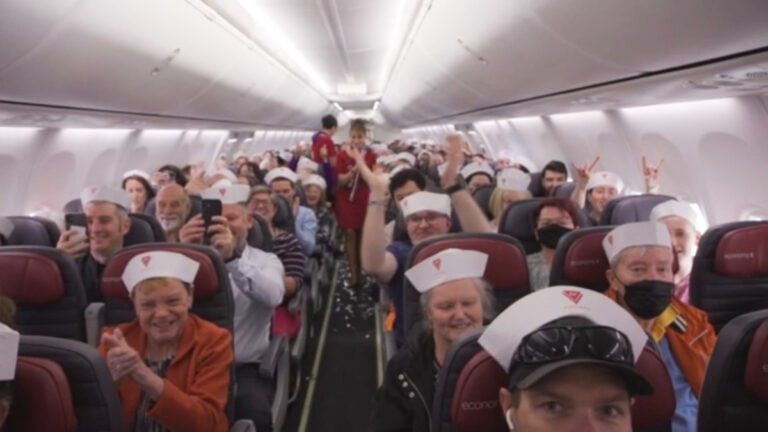
More than 150 travelers aboard Virgin Australia flight 1316 from Melbourne, Australia to Hobart, Tasmania got the ultimate surprise on Thursday, November 16, 2023.
Partway through the flight, Sir Richard Branson phoned in via FaceTime to make a very special announcement over the plane’s speakers, gifting all adults aboard the flight a free Virgin Voyages cruise.
“We’re counting down to Virgin Voyages’ arrival Down Under – setting sail the Virgin way with adults-only itineraries across Australia and New Zealand. Today, you happen to be travelling on the same route as our Aussie MerMaiden Voyage,”Branson explained.“To celebrate this milestone, I’m pleased to gift each adult on-board a free Virgin Voyages cruise.”
You can watch Sir Richard Branson surprising passengers with a free cruises and all the festivities in the video below:
Cheers erupted throughout the aircraft as the cabin crew handed out free cruise vouchers. The cabin crew, baggage handlers, and pilots associated with the flight also received a free cruise. In total, the prizes add up to more than $1 million (USD).
That specific flight was selected to win the unprecedented giveaway because it was following the same route that Resilient Lady will take for her MerMaiden voyage on December 11, 2023. The ship will leave Melbourne that day, visiting Hobart as her first port of call from an Australian homeport on December 13. The sailing will also visit Burnie, Tasmania before returning to Melbourne on December 16.
To further celebrate the occasion, the flight’s departure gate at Melbourne Airport was decorated as Branson’s “RockStar Quarters” – an exclusive suite onboard the ship – with a scenic ocean backdrop, a “hot tub” with scarlet confetti water, and one of the signature hammocks found on Virgin Voyages’ distinctive ladyship.
Richard Branson Gives Free Cruises (Credit: Virgin Australia)
Resilient Lady is currently making her way toward Australia with a repositioning cruise that departed Dubai on Sunday, November 5. The ship is enjoying calls in India, Thailand, and Malaysia before arriving in Singapore on Monday, November 20. The second leg of the repositioning to Australia will visit top destinations in Indonesia and northern and eastern Australia.
The third of the adults-only cruise line’s “ladyships” Resilient Lady joined the cruise line earlier this year and officially debuted in Greece on May 14, 2023. The ship spent the summer offering Greek Isles cruises.
Sailing Australia with Virgin Voyages
Resilient Lady will spend several months in Australia, offering a selection of diverse itineraries. Depending on the sailing date, the ship’s homeport will shift between Melbourne, Sydney, and Auckland to bring the cruise line’s unique experiences to more travelers.
Cruise lengths range from a quick 2-night getaway to 14-night adventures. Ports of call include Burnie, Hobart, Picton, Napier, Tauranga, Wellington, Dunedin, Christchurch, and more, depending on the exact cruise and sailing route.
Virgin Voyages Resilient Lady (Photo Credit: Stefano Tammaro / Shutterstock)
In March 2024, the 110,000-gross-ton ship will depart Australia on her way back to the eastern Mediterranean via Indonesia, India, and Dubai.
Resilient Lady can welcome 2,700 guests onboard each sailing, and features unique amenities such as an onboard tattoo parlor, more than 20 restaurants and bars, five production shows, and much more to enjoy. Also onboard are more than 1,100 international crew members to ensure that every passenger gets truly exceptional service on every sailing.
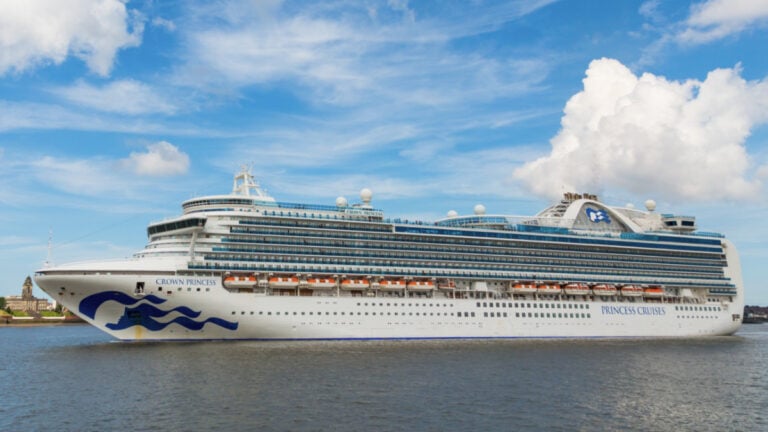
Princess Cruises has announced its 2025/26 Australian summer program, set to open for bookings at the end of November 2023. This program includes the Australian debut of Discovery Princess and the launch of the longest world cruise ever to sail roundtrip from Australia on the Crown Princess.
Crown Princess and Discovery Princess will be based out of Sydney, while another Princess Cruises vessel, Grand Princess, will sail out of Brisbane, visiting destinations around the Pacific Ocean on 14-day cruises. Together, all three ships will give guests Down Under a wide variety of cruise options.
Princess Cruises’ 2025-2026 cruise season promises to offer guests every opportunity to explore exciting port destinations in the region, but also to sail on a once-in-a-lifetime cruise around the world.
Crown Princess is set to undertake an epic 114-night world cruise, starting its journey from Sydney. The cruise distinguishes itself as the longest world cruise that has ever set sail from Australia, covering an impressive 35,000 nautical miles, and visiting 48 destinations in 31 countries across six continents.
The itinerary includes exclusive stops at two ports that have never been sailed to on a Princess world cruise – Alexandria in Egypt and Patmos in Greece – and overnight visits in New York, Lima, and Quebec, along with late-night stays in Reykjavik, Iceland, and Papeete, Tahiti, and sailing through the newest Panama Canal locks.
Photo Credit: Drew Rawcliffe / Shutterstock
Crown Princess will also sail Australia circumnavigations, visiting ports such as Port Douglas, Broome, Exmouth, and Albany. The ship will also be scenic cruising along the spectacular Kimberley Coast.
Besides Crown Princess, two more Princess Cruises ships will sail in Australian waters in 2025-2026, Grand Princess and Discovery Princess. Together, the three cruise ships offer 75 unique itineraries and 120 sailings, ranging from two to 37 days.
Guests will be able to embark on a cruise from a record number of ports in Australia and New Zealand, including Sydney, Melbourne, Brisbane, Perth, Adelaide and Hobart in Australia and Auckland in New Zealand.
Princess Cruises first began cruising in Australian waters in 1975. This marked the start of a long-standing relationship between the cruise line and the Australian market. The original Pacific Princess was one of the early vessels to offer cruises from Sydney, an event that symbolized the beginning of Australian cruising.
Discovery Princess Makes Her Debut Down Under
The 145,000 gross tons Discovery Princess will make her Sydney debut on December 6, 2025, as the biggest Princess Cruises ship to sail in Australian waters.
The Discovery Princess will sail a variety of 22 different itineraries during its four-month deployment, including 11 departures from Sydney. Guests who wish to arrive in Australia in style can do so during an 18-night cruise from Singapore to Sydney on Discovery Princess.
This cruise departs November 18, 2025, and will sail to Ho Chi Minh City and Nha Trang in Vietnam and Lombok in Indonesia.
“Cruising has come a long way in half a century, and we’re delighted to now be bringing a ship of the caliber of Discovery Princess to Australia as part of a fantastic line-up of summer cruising,”said Princess Cruises Senior Vice President of Asia Pacific, UK & Europe Stuart Allison.
Grand Princess, at 107,000 gross tons and with a capacity for 2600 guests, will be based in Brisbane, offering 14 roundtrip cruises to diverse destinations like Tasmania, Papua New Guinea, and New Zealand.
One of the highlights of Grand Princess‘s 2025-2026 season is a 37-night cruise to Hawaii and Tahiti, featuring visits to Pago Pago, Maui, Honolulu, Kauai, Kona, Hilo, Papeete, Moorea, Raiatea, Tonga, and Norfolk Island. The cruise sets sail from Sydney on October 16, 2025, or Brisbane two days later.
The new program will be available for booking starting at 9 AM AEDT (Australian Eastern Daylight Time) on November 29, 2023, for Elite guests and 9 AM AEDT on November 30, 2023, for general sales.
A woman has been banned for life from sailing aboard any Carnival Cruise Line ship for packing CBD gummies along in her carry-on bag for an August 2023 cruise from Miami, Florida.
Despite the controlled substance being conditionally legal in Florida, all major cruise lines prohibit such items, as is clearly stated on Carnival’s prohibited items list.
Banned for Life for Legal Substance
Melinda Van Veldhuizen, a loyal member of Carnival Cruise Line’s Very Important Fun Person (VIFP) program who receives priority boarding as a perk for her many sailings with the cruise line, will never again set sail on any Fun Ship.
Van Veldhuizen has been banned for life for attempting to bring along CBD gummies on a cruise aboard Carnival Horizon in August 2023. The gummies, which Van Veldhuizen claims to use as an occasional sleep aid, were in her backpack. When going through security at check-in for her cruise, security spotted the item and took her to a secure area at PortMiami for further questioning.
The gummies were legally purchased online, and while CBD is conditionally legal in Florida – items must have less than .3% THC to be legal – Van Veldhuizen’s gummies were only at .01%, well below the legal threshold.
Carnival Cruise Line, however, bans all CBD products, regardless of the regulations, laws, or restrictions from homeports in different states.
“Any illegal narcotics/drugs including synthetic, designer drugs, Cannabidiol (CBD) and medical marijuana [are prohibited],”the list states.“While certain CBD products used for medicinal purposes may be legal in the US, they are not legal in all the ports we visit and therefore are also considered prohibited items.”
Carnival Cruise Line brand ambassador John Heald has addressed this issue several times on his popular Facebook page in response to guest comments and concerns.
“In line with the strict rules of United States Customs and Border Protection marijuana, medical marijuana and its oil based forms are not allowed to be brought onto the ships,”Heald has said in reference to various products.“It is illegal to do so.”
The incident happened aboard Carnival Horizon‘s August 5 sailing, an 8-night Southern Caribbean cruise.
What a Ban Means
Van Veldhuizen was notified of her lifetime ban via a letter from the cruise line.
“This letter will confirm your discussion with Carnival Cruise Lines Carnival Horizon personnel where you were informed that you will be disembarked from the vessel and not be permitted to sail onboard any Carnival Cruise Lines vessel in the future,”the letter explained.
“This decision was based on your actions on the current cruise, which were a violation of the ship rules, interfered with the safety and/or enjoyment of other guests on the ship or caused harm to Carnival.”
While the language of the letter is quite generalized and Van Veldhuizen’s specific violation was not mentioned, the intent of the letter is clear that she will not be permitted onboard any Carnival cruises in the future.
“Your attempt to book a future cruise will result in cancellation and a possible loss of deposit monies,”the letter continued.
The letter does not specify whether or not the lifetime ban includes other cruise lines in the Carnival Corporation family, such as Princess Cruises, Holland America Line, or other cruise lines owned by Carnival.
If Van Veldhuizen were to consider sailing on other Carnival Corporation lines, it would be prudent to carefully consult with a travel agent and contact the cruise line for confirmation before proceeding with a booking.
All cruise travelers should regularly review the prohibited items list for their cruise line prior to sailing, as such lists are frequently updated with new items added that could lead to embarkation delays, fines, or outright bans.