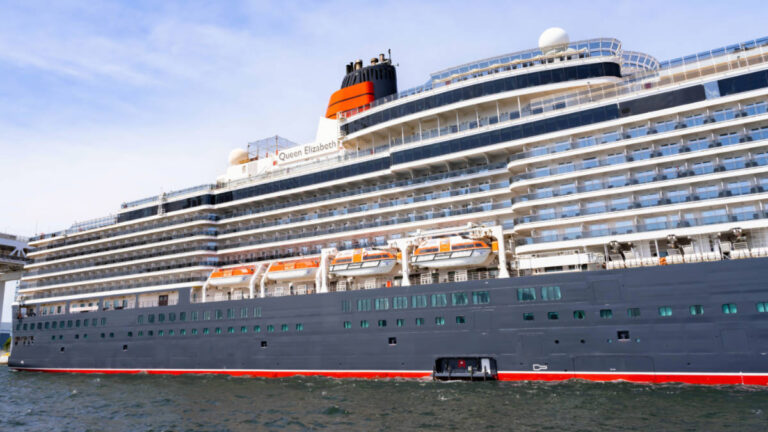
Guests boarding Cunard Line’s Queen Elizabeth in Sydney, Australia on Monday, January 22, 2024 will unfortunately not be enjoying the Great Barrier Reef itinerary that was originally planned.
Due to a developing tropical cyclone, the ship’s itinerary has been completely altered and the ship will be sailing south rather than north to ensure a safer and more comfortable voyage.
Queen Elizabeth Itinerary Change
Guests setting sail on Queen Elizabeth today will not be taking the planned cruise to Queensland and the Great Barrier Reef. This is due to the influence of a developing tropical cyclone in the Coral Sea with a track that will likely make landfall exactly when the ship would have been sailing off the Queensland coast.
The original itinerary for the 10-night sailing was to have included visits to Brisbane, Airlie Beach, Cairns, Port Douglas, and Willis Island. Unfortunately, those ports of call are directly in the path of the storm.
Now, Queen Elizabeth will instead be visiting Eden on Tuesday, January 23; Melbourne for an overnight call from Wednesday (January 24) morning until Thursday (January 25) evening; Adelaide on Saturday, January 27; and Port Lincoln on Sunday, January 28.
The remainder of the itinerary – Friday, January 26 as well as the last three days, January 23-31, will be days at sea. The ship’s departure from and return to Sydney are not impacted.
Queen Elizabeth in Australia (Photo Credit: Philip Schubert)
Cruise lines frequently adjust itineraries in the case of severe weather. Depending on the size and intensity of the storm, as well as its projected path, this might mean cancelling or substituting a port of call, reversing an itinerary to avoid the worst of the storm, or even completely altering a sailing to a new region and all new destinations.
The 90,901-gross-ton, Vista-class Queen Elizabeth can welcome 2,081 guests at double occupancy and is also home to 911 international crew members to provide the line’s distinctive luxury service.
Other Ships Possibly Impacted
In addition to Cunard Line’s Queen Elizabeth, several other cruise lines may also have itineraries impacted near Queensland in the coming days, depending on their planned itineraries.
While most other vessels sailing from Sydney are focused on New Zealand and south Australia itineraries, ships homeported from Brisbane may have itinerary changes. This could include Royal Caribbean International’s Quantum of the Seas, P&O Australia’s Pacific Encounter, and Princess Cruises’ Coral Princess.
Travelers booked on any ships in the region this week should stay in close contact with their cruise line to stay updated on any possible itinerary impacts, delays, or cancellations.
About Cyclone Kirrily
The low that will become Tropical Cyclone Kirrily is currently located 425 kilometers (265 miles) east of Willis Island, and is moving slowly southwest toward the Queensland coast. At the moment, the storm’s sustained winds are measured at 55 kilometers per hour (34 miles per hour), with gusts as high as 85 kph (53 mph).
The storm is expected to significantly intensify over the next few days as it draws closer to the Australian coast, with landfall forecast somewhere between Innisfail and Airlie Beach on Thursday, January 25. The storm could be as strong as a Category 3 cyclone at the time of landfall, which is similar to a Category 1 tropical hurricane as measured for Caribbean storms.
After landfall, the storm is likely to make a turn to the south and the intensity will gradually decrease over the inland areas, though significant flooding and wind damage could still be possible.
Residents in the projected impact area are urged to take appropriate precautions, particularly in coastal areas. Gale watch alerts are not in effect from Cairns to St. Lawrence, indicating gale force winds are expected to arrive within 24 to 48 hours.
The popular shore excursion destination Blue Lagoon Island has officially reopened for visitors following a comprehensive review of policies, staff training, marine fleet maintenance, and other protocols after a tragic incident in November 2023.
Additional training has also been held beyond the required exercises, and the destination is ready to welcome visitors once again.
Blue Lagoon Island Now Reopen
Blue Lagoon Island has now fully reopened with a variety of wildlife encounters, snorkeling, beach excursions, and other tour options for visitors, more than two months after rough waves caused a tour excursion boat to the island to partially capsize and sink, with one visitor fatality – a 75-year-old woman. The exact circumstances of her death have not been publicly disclosed.
The incident happened on November 14, 2023, and immediately after, the island was temporarily closed for review procedures and inspections. In the meantime, Royal Caribbean International suspended all shore excursions to Blue Lagoon Island. The guest who died in the boat incident had been a passenger aboard a Royal Caribbean ship.
Now, Blue Lagoon Island has successfully undergone a variety of inspections and reviews of its fleet of vessels, excursion policies, staff training protocols, and other safety operations. Approval for reopening comes from the Bahamas Port Authority.
Cruise Passengers on Sinking Boat in Nassau, Bahamas
“Our hearts and thoughts steadfastly remain with those impacted by the maritime incident in November 2023,”said Robert Meister, Managing Director of Blue Lagoon Island.“At Blue Lagoon Island, we prioritize safety and look forward to continue welcoming visitors to our beautiful island.”
Officials from Blue Lagoon Island note that while the destination has consistently complied with and exceeded industry standards for safe operations, all employees underwent enhanced safety training before the island first reopened at Christmas.
Blue Lagoon Island is located northeast of downtown Nassau and Paradise Island in the Bahamas, a short ferry ride from Nassau Cruise Port. With Nassau breaking records for numbers of cruise visitors, shore offerings like those available at Blue Lagoon Island are critical to offer amazing opportunities for guests to enjoy.
In addition to shore excursions, Blue Lagoon Island also operates a variety of educational experiences and works tirelessly for local conservation efforts to preserve the natural beauty and the flora and fauna of the Bahamas.
Will Cruise Lines Resume Shore Excursion Offerings?
While Blue Lagoon Island has fully reopened, cruise lines may choose to continue their suspension on shore excursion offerings while they conduct their own reviews of the safety inspections and other protocols for the destination.
With the Bahamas Port Authority’s endorsement for reopening, however, it is likely that cruise passengers will soon be able to book Blue Lagoon options through their cruise lines once again. Dates of tours being offered will vary as each cruise line makes its own individual determinations.
Blue Lagoon Tour Boat (Photo Credit: fitzcrittle)
Typical excursions to Blue Lagoon often include beach breaks, snorkeling tours via boat or from pristine beaches, nature hikes, and wildlife encounters with dolphins, stingrays, sea lions, and nurse sharks. Different cruise lines often offer similar tours, but selections, tour length, and group size will vary.
It should be noted that another popular shore excursion – a shark diving encounter – where a young boy was attacked just days ago, is not affiliated with Blue Lagoon Island, despite operating in the same area near Nassau. That particular tour is operated by Blue Adventures by Stuart Cove, affiliated with the Atlantic Paradise Island Resort.
The boy involved in that incident is expected to make a full recovery, though the tour has been temporarily closed while the situation is thoroughly reviewed.
It only took about two weeks for Royal Caribbean’s 9-Month Ultimate World Cruise to essentially become the hottest reality TV show happening live on social media. But what is it about the World Cruise that is attracting so much attention and why is it getting out of hand?
What Is So Captivating About Royal Caribbean’s Ultimate World Cruise?
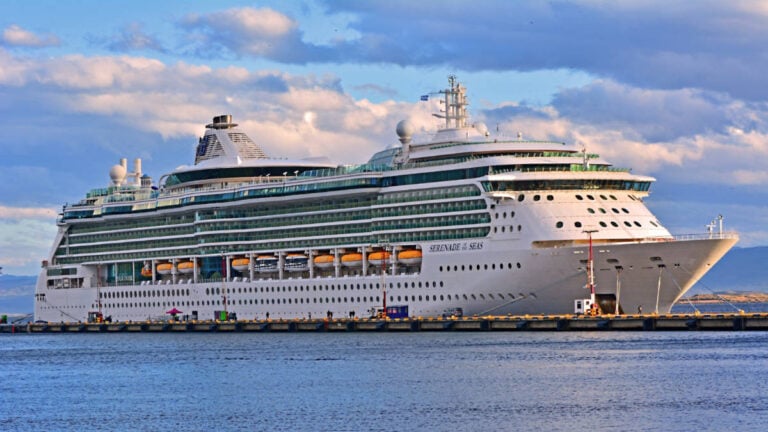
Royal Caribbean made waves when the cruise line announced its 9-Month Ultimate World Cruise near the end of 2021. The 274-night cruise, which set sail on board Serenade of the Seas on December 10, 2023, will visit all seven continents and call at 150 destinations across 65 countries when all is said and done.
As this is the longest cruise ever offered by Royal Caribbean, it’s no surprise that the sailing is drawing a lot of attention online.
It’s also the first time that a world cruise of this caliber has been offered by a family cruise line. Usually, these types of extended voyages are reserved for more luxurious brands like Cunard Line and Viking Cruises.
But while some attention on Royal Caribbean’s world cruise was expected, no one could have predicted the extent to which it would take over social media. It only took about two weeks from embarkation day for content from the sailing to go viral on TikTok.
At the time of this writing, the hashtag #ultimateworldcruise has earned over 150 million views on TikTok, with several passengers propelled to online stardom from posting about their time onboard the 2,490-passenger Radiance-class ship.
Photo Credit: StudioPortoSabbia / Shutterstock
Viewers at home are eager to catch up on the drama unfolding at sea, as well as to follow along on the voyage, living vicariously through influencers.
Joe and Audrey Martucci, who are currently onboard Serenade of the Seas, saw their TikTok skyrocket to over 89,000 followers after they started posting content about the cruise. The couple has been dubbed the unofficial cruise mom and dad by their followers.
When asked why the cruise content is so interesting, Audrey Martucci told Good Morning America: “They’re enjoying coming along for the trip through our eyes and getting to see places that they wouldn’t normally see.”
Others are eager for drama to unfold, seeing it as inevitable with the mix of alcohol and passengers living in close quarters for an extended period of time.
“There’s going to be mutiny. There’s going to be blood. Someone is going overboard. I want to watch. Bravo, where are you?”, says Sebastian in his video, which has been viewed 1.3 million times.
Sebastian joined the cruise for 18 nights during the South American and Antarctic segment, during which time he posted several videos detailing “the good, the bad, and the ugly” of his cruise experience, and went so far as to call it “an eternal hell.”
Jessica Maddox, an assistant professor of digital media at the University of Alabama, also likened the cruise TikToks to reality TV, noting that many of the storytime posts and sagas are posted episodically.
However, the professor also urges consumers to remember that wishing drama on people is a “morally gray” area and that there are real people impacted by the posts, even though consuming content as if it was reality television can make it feel less real.
Open Deck on Serenade of the Seas (Photo Credit: Jeff Whyte)
“For the world cruise TikTok, I think it’s OK to think of the content we consume on TikTok as reality television,” Maddox told NBC. “But I think it’s important to remember these are real people, and that even reality television is scripted and coerced and is forced drama.”
Another TikToker named Christine Kesteloo (@dutchworld_americangirl), lives on a cruise ship and has nearly 883,000 followers.She responded directly to Sebastian’s videos, insinuating that influencers like Sebastian are creating drama where there is none for views.
“This person has been put on the Royal Caribbean cruise for 18 days looking for the drama – ‘the tea’ – of living on a ship. I’ve been doing it for the last 12 years of my life. There’s no drama or tea on a ship but he’s been put there to get drama or tea,” says Kesteloo.
But whether the drama is exaggerated or not, the clicks and likes just keep on coming with no signs of the social media buzz calming down anytime soon.
The Biggest World Cruise Headlines Making Waves On TikTok So Far
In reality, most people on the World Cruise are enjoying themselves. But it’s what goes wrong that is driving views on social media – and plenty has already gone wrong.
Only three weeks into the Ultimate World Cruise, bad weather led to massive amounts of flooding on deck 12 onboard Serenade of the Seas.
Royal Caribbean World Cruise Flood (Credit: @aditaml2759)
There’s also been videos both ranting and raving about the quality of the food onboard, as well as theories about what will happen to passengers after nine months of only eating cruise food.
One of the most controversial rumors to have gone viral is that a caste system was forming on the cruise, where Royal Caribbean’s elite pinnacle members received preferential treatment over passengers in lower tiers of the cruise line’s royalty program.
There were also videos alleging that passengers only joining the cruise for a segment, instead of remaining onboard for all 274 nights, were being excluded by passengers completing the whole voyage.
Similarly, another TikToker named ND Cohen, who has dubbed herself the “Sea Tea Director,” posted that a British passenger onboard Serenade of the Seas named Emily Blinkhorn told her the American and non-American guests were being treated differently onboard.
Replying to @kay kay Royal Caribbean’s Ultimate World Cruise: Visas & More👀🍵 Yall please be sure to show these ladies some love! Thank you @Lindsay and @emily | travel ✈️🌍🚢🌴 for both sharing your processes on obtaining a visa for this trip! & Thank you to @Nadine Bower for your input and connecting me with Lindsay!🫶🏾 Everyone’s experience is going to be different. I appreciate the transparency💕 #ultimateworldcruise#visas#royalcaribbean#fyp#seatea#cruisetok#foryou
According to the influencer, who currently has over 190,000 followers, Blinkhorn alleges that American passengers were given a lot of advice and help abroad the cruise, particularly in regards to Visa requirements, while non-Americans were left to figure things out on their own.
Most recently, passengers have taken to TikTok to address rumors that the World Cruise, which is currently scheduled to end on September 10, 2024, may be cut short due to unrest in the Red Sea region.
One TikTok user named Adita (@aditaml2759), who has 57,000 followers, posted a video saying that the cruise might end early and asked for clarity from other passengers or Royal Caribbean.
“I don’t like putting rumors out there, but I think we also, the passengers that invested so much money and so much time to see the world, we deserve to know what is going on, what the plans are, what Plan B is,” Adita says in her video.
Royal Caribbean International later responded that there are currently no plans to change the Ultimate World Cruise itinerary – but not before the video received over 5,000 views and hundreds of comments.
Taking your children on their first cruise can be an incredible opportunity to share a memorable adventure together. While planning a cruise trip with the entire family is exciting, traveling with children always adds an extra layer of consideration when preparing for your trip, especially regarding travel documentation like passports.
Whether you are traveling with your own children or embarking on a cruise with nieces, nephews, grandchildren, or other young travelers, understanding passport requirements for yourself and these minors will help you enjoy a smooth and stress-free cruise experience.
We want to help you have the best cruise experience possible, so we have created this simple guide. We will explore the specifics of passport requirements for taking kids on cruises and dive into more complex scenarios involving guardianship and traveling with children with surnames different from your own.
Just as they are for adults, passport requirements for children on cruises will depend mainly upon the type of cruise you have booked and your citizenship. To make things simple, here are the main types of cruises, as well as the passport requirements for each:
Domestic Cruises and Closed-Loop Cruises
As the name suggests, a domestic cruise leaves from and returns to a domestic port. The domestic ports do not have to be the same, but they both have to be in the same country. Closed-loop cruises are similar but must depart from and return to the same port.
For American travelers who have booked a domestic cruise, this will likely mean the cruise ship will depart from and return to a U.S. port. This also means you and any children you travel with would not need to present a passport to board the ship.
Instead of requiring a passport, you must show valid government-issued photo identification for yourself. This allows the staff to match you to the name on the ticket. For children under the age of 16, it is a good idea to ensure that you carry a birth certificate or a certified copy of it. If your child has a passport and you want to play it safe, you can use this as a form of identification.
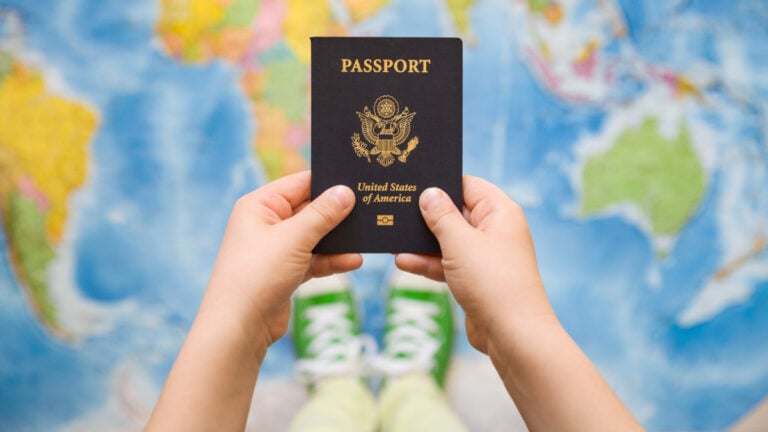
US Kids Passport (Photo Credit: BiLal45378)
Another consideration when booking a domestic cruise is whether or not the itinerary involves making stops in one or more foreign ports of call. In these situations, passport requirements can be a little bit more complex. Typically, it is advised that you bring a passport for yourself and any children traveling with you.
The U.S. Customs and Border Protection Agency offers a helpful guide to passport requirements for domestic and international cruises for American citizens. It also provides information regarding identification options for American citizens under 16 who are traveling on a domestic cruise. This is also helpful for children not born in the United States, so they cannot present a U.S. birth certificate as ID.
International Cruises
Any cruise with an international itinerary generally requires the presentation of a passport for all passengers, including children. Some countries will require passports for all cruise passengers to enter, so many cruise lines will check passports before you board the ship for the first time to ensure that they adhere to all international entry requirements.
While it may seem a little bit strange needing to present passports when you are departing from a country where you hold citizenship, remember that cruises often involve visiting other nations and destinations as part of their itineraries. Think of it as showing your passport as you progress through security on your way to boarding an international flight.
In short, you should bring a valid passport for each child you travel with on an international cruise, regardless of age.
What About Cruises with Children Not Under Your Legal Guardianship?
Things can get a bit more complicated if you travel with children who are not under your legal care. This tends to happen with nieces, nephews, grandchildren, or even family friends, but there are other scenarios where you might need to make sure you have the proper identification for the children you are traveling with.
Kids Going Cruising (Photo Credit: Karl Allen Lugmayer)
Regardless of legal guardianship status, you will still need a passport for each child if you have booked an international cruise. A valid passport for each child will make everything smoother, as it is the most universally accepted form of identification for any type of travel.
In most cases, you must also obtain permission letters from the legal guardians of each child under 17. Getting the letter notarized is a good idea, as this will help you avoid complications. Most cruise lines also provide letters of permission, which you can download, print, and fill out ahead of time. For example, here’s a sample of Royal Caribbean Group’s consent form for children under 18 to travel without their legal guardian.
What About Children Under Your Care Who Have Different Last Names to Your Own?
While the need for a passport will remain the same if you and the children under your care if you have booked an international cruise, you will also need to bring supporting documentation that clarifies why they have different last names.
Kids on a Cruise Ship (Photo Credit: Tomsickova Tatyana)
Supporting documents could include state or county-issued marriage licenses, divorce decrees, a government-issued name change document, or an official child adoption paper. These documents can be originals, or a notarized copy will also work.
Adoption and step-parent relationships are common reasons for confusion regarding last name differences, so it can feel a little bit frustrating having to prove that you are the legal guardian of the child in your care, but it is worth remembering that cruise lines and border security personnel do this to protect children. For international cruises, ensure your child has their passport, and you have the proper documents you can present if required.
Frequently Asked Questions (FAQs)
What if your child has lost their passport on the cruise ship?
In case of a lost or stolen passport, you should immediately report the incident to the cruise ship’s guest services. They will inform you of the next steps you should take.
While these incidents can be incredibly stressful, you can help avoid them by always holding passports and important documents for your children. Once you are sure the passport cannot be located, it should be reported as lost or stolen to protect your child from identity theft.
You can also help prepare for the worst by having photocopies of all important documents, like birth certificates, to help ensure the replacement process goes smoothly when you are back in your home country.
How old must an American child be before you can get them their own passport?
You can apply for a passport on behalf of your child as soon as they are born. Passports are available to citizens regardless of age, meaning even babies can hold valid passports. If you plan on taking an international cruise with your child when they are very young, you should apply for their passport as soon as possible.
Can you still travel if your child’s passport is expired?
No, expired passports are not considered valid forms of identification for international travel. In fact, most cruises will reject passports that expire within six months of your return date. This is why it is so important to renew the passports for you and your children well ahead of your cruise date if they are anywhere near their expiration date.
Final Words
While it can seem slightly confusing at times, it is worth ensuring that you have met all of the passport and identification requirements for children you are traveling with before you arrive for your cruise. If you have questions, you can always contact the specific cruise line you are traveling with, as they will be happy to assist you. After all, it is in their best interest that everything goes smoothly during the boarding process.
We also advise taking proactive measures to ensure that you have all of the accompanying documents with you if you are traveling with children with different last names to your own. As you should with your travel documents, you should also ensure that passports belonging to children in your care are always kept safe.
Children can be forgetful, so hold onto a child’s passport for them after you have presented it to the relevant crew and border agencies. If you are worried about traveling with a passport book for each child, you can also look into getting each one a passport card, which provides a more convenient alternative for certain forms of cruise travel.
Royal Caribbean continues to grow with even larger cruise ships, and now that Icon of the Seas is part of the fleet, many will wonder how the giant vessel compares with the second largest in the fleet. That’s why we’re taking you on a wow factor with Icon of the Seas vs Wonder of the Seas!
Wonder of the Seas made headlines when it debuted just a few years ago as the largest cruise ship in the world. However, as Royal Caribbean frequently does, the cruise line has something even bigger and better to follow Wonder of the Seas, in 2024.
Icon of the Seas sets sail for the first time this year and it’s been long-awaited as not only the next, biggest cruise ship in Royal Caribbean International’s fleet, but in the world. It’s also one of the line’s (and world’s) most extravagant and impressive cruise ships to date. Seemingly endless entertainment and dining options await cruisers who snag a spot on this ship in the coming months.
However, while both Wonder of the Seas and Icon of the Seas are impressive, new and overall mammoth, there are differences between the two ships — differences that may sway you to book a cruise on one over the other.
Wonder of the Seas is, of course, an Oasis-class ship, while Icon of the Seas introduces a new class of ships for Royal Caribbean, the Icon class, and that’s just where the differences start.
So, what can you expect and which should you book? Here’s everything to know about Icon of the Seas vs Wonder of the Seas.
Is Icon of the Seas Larger Than Wonder of the Seas?
As mentioned, while Wonder of the Seas is big in every sense, Icon of the Seas surpasses it, as the latest and greatest biggest cruise ship in the world at two decks higher, 10 feet longer, and 69 more staterooms. Here’s how the two measure up.
Stats
Icon of the Seas
Wonder of the Seas
Gross Tonnage
250,800
235,600
Length
1,198
1,188
Passenger Decks
18
16
Maximum Passenger Capacity
7,600
7,084
Passenger Capacity at Double Occupancy
5,610
5,734
Cabins
2,805
2,874
Crew Capacity
2,350
2,300
You might notice something a little weird, though. While Icon of the Seas is, yes, technically larger than Wonder of the Seas by gross tons, with more passenger decks, it doesn’t have a higher passenger capacity at double occupancy.
Instead, the passenger capacity at double occupancy is decreased by about 100 people. However, the passenger capacity at maximum occupancy is larger on Icon of the Seas, by about 600 people.
What does this mean? Well, it means Royal Caribbean is likely expecting more suite stays on Icon of the Seas, with more than two passengers staying in a single accommodation option.
Overall, it seems like Royal Caribbean really focused on providing more fun, more options and more luxury to love in Icon of the Seas, versus simply just making a bigger ship to hold more people.
Icon of the Seas vs Wonder of the Seas: Construction Cost
Icon of the Seas was built at Meyer Turku in Turku, Finland and was one of the most expensive ships to build, ever, at a whopping $2 billion. She is also powered by Liquefied Natural Gas (LNG).
Wonder of the Seas, in comparison, cost $1.35 billion to build, substantially less, yet still impressive. Wonder of the Seas was built at Chantiers de L’Atlantique in St. Nazaire, France.
Wonder of the Seas Construction
As the fifth Oasis-class ship, Wonder of the Seas was ordered nearly a decade ago, before construction began in 2019. The Covid-19 pandemic did impact the ship’s construction, delaying the delivery date, originally slated for early 2021. The ship was, instead, delivered in early 2022, when it began sailing out of Florida.
Icon of the Seas was similarly ordered in 2016, as the very first in a new class of ships for Royal Caribbean. Construction for Icon of the Seas began in 2021, wrapping up in late 2023. A January 2024 christening and debut in Miami kicks off the ship’s upcoming year spent sailing the Caribbean.
Icon of the Seas vs Wonder of the Seas: Neighborhoods
Royal Caribbean’s ships are split into neighborhoods — areas of the ship designed around a certain theme, and often dedicated to a certain type of activity. Icon of the Seas features eight neighborhoods, including:
AquaDome
Central Park
Chill Island
Royal Promenade
Surfside
Suite Neighborhood
Thrill Island
The Hideaway
Wonder of the Seas actually features eight neighborhoods as well, but the neighborhoods aren’t the exact same as those you’ll find on Icon of the Seas. Icon of the Seas features a few new neighborhoods, while also improving upon a few of the shared neighborhoods. Wonder of the Seas’ eight neighborhoods include:
Central Park
Royal Promenade
Suite Neighborhood
Boardwalk
Pool and Sports Zone
Entertainment Place
Youth Zone
Vitality Spa and Fitness
So what can you expect in each of these options? Well, among the ship’s shared neighborhoods, Central Park offers an indoor green space. Lush and airy, it’s a central hub in which you can find entertainment and dining venues.
Similarly, each ship’s Royal Promenade is likewise a hub of activity, where you can go to people-watch or find your way to the various venues along the promenade, including restaurants and retail. However, Icon of the Seas does feature that Iconic Pearl feature.
Royal Caribbean’s Wonder of the Seas
Both ships’ suite neighborhoods are exactly what they sound like: a neighborhood specifically designated for suite guests. Here, the ship’s VIP cruisers enjoy a bit of privacy from the rest of the cruising masses, with their own private pools and restaurants.
This is where the ships’ shared neighborhoods end. On Wonder of the Seas, you also have the boardwalk neighborhood, with its true boardwalk feel, with games, bright lights and plenty of activity.
The pool and sports zone is what you’d expect, with the ship’s pools and sports courts. Entertainment Place is likewise self-explanatory, housing the theater and casino, among other entertainment venues. The Youth Zone houses the ship’s children’s programming, including the Adventure Ocean kids club, arcade, and teen club. Lastly, the ship’s spa and fitness center get their own neighborhood.
On Icon of the Seas, the AquaDome is a new neighborhood that encompasses the AquaTheater, which you may have seen on past Royal Caribbean ships. It also, though, offers a bit of a nightlife location, with bars and restaurants.
Royal Caribbean’s Icon of the Seas
Chill Island is the new name for the ship’s pool area. There are four pools here (though you’ll find three elsewhere on the ship). There are also several bars in the pool area.
Thrill Island offers more water-themed fun, with six new water slides. When the ship debuts, it will boast the tallest drop slide on a cruise ship to date, as well as a few “first” water slides for a cruise ship, such as a mat-racing duo slide and an open free-fall slide.
Surfside is all about families. This is where you’ll find the kiddy pools, but also the sports courts and children’s programming. The Hideaway is just that — a tranquil spot where those looking for something quieter can escape. There’s an infinity pool here, plus a bar.
Staterooms
As already mentioned, while Icon of the Seas is definitely larger than Wonder of the Seas, Iconof the Seas can hold fewer passengers at double occupancy, but more passengers at overall occupancy — which basically translates to a focus on suites and other accommodation options where there will be more than two cruisers staying in a single stateroom or suite.
Panoramic Ocean View Cabin on Icon of the Seas
Regardless, what kind of staterooms can you expect on both ships? Icon of the Seas introduces a few new stateroom categories to Royal Caribbean cruisers. New staterooms aboard Icon of the Seas include:
Inside Plus staterooms
Panoramic Ocean View staterooms
Family Infinity Balcony staterooms
Surfside Family View interior cabins
Infinite Ocean View balcony cabins
Infinite Central Park View balcony cabins
An Inside Plus stateroom is an interior stateroom, upgraded. It offers a more luxurious experience with more privacy. Panoramic Ocean View staterooms are exclusively situated in the AquaDome neighborhood.
The Infinite Ocean View balcony cabins provide something that you may have seen on other cruise ships (in some version or another), but is a first for Royal Caribbean. The infinite balcony is separated from the rest of the cabin with a glass wall, and that glass wall can be lowered and raised to create an indoor-outdoor space that feels larger, airier and more ocean-view-perfect than ever before.
Icon of the Seas Ocean View Balcony
Family Infinity Balcony staterooms feature the ships’ infinity balconies, which allow you to enjoy a mix of indoor-outdoor space thanks to that wall that’s partially removable; the family versions can fit more cruisers. In the new Surfside neighborhood, Family View interior cabins replace the boardwalk cabins from prior ships.
Other staterooms on Icon of the Seas include:
Standard interior cabins
Spacious interior cabins
Central Park View interior cabins
Ocean view cabins
Ocean view balcony cabins
Ocean view large balcony cabins
Central Park balcony cabins
Staterooms on Wonder of the Seas include:
Studio single cabins
Virtual balcony interior cabins
Spacious interior family cabins
Promenade view interior cabins
Boardwalk and Central Park interior cabins
Boardwalk and Central Park balcony cabins
Ocean view cabins
Family ocean view cabins
Spacious balcony cabins
Ultra-spacious family balcony cabins
Most of these staterooms are pretty self-explanatory. Promenade, Boardwalk and Central Park cabins are obviously located in those neighborhoods within the ship, and their balconies overlook that space rather than the ocean. Virtual balcony cabins feature virtual balconies that display views from the exterior of the ship in real time.
Wonder of the Seas Balcony Stateroom
The ultra-spacious family balcony cabins can fit a max of six passengers, with 270 square feet inside and 80 square feet outside (the spacious interior family cabins are very similar, just minus the balcony). The spacious balcony cabins can fit four passengers, with 180 square feet inside and 55 square feet outside.
The family ocean view cabins are even more impressive and should really be considered more of a suite, since there are two bedrooms, with one tucked away behind a divider. Studio single cabins are designed for single cruisers in mind, and are a budget-friendly steal.
Suites
On new ships like these, you can expect some truly stellar suite options. Suite options aboard Wonder of the Seas include:
The Ultimate Family Suite
Junior suites
Grand suites
AquaTheater suites (with either one or two bedrooms)
Owners suites
Crown Loft suites
The Royal Loft
The Ultimate Family Suite made its debut on Wonder of the Seas and was an instant hit. However, it gets an upgrade on Icon of the Seas, as you’ll see below. Suite options aboard Icon of the Seas include:
The Ultimate Family Townhouse
Surfside Family suites
Junior suites
Sunset Junior suites
Sky Junior suites
Sunset suites
Panoramic suites
Infinite Grand suites
Owner’s suites
Grand suites
The Royal Loft
Icon Loft Suites
Some of these suites may be familiar to you, from past Royal Caribbean ships, but others might not be. For example, the Surfside Family suites are new for Royal Caribbean, and place families right in the heart of that family-friendly Surfside neighborhood.
The Ultimate Family Townhouse
The Ultimate Family Townhouse is an upgrade of the Ultimate Family suite introduced on Royal Caribbean several years ago, with plenty of over-the-top amenities for families, such as a theater, in-suite slide and more.
Icon Loft suites offer two floors and lots of privacy for up to four cruisers. Infinite Grand suites feature that new infinite balcony, and Panoramic suites are in the new AquaDome neighborhood.
Dining Venues
Do you have a favorite Royal Caribbean restaurant that you make a point of dining at every single time you’re on a cruise? If so, you’ll be glad to know that when it comes to Icon of the Seas vs Wonder of the Seas, both of these ships feature staple Royal Caribbean favorites, alongside lots of new, fun options. However, the dining options aren’t identical. Here’s what to expect:
Restaurant/Dining Option
Featured on Icon of the Seas?
Featured on Wonder of the Seas?
150 Central Park
No
Yes
AquaDome Market
Yes
No
Basecamp
Yes
No
Café Promenade
No
Yes
Celebration Table
Yes
No
Chops Grille
Yes
Yes
Coastal Kitchen
Yes
Yes
Dog House
No
Yes
El Loco Fresh
Yes
Yes
Empire Supper Club
Yes
No
Giovanni’s Italian Kitchen and Wine Bar
Yes
Yes
Hooked Seafood
Yes
Yes
Izumi Hibachi & Sushi
Yes
Yes
Izumi in the Park
Yes
No
Johnny Rockets
No
Yes
Main Dining Rooms
Yes
Yes
Park Café
Yes
Yes
Pearl Café
Yes
No
Pier 7
Yes
No
Solarium Bistro
No
Yes
Sorrento’s Pizza
Yes
Yes
Starbucks
Yes
Yes
Sugar Beach
Yes
Yes
Surfside Bites
Yes
No
Surfside Eatery
Yes
No
The Grove
Yes
No
The Mason Jar
No
Yes
Vitality Café
No
Yes
Windjammer Café
Yes
Yes
Wonderland
No
Yes
These ships both contain restaurants that Royal Caribbean has long featured on its ships, when it comes to Icon of the Seas vs Wonder of the Seas. Beyond the main dining room and classic cruise ship buffet (Windjammer Café), there’s also Sorrento’s Pizza, a Starbucks outpost, the tech-heavy restaurant Wonderland, Giovanni’s for Italian, Chops for steak and Izumi for Japanese.
The Mason Jar on Wonder of the Seas
However, each ship also offers a few favorites that the other does not. For example, Wonder of the Seas has Johnny Rockets, the boardwalk classic; Vitality Café, for healthful eats near the spa; The Mason Jar, which was Royal Caribbean’s take on a southern-style restaurant; and the Dog House, for quick hot dogs and similar bites near the pool.
Icon of the Seas brings new offerings such as the AquaDome Market, a food hall concept; Empire Supper Club, a fine-dining option with 1920s flair; and Izumi in the Park, for window ordering sushi.
Icon of the Seas Dining, Empire Supper Club
Other new options include Celebration Table for special events; Pearl Café for casual bites; Basecamp for fun, theme park-esque options; The Grove, for Mediterranean; and Pier 7, for all-day brunch. With Icon of the Seas, Royal Caribbean truly brings the culinary magic.
Bars and Lounges
There’s also a wealth of watering holes to be found on both Icon of the Seas and Wonder of the Seas. Some of these bars and lounges are new, while others are tucked away inside of restaurants, while still others are staples on Royal Caribbean ships (like the English pubs and Playmakers sports bar).
Bar/Lounge Option
Featured on Icon of the Seas?
Featured on Wonder of the Seas?
Bionic Bar
No
Yes
Boleros
Yes
Yes
Cantina Fresca
Yes
Yes
Diamond Club
Yes
Yes
English Pub
Yes
Yes
Playmakers Bar & Arcade
Yes
Yes
Pool Bar
Yes
No
Rising Tide Bar
No
Yes
Schooner Bar
Yes
Yes
Solarium Bar
No
Yes
Suite Lounge
No
Yes
Swim & Tonic Pool Bar
Yes
No
The Attic
Yes
Yes
The Hideaway Bar
Yes
No
The Lime & Coconut
Yes
Yes
Trellis Bar
Yes
Yes
Wipeout Bar
No
Yes
Vue Bar
No
Yes
1400 Lobby Bar
Yes
No
Basecamp Bar
Yes
No
Bubbles
Yes
No
Casino Bar
Yes
Yes
Dueling Pianos
Yes
No
Giovanni’s Wine Bar
Yes
Yes
Lou’s Jazz n’ Blues
Yes
No
Rye & Bean
Yes
No
The Grove Bar
Yes
No
The Lemon Post
Yes
No
The Overlook
Yes
No
Music Hall
Yes
No
Just as Icon of the Seas brings the culinary magic, it also brings all the libations one could need. You’ll find the line’s first swim-up bar (in addition to all the other pool bars), bars at many of the brand-new restaurants on the ship, and cool new lounges where you can catch unique drinks and live music, such as Lou’s Jazz n’ Blues.
Swim & Tonic Pool Bar on Icon of the Seas
Wonder of the Seas features many of the classic bars and lounges you likely know to expect on a newer Royal Caribbean ship, but has a few that Icon of the Seas does not, such as the Solarium bar (Icon of the Seas ditched the entire Solarium as a whole), and the Bionic Bar, with its robotic twist.
Activities and Entertainment
Both of these ships feature plenty of fun things to do. Beyond the pools, waterslides, and shows further detailed below, both ships also offer lots of extra fun spaces and activities, such as:
Arcade
Casino
Carousel
Mini-golf course
Sports court
Rock-climbing wall
Comedy Club
Escape Room
Ice skating
Laser tag
Karaoke
Entertainment that you’ll find on Icon of the Seas, but not Wonder of the Seas, includes a ropes course named Crown’s Edge. This feature is part skywalk and part ropes course that even takes guests extended out over the ocean! Wonder of the Seas offers a zip line instead. However, otherwise, the ships offer mostly the same entertainment options.
Pools and Waterslides
Both ships are packed with fun ways to soak up the sun and splash in the (manmade) waves. They both ships feature Royal Caribbean’s requisite FlowRider surf simulator. Both feature waterslides and hot tubs. However, there are differences.
Pools and Slides on Wonder of the Seas
Wonder of the Seas, for example, features The Perfect Storm trio of waterslides, which has appeared on a range of Royal Caribbean ships over the years. It also features the Ultimate Abyss, which is a dry slide. In total, Wonder of the Seas features five pools and four hot tubs.
Pools and Slides on Icon of the Seas
Icon of the Seas, however, features a whopping six waterslides, including record-breaking slides such as Pressure Drop, the first open free-fall slide to appear on a cruise ship; Frightening Bolt, the current tallest drop waterslide on a cruise ship; Storm Chasers, the first mat-racing slide on a cruise ship; and Storm Surge & Hurricane Hunter, the first family-friendly raft ride on a cruise ship.
Icon of the Seas features seven pools and nine hot tubs, including the Royal Bay Pool, the largest pool in the Royal Caribbean fleet. Another first is the first suspended infinity pool at sea, located in The Hideaway neighborhood. Located aft of the ship in the Surfside neighborhood, the younger guests can also enjoy the Splashaway Bay aquapark.
AquaTheater and AquaDome
Both of these ships feature the AquaTheater, but only one features the AquaDome: Icon of the Seas. Additionally, Icon of the Sea’s AquaTheater has received some upgrades.
Photo: Royal Caribbean
On Icon of the Seas, the AquaDome is situated in the ship’s new AquaDome neighborhood. The theater’s tech upgrades make each show even more immersive and impressive.
Shows
If you never take a cruise without checking out what’s playing in the onboard theater, then you’ll definitely want to be sure to make time in your busy vacay itinerary to catch one of the shows playing on either Icon of the Seas or Wonder of the Seas, whichever you choose.
Wonder of the Seas offers shows at the AquaTheater, as well as ice-skating shows at its ice rink. Theatrical shows include musical reviews, and you can find smaller, music-focused shows in more intimate settings throughout the ship (such as in the lounges) regularly.
Icon of the Seas AquaDome (Image Courtesy: Royal Caribbean)
Icon of the Seas’ shows include two AquaDome shows that take advantage of the AquaTheater’s unique space; live music performances; an ice-skating performance; and theatrical performances, including a family fairytale-type show entitled “Once Upon a Time: The King’s Royal Ball” and “The Wizard of Oz,” a classic.
Which Ship is Better?
So, which one is better, Icon of the Seas vs Wonder of the Seas? Whether you book your reservations for an upcoming cruise on Wonder of the Seas or Icon of the Seas is really going to be a personal decision that you’ll base on your own preferences; however, there are some elements that may sway you.
Royal Caribbean’s Icon of the Seas
If you’re a cruising fanatic and you love cruising on the biggest, best cruise ships, and being the first of your traveling friends to do so, you’ll want to, obviously, get on Icon of the Seas as soon as humanly possible. This ship has been making headlines for a reason. Avid travelers, and particularly cruisers, can’t wait to see what the latest and greatest from Royal Caribbean has in store, first-hand.
Likewise, if you’ve traveled on Wonder of the Seas before, or just traveled with Royal Caribbean on the line’s newer ships frequently, you may be craving something brand new, and, if so, Icon of the Seas fits the bill.
Royal Caribbean’s Wonder of the Seas
However, if you would like to avoid those huge crowds of eager travelers flocking to Icon of the Seas, you may prefer Wonder of the Seas. This ship is still relatively new and offers lots and lots of fun to love, so you won’t be missing out on all that much. You will, though, be missing out on all those crowds, which is a plus.
Lastly, on Icon of the Seas vs Wonder of the Seas, think about destinations. While you might be more interested in the ship than where it’s going, destination still matters. Getting to the departure port will be an added cost to consider, and you’ll likely want to disembark at least for some of the days in port. Would you rather disembark in the Mediterranean or the Western Caribbean, or the Bahamas? Do you want to have a Perfect Day at CocoCay?
Regardless, though, both ships are excellent options for a range of cruisers, whether you’re a single traveler or couple looking for luxury and lots to do, with plenty of entertainment, dining and drinking options, or you’re a family who wants to take the kids on an unforgettable trip.
Carnival Jubilee is just completing her fourth cruise and will be delayed returning to Galveston on Saturday, January 20, 2024 due to a medical emergency.
Consequently, this will delay the embarkation for the next cruise. Guests have been contacted and asked to adjust their arrival appointments, while guests already on board have been given a timeline for what to expect on debarkation morning.
Carnival Jubilee Delayed
A “medical deviation” has delayed Carnival Jubilee on her return to Galveston, Texas. The incident happened while the ship was north of the Yucatan Peninsula, at sea making her way back to Galveston at the and of a 7-night Western Caribbean cruise to Cozumel, Costa Maya, and Roatan.
While details of the medical emergency have not been released in order to protect the privacy of the individuals involved, it did require the ship to reverse course significantly.
Because of this deviation, Carnival Jubilee will not be in Galveston as early in the morning as planned. Guests booked on the next sailing are being asked to adjust their arrival to the cruise terminal.
“Due to a medical deviation on the return to Galveston, the ship will be arriving later than scheduled,”the email notification explained.“As a result, embarkation for your cruise has been revised. We must allow debarking guests to leave the terminal before we can accommodate your arrival.”
The embarkation delay is expected to be just one hour. If guests had selected an 11-11:30 a.m. arrival appointment, for example, their new arrival time would be 12-12:30 p.m. instead.
“Guests who arrive earlier will be asked to return at their newly assigned time,”the email warns.
All passengers must be onboard Carnival Jubilee no later than 3:40 p.m. for the ship’s departure, so it is critical that no one be late even with the day’s brief delay. The scheduled departure time from Port of Galveston is 4 p.m.
If guests have purchased transfer services through Carnival Cruise Line, their transfer times will be automatically adjusted based on the revised embarkation windows. Guests who will be driving to the port or who have made independent arrangements with shuttle services, ride shares, or other transportation will need to adjust their plans accordingly.
How This Affects Guests Onboard
Meanwhile, guests already onboard Carnival Jubilee have been alerted to the delay as well, and provided a timeline for how their slightly delayed debarkation will work on Saturday morning.
The estimated time for the ship to arrive to the Port of Galveston is 9 a.m., with actual debarkation expected to begin by 9:30 a.m. after the ship has been cleared by local customs and immigration officials.
Guests are asked to vacate their staterooms no later than 10 a.m. This will permit the cabin attendants to begin cleaning, changing bedding, exchanging towels, and doing other turnover work to prepare the staterooms for embarking guests. Public areas will be available for guests to wait until it is their time to debark.
Carnival Jubilee Arrives in Galveston (Photo Credit: Carnival Cruise Line)
Guests using self-assist debarkation – carrying all their own luggage off the ship – will debark first, followed by guests with priority debarkation privileges.
All guests must have left Carnival Jubilee no later than 12:30 p.m.
It should be noted that the earliest terminal arrival appointment on the revised schedule is 11:00-11:30 a.m. This does not indicate an actual embarkation time, however, but only when incoming guests will be able to complete their cruise terminal check-in and paperwork. As soon as all guests have left the ship, embarkation for the next cruise will be able to begin.
As the 183,521-gross-ton Carnival Jubilee can welcome 5,347 passengers at double occupancy or up to 6,631 guests when fully booked with all berths filled, it can take some time to process all travelers from one cruise to the next.
At this time, there is not expected to be any further impact on the ship’s next sailing, an identical 7-night Western Caribbean sailing. All ports of call remain as scheduled on the original itinerary.
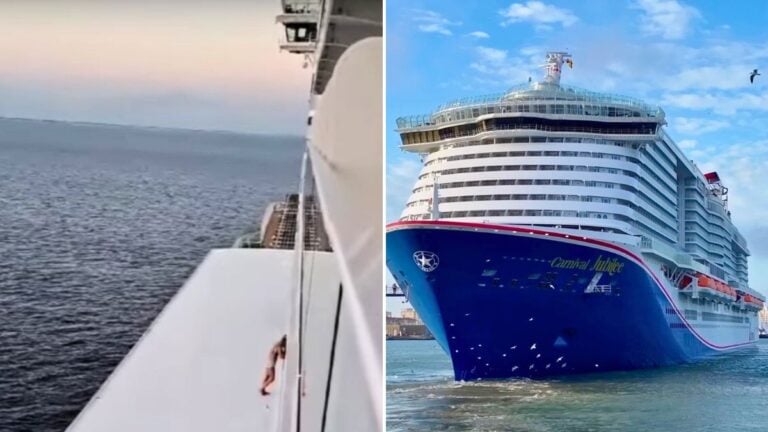
A Carnival Cruise Line guest could soon face severe consequences after video has surfaced of them climbing over the balcony of their stateroom and standing on an adjacent roof area.
The incident happened on the December 30, 2023 sailing of the brand new Carnival Jubilee, which was just the ship’s second ever voyage welcoming guests.
Carnival Guest Goes Over Balcony Railing
Video posted to social media shows disturbing behavior from a Carnival Cruise Line guest, as a woman is seen standing outside her balcony stateroom on an adjacent section of roof covering the public area of the deck below.
The short 18-second clip clearly shows the woman completely over her balcony railing, leaning back over and appearing to speak with someone before she hops back up to sit on the railing before swinging her legs over and disappearing from view. Another passenger is seen two decks higher, peeking over another balcony to watch the antics.
“Our security team on Carnival Jubilee identified the guests involved in this matter, and those guests will no longer be sailing on Carnival ships. The safety of everyone on board is our priority and we do not tolerate this behavior,” Carnival Cruise Line stated to Cruise Hive.
The ship’s bridge is clearly seen in the background, including ship officers moving about, but it is unclear whether or not they see the woman’s actions.
Carnival Jubilee Passenger
The video was taking on the December 30 sailing of Carnival Jubilee, the ship’s second ever cruise with guests. The ship’s maiden voyage was from December 23-30, while the second cruise departed Galveston on Saturday, December 30 and continued through January 6. There is no date listed with the video, which could have been taken at any time during the cruise.
What We Know
While the video is short and details are few, there is some information the clip provides. For example, the ship’s motion is clearly seen in the water, which indicates the incident did not happen while the ship was docked, but instead while it was at sea. This could have been during a day at sea or else shortly before or after Carnival Jubilee was in port.
The December 30 sailing was a 7-night Western Caribbean itinerary that visited Cozumel, Costa Maya, and Roatan – the same as all week-long cruises the ship is offering.
The stateroom the woman exited and then reentered was on Deck 9, which features a variety of balcony cabins. The deck below – Deck 8 – has a public promenade and lanai space around the ship’s edge, including outdoor eating space for Rudi’s Seagrill, a specialty restaurant only on the cruise line’s Excel-class ships. Much of this outdoor space is covered, which is the roof the woman was standing on.
The balcony stateroom in question is on the ship’s port (left) side, which is clear because of the orientation of the bridge.
Consequences of This Behavior
This type of reckless behavior is a clear violation of Carnival Cruise Line’s guest code of conduct policy, which prohibits unsafe behavior.
Section 9(j) of the Cruise Ticket Contract states: “Any Guest whose conduct affects the comfort, enjoyment, safety, or well-being of other guests or crew will be detained onboard and/or disembarked at their own expense and will be prohibited from sailing with Carnival in the future.”
Carnival Jubilee Cruise Ship
This situation could have had a much more tragic outcome than a brief video clip if she had slipped, fallen, or been affected by strong winds during her time over the balcony.
Unfortunately, such incidents are occurring more and more frequently as some travelers seek a brief moment of internet fame via social media sites by engaging in outrageous acts such as fishing off a cruise ship balcony, throwing items off a ship, or even climbing between balconies.
These poor behaviors are not confined to Carnival Cruise Line, as guests have been noted acting irresponsibly on various cruise lines. Such actions are not tolerated by the cruise lines, and often result in lifetime bans, extensive fines, being disembarked from the vessel at the next port at the guest’s expense – or all three. Is that risk, as well as the risk of injury or death, worth likes and shares?
Royal Caribbean International has commented on the fate of the immensely popular Ultimate World Cruise in light of rising tensions in the Red Sea that may threaten a significant part of the ship’s upcoming itinerary.
Speculation has arisen that the itinerary may be radically altered or the cruise could even be ended early to ensure the safety of the guests, crew, and ship.
The Ultimate World Cruise – Less Than Ultimate?
The Ultimate World Cruise – a 274-night adventure aboard Serenade of the Seas visiting all seven continents, 65 countries, and more than 150 ports of call – has only been sailing for five weeks, but already questions are being asked about whether or not the voyage will continue.
A woman by the name of Adita (@aditaml2759) is currently onboard Serenade of the Seas and posting regular TikTok videos of her experiences, including a discussion of rumors that the sailing may end in Los Angeles.
“I’ve been hearing a couple of rumors and I am starting to get a little worried,”Adita said.“The rumor that I’ve been hearing is that Royal Caribbean is thinking of ending the World Cruise in Los Angeles due to the problems in the Middle East and us not being able to go through the Red Sea and the Suez Canal.”
Adita asks for clarity and communication from Royal Caribbean and is not confirming any itinerary changes, but only asking if there has been any official word.
“I don’t like putting rumors out there, but I think we also, the passengers that invested so much money and so much time to see the world, we deserve to know what is going on, what the plans are, what Plan B is,”she said.
Possible options that have been speculated about include the itinerary shifting to go around Cape Horn and up the west coast of Africa. Alternatively, passengers could be flown from Dubai to a destination in the Mediterranean while the ship crosses the Red Sea and Suez Canal with minimal crew complement before picking guests back up to resume sailing.
Adita’s video on these rumors has been viewed more than 85,600 times and is one of her more popular videos documenting this extreme journey. Other videos include showing weather conditions it the Drake Passage, tips for organizing and storage for such a long trip, and other tidbits that bring viewers along on the spectacular sailing.
Royal Caribbean Responds
Royal Caribbean International has responded to the rumors and confirmed that at this time, there are no changes to the planned Ultimate World Cruise itinerary.
“Royal Caribbean’s Ultimate World Cruise will continue its current schedule as planned,”a cruise line spokesperson said to Business Insider.“The safety of our guests and crew is our top priority. In collaboration with our Global Security team, we continuously monitor the situation in the region and make any necessary adjustments. Guests will be notified directly of any changes.”
Several cruise lines have already adjusted or cancelled cruises in the Red Sea region due to escalating geopolitical tensions. Drones and mines have been used to disrupt marine traffic, and while no cruise ships have yet been attacked, all cruise lines are closely monitoring the situation as necessary to protect their respective fleets.
Serenade of the Seas (Photo Credit: Diego O. Galeano)
Royal Caribbean stated to Cruise Hive, “The Ultimate World Cruise has given guests the opportunity to see the world in a unique way, and we have loved watching their reactions to this incredible experience. This adventure will complete its first segment in February, and we can’t wait to kick off the next part of the journey shortly after and begin exploring Asia.”
MSC Cruises, P&O Cruises, Silversea Cruises, Cunard Line, and others are all keeping updated on the situation and will adjust itineraries if needed.
It should be noted that Serenade of the Seas is not scheduled to enter the Red Sea until mid-May. With four months to go until that portion of the Ultimate World Cruise is reached, there may yet be many factors to consider about whether or not the itinerary will proceed and the situation is evolving every day.
Meanwhile, if the speculation about the sailing ending in Los Angeles were accurate – which it is not – that would mean the cruise would end on February 11, 2024, just two months after beginning on December 10, 2023. Furthermore, this would mean the “world” cruise would only have explored one small section of its diverse and detailed itinerary.
The sailing has already had an itinerary change due to weather conditions near Antarctica, and undoubtedly there will be further itinerary adjustments in the months to come. Hopefully, tensions will ease and no such dramatic change as skipping an entire portion of the cruise route will be necessary.
For many cruisers sailing to the Bahamas, swimming with sharks in the tropical waters is at the top of their bucket list. But there is always a risk involved when interacting with wild animals.
One family learned this the hard way after their young son was bitten by a shark during a popular shark tank expedition in the Bahamas. The excursion has been temporarily closed in the wake of the attack.
Shore Excursion Closes After Shark Attack
The chances of being attacked and killed by a shark are low, only about one in 4 million. There’s never been a guest-related shark incident at Blue Adventures by Stuart Cove since its opening in 2006 – that is, until Monday, January 15, 2024.
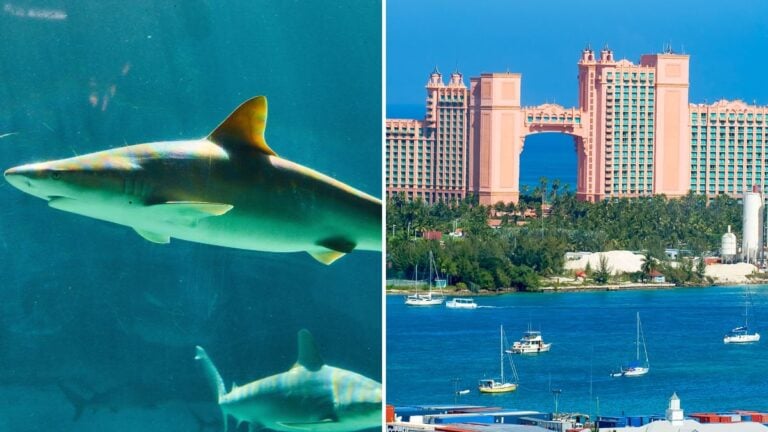
The up-close and personal shark experiences, run out of the Atlantis Paradise Island Resort in the Bahamas, has been temporarily shut down pending an investigation after a 10-year-old boy was bitten during his swim in the shark tank.
It’s unclear if his family was in the water with him, but the boy was accompanied by a dive instructor and dive guide when the incident occurred.
According to a statement from the Royal Bahamas’s Police Force, the boy was bitten on his right leg shortly before 4 p.m. local time. “He was transported to the hospital for medical attention and is currently in stable condition. Investigations are ongoing into this incident.”
Paradise Island in Nassau, Bahamas (Photo Credit: Francesco Joesph)
The unidentified boy was transported back to his home state, Maryland, on Wednesday, January 17, 2024, where he will receive further treatment. He is expected to make a full recovery.
Cruisers hoping to swim with sharks on an upcoming visit to Paradise Island, which is only a couple miles from the popular port of Nassau, may need to pick a new shore excursion, as the shark diving expedition has been temporarily closed following the attack.
Blue Adventures by Stuart Cove, which operates the experience, released a statement on January 17 saying they have opened an investigation into the incident and are “fully cooperating” with local authorities. The excursion will not reopen until the findings have been reviewed.
“Incidents like this involving interactions with marine life, even with the species of sharks included in this experience, are rare and never acceptable,”said the company.
Shark Diving In the Bahamas
Stuart Cove’s Dive Bahamas offers a variety of port adventures, including snorkeling, scuba diving, snuba, boat charters, and of course, shark diving. The company has partnered with Atlantis Paradise Island since the early 2000s to offer watersports and animal encounters at the Bahamas resort.
The shark tank expedition the victim participated in is part of the Mayan temple area of Paradise Island’s Aquaventure Zone. During the experience, participants wore special helmets to breathe underwater while they got up close and personal with nurse and reef sharks.
The shark excursion has since been removed from the resort website, but many other shark-related shore excursions can still be booked on popular websites like TripAdvisor, through companies like Unexso, Neal Watson’s Bimini Scuba Center, and Aquaquest escapes.
Shark
Carnival Cruise Line also offers its own Shark Encounter & Snorkel Excursion at Blue Lagoon Island, just three miles from Nassau, starting at $119.99 (USD) for kids and $129.99 for adults.
Ultimately, it’s up to each cruiser to determine if shark diving is right for them or if another shore excursion would suit them better. While shark attacks are rare, this boy was not the first shark bite victim in the Bahamas.
More recently, a 44-year-old woman from Boston, named Lauren Erickson Van Wart, was killed in a shark attack while paddleboarding in the Bahamas in December of 2023. Wart was less than one mile from shore when the shark bit, fatally wounding her.