Key Aspects:
- Only 700 individuals survived the sinking of the Titanic, and it’s estimated that less than 100 of those were rescued directly from the water.
- Hypothermia is now considered a major cause of death for Titanic passengers, superseding drowning, which was the originally recorded cause.
- Hypothermia can occur at any point where the body loses heat faster than it generates it.
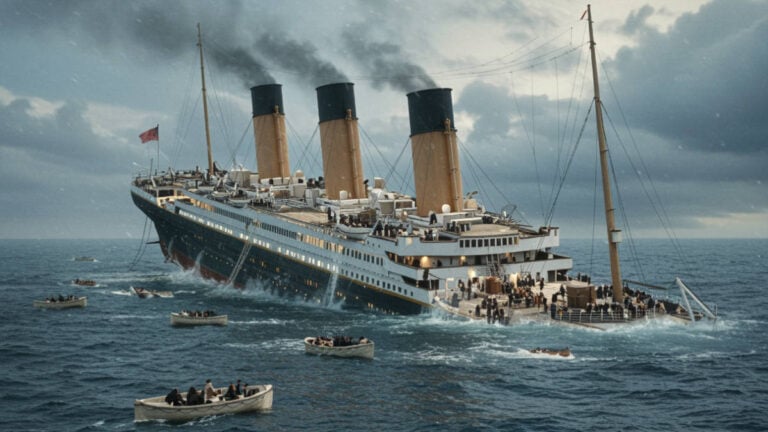
As the Titanic sank in the North Atlantic Ocean, the water was frigidly cold, at an estimated 28 degrees Fahrenheit, or negative 2 degrees Celsius. As such, the main cause of death for many of the Titanic’s passengers and crew members was hypothermia.
Here’s everything you need to know about what these passengers may’ve experienced during that fateful night, how the cold water impacted their survival, and how some passengers miraculously survived the cold temperatures.
Fast Facts Regarding the Titanic Sinking and Cold Water Conditions
| Date of sinking | April 15, 1912 |
| Location | North Atlantic Ocean, about 370 miles off Newfoundland |
| Water temperature | ~28°F (negative 2°C) |
| Air temperature | ~31°F (negative 0.5°C) |
| Time to sink | About 2 hours and 40 minutes |
| Number of people aboard | ~2,224 passengers and crew |
| Estimated deaths | Over 1,500 |
| Survival time in water | 15 to 30 minutes for most victims |
| Cause of death (majority) | Hypothermia and cold shock |
| Cold shock response | Occurs within minutes |
| Hypothermia onset | Within 10 to 15 minutes |
The Temperature and Water Conditions During the Titanic Sinking
When the Titanic sank on the night of April 14, 1912, in the North Atlantic, the water was 28 degrees Fahrenheit or -2 degrees Celsius. About 1,500 people died during the shipwreck, compared to the approximately 700 survivors.
While you might expect that the major cause of death for those who perished due to a ship sinking would be drowning, in this instance, that was not the case. Instead, hypothermia was the main cause of death in this tragedy, due to passengers’ exposure to the cold water.

But, you might be thinking, shouldn’t the water have been mostly frozen if it was colder than the freezing point of water? No, according to The Titanic Museum, the water, despite its temperature, would not be frozen, due to its high salinity.
And just how do we know the water temperature? The SS Californian traveled through the same icy water close to where the Titanic sank. Captain Stanley Lord provided the water temperature to the authorities while tracking it.
Although the SS Californian was relatively close, it was too far away to help the passengers of the Titanic. The closest ship at the time of impact was a sister ship called the RMS Carpathia. Unfortunately, this ship was 58 miles away, and it took four hours to reach the crash site.
How Does Hypothermia Occur?
Even if the water had been much warmer during the Titanic’s sinking, it’s very likely that the same number of people who fell overboard would have died due to hypothermia.
Experts consider “cold water” anything under 70 degrees Fahrenheit, and hypothermia can occur at any point where the body loses heat faster than it generates it, and the body’s core temperature drops below 95 degrees Fahrenheit.
What Happens During Hypothermia?
For the Titanic passengers who would’ve ended up in the water suddenly, they would’ve experienced initial cold shock, with immediate symptoms including involuntary gasping and hyperventilation, as well as panic.
If these passengers managed to keep themselves afloat during this panic, without drowning, they would still likely lose the ability to swim within three to 30 minutes.

While a life jacket can keep someone in this situation from drowning, unfortunately, the life jackets on the Titanic were not exactly ideal. In fact, it’s assumed that they were another major cause of death for passengers, as their construction made it so that, if anyone jumped into the water wearing them, their necks broke when they hit the water.
As hypothermia then begins to set in, after about half an hour, symptoms include violent shivering, shallow breathing, slurred speech, weak pulse, drowsiness, confusion and loss of consciousness as the heart and respiratory system fail.
However, before hypothermia fully and fatally sets in, it is still possible that an individual might slip below the water, fatigued, and drown, or experience a heart attack.
Those Who Survived Hypothermia
Of the Titanic’s 700 or so survivors, the very large majority did not survive if they landed in the water. While accounts differ, it’s estimated that the number of people who did survive the water’s frigid temps was definitely under 100.
One of the most famous people to survive was the Titanic’s head baker, Charles Joughin. As the ship began to sink, Joughin supposedly helped with the evacuation efforts, before the ship fully sank and broke apart, taking him with it (he’s said to be one of the last people, if not the absolute very last, to leave the ship). He then tread water for as long as two hours.

According to Joughin, one of the elements that added to his survival? Alcohol that he’d drank before the ship sank. However, it’s worth noting that alcohol increases risk of hypothermia, even if it might give you the initial sensation of being warmed up. If alcohol helped Joughin in any way during the sinking, it was probably in keeping calm.
It is theorized that more individuals could have survived the water than is officially recorded.
As the RMS Carpathia rescued those in lifeboats, the crew left behind anyone remaining in the wreckage. The ship’s authorities had assumed that those remaining individuals were dead, but some may have survived.
Furthermore, some doctors believe that more could have been done to mitigate the deaths from hypothermia. Crewmates could have grabbed individuals from the water, and doctors could have done CPR and rewarmed the bodies.
Hypothermic patients aren’t pronounced dead until they warm up to normal core temperatures and still do not respond to CPR. As such, there is a chance that the rescue teams didn’t bother pulling people out of the water who were alive with an opportunity to survive.