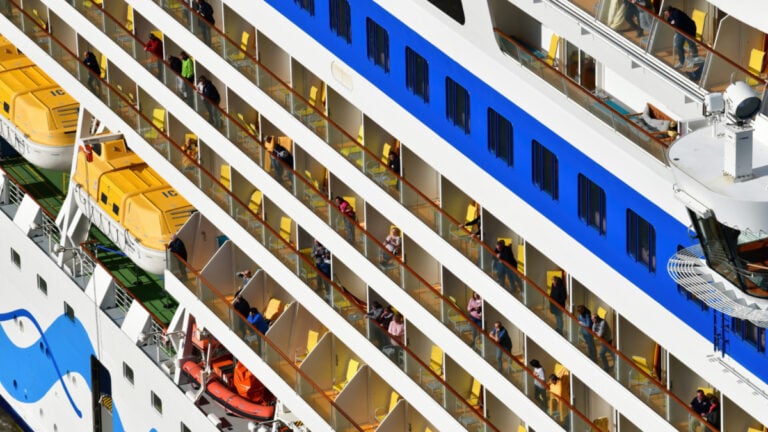
A major search operation has been launched by HM Coastguard in the UK in the English Channel for a crew member who is overboard from a Carnival-owned cruise ship named AIDAperla, operated by German-based AIDA Cruises.
Crew Member Overboard AIDAperla
Search operations are underway in the English Channel for an overboard crew member from the AIDAperla cruise ship. The incident occurred on Sunday morning, October 22, 2023. At the time, the large cruise ship was off Ramsgate, located approximately 20 miles north of the southeast coast.
The RNLI said to ITV News that the call was received at 8:20 AM by the Ramsgate crew, and a crew out of Dover was launched just 15 minutes later. The HM Coastguard is coordinating efforts since it was alerted of the overboard at approximately 8:55 AM. The search is being conducted approximately 25 miles off Ramsgate.
In a statement, HM Coastguard said: “The HM Coastguard search and rescue helicopter has been sent from Lydd alongside a Coastguard fixed-wing aircraft and the RNLI’s all-weather lifeboats from Ramsgate and Dover.“
According to the Cruise Ship Tracker, AIDAperla is currently sailing a search pattern, and data shows the vessel circling in the English Channel. The cruise ship is scheduled to arrive in La Coruna, Spain, on October 23. No details are yet known if that arrival will be delayed.
AIDA Cruises said to Cruise Hive: “AIDA Cruises confirms that there is reason to believe that a crew member of AIDAperla went overboard in the English channel in the early morning of October 22. The captain and crew of AIDAperla immediately initiated all necessary rescue measures in close coordination with the local authorities.
“The search on board confirmed that a male crew member is missing. The ship was immediately stopped and returned to the spot where the incident was believed to have happened and has taken part in the search since.“
The AIDA Cruises ship departed Hamburg, Germany, on October 20 on a three-segment sailing, which is part of a much longer 27-day transatlantic voyage, with multiple embarkation and debarkation ports, such as in the Canary Islands, Dominicana, and Barbados.
AIDAperla is among one of the larger vessels in the fleet, which is part of nine brands owned by the Carnival Corporation. The cruise ship is 124,100 gross tons and was constructed in Nagasaki, Japan. AIDAperla has a passenger capacity of up to 3,400 and a crew capacity of 900.
When booking a cruise vacation, you are probably far more concerned with the onboard amenities, dining options, cabin accommodations, and what shore excursion you want to do than you are with the actual structure of the ship.
Even though it may seem less glamorous than other aspects of your vacation, it is worth considering the ship itself. A greater understanding of the ship and how it works will help you appreciate how incredible a modern cruise ship is.
Today, we will take an in-depth look at what lies beneath the surface of a cruise ship by exploring the hull. Not only will we explain what is down there, but we will also explain the critical function the hull serves. We will even address some common questions cruise ship passengers have about the hull.
If you want to expand your understanding of cruise ships and their operation, you have come to the right place!
The hull of a cruise ship can be seen as the base and outer shell of the entire vessel. Essentially, it is the portion of the ship most submerged in the water. For this reason, the hull plays a critical role in keeping any cruise ship afloat.
The hull sits below the waterline, covering a cruise ship’s entire underbody. This means it extends from the bow of the ship right to the stern. In terms of its height, it also runs from the waterline down to the ship’s keep, which is the lowest point of any ship.
Since the hull must withstand harsh conditions, like crashing waves, significant water pressure, saltwater, and even impacts, it needs to be incredibly strong. Just how big a ship’s hull is and how much of it remains underwater depends on the specific size and type of cruise ship you are discussing; however, it tends to be a significant portion of the ship’s entire structure and mass.
What Are the Basic Functions of a Cruise Ship Hull?
The hull of a cruise ship is incredibly important. It provides a physical structure for the ship to be built upon and the buoyancy required to keep the cruise ship and everything it is carrying afloat. The hull also helps reduce water resistance, which helps with everything from improving fuel efficiency to allowing the ship to travel through the water smoother and faster.
Bulbous bow, hull and waterline (Photo Credit: canduca)
In this sense, the hull provides the stability required to allow such a massive vessel to float on the water. The hull also needs to safeguard the ship and prevent it from sinking. As we will discuss in greater detail, within the hull itself, you will also find various compartments that can contain essential equipment needed to keep the ship functioning efficiently and safely.
Even though you may not see much of the hull as a passenger, it plays a massive role in allowing you to enjoy any cruise vacation.
What Are the Different Areas of a Cruise Ship Hull?
Like just about any type of large vessel, a cruise ship hull will feature numerous different compartments and spaces. As you will learn, each plays an essential role in allowing the ship to function safely.
The Engine Room
As the name implies, the engine room contains the ship’s engines and propulsion system. It can be seen as the ship’s heartbeat, so it serves an important role. Since the ship’s propulsion system needs to sit below the waterline, it is only natural that the engine room sits within the ship’s hull.
Photo Credit: Turn_Mug / Shutterstock
A significant amount of the ship’s fuel will also be stored in the hull. Typically, the fuel is stored near the propulsion system, but it can be located in other segments of the ship to help maintain its overall balance and stability.
Ballast Tanks
A cruise ship hull will also contain ballast tanks, which help control the stability of the entire vessel. These massive tanks can be filled or emptied with seawater, which makes it possible to modify the ship’s center of gravity. Ballast tank adjustments are necessary to keep a cruise ship afloat and stable, so they are essential.
Wastewater Tanks and Waste Treatment Facilities
Modern cruise ships also feature enormous tanks that help store and treat waste and wastewater. While ships in the past may have dumped much of this waste overboard, modern standards help eliminate the environmental impact cruise ships have on the waters they travel through.
Garbage Disposal Area on Cruise Ship (Photo Credit: Mohd Syis Zulkipli / Shutterstock)
While these tanks and treatment systems are incredibly sophisticated and far more sanitary than you may assume, they still sit out of view of passengers. This explains why they are almost always located in the ship’s hull.
Storage Compartments
Since there is so much space available in the hull of a cruise ship, it is a good location for various storage compartments and refrigeration rooms. Depending on the ship’s needs, these storage areas can be used to store everything from food and beverages to medical supplies and bedding.
Crew Accommodations and Facilities
While each cruise ship varies, some cruise ships will feature crew quarters in the upper portion of the hull. Crew members can enjoy breaks and catch up on sleep in these areas. Some ships will also feature separate mess and canteens for crew members in the lower regions of the ship. There are also venues such as a crew bar, gym, and barber.
Photo Copyright: Cruise Hive
Can Passengers Explore the Hull?
While the hull is undoubtedly an interesting and important section of the ship, most cruise ships ensure that this area is entirely off-limits to passengers and other unauthorized personnel.
This is because the hull can be hazardous for those needing the proper training and expertise. For starters, various pieces of equipment and machinery could pose a severe safety risk. Not only is it essential to restrict access to the hull for the safety of the passengers themselves, but it is also essential to keep this area reserved for authorized personnel for the overall safety of the ship.
If, for example, passengers wandered into the engine room unsupervised, the results could be catastrophic. Numerous machines and pieces of equipment are essential to the entire ship’s safe operation down in the hull, so it needs to be protected.
The Structure of a Cruise Ship Hull
Now that you have an understanding of the inner makeup of the hull, we can take a look at the exterior layers and structure. While it may look seamless from the outside of the ship, the hull of a cruise ship is made up of several segments that all serve a unique function.
The hull’s outer plating composes the most visible layer of the hull. This plating can be seen as the outer skin of the hull. It protects the lower portions of the ship and provides the primary defense against external elements, like water pressure and floating objects. In most cases, this plating is made from hardened steel and coated with specialized paint that can withstand the corrosive effects of ongoing saltwater exposure.
Hull of a Cruise Ship (Photo Credit: Per-Boge)
Beneath the hull’s outer plating, you will find steel framing and bulkheads. This is what gives the hull its shape and strength. You can think of the framing as the skeleton of the hull. While the plating needs to be incredibly durable, this inner framing gives the entire ship its strength and rigidity.
From there, you will find the hull’s inner plating, which, alongside the outer plating, sandwiches the frames and bulkheads. It provides an additional layer of protection and helps enhance the hull’s structural integrity. Given that the entire ship could sink if the hull was not strong, this inner layer serves a vital purpose in maintaining the ship’s safety and stability.
FAQs
Why doesn’t the hull of a cruise ship rust?
Given that the hull’s outer surface is metal and has to withstand long-term exposure to saltwater, you might wonder why it does not rust. The ship’s outer surface is protected with corrosion-resistant coatings and paints. This acts as a water-tight barrier between the hull’s metal surface and the surrounding water.
This protective coating must be inspected and maintained at regular intervals to keep the ship safe from corrosion. Scheduled dry docks are used for hull cleaning.
Do cruise ships offer hull tours?
For the most part, cruise ships will not offer tours of the hull. The access to this segment of the ship needs to be carefully regulated to maintain the safety of the individual passengers and the entire ship. In simple terms, allowing passengers to explore the ship’s hull would be too dangerous, even if they were supervised by authorized crew members.
What is a cruise ship hull made from?
Most modern-day cruise ships feature high-strength steel hulls. This durable material is required to withstand the immense pressure and stress of traveling through oceans and large seas.
Final Words
If you are a true cruise enthusiast, it pays to have a working understanding of the ship from top to bottom, even if you cannot explore every region.
Even though the hull of a cruise ship is mainly hidden from view, it serves several essential purposes. If you would like to learn more about the design of a modern cruise ship hull, we encourage you to watch Royal Caribbean’s video guide to the Oasis of the Seas Hull Design.
More importantly, make sure you enjoy yourself on your next cruise vacation, whether you’re heading to New Zealand, New York, or New Orleans, and remember that the ship and the professional cruise line crew work incredibly hard to ensure you are safe and comfortable!
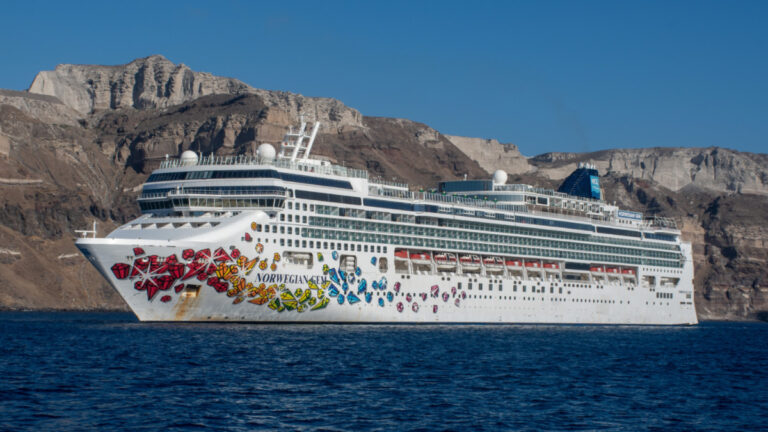
While many cruise ships have been forced to alter itineraries due to the tense situation in Israel, Norwegian Gem is having more significant changes than most vessels for her November 11 and November 22 sailings, the final two sailings before the ship heads back to North America.
Not only are port visits in Israel cancelled, but other ports have also been rearranged to accommodate the changes. This can cause difficulties for travelers who may have made various independent tour arrangements.
Norwegian Gem Itinerary Changes
Due to the heightened tensions in Israel, many cruise lines have opted to cancel port visits in the region. This includes Norwegian Cruise Line, which has cancelled all remaining calls to Israel for 2023.
This has led to some dramatic itinerary changes for the 93,530-gross-ton, Jewel-class Norwegian Gem, which is offering longer eastern Mediterranean sailings that were to have included two port visits in the country. The ship’s last two cruises of the season are both impacted, though the next voyage – the 15-night transatlantic between Rome and New York – does not have any changes.
November 11 Itinerary Change
The Saturday, November 11 sailing of Norwegian Gem is an 11-night voyage from Athens to Istanbul, with a total of 9 planned port visits. Now, three ports have been completely cancelled and the ship will no longer call on either Ashdod or Haifa in Israel or Port Said in Egypt.
Instead, Norwegian Gem will overnight in Alexandria, giving guests more time to enjoy that culturally and historically rich destination.
The planned visit to Larnaca, Cyprus has been moved up in the itinerary to replace Ashdod, and Limassol, Cyprus has been added to the itinerary to replace Haifa.
The visit to Alanya, Turkey, has also been moved a day earlier, and Heraklion, Greece has been added. Finally, the visit to Rhodes – still planned for Sunday, November 19 – will be one hour shorter, now departing at 5 p.m. rather than 6 p.m. as originally scheduled.
In total, 7 days of the 11-night sailing have been altered. Only the very first day – a day at sea – and the final call to Kusadasi, Turkey on Monday, November 20, are unaffected. The ship will arrive in Istanbul on Tuesday, November 21 for an overnight before debarkation the next morning.
While the cruise line will adjust pre-paid Norwegian Cruise Line shore excursions for changed port days and refunds will be given for tours in now-cancelled ports, guests with independent arrangements will need to contact their tour operators for refunds or other options.
November 22 Itinerary Change
The Wednesday, November 22, 2023 departure of Norwegian Gem – a 12-night Mediterranean sailing from Istanbul to Rome ahead of the ship’s transatlantic repositioning cruise – has likewise had 4 of 9 ports of call adjusted.
The sailing will leave Istanbul as planned on Wednesday, November 22, and the first two ports of call – Kusadasi, Turkey and Piraeus (Athens), Greece – are unchanged.
The next four days are all adjusted, however. The calls to Ashdod and Haifa are cancelled, a call to Heraklion, Greece has been added, and both the visits to Rhodes, Greece and Alanya, Turkey, have been bumped a day later than originally scheduled. Finally, Limassol, Cyprus has been added to the itinerary.
The remaining days – an overnight visit to Alexandria, Egypt; a day at sea; and visits to Siracusa and Naples in Italy – are not changed. The cruise will end on schedule in Civitavecchia (Rome) on Monday, December 4, 2023.
As with the previous sailing, pre-paid tours booked through the cruise line will be refunded if they cannot be rescheduled, but any independent arrangements must be settled through the tour operators guests have hired.
Challenges of Longer Itinerary Changes
It can be challenging for cruise lines to need so many itinerary changes, especially when the regional situation dictates that multiple cruise ships must be accommodated.
Alternative ports can only welcome so many ships, and vessels already booked into those ports have priority for available berths.
On longer, port-intensive cruises, it can be difficult to find replacement ports in the region if a ship already plans to visit the most popular destinations. In some cases, as with these two sailings of Norwegian Gem, shuffling the order of visits can help make it easier to add new destinations.
Another alternative can be to extend existing ports of call to give guests more time for immersive exploration, though this isn’t always feasible depending on a ship’s schedule and the distance to the next destination, as well as what timing a port can accommodate.
Guests booked on any eastern Mediterranean sailing in the coming months should stay updated about potential itinerary changes and what that may mean for their cruise vacation plans.
With just over six months before Cunard’s newest ship, Queen Anne, makes her debut, the luxury cruise line took the wraps off some of the artwork that will be showcased onboard the vessel.
A celebratory event was held on October 18, 2023, for cruise line and industry VIPs in New York, featuring a lively cabaret performance.
Celebratory Event Held as Ship Readies for Debut
Cunard’s Queen Anne cruise ship is still under construction at the Fincantieri shipyard in Marghera, Italy, but the countdown to her launch is already underway. The cruise line hosted an event at New York’s swanky Cipriani 25 Broadway to introduce some of the artwork the new 3,000-guest ship will feature.
The ship, the first new-build for Cunard in 13 years, also will sport a new entertainment venue when she launches in May 2024. Queen Anne will join three ships in the Cunard fleet: Queen Mary 2, Queen Elizabeth, and Queen Victoria.
Artists whose works will be displayed on the new Cunard ship include photographer Michael James O’Brien; Eric Louie, a Canadian artist; Shradha Kochhar, a Brooklyn textile artist; and London-based artist Tommy Camerno.
Along with a reception to showcase the various artworks, guests were treated to a cabaret-style performance by the renowned stage and screen actor Alan Cumming. The event was meant to evoke the atmosphere that guests aboard Queen Anne will find in the ship’s new entertainment venue, Bright Lights Society, a performance lounge featuring bold light installations.
Cunard Event for Queen Anne
“This evening is a full circle moment for the company as we come together at this historic, magnificent building, which bridges Cunard’s 183-year historic legacy with the modern era of ocean travel,” said Katie McAlister, President of Cunard.
“Our new ship, Queen Anne, will pay homage to her royal namesake, renowned for her dedication to the arts and innovative spirit; as such, the ship will usher in a new era for Cunard as we introduce new experiences for our guests, complementing our signature, timeless style,” added McAlister.
Details regarding Queen Anne’s design have been released by Cunard as the ship’s launch approaches. The line revealed in 2022 that a team of designers is creating a modern approach to her venues while incorporating elements of Cunard’s rich history.
Designers David Collins Studio, Richmond International, and Sybille de Margerie, are working with Adam D. Tihany, creative director for Cunard, to set the elegant tone of the ship, guided by five principles — heritage, craftsmanship, storytelling, style, and innovation.
The design teams reviewed the Cunard Archives, including historical poster advertisements, brochure covers, and photography, before deciding on materials, fabrics, patterns, and other elements.
New Suites, Dining Enhancements Planned
Among the new features onboard the 113,000-gross ton ship will be Cunard Queens Grill Grand Suites, offering guests exclusive, private residences on board. Some of the amenities include a dining room and adjacent butler’s pantry, walk-in wardrobes, marble-finished bathrooms with sea views, and spacious balconies.
Queen Anne Open Deck
The 14-deck Queen Anne will feature 15 dining venues, and while all of them are sure to provide excellent cuisine, guests dining in the ship’s Queens Grill restaurant will experience a unique menu created by two Michelin star chef Michel Roux, who partnered with Cunard in August 2023.
Queen Anne’s maiden voyage is scheduled to sail roundtrip from Southampton, UK, on May 3, 2024. The 7-night cruise will call at La Coruna, Spain, and Lisbon, Portugal. The ship will home port in Southampton, sailing to destinations such as the Canary Islands, British Isles, Norwegian Fjords, Scandinavia, and the Western Mediterranean, with some departures offered in Hamburg and Kiel, Germany, and Rome.
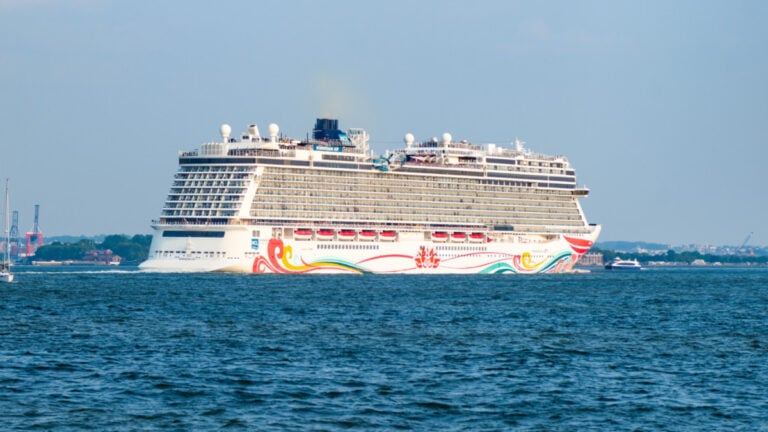
As Tropical Storm Tammy draws closer to the Eastern Caribbean, two Norwegian Cruise Line vessels are cancelling their visits to St. Maarten, both of which were originally scheduled for Friday, October 20, 2023.
While the storm is not forecast to reach St. Maarten until Saturday afternoon, these cancellations give the ships enough time to steer well clear of the roughest weather associated with the tropical system, which is likely to be a hurricane at that time.
Two Norwegian Cruise Ship Port Cancellations
Both Norwegian Sky and Norwegian Joy have cancelled their planned port visits to Philipsburg, St. Maarten on Friday, October 20, 2023. Confirmation of the cancellation comes directly from Port St. Maarten, noting that the cancellations are due to Tropical Storm Tammy.
At this time, the port remains open to cargo and shipping operations, but operational adjustments may be necessary depending on the overall weather and sea conditions.
The 77,104-gross-ton, Sun-class Norwegian Sky – the oldest, smallest ship in Norwegian’s fleet – was to have been in port from 9 a.m. to 6 p.m. as the third port on the ship’s current 9-night sailing from Miami. The ship has already called on the Dominican Republic and Puerto Rico, with Antigua, the US Virgin Islands, and Great Stirrup Cay still remaining on the itinerary.
Photo Credit: Felix Mizioznikov / Shutterstock
The much larger, 167,725-gross-ton, Breakaway-Plus-class Norwegian Joy is on a 12-night repositioning cruise from New York to Miami, and was to have been in St. Maarten from 12-8 p.m. on Saturday. The ship has already visited Bermuda – having just left New York on October 16 – and has six ports of call remaining on the itinerary after St. Maarten.
There is no confirmation whether or not alternative ports of call are to be arranged for the missed visits to St. Maarten, but options may be limited due to the path of the storm and the itineraries of both ships.
No other cruise ships are scheduled to visit St. Maarten for several days. Royal Caribbean’s Mariner of the Seas and Harmony of the Seas are both in port on Wednesday, October 25, by which time the storm will be well past the region.
Tropical Storm Update
Tropical Storm Tammy is currently located approximately 290 miles (467 kilometers) east of St. Lucia, moving west-northwest at 13 miles per hour (21 kilometers per hour). As the storm has slowed significantly in the past 24 hours, it has also gained strength and now has maximum sustained winds of 60 mph (97 kph).
Tammy is likely to continue strengthening, and will reach Category 1 or Category 2 status by the time she reaches St. Maarten, though some more extreme predictions are forecasting an even stronger storm.
Tropical Storm Tammy
Hurricane watches, tropical storm warnings, and tropical storm watches are already in effect throughout the Lesser Antilles.
After passing St. Maarten and the rest of the Lesser Antilles, the storm is expected to curve east back into the open Atlantic, and is unlikely to impact other islands. It is possible that some ships making transatlantic crossings next week might experience some rough weather from the storm, depending on their exact routes and scheduling.
The Atlantic hurricane season runs through November 30, but storms do tend to wind down and be less violent in the last weeks of the season. Any individual storm, however, can still be dangerous both to cruise ships as well as ports of call and cruise homeports, and travelers should always stay alert to weather updates when cruising at this time of year.
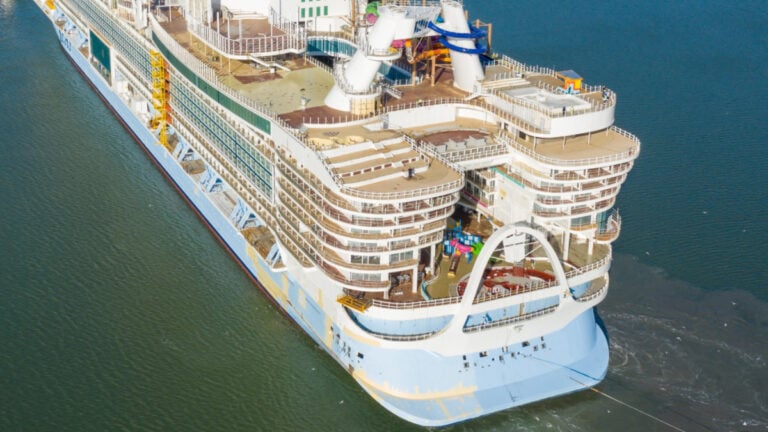
The countdown to the industry-changing Icon of the Seas has dropped to just 100 days until the ship’s debut. As the vessel is now in her final phase of outfitting prior to welcoming guests, there is a lot to look forward to as her inaugural sailing approaches.
Icon of the Seas to Set Sail in 100 Days
Royal Caribbean cruisers – currently booked guests as well as past guests in the Crown & Anchor Society loyalty program – along with anyone signed up for notifications from the cruise line has received an exciting email with a live countdown to Icon of the Seas.
99 days, a few hours, a few minutes, and seconds ticking down.
“In just 100 days, The World’s Best Family Vacation debuts. This is everything you’ve ever loved about every vacation, all rolled into one,”the email begins.“The countdown to the all-new Icon of the Seas is on.”
Royal Caribbean International has been hyping the new ship through its “Making an Icon” video series throughout construction, bringing eager guests behind the scenes into how the ship’s design was created, what innovations will be available onboard, and watching as each milestone of construction has been met.
Icon of the Seas Countdown
From the first steel cutting in June 2021 to installing the first liquefied natural gas (LNG) tank in October 2021 to teasing about the mysterious Pearl – now known to be a connection between decks on the Royal Promenade featuring multi-sensory, immersive sensations – there has been a lot to enjoy as time counts down to the ship’s ultimate introduction to the Royal Caribbean fleet.
What will be the world’s largest cruise ship passed her first sea trials in June, and is now undergoing final outfitting before her January 27, 2024 debut from Miami, Florida.
Iconic Adventures Await
Icon of the Seas will be unlike any ship that has come before, offering stunning themed neighborhoods, the largest ever waterpark at sea in Thrill Island, an exclusive family vibe in the colorful Surfside space, and so much more.
The outstanding AquaDome will be a transformational space filled with light and energy day and night, with the cruise line’s distinctive water theater shows taking center stage for each performance with new, dramatic highlights never seen before.
Guests looking for thrills will challenge the nerve-wracking Crown’s Edge ropes course with a zip line over the open ocean, along with the classic rock wall, FlowRider surf simulator, and other well-loved Royal Caribbean thrills.
Icon of the Seas Sea Trials (Photo Courtesy: Royal Caribbean)
The cruise ship will also make a splash with its seven unique pools, including the Water’s Edge suspended infinity pool, Splashaway Bay, and Baby Bay for young cruisers to stay cool.
While the ship itself is sure to be an iconic destination, the alternating 7-night Eastern Caribbean and Western Caribbean itineraries will also take guests to amazing ports of call, with each voyage visiting the cruise line’s private island, Perfect Day at CocoCay – including the new, exclusive Hideaway Beach just for adults.
So great is the anticipation for sailing aboard Icon of the Seas that when bookings officially opened on October 25, 2022 – well over a year before the ship would even set sail – the response was phenomenal. This single ship set single-day booking records that surpassed anything in Royal Caribbean’s 53-year history.
What Is Yet to Come
While thousands of eager cruisers – those already booked and those still making plans – are ready for Icon of the Seas, there are a few steps remaining.
The ship must be officially delivered to Royal Caribbean International, a handoff ceremony that will change legal ownership of the vessel from the Meyer Werft shipyard to the cruise line.
The ship will then receive crew members and begin final supply stocking ahead of her first sailing. At some point, the ship will leave the Turku, Finland shipyard for the final time and make her way to Miami, Florida, for her naming ceremony and welcoming guests onboard.
At that time, the immense 250,800-gross-ton vessel will take her place in the history books as the world’s largest-ever passenger cruise ship, setting sail with up to 7,600 guests onboard each week with a crew of more than 2,300 international team members.
These will be iconic cruise vacations indeed – you can count on it.
Celebrity Cruises’ Celebrity Silhouette has been delayed due to rough weather and will not return to her homeport of Southampton as scheduled.
As a result, the next sailing will have a slightly delayed embarkation, and guests are awaiting word about how to adjust their arrival at the cruise port.
Celebrity Silhouette Delayed by Weather
Celebrity Silhouette is currently sailing an 11-night Canary Islands and Portugal itinerary roundtrip from Southampton, but has encountered rough weather on her return to the UK. Because of this, guests on the next sailing have been notified that the ship will be delayed for her Sunday, October 22 return, and the subsequent embarkation of the next cruise will also be delayed.
“Today and tomorrow, Celebrity Silhouette will navigate around inclement weather on her return to Southampton,”the notification explains.“We anticipate this will delay her arrival time in port on your embarkation day, October 22, 2023.”
The exact amount of the delay has not yet been confirmed, but Celebrity Cruises will notify guests with updated embarkation times on Saturday, October 21.
“As always, the safety of our guests and crew is always our number one priority. Thank you for your patience and understanding,”the notification concludes.
Photo Credit: Felix Mizioznikov / Shutterstock.com
While it is not unusual for weather to cause delays for cruise ships, it is somewhat unusual for a cruise line to acknowledge such delays several days before they cause an impact on guests. This will be welcome for travelers, however, as they do not need to wonder and worry about embarkation but instead have early warning for the anticipated adjustments.
Celebrity Silhouette‘s next sailing is her 11-night transatlantic repositioning cruise from Southampton to Fort Lauderdale, calling on the Azores, Bermuda, and Nassau along the way.
Transatlantic cruises are always popular sailings for experienced travelers, and it is likely that many travelers have made plans to arrive in Southampton early to enjoy the city prior to setting sail. Knowing the ship will be delayed can help guests make arrangements for a later embarkation than previously planned.
Of special note is the fact that this particular transatlantic cruise will be Celebrity Silhouette‘s final departure from Southampton, where she has homeported seasonally since 2018.
The ship is to be replaced with Celebrity Apex for the 2024 season, while in summer 2024, Celebrity Silhouette will offer European sailings departing from Amsterdam, Rotterdam, Barcelona, and Athens.
Will the Next Itinerary Be Impacted?
Because the next sailing is a transatlantic crossing, it is unlikely that there will be any significant changes to the overall itinerary other than the adjusted embarkation.
During the 11-night cruise, Celebrity Silhouette will enjoy seven full days at sea – ideal opportunities for a slight increase in speed that will keep the ship on schedule for her planned ports of call.
Photo Credit: P.Cartwright / Shutterstock.com
In fact, the first two days are intended as sea days, so even the first port visit – Ponta Delgada in the Azores on Wednesday, October 25 – is unlikely to be delayed.
Of course, if the weather worsens and the embarkation delay is made more significant, it might have a knock-on effect on the rest of the ship’s itinerary. Celebrity Cruises will keep travelers updated should such changes become necessary.
Adjustments to Current Sailing
Because Celebrity Silhouette must wait out some rough weather returning to Southampton, it has been decided that the ship will not visit Vigo, Spain, as scheduled for Friday, October 20. Instead, the ship will remain in Lisbon, Portugal for a longer visit before returning directly to Southampton.
Current satellite tracking data confirms that the ship remains docked in Lisbon well past her 4 p.m. scheduled departure time on Thursday, October 19.
Guests onboard have also reported the itinerary change, but are in generally good spirits aboard the 122,210-gross-ton, Solstice-class cruise ship.
Celebrity Silhouette can welcome 2,886 guests aboard each sailing, and is home to a crew of approximately 1,500 international team members.
Returning to the Asia market for the first time in three years, Norwegian Cruise Line marked the October 19, 2023, departure of Norwegian Jewel on an 11-day voyage from Tokyo.
The ship will sail a series of 16 unique itineraries with a choice of nine embarkation ports.
Norwegian Jewel Departs on First Sailing From Tokyo
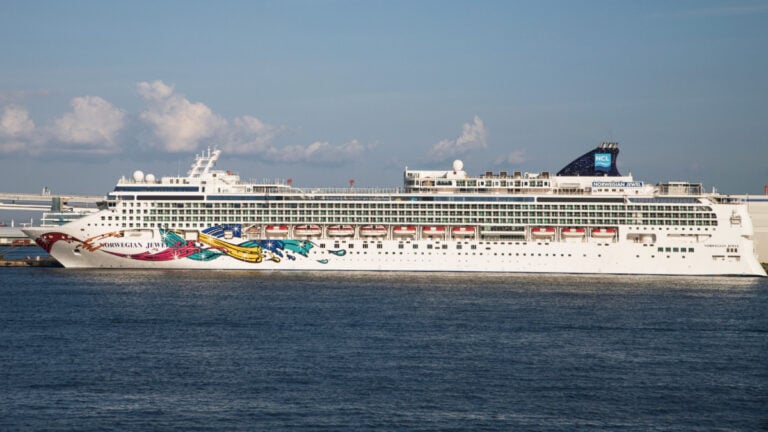
Norwegian Cruise Line’s 2,376-guest Norwegian Jewel has departed on the first of a series of cruises in Asia, offering 10- to 14-day itineraries on her six-month deployment to the region. It’s the first sailing in the continent for NCL in three years.
Her current 11-day sailing from Tokyo to Taipei, Taiwan, will call at such ports as Kyoto, Hiroshima City, Nagasaki, and Okinawa Island, Japan; and Hualien, Taiwan.
Besides Tokyo, Norwegian Jewel’s voyages offer eight additional departure ports: Bangkok, Thailand; Kuala Lumpur, Malaysia; Singapore; Taipei, Taiwan; Bali, Indonesia; Yokohama, Japan; and Seoul, South Korea. The Seoul embarkation port is a first for the cruise line.
Depending on departure, the series of cruises features port calls in 11 countries and is heavily focused on lengthy calls, such as 13.5 hours in Singapore and Ho Chi Minh City, Vietnam. Overnight stays are scheduled in Phuket, Thailand; Osaka, Japan; and Bali (Benoa), Indonesia, and the voyages feature fewer than two full days at sea, on average.
Some of the port calls in the series will mark inaugural visits for Norwegian Cruise Line, including to Manila, Boracay, Palawan, and Salomague, all in the Philippines; Bintan Island, Indonesia; and Hualien, Taiwan.
Norwegian Jewel Cruise Ship in Asia (Photo Courtesy: NCL)
“Today is a milestone moment, as we return to Asia with Norwegian Jewel’s arrival to Tokyo. We pride ourselves in delivering the best vacation experience and providing endless opportunities for our guests to explore the world…including Asia!” said David J. Herrera, president of Norwegian Cruise Line.
“This region delivers some of the most intriguing history, cuisine, and culture for travelers to discover, and we are thrilled to deliver a diverse selection of port-rich voyages. This market is important to us, and we are committed to servicing it in the long term,” Herrera added.
Three Additional Ships Will Deploy to Asia Pacific
Looking ahead into 2024 and 2025, Norwegian Cruise Line will expand its presence in Asia and in the Australia/New Zealand market, with the deployment of three additional ships —Norwegian Spirit, Norwegian Sun, and Norwegian Sky.
Norwegian Spirit, with a capacity for 2,002 guests, will sail Down Under from December 2023 through March 2024 on open-jaw cruises between Sydney, Australia, and Auckland, New Zealand.
Following some repositioning cruises in the South Pacific, the ship will offer 14 Asia sailings from September 2024 to April 2025. Departures will be offered from Manila, Singapore, Taipei, Tokyo, and Seoul.
Norwegian Spirit Cruise Ship
The 2,400-guest Norwegian Sun will make its debut in the Asia Pacific region with a six-month deployment beginning in October 2024. The ship will operate 13 unique itineraries — four of them brand new. The new routings include three sailings from Melbourne, Australia, and the fourth is a voyage from Auckland, New Zealand, to Bali, Indonesia.
Embarkation ports for Norwegian Sun’s series are Melbourne and Sydney, Australia; Auckland, New Zealand; Honolulu; and Papeete, French Polynesia.
The 2,000-guest Norwegian Sky will deploy to Asia from December 2024 to March 2025, and sail a series of seven voyages with embarkation offered in Manila, Philippines; Singapore; Taipei, Taiwan; Tokyo; and Port Louis, Mauritius. Guests can choose sailings from 10 to 17 days.
More Cruise Lines Expand Asia Offerings
Norwegian Cruise Line is not alone in seeking opportunities in Asia. MSC Cruises announced in May 2023 that it would deploy the mega-ship MSC Bellissima to Japan for the winter 2023-24 season.
Starting in November 2023, the 4,500-guest ship will sail 6-, 9-, and 11-night sailings from Yokohama. From January through March 2024, MSC Bellissima will reposition to a new homeport, Naha/Okinawa, and operate a series of 4- and 5-night itineraries.
Princess Cruises has also reaffirmed its commitment to the Japanese market with the current deployment of the 2,670-guest Diamond Princess to Tokyo. In 2024, the ship will sail 36 departures of 7- to 23-day voyages from Tokyo between March and August.
Disney Cruise Line has been steadily rolling out the DisneyBand+ to its fleet, with Disney Wish, Disney Fantasy, and Disney Magic already equipped with the wearable technology.
Now, guests sailing aboard Disney Dream will be able to utilize the convenient wristband for sailings beginning November 20, 2023, leaving just one ship without the capability.
Disney Dream to Receive DisneyBand+ Capability
Beginning with the November 20, 2023 sailing – a 5-night “Very Merrytime” Western Caribbean sailing from Fort Lauderdale, visiting Castaway Cay and Cozumel – Disney Dream guests will have the option to use Disney Cruise Line’s wearable, rechargeable band.
The DisneyBand+ offers guests simplicity and hands-free convenience with the waterproof wristband that serves as a stateroom key, account card for onboard purchases, and access key for exclusive youth spaces such as Disney’s Oceaneer Club and Scuttle’s Cove at Castaway Cay.
The bands are not required, but do offer some benefits to Disney Cruise Line guests who purchase a band in advance of their sailing.
✨ Exciting news! ✨ DisneyBand+ is now on-sale for guests sailing on the Disney Dream starting 11/20. Enjoy more convenience and magic while onboard your cruise!
The wireless, RFID-driven technology helps smooth and speed up the port experience through cruise check-in, and even adds more magic throughout each cruise with interactive connections onboard.
The availability of the DisneyBand+ aboard Disney Dream follows the introduction of the technology first to the cruise line’s newest and largest vessel, Disney Wish, this past spring. In July 2023, Disney Fantasy became the second ship equipped for the technology, followed by Disney Magic set to debut the band’s use from October 22, 2023.
Disney Dream guests will be able to order their DisneyBand+ wristbands as early as 45 days prior to sailing, but must complete their orders no later than 11 days before departure to ensure adequate processing and delivery time. The approximate wait time for delivery is 10 business days.
The bands cost $34.99 (USD) for a solid color and $44.99 for a themed design, such as favorite Disney characters, the cruise line logo, and more. Shipping costs are included in the price, and all bands come with a charger. Guests should be sure the band is fully charged prior to arriving at the cruise terminal – charges last approximately 1-3 days, depending on individual usage.
Guests who already have a DisneyBand+ from a previous cruise on a different ship can reuse their bands on Disney Dream, or can order a new design to add to their collection. At this time, DisneyBand+ orders can only be shipped to valid US addresses.
What About Disney Wonder and Future Ships?
Disney Wonder does not yet have the capability to support the DisneyBand+, but should have the technology available before the end of 2023. This will complete the rollout across the Disney Cruise Line fleet, bringing the band to thousands of Disney cruisers every week.
While no announcement has yet been made about future Disney ships and their potential connection to the DisneyBand+, it is likely that every new vessel will be equipped as they set sail. It is possible, however, that there may be initial glitches in how well the technology works onboard, though it is common for any new ship to have some early difficulties.
Disney Treasure is the next ship that will join the Disney Cruise Line fleet. The ship is already under construction at the Meyer Werft shipyard in Papenburg, Germany, and will be the first sister ship to the immensely popular Disney Wish – which is already using the DisneyBand+ technology. Disney Treasure is scheduled to debut in December 2024.