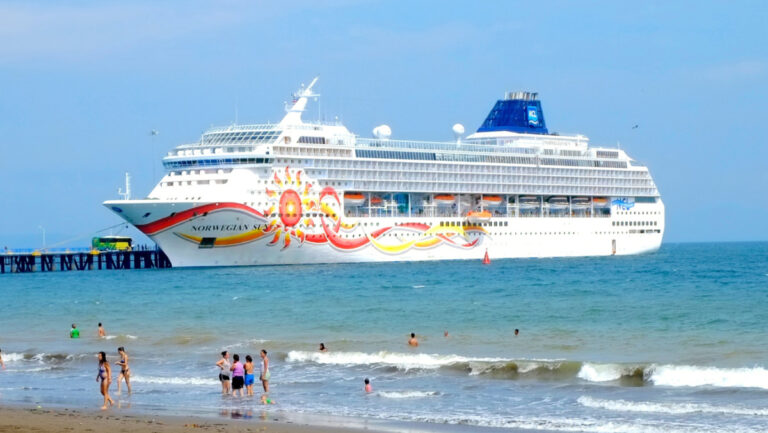
Norwegian Cruise Line has reached out to travel agents and booked guests to notify them that seven months of cruises aboard Norwegian Sun have now been cancelled. This includes cruises from late March through early November 2025.
Norwegian Sun Cruise Cancellations and Refunds
Booked guests have begun to receive notifications that seven months of sailings aboard Norwegian Sun have been cancelled. The email is also being sent to the cruise line’s travel partners so they may contact any of their impacted clients.
“As a result of a fleet redeployment, Norwegian Sun’s sailings from March 28, 2025 through and including November 3, 2025 have been canceled,”the email said.“We sincerely apologize for any inconvenience this may cause.”
Full refunds for all the cancelled sailings – a total of 22 cruises – are being automatically processed back to the original form of payment used when the reservation was made. These refunds will be processed from the cruise line within 30 days, and may take 7-10 days after that time to be processed through individual financial institutions.
If guests used a future cruise credit (FCC) to book their now-cancelled cruises, those FCCs will be reinstated to their loyalty accounts.
Furthermore, all guests will receive a 10% discount FCC for use on a future cruise vacation, valid for any Norwegian Cruise Line published sailing from November 20, 2023 through December 31, 2025.
“We sincerely appreciate your understanding and look forward to welcoming you aboard very soon,”the email concludes.
The 78,309-gross-ton Norwegian Sun can welcome 1,976 guests per sailing when booked at double occupancy, meaning as many as 44,000 guests or more may be impacted by this dramatic cancellation. The actual number of passengers affected is likely to be somewhat lower, however, as the sailings had not yet sold out before being cancelled.
Alternative Cruises
Norwegian Cruise Line is also informing guests that Norwegian Sky – sister ship to Norwegian Sun – will be offering similar itineraries to the now-cancelled cruises during the same March-through-November 2025 window, should travelers wish to rebook a different cruise.
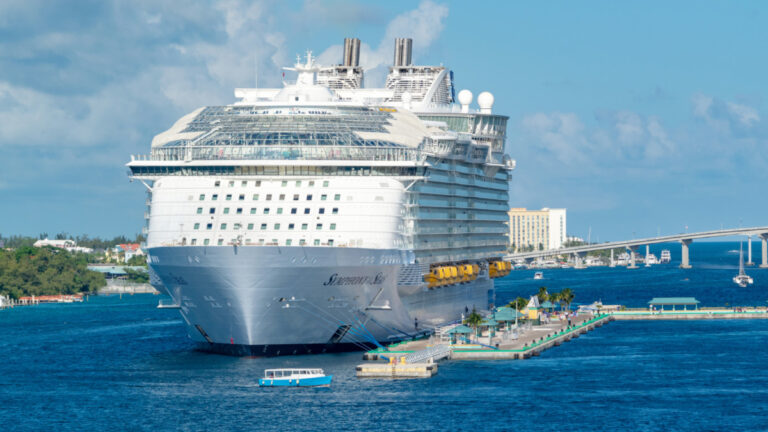
Photo Credit: Felix Mizioznikov / Shutterstock
The cancelled cruises aboard Norwegian Sun ranged from 7-16 nights, with most being 9- or 10-night cruises. Both Middle East and Mediterranean itineraries are impacted.
No explanation has been given for such extensive cancellations, other than “fleet redeployment.” This is the same explanation that was offered when months of Alaska cruises were cancelled for Norwegian Spirit, which was being chartered for the impacted window.
Norwegian Cruise Line has an unfortunate history of these types of mass cancellations as ships are moved to different regions or dry dock schedules are shifted. Similar cancellations have previously impacted Norwegian Epic, Norwegian Joy, and other vessels.
Speculation will undoubtedly be rampant that Norwegian Sun may be leaving the cruise line either to be sold to another line or scrapped altogether, but these rumors are as yet unfounded and without official confirmation.
Norwegian Sun Cruise Ship in Jacksonville (Photo Credit: NEFLO PHOTO)
It is true that Norwegian Sun is one of the oldest ships in the line’s fleet, having first set sail in September 2001. By the time of the cancelled sailings, the ship will be more than 23 years old, a decent operational lifespan for any vessel, but not necessarily the end of useful operation altogether.
Smaller, more “seasoned” ships are often preferred for longer itineraries, as they offer an intimacy that larger vessels cannot.
They are also ideal for visits to more remote or unusual ports of call that may not be equipped to accommodate today’s largest ships and the thousands of passengers they can host on every sailing.
Stay tuned to Cruise Hive for more details as the future of Norwegian Sun is revealed.
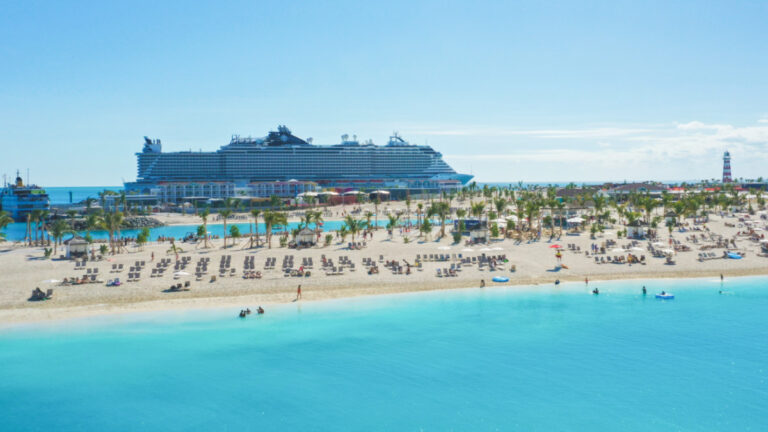
MSC Cruises has announced a comprehensive development plan for Ocean Cay MSC Marine Reserve Private Island in The Bahamas to enhance the guest experience and contribute to marine conservation.
The investment, valued at $100 million, marks a new chapter for the private island destination, which has been an example of sustainable and environmental stewardship. MSC Cruises transformed the former sand excavation site into a marine reserve and now aims to take that development even further.
Enhancing Guest Experience and Marine Conservation
MSC Cruises and the Bahamian government have signed a new agreement where the cruise line will invest a further $100 million into its private island resort, Ocean Cay Marine Reserve.
The development plan, unveiled during a ceremony in Bimini attended by Bahamian Prime Minister Philip Davis and other key officials, is poised to generate substantial economic benefits for The Bahamas.
This initiative will create numerous construction jobs and long-term employment opportunities on the island, a significant contribution to the local economy.
Prime Minister Philip Davis said to Eyewitness News:“My government has fully embraced the development of our Family Islands. Whether through capital infrastructure projects, partnerships, or in support of private sector investments like this one, we are committed to developing and growing the economy of every island in our archipelago.”
“This project represents the kind of corporate responsibility effort and environmental stewardship we want to see from all major developmental projects moving forward.”
Ocean Cay MSC Marine Reserve, a former industrial sand excavation site transformed into a flourishing marine reserve and private island destination, will see a series of enhancements designed to elevate the guest experience.
MSC Cruises Private Island in the Bahamas (Photo Courtesy: MSC Cruises)
New amenities for MSC Cruises’ guests include the introduction of pavilions where guests can undertake watersport activities and island tours. There will also be a diving and snorkel center and additional dining options.
The development also includes new accommodation facilities for the island staff, which is set to increase from 150 to 280 employees. Additionally, MSC Cruises has pledged to support the LJM Maritime Academy and the University of The Bahamas, fostering the training and development of Bahamian seafarers.
Commitment to Environmental Sustainability
A central component of the expansion is the establishment of the MSC Foundation’s Marine Conservation Centre. This facility will serve as a hub for coral reef research and education under the Super Coral Program, featuring interactive pavilions, a lecture hall, and coral exhibition tanks.
The Super Coral Program on the island represents a critical effort in understanding and fostering coral reef resilience across the tropical Western Atlantic.
MSC Cruises Private Island in the Bahamas (Photo Courtesy: MSC Cruises)
The expansion will also include the installation of a third solar farm and an advanced wastewater treatment plant, which will help MSC Cruises achieve its goals for zero greenhouse gas emissions for Ocean Cay.
A comprehensive landscaping plan will further enhance the island’s ecosystem, featuring native and adaptive plant species for erosion control and vegetation improvement.
With the new additions and enhancements, Ocean Cay MSC Marine Reserve will become an even more important example of how tourism can be done sustainably in the Caribbean, offering a unique blend of natural beauty, ecological awareness, and amenities.
Those looking forward to visiting Ocean Cay MSC Marine Reserve during the winter 2023-24 season will have ample choice. MSC Cruises will deploy five ships in the North American market – MSC Divina, MSC Magnifica, MSC Meraviglia, MSC Seascape, and MSC Seashore, all making stops at Ocean Cay.
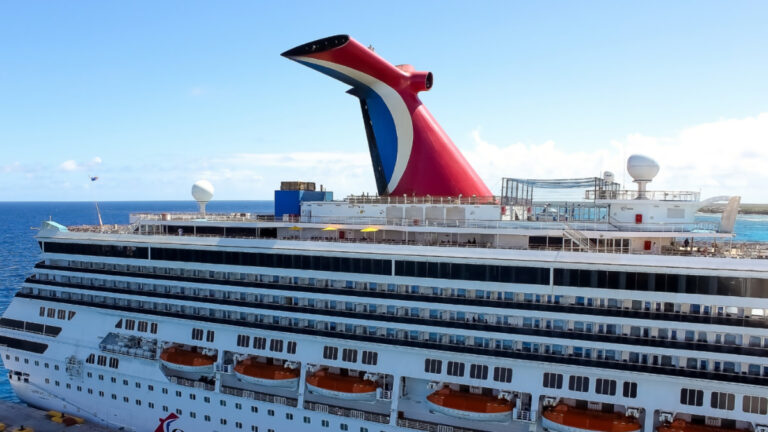
Carnival Panorama is on her way to the second shipyard for her necessary engine repairs, after having been foiled in her attempt to reach the first shipyard – where those repairs will take place – due to low bridges.
Now, the ship is en route to Victoria, British Columbia, where her “whale tail” funnel will be removed, before she can have her engine repairs completed in Portland, Oregon.
Carnival Panorama Engine Repairs Hit Unusual Snag
The urgently needed engine repairs for Carnival Panorama are proving trickier than expected, but not because the repairs themselves are necessarily complicated. Instead, the ship is having difficulty reaching the shipyard in Portland, Oregon, where those repairs will be completed.
The Portland shipyard ready to service Carnival Panorama lies roughly 95 miles (153 kilometers) up the Columbia River from the coast, a route crossed by low-lying bridges. The 133,500-gross-ton, Vista-class ship has 15 passenger decks, with her iconic whale tail funnel rising high above the tallest deck.
Worth Reading: Cruise Ship Diverted for Urgent Repairs Following Severe Weather
That funnel is too tall to pass underneath the river’s bridges, and must be dismantled before the ship can reach the dry dock facilities. It was initially hoped the funnel could be removed in Astoria, Oregon before the ship began moving up the river, but that has proved impossible.
Now, satellite tracking data shows Carnival Panorama heading for Victoria, British Columbia, where the shipyard facilities are equipped to safely remove the upper part of ship’s funnel so she can then return to Oregon and proceed to the dry dock.
After the engines are repaired, the ship will likely need to move back to Victoria once again for her funnel to be reassembled before she will finally return to Long Beach to welcome guests.
While this is a complicated situation, Carnival Cruise Line brand ambassador John Heald has explained that the cruise line did look for alternative shipyards that could service Carnival Panorama, but options at west coast shipyards were limited due to facilities and docking schedules.
“The ship is making a brief stop in Canada and then will head to Astoria,”Heald confirmed about the convoluted arrangements.
Guests Nervous
Guests booked on Christmas and New Year’s sailings of Carnival Panorama are understandably nervous about whether those cruises will be cancelled if the repairs take longer than anticipated.
Both holiday sailings are Mexican Riviera cruises. The Saturday, December 23 departure is the first planned for the ship after repairs are complete, and is a 7-night cruise visiting Puerto Vallarta, Mazatlán, and Cabo San Lucas.
The 8-night New Year’s Cruise will depart on Saturday, December 30 and will call on the same ports as the previous voyage, as well as an extra port of call in La Paz.
Heald has attempted to assuage guests’ concerns and reassure them that the sailings are expected to move ahead as planned.
“We fully expect [the] ship to be back ready to give you all the fun you deserve,”Heald said.“I promise we will keep you updated if anything were to change so please don’t worry, but now we’re saying we can’t wait to see you having fun.”
Cancelled Cruises
When Carnival Panorama first developed these engine difficulties at the beginning of November, the ship’s maximum cruising speed was impacted and the November 4, 2023 sailing had two ports of call cancelled so the ship could return to Long Beach on schedule.
After the difficulties were assessed, four cruises were cancelled so the ship could be removed from service for immediate repairs. As the difficulties with securing dry dock facilities became clear, however, two additional cruises were cancelled to ensure enough time for these technical repairs to be completed and allow the ship to return to service with her maximum propulsion intact.
At the moment, it is hopeful that Carnival Panorama will be full speed ahead for her Christmas and New Year’s cruises, but booked guests should stay in close contact with Carnival Cruise Line for any further notifications, cancellations, or adjustments.
A recent maritime emergency unfolded near Brazil’s Ilha Grande Bay, where an MSC cruise ship played a key role in rescuing six fishermen from a sinking fishing boat.
The incident began when the fishing boat with seven fishermen aboard went missing near Jorge Grego Island, Ilha Grande. On a scheduled deep-sea fishing excursion, the fishermen were due back by Sunday but failed to return, leading to concerns over their safety. A storm in the area had disrupted communication, complicating the situation.
Rescue Operation for MSC Preziosa
On a routine deep-sea fishing trip near Jorge Grego Island, Ilha Grande, a boat with seven fishermen experienced an emergency. The group, which had set out on Saturday morning, November 18, was expected to return by Sunday lunchtime.
However, a storm disrupted the fishermen’s plans, leading to unsuccessful attempts by shoreside authorities to contact them. This triggered a comprehensive search operation involving Fire Department divers, the Port Authority, and various other search and rescue resources such as boats, jet skis, and aircraft.
The SOS call was received by the 137,936 gross tons Fantasia-class cruise ship MSC Preziosa, which had been cruising in the area during a three-night cruise from Sao Paolo to Sao Paolo. Six of the seven fishermen were rescued by MSC Preziosa, and taken onboard.
The rescued fishermen, though distressed, were conscious and alert when transported to nearby Vila do Abraão by the MSC cruise ship. They received immediate medical attention, with one in a weakened state. Tragically, the body of the seventh fisherman was later recovered by firefighters.
MSC Preziosa Cruise Ship in Brazil (Photo Credit: Joa Souza)
Jorge Grego Island, where the incident occurred, is a well-known and popular tourism hotspot. The area around Ilha Grande features often on cruise itineraries in the area.
While the reason behind the incident is likely the storm that had been active in the region over the weekend, the question remains how it could happen that the fishermen were unable to radio for themselves.
Since the accident, the Brazilian Navy stated to the Brazilian newspaper O Dia that it would: “initiate an internal procedure to determine the causes, circumstances, and responsibilities of the incident, as well as to extract lessons to reduce the likelihood of similar future events and to assess whether the bad weather contributed to the incident.”
MSC Preziosa Continues Scheduled Cruises
After bringing the affected fishermen to safety, MSC Preziosa resumed her regular scheduled cruises from Sao Paolo.
The upcoming itineraries include a 3-night South American cruise starting on November 21, with a stop in Camboriu on Brazil’s southern coast. This is followed by a 4-night cruise beginning on November 24, visiting Buzios and Ilhabela.
Photo Courtesy: MSC Cruises
The ship will then offer another 3-night cruise starting November 28, featuring destinations like Buzios and a return to the rescue area, Ilha Grande.
MSC Cruises, one of the world’s leading cruise operators, has established a significant presence in Brazil, catering to a growing market of cruise enthusiasts in the region. Besides MSC Preziosa, other MSC cruise ships that operate in the area include MSC Seaview, MSC Armonia, MSC Lirica, MSC Grandiosa, and MSC Musica.
In response to guest comments, Carnival Cruise Line brand ambassador John Heald has offered some guidance on service dogs onboard, including where the dogs are permitted and what types of service dogs can set sail on the Fun Ships.
Guest Questions Service Dog
On a recent sailing of Carnival Horizon, currently based out of Miami and offering a range of Caribbean itineraries, a service dog was aboard that raised some questions from a concerned guest about the dog’s breed and whether it was legitimately a service dog.
“There was a visually impaired man on our Horizon cruise with a service dog. I have never seen a Giant Poodle dog. I have never heard of these being used as seeing eye dogs,”the guest explained.
“The man was seen playing slot machines in the casino,”the inquiry continued.“My point is dogs should not be allowed to be on board especially in public places like the casino and main dining hall. What checks does Carnival do to make sure this was a real seeing eye dog?”
Fortunately, Carnival Cruise Line brand ambassador John Heald was able to quickly and firmly address these concerns. He first noted that the cruise line does check into service dog requests very thoroughly.
“The only dogs Carnival permits aboard our ships are working service dogs, which are legally defined and individually trained to meet disability-related needs by performing tasks like guiding a blind person, alerting a deaf person, pulling wheelchairs, alerting and protecting a person who is having a seizure, or performing other special tasks,”Heald explained.“Working service dogs are not pets.”
Dog on Cruise Ship (Photo Credit: Zivica Kerkez)
Any breed of dog can be trained as a service dog, and there are different sizes of poodles recognized by dog breeding and kennel club organizations around the world. All poodles are highly intelligent, affectionate, and easy to train, making them an ideal choice as service dogs.
All service dogs are highly trained for individual tasks, as Heald explained. Each individual’s needs will vary, and it may not be immediately apparent what tasks a dog is trained to assist with. There is no single organization that “certifies” service dogs, nor is there any standardized paperwork for any type of service animal.
Carnival’s website does distinguish that “Emotional support dogs, which are not recognized by the US Department of Justice, are also not permitted on Carnival ships.”
Where Can Service Dogs Go Onboard?
Heald also addressed where service dogs are permitted onboard Carnival ships. In short, a service dog will be permitted anywhere guests are permitted.
“We are proud to be able to say that along with following ADA requirements that we love having these guests on board, because they deserve to have Fun as much as anyone… Even more perhaps,” Heald commented. “The dogs are allowed in the dining room. They are allowed in the casino.”
Carnival Cruise Line’s Guests With Disabilities website does cover service dogs, noting that service dogs that are still in training are not permitted.
Photo Courtesy: Carnival Cruise Line
Different ports of call may also have strict entry requirements or limitations for animals, including service dogs, and guests are responsible to meet the requirements of any port if they will want to debark the ship with their service dog.
Onboard, a relief area will be set up for service dogs in an out-of-the-way area using dog litter. Guests can also bring along a different type of litter material if preferred.
When a Service Dog Is Onboard
When travelers realize their cruise includes a four-legged guest, it is important to note that disabilities come in many different forms and degrees, and it is always inappropriate to question whether or not a service dog is necessary or permitted.
The cruise line has done the work to ensure the animal is permitted, and has made the necessary accommodations as needed. If there are any concerns, they should be politely and discreetly addressed with the Guest Services team.
At all times, it is important to treat everyone onboard – guests, crew members, and service animals alike – with respect and dignity, on every cruise.
The sinking of the Titanic continues to fascinate people from all over the world. Everything about the world’s most famous ocean liner is studied with enthusiasm, from its iconic scale and luxury to the details of its tragic maiden voyage.
Today, we will take a deep dive into the story of the Titanic’s demise. Not only will we uncover just how deep the RMS Titanic is, but we will also explore where it sank, the challenges of reaching its wreckage, and the types of efforts that go into exploring the remains of this famous ship.
So, if you are ready to expand your knowledge of the Titanic and its tragic demise, let’s get started!
Today, the Titanic remains deep beneath the surface of the North Atlantic Ocean. To be more exact, it is resting at a depth of roughly 12,500 feet or 3,800 meters below the surface. Given that the average depth of the Atlantic Ocean is approximately 12,100 feet, the Titanic sits at a particularly deep location.
For perspective, this is approximately the equivalent of a 1,155-story building. Currently, the world’s tallest building is the Burj Khalifa in Dubai, UAE, and it rises to a height equivalent to 163 stories.
As you can imagine, this incredible depth makes reaching the Titanic’s wreckage site extremely difficult and dangerous.
When and Where Did the Titanic Sink?
The Titanic sank on April 15, 1912, less than four days after it began its maiden voyage. The tragic event started when the ship struck an iceberg in the North Atlantic Ocean at 11:40 PM. This collision caused significant damage to the ship’s hull, causing ice-cold ocean water to flood into the ship and weigh it down.
When it finally sank, the Titanic was roughly 350 miles off the coast of Newfoundland, Canada. The exact coordinates of the Titanic when it sank were 41° 43’57” N 49° 56.8’49” W.
Why Is it Difficult to Reach the Titanic Wreckage?
Given the immense depth of the Titanic’s wreckage, as well as its remote location, there are numerous challenges that any researchers and explorers must overcome if they plan to visit the remains of the ship.
Intense Water Pressure at Wreckage Site
Colossal water pressure will always be an issue when discussing any object that sits 12,500 feet under the water. At such a tremendous depth, the pressure is nearly 400 times more intense than you would experience at the surface.
This type of water pressure can instantly crush metal and destroy research submarines not specially designed to withstand these forces.
Extremely Cold Water Temperatures
Aside from the intense pressure at the Titanic’s depth, water temperatures in the North Atlantic Ocean are frigid, even at the surface. The deeper you go, the colder the water temperature becomes. Naturally, these freezing cold conditions pose a significant risk to the explorers but can also present a series of challenges to the equipment.
Titanic Sailing Near Icebergs (Image Credit: Elenarts)
To safely operate a manned exploration submersible, the submarine needs to be designed to function in extreme cold and keep occupants warm enough to survive.
Total Darkness and Visibility Limitations
At the type of depths where the Titanic rests, natural light can’t reach. This means the Titanic’s wreckage sits in total darkness throughout the entire year; any exploration effort needs to involve powerful underwater lighting systems that can improve visibility. The illumination systems must do everything with a complete lack of natural light, so they need a significant power supply.
Beyond the lack of light, there is also the fact that sediment from the ocean floor can make it even more challenging to locate and see the Titanic’s wreckage. Even slight movements along the ocean floor can disturb the sediment and silt, making studying and exploring the shipwreck nearly impossible.
What Is the Condition of the Titanic Wreckage?
Given that the Titanic has been sitting at the bottom of the North Atlantic Ocean for over 100 years, it is in a very fragile and deteriorated state. Again, this complicates any effort to explore the wreckage or retrieve artifacts from the shipwreck site.
Metal components of the Titanic, such as its enormous hull, have undergone extensive corrosion. Constant exposure to saltwater and the immense water pressure has seriously deteriorated the ship’s metal structures. Organic materials, like the Titanic’s renowned wooden interiors, have decayed over the years.
The exterior of the ship itself underwent significant damage during the sinking. In fact, the Titanic is split into two main sections, which fell apart from each other during the ship’s final descent to the ocean floor.
The Titanic Wreckage in the Deep Atlantic Ocean (Photo Credit: NOAA)
The bow section, where most of the Titanic’s passengers would have been, actually sits roughly 2,000 feet away from the stern area of the ship.
When the Titanic was sinking, the ship broke apart, but it was during the descent that the two pieces really separated. When they eventually hit the ocean floor, it is believed that they hit at different angles, which forced them even farther apart.
Furthermore, numerous attempts to explore the ship’s remains and retrieve artifacts have damaged the Titanic’s wreckage even more. While most research expeditions have preservation as one of the primary goals, the remains of the Titanic are incredibly fragile due to corrosion and decay.
What Is the Condition of the Interior of the Titanic?
The interior of the Titanic is in even worse shape than its exterior. This is due to significant deterioration. While corrosion is eating away at the ship’s metal hull, the wooden components featured so heavily in the design of the ship’s lavish interior have decayed heavily.
That said, exploring the ship’s interior is even more difficult than visiting its exterior, so much of it remains a mystery. Naturally, the tight spaces make manned missions extremely difficult. Even unmanned submersibles struggle to reach the ship’s interior without damaging it.
While many assume that the Titanic is enormous and exploring the interior would be relatively simple, the ship was not as big as you may think. It was indeed a marvel of engineering for its time, but cruise ships of the modern day would dwarf it.
When Was the Titanic Wreckage First Reached?
In September of 1985, a joint French and American research expedition launched by Dr. Robert Ballard became the first successful attempt to locate and visit the Titanic wreckage site. This groundbreaking discovery involved the use of a remotely operated submarine called Argo.
While it was an uncrewed expedition, it was considered a major scientific breakthrough due to the incredible depths of the Titanic wreckage. It also resulted in the first images of the Titanic since its tragic sinking, which reignited global interest in the Titanic and its tragic maiden voyage.
Titanic at Sea (Photo Credit: meunierd)
In 1986, just one year after the Argo expedition, Dr. Robert Ballard launched the first successful crewed expedition to visit and explore the Titanic. As you would expect, safety was a significant concern due to the immense depth of the wreckage. To reach the Titanic, the team of oceanographers and underwater archeologists relied on a deep-sea submersible named Alvin, which was created and operated by the Woods Hole Oceanographic Institution.
This expedition marked another critical moment in Titanic exploration. It also resulted in the capture of detailed imagery and video footage of the shipwreck. This information proved incredibly useful for later manned and unmanned exploration attempts. More importantly, it gave researchers an accurate picture of the shipwreck’s condition, location, and exact depth.
What Types of Technology Are Used to Reach and Explore the Titanic Wreckage?
Given its immense depth, specialized deep-sea technology must be used to explore the Titanic wreckage site.
As was evidenced by the very first successful mission, unmanned submersibles, known as remotely operated vehicles (ROVs), continue to play an essential role.
These specialized vehicles are designed to withstand immense water pressure while eliminating the dangers of sending people down to the bottom of the ocean. They can capture images and video footage and retrieve and manipulate artifacts with remote-controlled arms.
Crewed submersibles, like Alvin and DeepSea Challenger, allow human observers to visit the site. These specialized miniature submarines need incredibly durable outer hulls that can withstand the metal-crushing pressure of the ocean floor.
DeepSea Challenger (Image Credit: Jacques Dayan)
They also need to be capable of keeping occupants warm and provided with breathable air. Like unmanned submersibles, they feature high-resolution cameras, powerful lighting systems, and telescopic arms that can retrieve artifacts from the wreckage site.
Sonar mapping systems were also used heavily during the attempts to locate the wreckage. Today, these systems continue to play a role during expeditions, allowing researchers to map the ocean floor surrounding the Titanic.
Modern submersibles are also equipped with more advanced side-scanning sonar systems that can be used to create detailed 3D images of the Titanic and the seabed surrounding it.
These advanced technologies make research expeditions possible and enable researchers to study the wreckage site without disturbing it. Given the fragile state of the Titanic wreckage, preservation is now one of the most important concerns whenever any expedition is launched.
Frequently Asked Questions (FAQs)
How long did it take for the Titanic to sink to the bottom of the ocean?
While it is impossible to say for sure, researchers can use the depth of the wreckage and the Titanic’s weight to come up with reasonable estimates of how long it would have taken for the doomed ship to reach the ocean floor. These estimates must also consider other factors, such as ocean currents and the ship’s angle.
According to these calculations, most researchers agree that the Titanic would have taken five to ten minutes to reach the bottom of the North Atlantic Ocean. This means that the two sections of the wreckage would have traveled at an average speed of approximately 70 kilometers per hour during their descent!
Will the Titanic continue to sink even deeper into the ocean floor over time?
While the wreckage does shift over time, it will not sink any deeper into the ocean floor. According to researchers and experts, the Titanic’s remains have remained relatively stable since they first settled on the ocean floor.
With that said, sediment and marine life are building up on the surface of the Titanic, which will continue to give the appearance that the Titanic is continuing to sink to further depths.
How long does it take to reach the depth of the Titanic in a research submarine?
While the amount of time it takes to reach the Titanic’s depth will depend on the submersible being used, most expeditions tend to take between two and four hours to reach their final depth.
This can make the descent a lengthy and stressful event for crewed missions. As you may know, these types of expeditions can be incredibly dangerous. In fact, the recent OceanGate Titan expedition failed during the descent, as the submersible could not withstand the immense water pressure at that depth. Sadly, this doomed expedition resulted in the loss of five lives.
Final Words
Everything about the Titanic and its doomed voyage is fascinating. Part of what makes it such an alluring story is that its final depth of 12,500 feet is challenging to visit. In many ways, its final resting place at the bottom of the Atlantic Ocean means it almost feels otherworldly.
Despite the difficulties posed by visiting a wreckage site approximately 12,500 feet below the surface, researchers and adventurers from around the world continue to take risks to explore the wreckage site and uncover the secrets of this legendary ocean liner.
While the bottom of the North Atlantic Ocean may hold many mysteries, the wreckage site of the Titanic continues to be amongst the most captivating. If interested, you can learn more about the Titanic and how it compares to modern-day cruise ships.
At least one cruise line has cancelled all shore excursions to Blue Lagoon Island in the Bahamas following the sinking of a ferry boat and the death of a cruise passenger on Tuesday, November 14.
Royal Caribbean International has temporarily suspended all tours to the island at least through Thursday, November 23, 2023.
Royal Caribbean Cancels Shore Tours
Royal Caribbean has sent notices to all guests with pre-booked shore excursions for Blue Lagoon Island for the next week that their tours have now been cancelled. This includes tours such as beach breaks, dolphin swims, stingray encounters, and similar excursions.
“We’re currently working with authorities to evaluate a boat incident that took place during a shore excursion,”the notification to guests read.“In light of this incident, we have decided to cancel all Blue Lagoon tours through November 23.”
During the next week, Royal Caribbean has 11 ship calls scheduled for Nassau, and guests booked on all those vessels will have their Blue Lagoon Island excursions cancelled and fully refunded. No other shore tours are affected.
Cruise Passengers on Sinking Boat in Nassau, Bahamas
The impacted ships include the cruise line’s Symphony, Mariner, Liberty, Allure, Adventure, Independence, Vision, Freedom, and Anthem “of the Seas” ships.
Two vessels – Allure of the Seas and Liberty of the Seas – both have two visits to Nassau in that time period – on Saturday, November 18 and Wednesday, November 22 for Allure of the Seas, and on Saturday, November 18 and Thursday, November 23 for Liberty of the Seas.
“We’re sorry for any inconvenience caused by this. Please know your safety is our top priority,”the notification concludes.
While the suspension is only through November 23 at this time, it is possible the cancellations will be extended further and additional cruises will be impacted, depending on how long the incident investigation takes and what its conclusions may be.
Renewed safety inspections of Blue Lagoon ferries or updated certifications may also be necessary before the cruise line will resume offering the tours.
Will Other Cruise Lines Cancel as Well?
It is likely that other cruise lines may similarly cancel Blue Lagoon Island excursions for the time being, depending on their own tour offerings and safety considerations. How long such excursions may be cancelled will be up to each individual cruise line.
Through the end of the month, ships from Carnival Cruise Line, Celebrity Cruises, MSC Cruises, Disney Cruise Line, and Norwegian Cruise Line are all scheduled to visit Nassau and may have their shore tour options impacted.
Photo Credit: YULIYAPHOTO / Shutterstock
A Royal Caribbean spokesperson has confirmed that the 74-year-old female cruise guest who died in the incident was a guest aboard Independence of the Seas, the only Royal Caribbean ship visiting Nassau the day of the accident.
Tour companies, which are independent contractors and not affiliated with any cruise line, often combine tour offerings from multiple vessels, particularly for transportation to tour sites. It is possible that guests from different cruise lines were also aboard the stricken boat.
According to guests on the ship as well as video of the incident, large waves hit the double-decker ferry which then began taking on water. The boat listed severely and eventually sank in the relatively shallow water close to Blue Lagoon Island, eventually stabilizing with the top deck still above water.
Cruise lines occasionally cancel shore excursions due to bad weather or other reasons, such as lack of adequate transportation or staffing on the part of the tour company to accommodate all interested guests.
In the meantime, guests can enjoy a wide range of great activities when visiting Nassau, including visiting the Atlantis resort and waterpark, snorkeling, the famous “swimming with the pigs” tours, beach breaks at different local resorts, jeep adventures, cooking classes, historical tours, the dancing flamingos of Ardastra Gardens, glass bottom boat tours, and more.
The US Coast Guard has officially suspended search efforts in the Gulf of Mexico for the missing guest from Carnival Glory.
The guest was reported missing on Monday, November 13 and later confirmed overboard, but despite an exhaustive search and rescue effort with multiple air assets, crews were unsuccessful in locating the passenger.
Search Suspended for Carnival Glory Guest
A 28-year-old male guest from Carnival Glory, identified as Tyler Barnett of Houma, Louisiana, was reported missing on the afternoon of November 13, and after emergency operations failed to locate him onboard the cruise ship, the US Coast Guard (USCG) was alerted to begin a search. That notification was received at approximately 12:40 p.m. on Monday afternoon.
That search has now ended as the USCG has suspended efforts without success, despite covering approximately 5,625 square miles (14,570 square kilometers) of search area, an extraordinarily broad search zone roughly larger than the state of Connecticut.
#UPDATE The Coast Guard suspends search for missing cruise ship passenger.
Coast Guard crews searched approximately 5,625 square miles, roughly larger than the size of Connecticut.
“The Coast Guard launched multiple search and rescue assets as soon as we were notified of a missing passenger from the Carnival Glory,”said Lt. Cmdr. Sean DiGeorge, Coast Guard District Eight search and rescue mission coordinator.
“Our crews battled severe weather conditions for multiple days and made every effort to find Mr. Barnett. Suspending an active search is never a decision we make lightly, and we offer our most sincere condolences to Mr. Barnett’s family and friends.”
The search area was so large, covering roughly 200 miles of the ship’s route, because initially it was not known what area to search, as the time of Barnett’s disappearance was not immediately clear.
US Coast Guard Search of Missing Carnival Passenger
A review of security footage from the cruise ship did finally determine that Barnett had gone overboard at approximately midnight between Sunday and Monday, which allowed the search area to become more focused.
Search assets involved in the operation included HC-130 Hercules aircrews from Air Station Clearwater, Florida; HC-144 Ocean Sentry aircrews from Aviation Training Center Mobile, Alabama; and a MH-60 Jayhawk helicopter aircrew from Air Station New Orleans.
An alert was also issued to all marine craft near the search area to keep a lookout for the missing passenger, ultimately to no avail.
Weather Hampered Search Efforts
Rough weather in the search area, including gale force winds and significant waves, forced search efforts to be paused overnight Monday and again overnight Tuesday when visibility became inadequate for efficient searching and too hazardous for the aircraft to continue. The search was resumed as soon as crews could safely do so.
The poor weather would also impact the probable survivability of an individual in the water, which can contribute to the decision to suspend search efforts.
Carnival Glory is currently sailing a 7-night Western Caribbean cruise, having departed New Orleans on Sunday, November 12, with port visits to Montego Bay, Jamaica; George Town, Grand Cayman; and Cozumel, Mexico.
The 110,000-gross-ton, Conquest-class ship’s itinerary has not been affected by this incident, and the vessel will return to New Orleans on Sunday, November 19, as scheduled.
Overboards Rarely End With Good Results
Unfortunately, while search efforts are always made in earnest, they are not always successful.
In incidents when an overboard is noted quickly and a response can be immediate, it is must more likely that an individual in danger can be found with a positive result.
In the realm of cruise vacations, internet speeds have always been the one thing that has disappointed guests. A significant leap forward has been the introduction of Starlink Internet onboard cruise ships in the last year or so.
However, Carnival Cruise Line is taking this a step further with the introduction of 5G mobile connectivity on Carnival Jubilee, signaling a new era of hyper-connected cruise travel.
Carnival Jubilee Pioneers 5G Connectivity at Sea
Carnival Cruise Line announced a groundbreaking development for its upcoming cruise ship, Carnival Jubilee, on November 16. The cruise ship will be the first in North America to offer guests the luxury of 5G mobile phone service. This industry-first initiative is a result of a collaboration with Wireless Maritime Service (WMS), a leading cellular provider.
Luis Terife, Vice President of Onboard Guest Commerce at Carnival Cruise Line, emphasizes the significance of this advancement.
“Carnival Jubilee will be the fleet’s most-connected ship – literally raising the connectivity bar for our guests and serving as another big step in a period of vigorous advancement of our onboard connectivity,”Terife said.
Scheduled to launch in December, the 5G-enabled Carnival Jubilee represents a new chapter in cruise ship connectivity. Guests will be able to access this service early in 2024 through various service plans offered by their wireless carriers.
John Harshaw, Vice President of Global Infrastructure at Carnival Cruise Line: “We’ve received very positive feedback from our guests who are enjoying the more reliable Wi-Fi across the fleet as we continue to increase our capacity through Starlink and other service providers.”
This initiative not only upgrades the guest experience on Carnival Jubilee but also sets a precedent for the rest of the fleet, with plans to extend 5G capabilities to other ships.
However, guests might have some issues finding a carrier that is capable of offering the type of data sets that 5g requires. Major wireless carriers have yet to align their current cruise ship service plans with this new technology.
The existing cruise plans from AT&T, Verizon, and T-Mobile primarily focus on providing traditional cellular services, like talk and text, with limited data options, and do not specifically cater to 5G connectivity.
Carnival Cruise Line Onboard Connectivity
The introduction of 5G on Carnival Jubilee is part of a broader strategy to enhance internet accessibility on all Carnival ships. The cruise line has completed upgrades across its 25-ship fleet, installing the infrastructure needed for SpaceX’s Starlink Satellite service.
“The ongoing enhancements we’re rolling out on all of our ships, such as SpaceX’s Starlink satellite internet service, make it significantly easier for guests to share the memorable experiences of their cruise with friends and family.” Terife added.
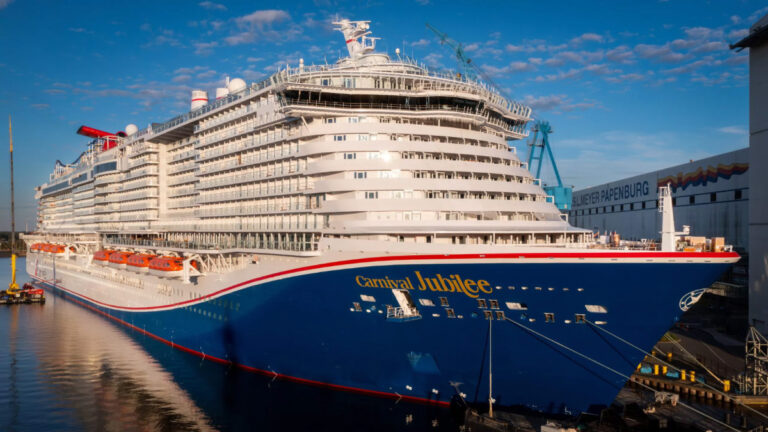
Carnival Jubilee Conveyance on the Ems (Photo Credit: Carnival Cruise Line)
This comprehensive approach ensures that guests have access to the most robust and reliable service available, backed by partnerships with multiple internet vendors.
“Our multi-provider, multi-orbit strategy minimizes single-provider supply chain constraints and improves overall connectivity in support of our operations and the enhanced experience for our guests and team members,” according to Harshaw.
Carnival Jubileerecently completed her sea trials and is set to make its debut voyage from Galveston on December 23, 2023. She will offer week-long Western Caribbean cruises, including visits to popular destinations like Cozumel and Costa Maya in Mexico, and Mahogany Bay in Roatan, Honduras.