Cruise ships are so massive that it is natural to be curious as to what the lowest deck on a ship is like and whether there are any advantages to traveling on the lowermost deck.
Surprisingly, there are some benefits to skipping the main deck or the upper deck and an interesting history behind the name.
The lowest deck on a ship is known as the orlop. This is the area where cables tend to be stowed, and it’s usually located below the water line. It is suggested that the name “orlop” originates from the over-looping of cables.
It may also reference a corruption of the word overlap, which references an overlapping balcony half deck that consumed part of the lowest deck space.
How Are Decks Numbered?
Cruise ships tend to be numbered going from the bottom up. It begins with Deck 1 and can go up as high as Deck 20-plus. On most ships, the lowest deck isn’t accessible to guests. Passengers tend to board a cruise ship on Deck 4 or 5.
Cruise Ship Deck Number (Photo Credit: Bjoern Wylezich / Shutterstock)
Some vessels have deck names in addition to numbers. An example is the MSC Grandiosa, where decks contain the names of famous artists like Van Gogh and Monet. On Costa Deliziosa, they’re named after ornamental flowers.
What Is the Lowest Deck for Passengers?
For some ships, Deck 1 is the lowest deck of the ship. For others, Deck 1 is the lowest deck that is accessible to guests. With Disney Cruise Lines and Carnival Cruises, cabins can be booked on Deck 1. For others, the lowest cabins are found on Deck 3 or 4.
Photo Copyright: Cruise Hive
Below guest cabins, the crew cabins, engine rooms, laundry, medical center, and jail can exist. Some ships choose to label these as Decks 1 and 2. On cruise ships containing passenger cabins on Deck 1, the lower levels may be labeled Decks A, B, and C.
Are There Benefits to Staying on a Lower Deck?
For some passengers, having a cabin on the lowest passenger deck is the best way to prevent seasickness. The top of a cruise ship will sway side-to-side more than the bottom decks. To avoid the effects of motion sickness, select a cabin close to the waterline.
If motion sickness is of great concern, book a cabin that contains a balcony. Guests who can sit on their balcony and view the sea may feel less nauseous than when resting on a bed in a windowless cabin. With a windowless cabin, passengers are more likely to feel each motion than when they are outdoors.
Photo Credit: Pau Peset / Shutterstock
If a balcony stateroom isn’t in your budget, book a room that contains a window. These are located on the lowest decks. They will enable you to view the horizon and enable your brain to cope with motion. This will help with the queasiness through rough seas.
Additionally, if you have difficulties with mobility, accessible cabins are usually on lower decks since they are closer to disembarkation and embarkation.
They are also closer to theaters, lobbies, and main dining rooms, making them more accessible. They can be roomier in the halls, which makes moving around easier for those in wheelchairs.
Are There Any Downsides to the Lowest Deck?
If you are a passenger, cabins in this area are the cheapest. It can be quite noisy residing in the lowest part of a ship. You may hear the humming of the engine, clanging of anchor chains, and blast of bow thrusters.
Costa Smeralda Cruise Ship (Photo Credit: Stefano Garau / Shutterstock)
Depending on the cruise ship, some people report they feel vibrations that are severe enough to make hangers rattle. However, not all low decks are noisy. Yet, at certain times, during bad weather and when a ship is going in and out of ports, guests can hear more noise on lower decks than on higher ones.
Summary
When asking the question “what is on the lowest deck of a ship?” you may have to clarify whether you want to know the absolute lowest deck on a ship or the lowest passenger deck. There may be differences in the answer depending on how the person is interpreting your question.
Some people will interpret the question to be the absolute lowest level on a ship. That would be the orlop, which holds the cables found below the waterline. This is what this area is referenced as unless you are discussing ships that are very old.
In terms of passenger levels, the lowest deck would be the level above the engine. One is a more technical answer, while the other is more of a passenger reference. When it references passenger levels, there are pros and cons to having a cabin in this area. Each advantage and disadvantage varies according to the cruise line.
Many people marvel at the sheer size of cruise ships. They secretly wonder how something so large and heavy could move so easily in water or how something that massive could even float in the first place! In this post, we’ll explain how cruise ships float.
The answer to this question boils down to materials, design, water displacement, and buoyancy. So, in short, a combination of design and physical elements.
Cruise ships were designed to be massive yet displace the same amount of water that is equivalent to their mass. The ocean’s pressure, at the same time, pushes against the hull of the ship, countering the downward force of the mass of the cruise ship. This downward force in conjunction with the ocean’s upward force work in tandem to make the cruise ship buoyant.
The Science Behind It
This concept is known as Archimedes’ Principle. Archimedes’ Principle teaches that when an item floats, the weight of the displaced water equals the weight of the object. Surrounding fluid will push back with a force that is equal to the displaced amount. When the two forces are equal, the object will float.
In other words, while a cruise ship rests in water, it provides room for its mass by displacing water outward and downward. The opposing forces’ balance is what causes it to float.
Additional Features Supporting Buoyancy
Displacement and buoyancy aren’t the only factors keeping cruise ships floating. There are additional factors in play as well.
Design and Material
To achieve any type of buoyancy, cruise ships must be made of sturdy, lightweight materials that are denser than water, for example, extra-strength steel. Plus, these materials must be used with a design allowing them to displace the weight in water prior to it being submerged.
Most of the design tends to be incorporated into the hull. The hull is the shell or body of the vessel that rests below the main deck. It pushes the water out of the way when the cruise ship is in motion and permits it to float.
Photo Via: Meyer Werft
Through years of experimentation, engineers discovered that if they created a wide, rounded, and deep hull, it better disperses the cruise ship’s weight across the body. A large cruise ship will have a hull shaped like a “U.” It permits water to flow away from the cruise ship, creating a smooth ride, dissipating drag, and keeping the cruise ship on schedule.
Other Safety Features and Double Hulls
Cruising smoothly and remaining afloat is not enough for a vessel. The hull design needs to protect guests against reefs, icebergs, and sandbars. These underwater hazards are capable of easily ripping apart a ship’s outer layers, causing damage or sinking it.
To protect against this, builders use extra-strength steel. This is used to build vessels containing double hulls (one hull is located inside the other) to provide additional protection. Vessels also have bulkheads helping them float in case the cruise ship receives major damage.
Cruise Ship Hull (Photo Credit: Andrew Pridmore / Shutterstock)
The watertight divider is installed through the ship’s interior. It can be closed to prevent water from rushing in if the hull is damaged. Limiting the inflow of water prevents cruise ships from sinking and flooding.
How Does a Ship Stay Standing Up?
With cruise ships testing the limits of height and weight, one must wonder what prevents them from capsizing. The answer to this question rests in the design of the hull. However, to appreciate this, you must first comprehend the differences in a ship’s center of buoyancy and center of gravity.
More Science … Shifting Center of Buoyancy
The center of gravity of a ship (central focus points for gravity’s push downward) can’t be changed. Therefore, a cruise ship’s U-shaped hull is created so the center of buoyancy shifts naturally as the vessel tilts sides. This change in center of buoyancy helps to push the ship back to its upright position, no matter how large it is.
Cruise Ship Buoyancy (Image Credit: Fouad A. Saad / Shutterstock)
Center of Gravity
If everything contained on a ship weighed the same, the center of gravity should be in the middle. However, engines, machinery, and fuel weigh much more than things like passenger spaces, cabins, or theaters.
This creates an effect where the center of gravity is placed downward. The center of gravity for a cruise ship is toward the bottom half of the vessel.
Maintaining Centerline
When ships are upright, the force pushing it can swing past the centerline, causing it to tilt to the opposing side. This is known as rolling, which can cause passengers to experience seasickness. To address this issue, cruise lines contain several features limiting the roll of the ship.
Photo Credit: J. Helgason / Shutterstock
This includes stabilizing fins located below water and an active ballast tanks/anti-heeling system. An anti-heeling system rapidly pumps the sea water located below the waterline into holding tanks found on one side to the other. This will correct sideways leans.
Conclusion
The stabilizing features of cruise ships are very effective. In fact, these vessels are so well made that it is rare for guests to experience or feel side-to-side motion. Even more so, cruise ships never turn over despite being so huge and heavy.
Witnessing a large cruise ship slice gracefully through a calm, blue ocean can be quite fascinating. What is more remarkable is learning how these modern marvels are equipped to float on water. When examining how cruise ships float, the answer truly lies in a mixture of scientific principles and design.
Cruise ships were created with not only physics in mind, but also with how to make the ship more durable. While we learned many years ago that no ship is indestructible (Titanic, anyone?), engineers have learned how best to protect passengers on board. This enables the cruise ship to be safe while gracefully gliding through even the most turbulent waters without capsizing.
While the movement looks effortless, there is a great deal of engineering beneath the surface keeping it afloat.
Just looking at a cruise ship makes people wonder how it doesn’t capsize during harsh weather conditions. It looks incredibly top-heavy. So, what happens when a cruise ship hits a giant wave? Who will be the victor in this scenario?
Well, before we get into that, there are measures that are put into place to prevent the worst-case scenario from occurring. Cruise lines put a lot of money and effort into ensuring that guests and crew are always kept safe.
Preventative Measures: Monitoring Weather
Modern cruise ships contain the best weather forecasting equipment available. This is far better than what can be searched on your smartphone.
The command center (bridge) has a plethora of satellite images with storms, weather maps, computer models from NOAA (National Oceanic and Atmospheric Administration), and third-party meteorologists. Plus, the officers and crew constantly monitor the forecasting equipment.
Photo Credit: Philip Schubert / Shutterstock
Safety is always a priority for cruise lines. Many use additional layers of precautionary measures in case they encounter a rogue wave. For example, Royal Caribbean hired James Van Fleet in 2017 as the first industry-dedicated meteorologist. James previously worked for 20 years as a television meteorologist.
Felt so good being back on the Bridge with our @RoyalCaribbean Officers last week in Alaska, Canada, and Washington. Miss them sooo much. Video Conference Calls just aren’t the same. Looking forward to being back on more Ships later this year after peak Hurricane Season wraps up. pic.twitter.com/HNbWnu1bYQ
During seasons of high typhoons and hurricanes (June to November), James is in Royal Caribbean’s Miami headquarters monitoring a wall of weather screens.
He shares this information with 26 different ships plus an executive team. James reports that he can see storms from 7-10 days out. He can advise other ships on ways to avoid it.
Prevention: The Overall Design
Modern ships are designed to withstand heavy weather and remain on schedule. Hurricanes are the largest and most dangerous type of storm any crew may face. No one wants to be caught in the middle of one.
Weight
Cruise ships are made of heavy steel, making them quite weighty. Add passengers and crew, and the ship is even heavier. With all this weight, the vessel can easily roll through rough waters or a rogue wave. It’s more dangerous to be on an empty ship as the additional weight acts as a balancer in rough seas.
Photo Credit: Royal Caribbean
In the roughest waters, the worst that can happen is a ship may tilt to one side. However, this is unlikely. Shipbuilders will test the center of gravity and buoyancy while the ship is being constructed. This involves placing scale models of the ship through different types of storm simulations. They ensure that all cruise ships are designed to handle storms even when it is hurricane season.
Center of Gravity
If the entire weight of the ship was evenly distributed, the center of gravity would be in the middle. However, machinery, engines, fuel stores, and other items weigh more than passenger areas, cabins, restaurants, theaters, etc.
This drags the center of gravity downward. Therefore, a cruise ship’s center of gravity is at the bottom half of the vessel.
Center of Buoyancy
When examining the center of buoyancy, one looks at what parts of the ship are underwater to locate it. All that is needed is finding the center of its water plane area. This involves finding the center of the part of the ship located underwater.
Cruise Ship Bow
The buoyancy of anything on the water depends on density. If the object is denser than the surrounding water, the item sinks. If it is less dense, the object floats.
What prevents cruise ships from sinking is the opposing upward force and water pressure. The upward force weighs about the same as the displaced water, preventing the cruise ship from sinking.
What Happens During a Storm?
Bad weather can push a cruise ship to one side. The ship remains upright because all the heavy equipment is located below deck, providing a low center of gravity. The shape of a cruise ship’s hull is rounded and wide. This enables it to move smoothly through ocean waters with minimal drag.
A rounded edge increases the stability of a ship, preventing it from rocking and swaying. It also reduces motion sickness.
Photo Credit: Steve Heap / Shutterstock
When it comes to balance, cruise ships contain ballast tanks. They have water that can be pumped to either side of the ship. In emergencies, they help keep ships balanced, reduce rocking effects, and counter large waves. Larger vessels will contain several ballast tanks.
What prevents a ship from capsizing is a combined effort of having a low center of gravity, a cruise ship’s buoyancy, and ballasts.
When Will a Ship Be Rerouted?
Unfortunately, captains can’t always avoid every storm. There are many factors at play, like being on a tight schedule, running low on fuel, and trying to minimize costs associated with fuel.
While safety always comes first, captains must assess the situation and do what is best. This involves examining all variables and minimizing potential damage.
Cruise ships will stick to destinations where bad weather can be avoided, like the Caribbean in the winter or the Mediterranean during summertime. However, going to Caribbean destinations is popular with families when children are on summer vacation even though they may face unpredictable weather during hurricane season.
Photo Credit: STUDIO MELANGE / Shutterstock
However, if the seas become rough, ships have the technology onboard to stabilize themselves. If there is a serious storm ahead, a cruise ship will try to avoid or outrun it. Ships can be steered away from fog, hurricanes, typhoons, and huge storms.
Even when they encounter the weather, cruise ships will attempt to find the calmest patch of sea. If the storm is unavoidable, the itinerary may be changed, which could involve heading into a different port or lengthening or shortening a cruise by a few days.
All decisions are made in collaboration with the captains, with the safety and comfort of passengers the top priority. Ships can dock in alternate ports, ports can be skipped altogether, or sometimes ships remain at sea for a few hours prior to reaching port.
There are various ways that the captain and crew can handle the situation.
Hurricanes: The Worst-Case Scenario
Storms are a part of life at sea. For the most part, the ship’s captain and crew pay close attention to weather reports. They make informed decisions on their navigation and may need to make some adjustments along the way due to inclement weather. The captain may decide to slow down to miss a storm or change course.
Photo Credit: Mike Mareen / Shutterstock
But there may be times when a course correction cannot be completed in time and the cruise ship is destined to hit a storm.
The worst storm to encounter is a hurricane. While it is rare to experience this on a cruise ship, we did include it for those who are curious about what would happen in the worst-case scenario. Entering a hurricane would be one of them.
So, who would be the victor between a cruise ship vs giant wave? Cruise ships are designed with proactive measures in place, enabling ships to avoid the effects of going through a storm.
Cruise ships are designed with measures put into place to ensure they’re kept afloat. For the most part, a cruise ship should be able to handle turbulent environments.
As the cruise industry ramps up to 100% operational status, protests over the arrival of cruise ships in environmentally important areas are on the increase as well.
Although the industry has been adamant that the environmental damage is decreasing due to the introduction of LNG-powered vessels and the promise to be carbon neutral in 2050, protesters in five Norwegian Ports met cruise ship passengers stating their presence is not wanted.
Protestors campaign against cruise ships in Norway
A campaign group has been meeting arriving cruise ships in five different Norwegian ports to protest against the environmental and social damage the vessels are causing, according to CruiseNOTWelcome.
The group put up thousands of posters in ports popular along the Norwegian Fjords route, such as Flåm, Trondheim, Stavanger, Bergen, and Oslo.
CruiseNOTWelcome hopes to draw attention to what it calls the detrimental impact the cruise industry has on the environment through carbon emissions, but also dumping of grey water, and unverified accounts of throwing rubbish overboard.
The posters had writing on them that stated: “Please go back to your boat and tell all on board that you are parasites. You are NOT welcome in Norway!” others read, “CRUISE? Just don’t!”
It’s not just the environmental aspect the protestors are campaigning against. The posters state cruise ships are primarily registered in ports of convenience, don’t pay taxes, and the many tourists coming from the ships cause towns to overflow in Norway.
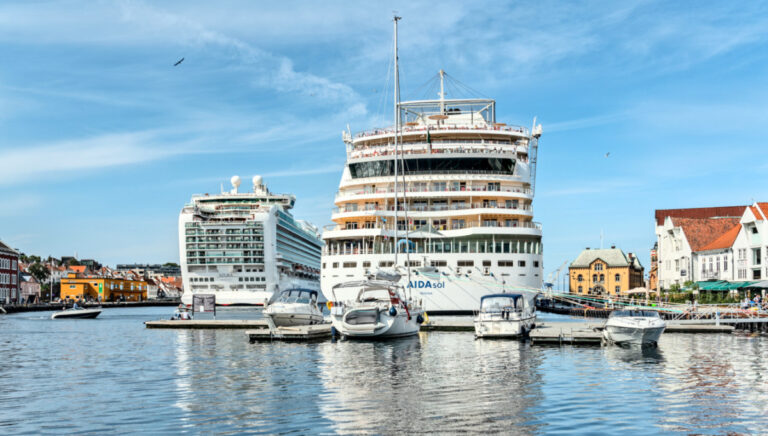
Stavanger, Norway (Photo Credit: Richard Walker Media / Shutterstock)
The founder of the campaign group, Bengt Erik Waldow, says the following on his website: “We are tired of the cruise shipowners profiting from spying on our common infrastructure while registering their ships with flags of convenience to avoid taxes on labor on turnover on board while giving workers on board miserable working conditions.”
“We are tired of having to queue in our own cities. We are tired of shipowners’ floating hotels being driven by cheap asphalt-like oil that pollutes the air we breathe and contributes to enormous CO2 emissions.”
Cruise Industry In Norway Booming
While there might be protests, the cruise industry continues to receive a warm welcome from most of the residents of the Nordic country. The sector plays a significant role in the development of the tourism industry in the Norwegian Fjords area in particular. So much so that for this year alone, there are more than 2,950 port calls scheduled in the country.
Norway expects to welcome more than four million cruise passengers this year and onboard more cruise ships than have ever visited the country before.
The government expects a rise in cruise ship calls of around 700 calls over 2019. Much of this has to do with several cruise lines canceling their Baltic cruises due to not being able to visit St. Petersburg.
In 2017, Norway was the busiest cruise country after traditional cruise countries Spain, Italy, the UK, Germany, and France. The total direct cruise expenditure reached 712 million euros in that year alone. A number that will be nearly doubled according to estimates in 2022. According to CLIA, this growth is achieved together with local governments and communities:
Cruise Lines International Association (CLIA): “CLIA and our member lines work closely with communities and local governments in ports and destinations around the world to deliver sustainable tourism.”
“Our ships are greener and more efficient than ever before, as the industry leads the way in the development of new environmental technologies. Cruise lines have committed to a vision of net-zero carbon cruising by 2050.”
With the increase in cruise ship traffic, it comes as no surprise that some would rather see cruise ships disappear entirely, as we saw in Venice last year. However, the cruise industry does create income for residents, suppliers, agents, and the local tourism industry.
Banning ships is not the answer to the problems that CruiseNOTWelcome points out. Regulating traffic while decreasing the environmental impact is. Something the cruise industry has been more than willing to work towards in recent years.
Norwegian Cruise Line has announced the finalists of its 2022 “Giving Joy” cruise vacation giveaway, a promotion that draws connections between education and travel and rewards 100 teachers with dream vacations.
Grand Prize Winners, which have not yet been announced, will also receive significant funds for their schools.
Giving Joy Teachers Announced
Now in its third year, the Giving Joy program accepts nominations of teachers, then permits open voting to select which teachers show the greatest dedication and best inspire their students. The top 200 semi-finalists have their credentials and experience verified, before the 100 finalists are announced.
Those 100 deserving teachers have now been revealed, and include educators from all grade levels and subject areas. The 100 finalists come from 27 different U.S. states, Puerto Rico, and two Canadian provinces. Entries were open to all eligible educators in the United States and Canada.
The contest period ran from Teacher Appreciation Week in early May through early June.
Finalists include educators from public and private schools and universities, involved in all types of programs and activities at their respective schools.
“Each of these educators dedicate themselves to their students and their communities. Their role is to broaden their students’ horizons with new experiences, and now we are honored to have the opportunity to do the same for them,”said Harry Sommer, president and chief executive officer of Norwegian Cruise Line.
Each of the 100 finalists has won a free cruise for two on an exclusive, 5-night sailing of Norwegian Cruise Line’s upcoming flagship, Norwegian Prima, from October 27-31, 2022. During that sailing from Galveston, Texas, the Grand Prize Winners will be announced, and all finalists and their guests will be treated to a concert by Grammy award-winning pop artist and television star Kelly Clarkson.
“We couldn’t be more excited to celebrate and reward these classroom warriors with an incredible vacation on board our newest, beautiful ship, Norwegian Prima,”said Sommer.
The prize for all finalists also includes airfare, a one-night pre-cruise hotel stay, transfers to and from the ship, and other onboard amenities.
Grand Prize Winners Yet to Be Announced
Onboard the celebratory cruise, the three Grand Prize Winners – selected from the pool of 100 finalists – will also be announced at a special award ceremony. The first, second, and third grand prize winners will each receive $25,000, $15,000 and $10,000, respectively for their schools.
A special judging panel will select and verify the grand prize winners.
By the end of 2022, the Giving Joy program will have rewarded 230 teachers across the U.S. and Canada with free cruises and donated over $235,000 to schools since it began in 2019.
Celebrating With Norwegian Prima
It will be a celebration indeed for the finalists, their guests, and everyone aboard Norwegian Prima, as Norwegian Cruise Line welcomes the new ship to the fleet. The first of the new Prima-class of vessels, Norwegian Prima will weigh in at 142,500 gross tons with a capacity of 3,215 guests.
Render Courtesy: Norwegian Cruise Line
Onboard, the ship will feature outstanding amenities and venues, including the Prima Speedway, the first three-level go-kart racetrack at sea, the spacious Ocean Boulevard promenade, The Rush, a dueling slide over the ship’s starboard side, The Drop, the first freefall dry slide in the world, a relaxing charcoal sauna, and more than 30 restaurants, bars, and lounges.
The ship has suffered delays due to the COVID-19 pandemic and supply chain issues, which forced the cancellation of its previously planned inaugural voyage from Amsterdam in mid-August, but no further delays have been announced and the ship is well on its way to welcoming guests as scheduled from Galveston in October, after leaving Europe in early September.
When you look at the ocean on a still day it may appear to be flat. However, it is not. When you take a closer look, the movement of the ocean causes a ship to have six different degrees of motion.
These are: heave, surge, sway, roll, yaw, and pitch. Plus, weather generates a quickly changing, dynamic plan that each cruise ship moves across. Here, we’ll examine the various types of ship rocking.
Cruise ships move forward/reverse, up/down, side-to-side, and, during a large wave, they can heave into the air. All six types of motion can happen in combination. Understanding this factor enables engineers, scientists, and bridge operators to assess what is going on so they can make informed decisions regarding the ship’s operation.
Cruise ships are designed to withstand stresses, whether it is structural, wave loads, turning, or wind forces. To counter the motion, people must be able to understand a vessel’s response to each.
Ship Motion: Across the Six Planes
As mentioned, there are six ways a ship moves. Let’s explore each of these terms in greater detail.
Surge: This happens when large swells arise. A surge pushes the ship forward, impacting the vessel with front-to-back motions. This occurs when a ship rapidly decelerates and accelerates. The cause is from waves hitting the ship from stern or fore.
Sway: The sliding motion that happens when the ship’s hull is pushed by currents or wind is called a sway. The motion is transverse, happening when waves strike the ship perpendicularly. This causes a rocking across the starboard and port sides. The force distribution in a sway is uniform, and there is an absence of uneven loads.
Heave: This is the up-and-down sensation as a large swell heaves a cruise ship vertically on the troughs and crests of waves. Heaving involves a difference in weight and buoyancy forces. This imbalance of force generates the heaving motion.
Yaw: This will spin a ship on an “invisible middle line.” It is like swiveling around on a chair. The cause of this may be waves moving perpendicular to the ship’s motion, changing the direction or where it is heading. Proper rudder corrections reduce the yaw’s effects.
Roll: This is the tilting motion of a ship as it rocks side-to-side. Waves and wind push against a ship, causing the vessel to rock. This is caused by waves moving in the same direction as the vessel.
Pitch: This is the movement of a ship going up and down. This happens due to the falling and rising of the ship’s stern and bow like a teeter-totter. A pitch tends to be experienced over open waters and in bad weather conditions.
Hogging and sagging don’t necessarily rock the ship, but they are reactions to the motion. Simply put, this is when a ship rises in the middle or sags. It is simply some ship’s ability to flex in response to crests.
Bow, Stern, and Bottom Slamming
Slamming is the quick deceleration of a cruise ship as it strikes the surface of water. It is caused by large shiploads exerting a force around the three main ship parts. The main parts include the stern, bow flare, and the bottom.
The bow is the very front part of a ship, while the flare identifies how a ship’s beam will increase from a waterline till a forecastle deck. Vessels containing large flares typically encounter a larger loading condition attributed to hydrodynamic behavior and overall design. To counter the effect, draft corrections are made so flares can be utilized without damaging the hull.
Photo Credit: Paul Vinten / Shutterstock)
Bow flare slamming happens when keel portions of a vessel unexpectedly slam into the water. This happens when the ship’s weight found at the fore is not supporting buoyancy forces. Therefore, it suddenly drops.
Bow slamming is very common on open waters. It exerts a tremendous force on the cruise ship and, if not accounted for, it can cause structural failure. To reduce it, sections are reinforced. They provide the necessary rigidity and distribute the load evenly. By increasing the draft drastically, it is possible to reduce bow slamming.
This type of slamming is common when the ship is further away from the mainland. This is where large waves can exert extreme loads against the hull’s structure.
Stern slamming is like bow slamming. The only difference is it happens only at the stern when its weight becomes imbalanced by a lack of buoyancy forces. Since ships have heavy engines, rudders, and propellers, this slamming can damage the aft.
The good news is that it is a less common type of rocking due to hydrodynamic characteristics and the shape of the ship.
Photo Credit: Steve Heap / Shutterstock
The last type of motion is bottom slamming. While less common, it occurs at the keel area close to the midship section when it slams into water.
For most passengers, they probably won’t notice the different types of motions aboard a ship. You may notice the boat swaying during turbulent waters or as it moves, but usually not much else. The ship’s captain and crew tend to be good at navigating through anything the ocean throws at them. They know the ship and how it is constructed.
Therefore, they consider these different types of rocking to provide safe passage to various destinations and to reduce any ill effects against the ship.
Are Ships Safe?
Absolutely! These types of things are taken into consideration when the cruise ship is being designed. Most ships have been strengthened sufficiently at various components that receive most of the stress. They also have additional support.
The main point that is kept at the forefront when ships are designed is that they can withstand any loads acting as a force on the vessel. These forces must be evenly distributed – which they are.
While there are different types of ship rocking, as mentioned, guests rarely notice them. While some may experience motion sickness, many just notice the ship rocking back and forth. This is because crew members in charge of navigation can account for various types of motion, plus ships tend to travel at a speed at which passengers enjoy a smoother ride.
When determining if it is safe to go on a cruise, the answer will depend on what your concerns are. For some, it is the concern over COVID-19 outbreaks. After all, we go on cruises to relax – not to get sick with a virus.
For others, the concern is the overall safety of traveling on the open sea. What happens during bad weather? However, it is natural to wonder if it is safe to go on a cruise. Here, we’ll break down all of your potential concerns.
While most countries have adopted more of a “learning to live with COVID” mentality, there are still some concerns about cruise travel. This is especially true when people see the news of recent outbreaks occurring. It may cause them to question their summertime plans.
It is not just catching COVID that is a concern, either. News of outbreaks on cruise ships, such as the Carnival Cruise ship docked in Seattle, has left many people wondering if it is safe to go on a cruise and what precautions should be taken.
This is probably the No. 1 reason people are skeptical about going on cruises. They are concerned for their overall health.
What Are My Chances of Catching COVID-19?
The answer to this is complicated. While the CDC (Centers for Disease Control and Prevention) lifted its mandates for the cruise industry, passengers are advised to be current with vaccinations prior to boarding.
They also advise those who are immunocompromised or at risk to discuss the situation with their health care practitioner prior to booking a trip with a cruise operator.
Aside from the CDC, health experts are warning that COVID can easily spread between those in close proximity. Even if they are vaccinated, some variants of the COVID-19 virus can still quickly spread, putting guests at risk for infection.
Safety Measures
Months ago, the CDC had a Conditional Sailing Order that cruise ships had to abide by. This detailed the requirements and precautions to take if people wanted to go on any trips.
However, this order expired in January. Now, cruise ships like the Royal Caribbean or the Norwegian Cruise Line can elect to join CDC’s COVID-19 Program.
What Is the CDC COVID-19 Program?
Even though it is not required by cruise lines, it is recommended that fleets join this program. It tracks the virus’s status on each ship found in U.S. waters.
It provides a cruise ship with a specific color code that measures the level of COVID-19 on the ship. It also provides a threshold for the percentage of vaccinated passengers that should be on the journey.
The color code is as follows:
Green – No cases reported.
Yellow – Under 0.3% of all passengers/crew tested positive for the virus.
Orange – 0.3% or more of total passengers/crew tested positive.
Red – Over 0.3% of overall passengers/crew tested positive for the virus, plus there is sustained transmission. The condition is causing an overwhelming effect on health and medical resources. Concerning variants are found in these onboard cases.
Grey – The cruise ship has opted out of the program.
Photo Credit: Brenda Rocha – Blossom / Shutterstock.com
If the vessel is yellow, orange, or red, the CDC will launch an investigation. The organization then informs the ship of the status and reminds it of preventative measures. If the code is red, passengers may need to be tested mid-voyage, with increased testing for the crew. There may be required masking for guests and crew indoors.
It is recommended that guests are current with their vaccines and check the vaccination status on the ship you are boarding. Also, guests are advised to see if the cruise ship is requiring testing or vaccinations. Good hygiene practices are also encouraged.
What Other Changes Are Cruise Lines Implementing?
The experience on board a cruise line has changed, but mostly for the better. While these changes may be tiresome to some when all you want to do is relax, keep in mind that it is being done with the health of all passengers in mind.
E-Muster/Digital Muster Drills
The muster or lifeboat drill has been commonplace on cruise ships for more than a century. In fact, it is required by SOLAS (Safety of Life at Sea). Though the drill used to be completed on an exterior deck and given by crew members, which often made it hard to hear the instructions being given, COVID revolutionized the drill’s effectiveness by making it electronic.
Image Via: Royal Caribbean
Royal Caribbean was the first to patent this idea in 2020. Now, similar systems are being adopted throughout the cruise line industry. Passengers review safety instructions on their stateroom television, smartphone, or visit a designated muster station to check in.
Fewer Touchpoints
While cruise ships want to provide guests with an interactive, personalized experience, touching surfaces can cause the spread of the virus. Therefore, cruise lines have looked for ways they can generate that personal touch without actual face-to-face interaction.
Right now, this means that there are more QR codes to access restaurant menus along with facial-recognition technology used to identify guests as they enter and depart the ship at various ports.
Better Sanitation
Staff wipe down surfaces like hand railings several times per day, as well as disinfect public areas like restaurants, gyms, and clubs.
Photo Credit: Melissa Mayntz
Also, mask mandates and social distancing can still be enforced on cruise ships. Plus, there are various stations that offer hand sanitizer. The CDC is tracking sanitation protocols that every cruise ship is undergoing as part of its commitment to safety.
Purification Systems
Some ships contain air purifiers that filter viruses and bacteria in enclosed areas. There are also backpack-style foggers being used as disinfectant and enhanced sanitization/cleaning equipment.
None of these items are bad unto themselves. They are merely different. Increased sanitation measures benefit everyone – COVID or not. It is just a different way of doing things. The bonus is also that it cuts down on all viruses like colds and the flu.
What to Expect When Going on a Cruise
Many cruise lines are requiring passengers to be fully vaccinated. Disney Cruise Line has extended this rule to those under five. Guests may need to take supervised antigen or PCR tests prior to boarding. People are also being told to wear masks indoors. Other precautions may include:
Staggered boarding times. Guests can select times to arrive at their port by using an app. Using the app spaces out people entering the cruise ship
Areas are frequently disinfected.
The air found in public areas gets replaced every five-to-six minutes by using enhanced filtration systems.
Medical professionals have received extended training to deal with COVID-19, while medical centers are being equipped with testing.
Muster drills are provided through videos guests can watch in their rooms prior to checking in at the muster station prior to departing.
What About if COVID Is Not Your Main Concern?
If your concern is overall safety, you should know that cruise ships are designed to be completely safe. They are well-maintained and go through rigorous inspection to ensure safe passage to and from ports.
Photo Credit: rahulraju / Shutterstock
The safety and well-being of passengers is always a top priority no matter what cruise ship you go on. Plus, cruise ships are designed to be completely safe despite their overwhelming size.
Although accidents on cruise ships sometimes do occur, they are not common. Those that sail in U.S. waters are inspected regularly by the U.S. Coast Guard, who examines the ship for safety issues and irregularities.
Safety Concerns
Every cruise ship, no matter where they travel, operates under a set of international rules (SOLAS). These regulate everything from fire safety to maritime security and navigation. All cruises need to abide by these regulations.
While some incidents may occur, like outages, small fires, or propulsion issues, guests are rarely aware of them and their safety is never compromised.
Weather Concerns
If you are concerned about bad weather, there are safety measures in place that every cruise ship abides by. Each ship carefully watches for upcoming storms and changes in weather patterns that may indicate trouble on the open seas. They can track weather days in advance and advise any ship in its path to change course.
Photo: Copyright Cruise Hive
Generally, the ship will be advised to head for calmer waters or go to a different port, among a host of other options. If, for whatever reason, a cruise ship is caught in a storm, the likelihood that it will capsize is very slim.
Ships are built with several different safety measures in place based on the principles of buoyancy and center of gravity. They are designed to stay afloat.
Furthermore, guests are always prepared if there is an emergency. It is part of the safety protocols that each ship must abide by.
What About Hurricanes?
While traveling to certain destinations is popular for families during the summer months, you may run the risk of encountering hurricane season.
Hurricanes have increased in frequency since the 1980s. This is the period in which high-quality satellite data has been available. Not only have they increased in frequency, but they have become more intense and longer in duration. Additionally, they are also beginning earlier in the season.
Photo Credit: Mike Mareen / Shutterstock
If you have booked a cruise and a hurricane is on the horizon, most cruise lines will cancel the trip. However, if you don’t want to have to contend with this possibility, then you can avoid cruises to the Caribbean during the months of June to December.
If you want to travel to this area, select a location in the southern Caribbean where, statistically, there are less severe hurricanes.
Are There any Unsafe Locations to Travel?
When it comes to Balkan or Baltic cruises, the itinerary may be altered. Some trips are canceled because of the Russian invasion in Ukraine. Many cruise lines are stopping in St. Petersburg during the summer but may not go further.
If you are wondering if it is safe to go on a cruise, it still depends. While cruise lines are diligent regarding the safety and health of their passengers, sometimes outbreaks do occur. The best thing that can be done in any situation is to have protocols in place to minimize exposure.
Disney Cruise Line has slightly increased its recommended gratuity rates for select crew positions, which in total raises the gratuity rate by $1 per day, per stateroom guest.
The cruise line has also recommended an $8 per day, per stateroom guest gratuity for the Concierge Lounge team, though this is not part of any automatic or pre-paid gratuities to guests’ accounts.
Gratuity Rates Increase
The increase in gratuities brings the per passenger, per day gratuity rate aboard Disney Cruise Line ships to $14.50 (USD) for most staterooms, and $15.50 per passenger, per day for concierge staterooms and suites, which includes the stateroom assistant host in the automatic or pre-paid gratuities.
In a statement discussing the gratuity increase, Disney Cruise Line says:“Since our very first sailing, Guests have told us how much they enjoy their interactions with the crew members. Providing world-class service and creating life-long memories for our guests are among the most common comments we receive. In recognition of all that they do, we have increased our recommended gratuity guidelines for select positions.”
Photo Credit: MartinLueke / Shutterstock
Broken down, the standard gratuities cover the three levels of dining room server – head server, assistant server, and server – as well as the stateroom host that cleans and services guests’ cabins. The recommended daily gratuity for each of these positions has been increased by $.25 per passenger, per day.
These gratuity changes take effect immediately aboard all Disney ships, including Disney Wish, which will set sail on her maiden voyage with guests on Thursday, July 14, 2022.
Guests booked on upcoming sailings who chose to pre-pay their gratuities at the lower rate will not have any additional charges added to their accounts, as the prior rate will be honored.
Guests who have not pre-paid gratuities will have the charges automatically added to their account during their cruise at the prevailing rate when the ship sails.
All guests can always contact Guest Services to adjust the gratuities as desired, or may offer additional gratuities to special crew members in person.
Other Cruise Lines’ Gratuity Rates
This increase is not unexpected, as Disney Cruise Line has not changed gratuity rates since January 2019. With general economic inflation over the past three years, crew members’ salaries, including their tips, do not go as far as they once did, and the new increase is similar to gratuity rate increases other cruise lines have recently instituted.
Norwegian Cruise Line increased gratuity rates in April 2022, raising the recommended tipping guidelines to $16 per person, per day for most cabins, and $20 per person, per day for suite and the exclusive Haven staterooms. This is a $.50 and $1.50 per person, per day increase, respectively.
Other cruise lines have similar per day gratuity rates and tipping guidelines, with totals of $14.50-$17.50 per person, per day aboard Royal Caribbean ships, $14.50-$16.50 per person, per day for Princess Cruises, and $15.50-$17 per person, per day for Holland America Line.
What Is Not Included?
Aboard Disney ships, the pre-paid or automatic gratuities only include the rotational dining staff (servers) and stateroom attendants. An 18% gratuity is also added to all bar, beverage, wine, and deck service tabs, as well as spa services, at the time of those purchases.
Not included in gratuities are the serving staff members in each ship’s specialty restaurants, room service, and other individual services onboard. Guests can always offer gratuities to these team members at their own discretion.
Immediately after the impact, which was captured on video by guests on board, the ship slowed its speed and adjusted its route to head for inspection in Juneau.
Repairs have now been completed, and Norwegian Sun is ready to sail again. Norwegian Cruise Line has confirmed in a statement to Seatrade that “no further cancellations are set at this time,” and the ship’s next scheduled sailing – departing Seattle, Washington on Thursday, July 14, will proceed as planned.
That voyage is a 7-night, roundtrip itinerary with scheduled port visits to Icy Strait Point, Juneau, Ketchikan, and Victoria, as well as a day of scenic cruising near Hubbard Glacier.
Norwegian Sun Cruise Ship in Alaska (Photo Credit: SebZet / Shutterstock)
The ship is already docked in Seattle awaiting guests. Undoubtedly the vessel’s 906 international crew members are ensuring the ship is refreshed, cleaned, and fully stocked for its upcoming sailing.
Guests on upcoming sailings are unlikely to notice anything different about the vessel, as the repairs have been completed and cosmetic repairs – refreshing scraped paint on the hull – have also likely been finished.
Damage Minor, but Caution Warranted
The Sun-class vessel struck the iceberg – classified as a growler, a relatively low berg of small to moderate size, roughly equivalent to a grand piano or pickup truck – on June 25. Because much of the impact was below the waterline, the extent of the damage was uncertain and the ship needed proper inspections to certify its condition.
The hull was not breached with the impact and damage to the vessel was minor, but did require repairs out of an abundance of caution.
There were no injuries to guests or crew members as a result of the iceberg impact, and onboard services and operations were not affected.
Photo Credit: SebZet / Shutterstock
To provide time for the repairs to be completed, Norwegian Cruise Line canceled the June 30 and July 5 sailings for the vessel. This helped ensure not only could the repairs be completed properly, but that all necessary supplies would be available for the most suitable repair options.
Guests on the impacted sailings were provided full refunds, as well as Future Cruise Credit (FCC) compensation due to the last-minute cancelations.
Consideration was also given for reimbursement of airline change or cancelation fees, though those reimbursements had to be considered individually after guests submitted the necessary receipts or other claim paperwork.
Norwegian Sun weighs in at 78,309 gross tons and has a capacity of 1,976 guests at double occupancy, and up to 2,400 passengers when fully booked. She is one of five Norwegian Cruise Line vessels offering Alaska sailings this year, along with Norwegian Bliss, Norwegian Encore, Norwegian Jewel, and Norwegian Spirit.
After finishing the Alaska season in October, Norwegian Sun will first return to Miami, then New York, and eventually Lisbon, where she will spend the winter offering a variety of European sailings to destinations around Spain, Portugal, Morocco, and the Canary Islands.
Norwegian Sun will return to Seattle for the 2023 Alaska season in May.