Decorating your cabin door on a cruise ship is a fun and exciting activity that can make your cruise even more unique, especially when you’re on a Disney Cruise Line ship with so many characters to choose from.
Not only will you get to look at your favorite character every time you return to your stateroom, but you can also take your door magnet home, stick it on your refrigerator, and remember your cruise every time you walk into the kitchen.
But why would you want to buy Disney cruise door magnets in the first place? Decorating your stateroom door helps you engage with the culture of the cities you’re visiting and identifies you and your interests.
Photo Credit: Juan Camilo Bernal / Shutterstock.com
In the case of Disney, the fun magnets are really family-friendly and are an excellent way for your kids to bring their imaginations and interests to life. Plus, the Disney Universe is so vast there’s sure to be something for everyone.
Buying Disney magnets for your cruise ship door lets your door stand out and cements your memories of your Disney cruise. There are many places to find a Disney cruise door magnet, including when you’re on the ship, but we recommend getting something before you go.
Some of Disney’s Favorite Door Magnets
There are many door magnet options when going on a Disney cruise. You can stick with the classics, like Mickey and Minnie magnets, or opt for a classic with a twist, like Pirate Mickey Mouse. You can’t go wrong picking a character from your favorite movie, whether it’s Aladdin, Lilo & Stitch, or The Lion King, or go with The Little Mermaid, Moana, or Frozen to stick with the water theme.
You can even go for a personalized magnet to make your door more special, like a personalized Disney Cruise Cast Member badge or a custom Disney Cruise Family magnet.
Disney Door Magnet (Photo Credit: arctic_whirlwind / Shutterstock)
And don’t forget, the Disney Universe has expanded to include Star Wars and Marvel, so you can always add a magnet of Chewbacca, Grogu/Baby Yoda, Iron Man, or Captain America.
Something to keep in mind is that not all cruise ship doors are magnetic. It’s always a good idea to bring along extra adhesive, just in case you need an alternate way to hang up your magnet. Just make sure it won’t damage the surface of the door when you remove it.
Where to Buy Disney Cruise Ship Magnets on Your Disney Cruise
One of the most direct places to buy Disney cruise door decorations and fun magnets is on board your cruise in the gift shop! However, Disney advises that the magnets in the gift shop are pretty generic.
The other option for your Disney cruise is Castaway Cay, Disney’s private island, where you might be able to find something special. Your best bet, though, is to find a Disney magnet for your door decoration before you go.
Image Courtesy: Disney Cruise Line
Amazon has a vast selection, but you’ll find many unique ideas on Etsy, and you’ll also be supporting a small business. Decorating your cabin door is a fun part of cruising that can make the experience even more special, and it’s better to come prepared than it is to hope you’ll find something special when you’re on the cruise and have limited options.
Conclusion
There are many places to find a Disney magnet to decorate your cruise ship stateroom door on your next Disney cruise. Etsy and Amazon are your best bets if you want to have something when you board, but if you haven’t found something you like, you can always check the Disney Cruise Line gift store or Castaway Cay, Disney’s private island.
Disney cruise door magnets are a fun way to make your family’s trip a little more unique, adding to the sense of togetherness you get while onboard the cruise of a lifetime. You can also take your magnet as a souvenir of your trip and solidify the memories you made onboard.
Every time you pass by your Disney magnet, you’ll remember your cruise and all the fun times you had.
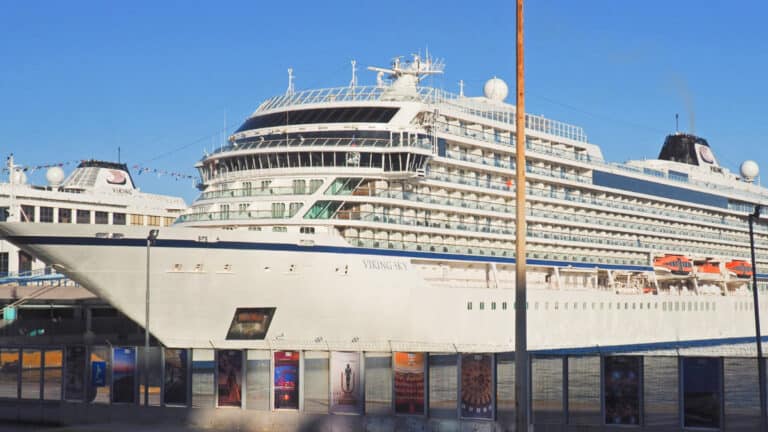
The history of Viking Cruises is a rich one. It is a company with over two decades of longevity and a sterling reputation in Europe and America. It has received ratings such as the Best River Cruise Line and the number one Ocean Cruise Line by Condé Nast Traveler’s Readers Choice Awards of 2022.
Founded in 1997 by Torstein Hagen, Viking Cruise Line is a smaller cruise ship company dedicated to cultural immersive and destination-focused journeys. Viking Cruises offers trips to all seven continents through rivers, oceans, and other expedition channels.
It entered the American market at the turn of the millennium, in 2000. Committed to its values of facilitating in-depth excursions for intrepid travelers, each Viking river ship offers deep immersion in its destinations, programs replete with music, art, cooking demonstrations, information-rich port talks, and guest lectures by cultural experts. Some significant rivers it covers include the Nile, Danube, Seine, Rhône, and most recently, the Mississippi River.
About Torstein Hagen
Torstein Hagen started Viking Cruises with only four ships, all purchased from Russia. He brought Viking Cruises into the American market in 2000 and established a sales and marketing office in Los Angeles, California.
Ever committed to careful yet robust expansion of his fleet and its offerings, in 2013, he introduced Viking Cruises to ocean expeditions with its first ocean vessel created in 2015. His ships have stunning verandas, and the ships most recent to the fleet are all named after planets. Viking has just begun to offer cruises on American rivers in 2022.
Torstein Hagen
Hagen is a Scandinavian native, born in Norway, so his company’s name is apropos. His tenure in the cruising industry is vast. From 1980 to 1984, he held the esteemed position of CEO at Royal Viking Line, arguably the most prominent cruise line of its time.
Having also served on the board of directors for two other major cruise lines and as a management consultant for McKinsey and Co. (Europe), his knowledge of the business principles of managing a successful enterprise runs deep.
Hagen studied computers at the esteemed Wesleyan University, one of the preeminent liberal arts colleges in America. Having received one of the most prestigious university awards available, the Fulbright Scholarship, he also completed his master’s at the Norwegian Institute of Technology and studied Business Administration at Harvard University.
Features of Viking Cruise Ships
Viking Cruises’ ships are equipped and power-packed with many features and amenities, which differ between its river and ocean ships.
River Ships
All Viking Cruises’ longships – its river ships – have an abundance of stateroom categories and two-room suites with verandas overlooking the majesty of the ships’ surroundings. Each Viking longship is identical and includes a restaurant, bar and lounge, sun deck, and library.
A separate terrace for al fresco dining (open-air dining) boasts elegant Scandinavian designs that promote environmentally-friendly features such as solar panels, an onboard garden, and high-efficiency hybrid engines.
For the new Mississippi River ship, environmental consciousness was key to its construction and vision. It is designed to maximize energy efficiency and minimize emissions expenditures. It’s a diesel-electric hybrid system (better than most hybrid cars!), electric hydraulic units, and an exhaust scrubbing system that significantly reduces sound and emissions. This ship also has expansive windows and views.
Ocean Ships
These luxurious vessels are equipped with the connoisseur’s paradise of amenities and features. Every stateroom has a private veranda, several restaurants to choose from – including fine dining, a Nordic spa, and many other cultural resources and gems to make ship goers’ visits indelible memories.
One of the unique features of Viking Cruises’ ships – and indeed, borne of its philosophy of cultural immersion – is that they dock at ports for travelers to maximize their time off-ship. From Northern Europe (including an emphasis on Scandinavia) to the Mediterranean and everything in between, Torstein Hagen has designed a modern luxury travel fleet to enrich and inspire.
Lastly, Viking’s ocean ships are also deliberately engineered to respect the environment as much as possible. Their internal mechanics have won the Best Energy Efficient Design Index (EEDI) in its class. Each Viking ocean cruise ship has a closed-loop exhaust system to migrate and dispose of pollutants safely.
Conclusion
Viking Cruises is an exceptional cruise ship line because it cares so much about its visitors being immersed in the culture of their selected destinations. Offering a full boutique of restaurants featuring cuisine local to the countries it visits, it has both Viking river cruises and ocean cruises replete with verandas, haute couture, and educational offerings.
Torstein Hagen, an entrepreneur and systems thinker, designed the company to be highly environmentally conscious, from the outer parts of the ships to their innards.
With hybrid engines, efficient hydraulics and pollutant disposal systems, solar panels, and more, Hagen has built an enterprise based on sound principles and superior attention to detail. Go figure that Viking Cruises has earned coveted top spots in reader’s choice magazines.
What is a cruise ship stabilizer? How does it work? Stabilizers serve an essential function on cruise ships. They are fins or rotors beneath the water line, extended from the ship’s hull to stabilize the ship and prevent it from rolling. This rolling could result from either wind or waves, and the stabilizer steadies the ship.
In general, you don’t need to worry about how the ship stays stable – that’s for the engineers to concern themselves with. However, if you’re curious, the following is a guide you can reference for your safety, comfort, and enjoyment.
Modern ship stabilizers – of which there are many types – are highly effective and efficient. Below, we describe the different types and how they function.
Passive Systems
These systems don’t require external power or control. Examples include a bilge keel, fixed fin, and moving weight system.
Bilge Keels
These are used widely throughout the cruise ship industry. A bilge keel is an externally-fitted bulb plate that forces the water to move with the ship, which creates turbulence – a necessary controlled underwater force for smooth sailing – and reduces motion. It functions best at higher speeds.
Active Systems
These systems use external power and control to provide a roll that opposes the natural roll of the water underneath the ship at any given time. Examples include active fins, gyroscopes, and active moving weight systems.
Active Fins
Active fins use a roll sensor that conveys the roll angle and velocity to a main external controller. That controller processes these two factors using data algorithms and transmits back the correct response to counterbalance against the roll, using fins and hydraulic pressure.
Cruise Ship Stabilizer Fin (Photo Credit: Templar52)
Active fins have a relatively high 90% success rate, ensuring smooth sailing (literally). It also keeps the resale value of the ship high. Like bilge keels, active fins are less effective at very slow speeds, but there are modern technologies that can fix that.
Active Anti-rolling Tanks
These work above the water line. These tanks use pumps or air pressure to control the water’s motion, decreasing roll while a second axial pump transfers water from one side of the ship to the other. The tanks time the water flow in sync with the ship’s roll, reducing overall roll and motion.
While highly effective, there can be a lag time in filling the tanks, which would cause a delay in the tanks’ ability to stabilize roll effectively.
More on Stabilizers
Consider this section more casual parlance about stabilizers, in case the technical specs were too techy. People who board a cruise ship are sometimes afraid that the boat will rock so much as to make them seasick. We have great news to the contrary – that rarely happens!
The ship stabilizers are responsible for that stability. While a bit of motion here and there is inevitable, you likely won’t feel it unless there’s a disaster or an unexpected turn, which is rare. Check out the secret codes on cruise ships for more information about those phenomena.
For the active and passive finned stabilizers, a cruise ship’s stabilizers essentially act how you would expect fins to act in the water. They extend out from both sides of any given cruise vessel. They are usually below the waterline, invisible to passengers and crew, while engineers have access to them in case of an emergency onboard (i.e., they stop working).
Image Credit: Tosaka
Smaller ships have two, and larger ships and other vessels, such as military craft, have four.
In layman’s terms, all “roll” means is the vessel’s movement at sea. Since you want to do all sorts of things that require stability, such as hitting the gym, dancing, or clinking wine glasses with friends – preventing roll is paramount.
The fins adjust and calibrate according to the motion of the water. One fin lifts, and the other goes down. It’s all about balance. These motions help the ship stay stable and in equilibrium by cutting through the water and creating drag, no matter what the movement of the water will bring. Heavy storms are possible, but cruise ships are so elegantly and maturely designed that they know just what to do.
Technology has its limits, though. There is what’s called “pitch” on all maritime vessels. Pitch is the up-and-down movement of the ship, so lengthwise or horizontal motion. Manual labor is the way through that natural phenomenon – adjusting the ship’s course. With skilled captains at the helm, this won’t be a problem.
Conclusion
This is your go-to guide on ship stabilizers. We’ve provided both highly technical and highly accessible descriptions and specifications of stabilizers, including differentiating between the different types that are out there.
We learned that finned stabilizers act like real water fins, balancing out the motion of the water and helping the ship compensate for it by creating drag. You might want to take this guide with you when you board a cruise ship for the first time or anytime. It will put you at ease.
With poor weather impacting a number of ships in The Bahamas and Bermuda over the weekend, several ships adjusted itineraries and port visits to steer clear of the worst swells and gusty winds.
For Carnival Sunshine, these adjustments meant a Bahamas sailing turned into a cruise to nowhere with no ports of call, but guests received excellent compensation for their radically altered cruise.
Carnival Sunshine Cancels Visit to Nassau
Carnival Sunshine is currently sailing a 4-night cruise from Charleston, South Carolina, with just one planned port of call – Nassau in The Bahamas. That visit had been scheduled for Saturday, January 14, 2023, from 9 a.m. to 5 p.m.
Guests were notified onboard, however, that the visit was not possible due to poor weather. “We are not able to visit Nassau today due to unfavorable weather that would make docking unsafe,”the letter delivered to guests said.“We know you were looking forward to your time in port and apologize for this change of plans.”
During the time Carnival Sunshine was to have been docked, Nassau was experiencing steady winds at about 20-25 miles per hour (32-40 kilometers per hour), with gusts as high as 40 mph (64 kph).
Carnival Sunshine Cruise Ship
These conditions created unstable conditions on the dock, making it unsafe for guests to cross the gangway to get on or off the ship, or to walk down the dock into the downtown area.
Furthermore, many of the most popular excursions, such as snorkeling trips or dolphin encounters, would have been impossible in the choppy water.
Since the ship did not stop at the port, all shore excursions, as well as taxes and port fees, were automatically refunded to guests’ Sail & Sign accounts.
Cancelling the port of call is the second alteration to Carnival Sunshine‘s current sailing. Prior to setting sail, guests had been informed of a change in embarkation time in Charleston, and had to adjust their arrival times one hour earlier than originally planned.
Fortunately, no further delays or changes to the cruise are expected, and Carnival Sunshine should arrive back in Charleston as expected on Monday, January 16.
Compensation Offered
Because the single-port cruise has now become a cruise-to-nowhere without any port visits, Carnival Cruise Line is offering generous compensation to guests.
In addition to the automatic refunds of fees, taxes, and shore tours, guests are receiving $100 (USD) per stateroom of onboard credit, which can be used for drinks, spa treatments, specialty dining, photos, and onboard shopping. That is not the only compensation guests on this cruise are receiving, however.
Photo Courtesy: Carnival Cruise Line
“We also want you to return to experience the cruise we had intended for you,”the letter read.“So, we are extending a 50% future cruise credit for you to use towards another Carnival Cruise.” The letter was signed by the ship’s master, Captain Leonardo Contarino.
The future cruise credit (FCC) is based on the fare guests paid for this voyage, and is unable to be used for a deposit on a new cruise but can be applied to additional payments for the fare. The FCC must be redeemed by January 31, 2024, and can be used for any departure from any homeport and on any ship in the Carnival fleet.
Many Ships Impacted by Weather
Carnival Sunshine is not the only ship that has been impacted by the strong cold front that moved through The Bahamas over the weekend.
Two Royal Caribbean ships, Liberty of the Seas and Oasis of the Seas, had to skip visiting CocoCay on Saturday because of rough waves and wind gusts that made the dock unsafe.
Several other ships, including Disney Wish, Norwegian Pearl, Carnival Liberty, and Royal Caribbean’s Mariner of the Seas, also had to skip Nassau on Saturday.
Earlier in the storm’s track, Norwegian Gem had to drastically shorten its port time in Bermuda to avoid the worst weather conditions.
Poor weather can affect any cruise ship on any itinerary at any time of year. Cruise guests should always stay in touch with their cruise line for updates as their sailing date approaches, and remain flexible in their vacation expectations in case changes are necessary.
For cruise ships to float on open seas, they must be able to stand up to the weight of the vessel in addition to luggage, crew, cruise passengers, and supplies. This is done through a combination of buoyancy and density.
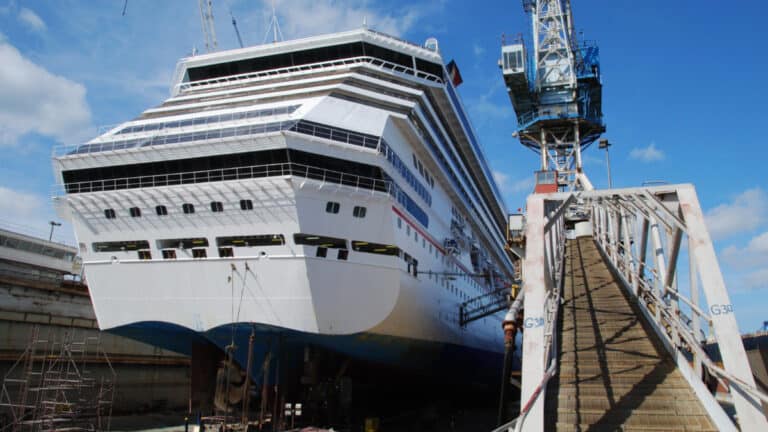
Ships can weigh up to 71,550 tons, displacing the same amount of water when in the ocean. They do all this while being pushed up due to buoyancy. So, what does a cruise ship out of water look like?
When examining a cruise ship out of the water, people wonder how such a small percentage of the vessel can be submerged while the rest of the ship towers above and stays afloat. The entire cruise ship looks incredibly top-heavy, making people wonder how it simply doesn’t topple over with the weight.
Taking a ship out of water is known as dry docking; when the ship sails into its shipyard, the water is drained from the dock area allowing its workers to make repairs or inspect it in a dry area. This maintenance is significantly easier for the crew to accomplish on dry land than when the ship is in the water.
When engineers discuss the weight of a ship, they talk about water displacement rather than the actual weight. To prevent a cruise ship from sinking, it needs to displace its own weight in water before being submerged. It is easier to accomplish if the ship is built so it is less dense than the water below it.
To put it in practical terms, if you submerge a bowling ball into the water, it will sink since it doesn’t displace enough of the water before entering it, causing a sinking effect. However, if you put a beach ball in the water, it will always float.
Buoyancy
Buoyancy is accomplished by selecting lightweight materials that disperse weight across the ship’s hull yet are composed of sturdy materials.
The hull, the body of a cruise ship below its main deck, is wide and contains deep baselines. Large vessels like cruise ships usually have displacement hulls that push water out of the ship’s way. This allows it to remain floating.
Adjusting for Center of Gravity
Wide hulls, low centers of gravity, and ballast tanks containing sea water and fuel prevent ships from capsizing. The center of gravity can be manipulated by adjusting a vessel’s weight, commonly in the fuel and ballast tanks. In extreme situations, crew members can drain swimming pools on the upper deck for more stability, allowing the center of gravity to move higher.
Cruise ships have mechanical stabilizing systems that deploy when at sea. This mechanism extends fins that rotate and can exert a righting force when the cruise ship moves. While it won’t prevent rolling, it will considerably reduce it.
Bilge keels also assist with roll. They are metal fins that are long and welded on each side of a cruise ship.
Displacement Hulls
Displacement hulls with a round bottom appear like large rectangles with rounded edges. They work to dissipate any force or drag exerted against the ship. Rounded edges decrease the water’s force against its hull, permitting larger, weightier ships to move smoothly.
If you examine a ship when it isn’t in the water, the hull appears to be in the shape of a large “u,” depending on keel size. Keels run from stern to bow, creating the backbone of any ship.
Displacement hulls with rounded bottoms have both pros and cons. These hulls move through the water easily, making them seaworthy and stable. Passengers tend not to notice any rocking movement while on board.
Cruise Ship Hull (Photo Credit: El Greco 1973 / Shutterstock)
They move fluidly through the sea; however, the water resistance makes it slower. These ships can only sail at a top speed for so long before the engine power reaches points of diminishing returns. The requirements for smoothness and stability will always override high speeds, making this type of hull the best fit for a cruise ship.
Hulls also protect against icebergs, sandbars, and reefs which can tear through their materials. To prevent extensive damage, builders construct the hull using extra-strength steel. They also insert a double hull to provide additional protection. Double-hull designs look like a hull within another hull.
Regrettably, accidents can happen. To prevent sinking if the first two lines are compromised, ships are equipped with bulkheads, which are watertight dividers in the interior of a ship’s hull.
In an emergency, the bulkheads will keep a damaged cruise ship floating by containing any incoming water and placing it into the compartments. This prevents the ship from flooding or taking on water.
Flat Bottoms
The square shape on the bottom maximizes the space on board a cruise ship and allows the vessel to be stable. Flat bottoms make construction simpler and the dry dock process easier. The bottom, however, is not quite as flat close to the bow or at a raised area located where the propellers lie close to the stern.
What About Power?
Ships move by using reciprocating diesel engines for propulsion. The power goes through transmission into propeller shafts. The transmissions are what determine a propeller’s revolution. Most ships contain diesel-electric, gas turbine, or LNG-powered solutions.
Photo Credit: Ihor Koptilin / Shutterstock
The larger the ship, the higher the demand for electrical power. Some ships only need two different sources of power, one for electrical power and one for propulsion.
Special Markings
Looking at its draft marks, people can see how deep the cruise ship is when sitting in water. These marks are at the stern and bow of a ship.
The load line marks the center of the side of a ship and is known as the Plimsoll line, named after Samuel Plimsoll. Samuel Plimsoll campaigned for safe draft marks, which was enacted in 1875.
Plimsoll Line (Photo Credit: Luca DAddezio / Shutterstock)
A line through a circle indicates the lowest a ship should sit in the water when it is fully loaded. There are different lines for maximum drafts in specific conditions. These are:
T for tropical
S for Summer
W for Winter
An S load line is typically used as it is illegal for a ship to sail with the S line submerged. If it is, the cruise ship is overloaded.
N and V designations are the ship’s classification society. They ensure it is maintained and constructed according to the relevant international standards. NV indicates Bureau Veritas while LR is Lloyds Registrar.
Additional Items
In addition to engines and propellers, most guests will note the towering decks on any cruise ship. The upper decks contain all the cabins and staterooms. The lower decks are where the crew live, sleep, and eat.
There are also rooms used as the morgue and jail or brig on a cruise ship. These are all below deck and set apart from guests, with only the crew having access.
Photo Credit: Broadbelt / Shutterstock
Within this construction, on the inside, are specialty dining, entertainment venues, an assortment of activities, pools, water slides, spas, whirlpools, and a myriad of fun activities available to anyone on the cruise.
Is it Possible for Cruise Ships to Roll Over?
While it may be technically possible, it is unlikely. In the cruise industry, navigational officers and the Master continually monitor a cruise ship’s stability. Weight distribution is adjusted as needed to ensure the safety of all guests on board.
Cruise ships, however, can capsize if buoyancy and weight distribution are compromised, creating negative stability. However, in large cruise ships, tipping is impossible even if you are traveling in the most turbulent of waters.
Final Thoughts
The design of a cruise ship is remarkable. A cruise ship out of water will contain a flat bottom, hulls in a u-shape, plus bilge keels and stabilizers to prevent rolling. All these things coordinate to ensure the cruise ship is kept in an upright position.
Deck officers and the Master monitor the ship’s stability continuously by adjusting the ballast and other items to ensure the ship remains upright and preserves its stability within the designated parameters.
Formerly called Royal Caribbean Cruises Ltd, Royal Caribbean Group operates globally and was incorporated in Liberia while based in Miami, Florida. After Carnival Cruise Line, it is the second largest cruise line.
As of January 2021, it owns three cruise lines: Royal Caribbean International, Silversea Cruises, and Celebrity Cruises. They also have a 50% stake in TUI cruises, CDF Croisières de France, and Pullmantur Cruises. So, who owns Royal Caribbean?
This group was originally called Royal Caribbean Cruises Ltd. Things changed in 1997 when it bought Celebrity Cruises. The decision was made to keep the two brands separate following the initial merger. The company was later rebranded to Royal Caribbean International because of this decision. Royal Caribbean Cruises Ltd was made the parent company of both brands.
In 2000, Island Cruises formed as a joint venture between Royal Caribbean and First Choice Holidays. It became a type of informal line for the Brazilian and British markets.
Another acquisition occurred in 2006 with the purchase of Pullmantur Cruises in Spain. Following this purchase, Royal Caribbean experienced a rapid expansion by creating Azamara Cruises. Azamara Cruises became a subsidiary of its Celebrity Cruises branch in 2007. May 2008 saw the company form CDF Croisieres de France to reach the French-speaking markets.
Royal Caribbean Offices, PortMiami (Photo Credit: byvalet / Shutterstock)
In 2009, they expanded into the German market by acquiring shares in TUI Cruises. The subsidiary of TUI Cruise, TUI Travel, contained 50% interest in Island Cruises after merging with First Choice Holidays. Holdings were rationalized by selling TUI Island Cruises.
A joint venture was announced in 2019 with ITM Group, which led to the formation of Holistica to develop cruise destinations. The only area they want to establish is Grand Lucayan Resort in Freeport. The hotel campus had been sold to a subsidiary of the Bahamian Government.
Royal Caribbean Cruises bought the remaining Silversea Cruises shares in 2020. They changed the logo and renamed themselves Royal Caribbean Group. They later sold Azamara Cruises to Sycamore Partners for $201 million.
Just recently, in 2022, they obtained court approval to buy Endeavor, a former ship for Crystal Cruise, for $275 million. It will later be renamed Silver Endeavor when it joins the Silversea Cruise fleet.
Who Owns Royal Caribbean?
Royal Caribbean International and its numerous subsidiaries fall under the Royal Caribbean Group banner. They have a fleet of 64 cruise ships and travel to 1,000 destinations around the world.
Capital Research & Management owns the most shares in Royal Caribbean. Capital is a large investment group formed in 1931 with $2.6 trillion in assets in its portfolio. Currently, they own 16% of the cruise company.
Photo Credit: Ceri Breeze / Shutterstock
Even this 16% ownership is split between several branches within the group—Capital Research & Management Company’s international investors have an 11.66% stake. The remaining top ten of their shareholders are large investment groups like JPMorgan, The Vanguard Group, and several others.
Who was the Founder of Royal Caribbean International?
Royal Caribbean International was founded in 1968 in Norway by three shipping companies. These founding companies were IM Skaugen & Company, Anders Wilhelmsen & Company, and Gotaas Larsen. Song of Norway was their first ship, which launched two years later. Nordic Prince was added one year later, and Sun Viking followed in 1972.
In 1978, Song of Norway was the first cruise ship to be lengthened by adding an 85-foot section to a severed center of the ship. Since this project was so successful, the company decided to do the same to Nordic Prince two years later. During the modification, the sterns were changed, creating additional space. The only ship that wasn’t changed was Sun Viking.
The group that founded Royal Caribbean later listed itself on the New York Stock Exchange before becoming the Royal Caribbean Group. This same group later incorporated the company in Liberia.
The company chose to incorporate in Liberia to avoid paying U.S. taxes and having to follow the labor and wage laws of the country. This is the same logic that several cruise lines adopt by registering themselves in countries like the Bahamas.
Who Is the CEO of Royal Caribbean?
Michael Bayley is president and CEO of Royal Caribbean International. The president and CEO of Royal Caribbean Group is Jason Liberty.
What Is the Net Worth of Royal Caribbean?
There is no listed net worth for Royal Caribbean International. However, Royal Caribbean Group had a net worth of $11.93 billion in September 2022. This number places it ahead of Carnival Group by $1 billion.
Does the Company Have Stock?
Royal Caribbean Group does have stock, and the New York Stock Exchange lists them as RCL. Royal Caribbean International, however, does not have stock. Currently, Royal Caribbean Group contains the highest value for cruise line stocks for people to invest in.
Photo Credit: StudioPortoSabbia / Shutterstock
If you make an investment and purchase 100 shares, you receive shareholder benefits when you cruise on one of their Royal Caribbean ships. This also applies to Celebrity Cruises, except for cruises to the Galapagos Islands.
Shareholder benefits include:
$250 onboard credit per stateroom for cruises lasting 14 nights or longer
$100 onboard credit per stateroom for cruises lasting 6-13 nights
$50 onboard credit per stateroom for cruises lasting five nights or less
To claim these benefits, stakeholders should apply through the Royal Caribbean website. You will need to provide proof of your shares.
How Are Shares Purchased?
Shares are purchased using a stockbroker. They may be a licensed stockbroker or smartphone/laptop platforms. You will need to find a platform that deals with the NYSE and make a request to purchase RCL stock.
Photo Credit: Melissa Mayntz
Stockbrokers tend to cost more; however, they will offer you advice. This is usually better for those who need help deciding what to invest in. However, if you understand the risks, going through the online stockbroker platform tends to be cheaper.
Conclusion
Three shipping companies originally founded Royal Caribbean. Through diligent work and strategic expansion efforts, they quickly morphed into a vast empire enjoyed by millions of cruisers each year. Royal Caribbean continues to stay on the top of the cruise line empire by continually adapting itself to suit changing times.
Carnival Cruise Line was voted the best cruise line of 2022 by Cruise Hive readers, with 32% of the votes. 2022 is also the 50th anniversary year for Carnival, making this achievement even more special.
The Cruise Ship Awards are an annual event, and this year, readers could type in the name of any cruise line to cast their vote, making sure that the vote included all eligible cruise lines.
Carnival Votes Best Cruise Line of 2022
The Miami-based cruise line has received more votes than rival lines such as Royal Caribbean and Norwegian in the annual Cruise Ship Awards. The cruise line, which has gone through an eventful 2022, is the Best Cruise Line of 2022, according to Cruise Hive readers.
It has been an extraordinary year for Carnival Cruise Line. After a challenging year post-global pause in operations, the popular cruise line is back stronger than ever. America’s cruise line celebrated its 50th anniversary, which started with various events ashore and onboard and included some spectacular ship meet-ups around the Caribbean, Pacific, and the Bahamas.
Photo Copyright: Cruise Hive
The 50th Anniversary celebrations concluded with the launch of the cruise line’s second Excel-class LNG-powered cruise ship, Carnival Celebration, which also won the Best New Cruise Ship of 2022 category.
Carnival Celebration‘s sister ship, Mardi Gras, also came out on top in a different category. Mardi Gras was voted the best cruise ship of 2022, beating out competition from other top cruise lines. Mardi Gras features a number of innovative features, such as the first roller coaster at sea and several dining options from popular chefs.
In 2022, Carnival Cruise Line also introduced a new initiative called Carnival Fun Italian Style and took possession of the former Costa Luminosa and renamed it the Carnival Luminosa. The Carnival Luminosa offers a unique cruise experience focusing on Italian culture.
However, the true nature of Carnival Fun Italian Style will become apparent when Carnival Venezia joins the fleet next year. Carnival Cruise Line concludes the successes it booked this year with the win of the Best Cruise Line Award, taking home 32% of the votes.
Carnival Cruise Line has won the Cruise Hive Ship Awards multiple times since 2018, only missing out in 2020 as there were no awards that year due to the industry suspension.
Royal Caribbean and Norwegian Complete the Podium
In second place in the Cruise Hive’s Cruise Ship Awards was Royal Caribbean, with 23% of the votes. Royal Caribbean is known for its innovative ships and wide range of activities and amenities.
In third place was Norwegian Cruise Line, with 13% of the votes. Norwegian is known for its Freestyle Cruising concept, which allows passengers to have a more flexible and customizable vacation experience. Fourth place went to Celebrity Cruises, with 8% of the votes. Celebrity is known for its luxury cruises and top-rated dining options.
Carnival Cruise Line was a clear winner in the awards, with a strong showing in multiple categories. Its 50th anniversary was marked by the successful launch of the Carnival Celebration and rave reviews for Mardi Gras, as well as the introduction of the Carnival Fun Italian Style initiative and the launch of Carnival Luminosa.
With its wide range of new ships, initiatives, and fun atmosphere onboard, it’s no wonder that Carnival Cruise Line was voted the best cruise line of 2022.
Royal Caribbean’s Perfect Day at CocoCay has been voted Best Cruise Line Private Island of 2022 in Cruise Hive’s annual Cruise Ship Awards. The island oasis in the Bahamas also earned the coveted title in the 2021 awards.
Perfect Day at CocoCay Wins Again!
Perfect Day at CocoCay has again been voted top in the Best Cruise Line Private Island award category, getting 34% of the vote. Carnival Corp’s Half Moon Cay was a very close second, coming in with 33% of votes (it also won second place in 2021), and MSC Cruises’ Ocean Cay MSC Marine Reserve was third, with 7% of votes.
Other private islands in the competition were Disney Cruise Line’s Castaway Cay, Norwegian Cruise Line’s Great Stirrup Cay and Harvest Caye, Royal Caribbean’s Labadee, in Haiti, and Princess Cruises’ Princess Cays.
Voting for the 2022 awards opened up in September, with readers being able to make cast a single vote in each of the eight categories. Any suspicious or repeated votes were not included in the final result. The awards have been running since 2014 and, each year, are open for Cruise Hive readers. You can check all the results so far right here.
CocoCay Offers Multiple Beaches, Thrill Rides
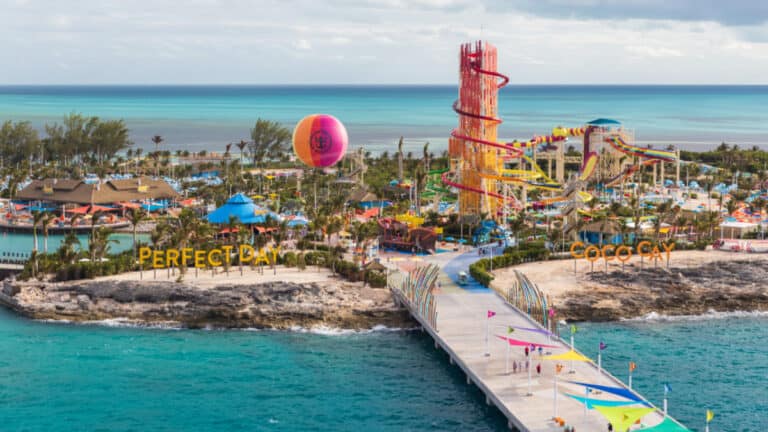
Perfect Day at CocoCay is located in the Berry Islands of the Bahamas, about 55 miles north of Nassau. A major $250 million refurbishment in 2019 transformed the island, and it reopened to Royal Caribbean cruise guests in 2020. Among the upgrades was an exclusive VIP area, Coco Cay Club, which wowed guests with floating cabanas.
In fact, the cabanas made CocoCay the first cruise line private island to feature the overwater luxury amenity. The club complex also has an infinity pool and an exclusive restaurant.
Photo Courtesy: Royal Caribbean
CocoCay has three beaches and a slew of water activities in its Thrill Waterpark, offering the biggest wave pool in the Caribbean, and 13 waterslides, including Daredevil’s Peak, the tallest waterslide in North America at 135 feet high.
The Splashaway Bay children’s water park, a 1,600-foot-long zip line, Oasis Lagoon, which is the largest freshwater pool in the Bahamas, plus helium balloon rides and other adventure activities are offered.
The island’s South Beach area is geared toward sports lovers, and features volleyball, soccer, and basketball courts, plus equipment for paddle boarding and kayaking. The private island is available only to Royal Caribbean cruise guests. Its pier accommodates two ships, and no tendering is required.
Half Moon, Ocean Cay Are Runners Up
Coming in a hair’s breadth (1 percentage point) behind CocoCay, second-place winner Half Moon Cay is located midway between Eleuthera and Cat Island in the Bahamas, about 100 miles southeast of Nassau.
The Carnival Corp island, comprising 2,400 acres, has a water sports center for adults and the Half Moon Lagoon Aqua Park for youngsters, featuring slides and a pirate ship. Horseback riding on the beach is a featured activity, and a food pavilion and bar, plus other eateries and shopping opportunities are offered as well.
Photo Credit: KaryBntz / Shutterstock.com
There are no docking facilities at Half Moon Cay, so cruise guests board tenders to reach the island. Ships from multiple Carnival cruise brands call at the island.
Ocean Cay MSC Marine Reserve was the third-place winner in the cruise awards, with 7% of votes. Located about 65 miles east of Miami, the island has eight beaches on its 95 acres.
The island does not have a waterpark or thrill rides, but offers water sports such as snorkeling, plus soccer and volleyball courts, massage huts on the beach, a Bahamian shopping village, and entertainment including a Junkanoo Parade, beach. Picnics, and a Luna Libre Party. MSC guests are transported to the island by tender.
Carnival Cruise Line’s Carnival Celebration has been voted the Best New Cruise Ship of 2022 in Cruise Hive’s annual Cruise Ship Awards. The 5,374-guest ship was in competition with nine other new vessels that debuted during the year.
Carnival Celebration received 34% of the votes for Best New Cruise Ship of 2022, coming in ahead of second-place Wonder of the Seas, a Royal Caribbean ship that garnered 26% of the votes, and Norwegian Cruise Line’s Norwegian Prima, which received 14% of the votes.
Other ships that competed for the Best New Cruise Ship of 2022 award were P&O Cruises’ Arvia, Celebrity Cruises’ Celebrity Beyond, Princess Cruises’ Discovery Princess, Disney Cruise Line’s Disney Wish, Viking Cruises’ Viking Mars, and MSC Cruises’ MSC Seascape and MSC World Europa. Readers could only cast a single vote in each category.
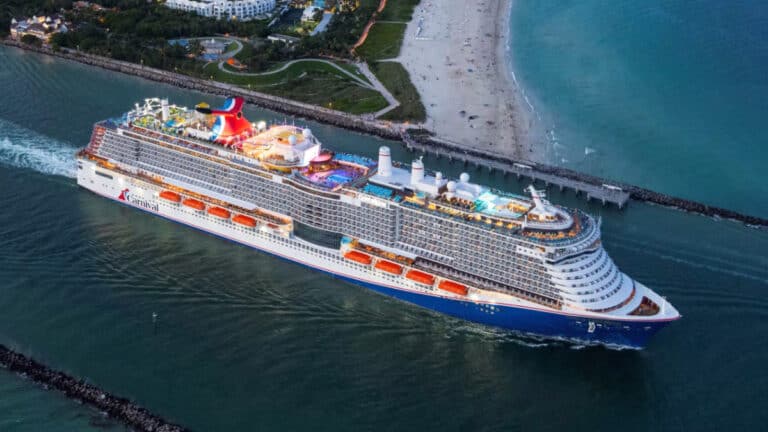
Carnival Celebration is the largest ship in the Carnival Cruise Line fleet, with a gross tonnage of 183,521, 19 decks, and 2,600 staterooms. The ship was built by Meyer Turku in Finland at the cost of $1 billion.
Voting for the 2022 awards opened up in September, with readers being able to make cast a single vote in each of the eight categories. Any suspicious or repeated votes were not included in the final result. The awards have been running since 2014 and, each year, are open for Cruise Hive readers.
Carnival Celebration Sails the Caribbean From PortMiami
Carnival Cruise Line took delivery of Carnival Celebration at the shipyard on November 2, 2022, and she then became the first new Carnival ship to arrive in the UK in 20 years, sailing her inaugural cruise from Southampton, England, on November 6, 2022. The maiden voyage included port calls in La Coruña and Vigo, Spain; Funchal (Maderia), Portugal; and Tenerife (Canary Islands), Spain.
The ship arrived in Miami on November 20, following her transatlantic cruise from England. Sailing from Terminal F at PortMiami, the ship is operating a winter series of Eastern and Western Caribbean cruises.
Carnival Celebration features 13 bar/lounges and eight specialty restaurants: Bonsai Sushi, Bonsai Teppanyaki, Cucina del Capitano, Emeril’s Bistro 1396, JavaBlue Cafe, Rudi’s Seagrill, The Seafood Shack, and Fahrenheit 555 Steakhouse.
Carnival Celebration’s attractions include BOLT: Ultimate Sea Coaster, which was voted the Best Cruise Ship Feature in the Cruise Ship Awards. The roller coaster, located in the Ultimate Playground portion of the ship, lets guests soar 187 feet above the sea and reaches speeds of 40 MPH. BOLT beat out second-place winner Royal Caribbean’s Ultimate Abyss and third-place winner Norwegian Cruise Line’s Go-Karts in the 2022 award category.
Photo Credit: Jouni Niskakoski / Shutterstock
Carnival Celebration’s Ultimate playground area also is home to the ship’s water park, mini golf courses, sports courses like a basketball court, and a ropes course.
Carnival Cruise Line’s third Excel-class ship, Carnival Jubilee, is under construction at the Meyer Werft shipyard in Papenburg, Germany. It is scheduled to debut in late 2023 and be home-ported in Galveston, Texas.