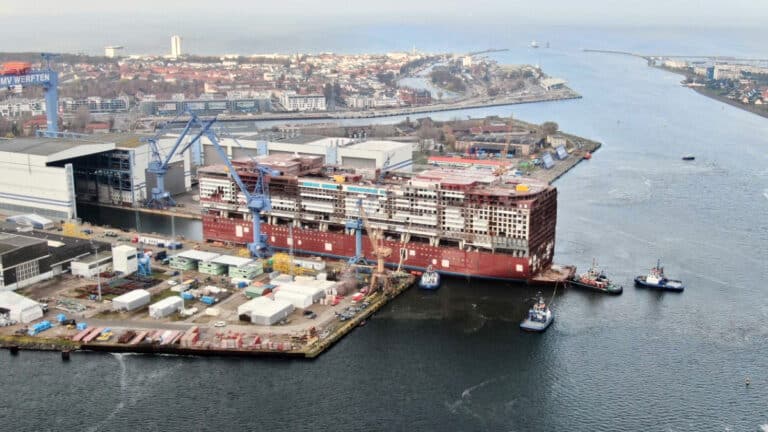
After much uncertainty over the last months about what would happen with the largest cruise ship by passenger volume in history, there seems to be a buyer for Global Dream after all.
The ship, which the now-bankrupt Genting Hong Kong built for Dream Cruises, could be sailing for Disney Cruise Line in the future, according to a German news outlet.
The news was announced by the insolvency administrator for the shipyard where the vessel is under construction, Christoph Morgen. Global Dream would be completed at the MV Werften, where the ship could be under the direction of Meyer Werft in Papenburg, where Disney Cruise Line already has another ship on order.
Disney Cruise Line Takes a Huge Step
That someone would be stepping up and buying the 208,000 gross ton Global Dream seemed to be an unlikely affair as time passed since Genting Hong Kong went bankrupt earlier this year.
The 9,000- passenger cruise ship, by far the largest cruise ship to ever be constructed by passenger volume, has sat untouched in the shipyard in Germany since January of this year.
As the vessel was intended for the Asian market and specifically built to sail in Asia, the likelihood of an American or European cruise company coming forward and purchasing the ship seemed slim at best.
Rendering Via: Dream Cruises
However, in an astonishing move, it seems that Disney Cruise Line could be willing to put up the money for the vessel and complete the construction. German news outlet NDR, a respected and well-known broadcaster in Germany, broke the news yesterday.
According to a statement by the insolvency administrator Christoph Morgen, Global Dream will be completed under the direction of the world-famous Meyer Werft from Papenburg, Germany.
Workers will complete the vessel at the Wismar-based MV Werften, where construction has been ongoing for several years now. Meyer Werft has already built ships for the Walt Disney Group’s Disney Cruise Line.
Purchase Price Not Known
Global Dream had an initial construction price tag of 1.6 billion euros. However, it is unlikely that Disney Cruise Line would be paying that amount for the vessel. The amount is expected to be just a fraction of the initial cost.
While Christoph Morgen has confirmed the purchase by Disney Cruise Line, neither the cruise line nor local Economic Minster Reinhard Meyer have made concrete comments on the news. When asked, the Minister spoke merely of confidential discussions with Disney Cruise Line.
Disney Wish Cruise Ship at Meyer Werft
The news is positive for the 950 employees of the former Genting shipyard where the vessel was being constructed, and who now would be able to go back to work in the construction yard. It also means that rumors the ship would be sold as scrap metal can possibly be put to rest.
A Meyer Werft employee was quoted by NDR, saying:“It is a very different picture psychologically if this large ship is finished in Wismar than if it were towed out there and scrapped somewhere in the world.”
Global Dream, which was scheduled to commence sailing this year, is only 75% completed. Cooperation between Disney and Meyer Werft to complete the vessel is more than likely. The shipyard already built three cruise ships for the company in 2010, 2012, and in 2022, Disney Wish. Three more LNG-powered cruise ships are on order.
The former owner of Global Dream, Genting Hong Kong, went bankrupt in January of this year. The direct result of the global pandemic. The demise of the largest Asian cruise operator meant the end of operations for Dream Cruises, Star Cruises, and Crystal Cruises.
Since that time, Crystal Cruises has restarted under Abercrombie & Kent, and Dream Cruises made a restart under resorts World Cruises, a subsidiary of Genting in Singapore & Malaysia.
When going on a cruise, it is essential to pack the proper footwear and not to overpack. Shoes take up a lot of room in a suitcase. And you may not even wear half of them! When selecting shoes, be practical since you’re going to spend time on your feet, but you can also pack a few fashionable items. We outline the best shoes for cruises.
The best tip regarding footwear is to pack shoes that are, above all, comfortable, but they can be stylish and versatile, too. Choosing the right shoes prevents you from overpacking and allows you to pair what you have with other outfits.
The shoes we recommend are perfect for evening and daytime and take you from casual days to formal nights.
Determining how many shoes to bring depends on your stay and the shore excursions. Most people scale things back to four to six pairs of footwear for seven to 14-night cruises. Some can get away with only three pairs if packing light. However, more options will give you flexibility and allow you to pair different styles with your outfits.
If you are prone to having your feet or ankles swell, you can change shoes between day and nighttime. Many guests pack open-back shoes to accommodate swelling as they are more generous and easier to get into.
For Warm Climates
Warm weather cruises require different types of footwear, including:
Flip flops
Wedges or casual sandals
Walking shoes or sneakers
Water shoes
Dress shoes
Don’t bring brand new shoes on a cruise. A cruise is not a good time to break them in, as you want to avoid blisters and calluses. Choose proper fitting shoes, especially if you plan to do a lot of walking or hiking on your shore excursions.
Photo Credit: nistordrag83 / Shutterstock
For Cold Climates
For an Alaskan cruise, it is advisable to bring:
Warm shoes
Hiking boots
Insulated boots
Ankle boots
Waterproof shoes
Water-resistant shoes can let water in, so go with waterproof ones instead. The difference between waterproof and water-resistant is that the seams are sealed and treated in a waterproof shoe. Also, the tongues go higher on the foot, keeping water from seeping in.
What Is the Best Type of Shoes for Cruises and Why?
While you can bring many shoes, only a handful are truly advisable. Here is our packing list and why each is important for your trip.
Flip Flops
Great for warm weather, flip-flops are comfortable and convenient. They are great when walking around the cruise ship deck or going to the pool. They take up little room, and you can carry them in a tote when going out on excursions.
Flip Flops (Photo Credit: New Africa / Shutterstock)
Note that you should not wear flip-flops in all circumstances just because you can easily pack them. This type of footwear is not advisable if you are going for a hike or walking for extended periods.
These shoes will not protect your foot against sprains and strains as there is no ankle protection. If you are hiking, you can easily get scraped and cut, and you may quickly discover the ball of your foot and calves become tired or sore.
Sandals
Sandals are more comfortable because you can choose wisely and according to the occasion. Sandals are a versatile choice as you can dress them up or down. They also pair easily with various outfits and can keep you cool on humid days.
You can wear them for cruise excursions or short walking trips. The best sandals have a cork base and arch support to avoid foot fatigue. The cork warms up as you wear the sandals and conforms to your foot, making them more comfortable.
Choose sandals with a backstrap or enclosed back to prevent the same issue you would have with flip-flops. Espadrilles are suitable for serving a dual function. They are versatile in terms of what you can pair them with; they look classy and offer proper ankle support.
It is also good to wear sandals with a heel lower than two inches. Any more than that will harm your posture since it throws the stomach forward and arches the back.
Lightweight Sneakers
Walking shoes with mesh are perfect for warm climates as they are more breathable. In addition, consider moisture-wicking socks when necessary. Not only do they keep your feet dry, but they also eliminate foot odor.
These shoes are not great for formal events but are wonderful for cruise excursions and activities. Always ensure they have adequate arch support, and wear the best shoe for whatever activity you’re doing.
Walking shoes are great for walking or milling around. They offer no midsole support, so you shouldn’t wear them for side-to-side movements or if you require ankle support.
You can wear running shoes while running or walking. They are great for people who have difficulty walking as they have rocker soles, making forward movement more manageable and fluid. It works well for those with knee and ankle injuries, too.
Cross trainers or hiking shoes are ideal for hiking or side-to-side motion because they are stable through the midsole. They may not have as much arch support but will prevent you from rolling your ankle.
Wedges
These are versatile shoes you can dress up or down and take up little space. They offer more of a heel than a flat sandal and more stability than a traditional high heel.
Wedges (Photo Credit: Stock Holm / Shutterstock)
The same rules for flip-flops and sandals apply to wedges. While they may provide better stability, there is a chance of hurting your ankle if they are too high, having calluses or blisters from friction, and a sore back from the height.
Dress shoes are great for formal occasions. You can combine some with other outfits, and they are a must for any cruise vacation.
Again, watch the heels. They are not great for your posture, feet, or back. You are fine if you wear them for short durations or while sitting. However, if you are going dancing, you may quickly regret this fashion statement.
Conclusion
Regarding the best shoes for cruises, you need to be versatile and practical in your selection. Choose comfortable shoes that won’t cause you physical pain. Also, wear the correct shoe for the right occasion.
Welcome to Amber Cove, Dominican Republic, in the eastern Caribbean. Carnival’s private resort destination is located on the bay of Maimón, 7 miles northwest of Puerto Plata, on the eastern half of the island of Hispaniola.
This private 30-acre retreat is exclusively offered as a port of call to cruisers with Carnival and its sister companies. Opened in 2015, the port at Amber Cove has two berths to hold two large cruise ships simultaneously and is designed to handle up to 8,000 passengers. The zone is crammed with watersports activities, dining opportunities, shopping, shore excursions, and fun attractions.
Amber Cove is a private 30-acre port destination located at Maimón in the province of Puerto Plata. The resort is owned and managed by Carnival and is used as a popular port of call for its brands. Packed with watersports activities, shopping, food and fun, it was created to keep visiting cruisers entertained as part of their Caribbean cruise itinerary.
Amber Cove is named after the rare and beautiful semi-precious stone that is found on the island. The amber gemstone is actually fossilized tree resin and is used in local jewelry and souvenir items.
Puerto Plata dates back to the 16th century, and the port serves as a gateway to the area. In keeping with the history and architecture of the area, Amber Cove features architecture reflecting Victorian, Colonial and Spanish styles.
A long pier leads from the cruise ship to the huge shopping area with cobblestone plazas. Further away, there’s a giant Aqua Zone with pool, swim-up bar, cabanas and exciting watersports activities.
The resort boasts a selection of restaurants and bars serving a wide choice of local and international cuisine. Further inland, the hilly tree-covered backdrop overlooks the swimming pool and provides panoramic views of Amber Cove and the surrounding turquoise sea.
How to Get to Amber Cove, Dominican Republic
Amber Cove is the newest cruise port in the Caribbean. It brought cruise ships back to the Dominican Republic after almost 30 years of absence.
Carnival Corporation spent $85 million creating Amber Cove on the north coast of the Dominican Republic and it has since welcomed over a million cruisers. The first 3,000 guests arrived aboard the Carnival Victory in October 2015. It has since become a popular port of call on many Eastern Caribbean cruise itineraries.
Photo Credit: Melissa Mayntz
The only way you can visit Amber Cove is by booking a cruise that includes Amber Cove, Dominican Republic, as a port of call on the itinerary. It is exclusively used by Carnival Cruise Line and its sister cruise companies, including Princess Cruises, Holland America Line, Seabourn and Costa Cruises.
Amber Cove is reached along a private pier so cruisers do not have to queue up or use tenders to get ashore. Visitors are greeted by Caribbean music and local dancers to make you feel welcome the moment you step ashore. For cruisers with mobility issues, there are golf carts with local drivers to transport you around.
Things to Do at Amber Cove
There’s no admission fee for cruisers to visit Amber Cove. Guests get complimentary lounge chairs, hammocks, pool access and many free fun activities. There’s also a Photo Op point for getting a selfie with the cruise ship in the background.
Amber Cove is divided into two distinct areas: the waterfront Welcome Center Marketplace and the Aqua Zone. The duty-free shopping area has a range of shops, craft stalls, restaurants and bars. The water zone has three pools connected by a flowing river with pedestrian bridges over it.
Pool activities
The largest pool at Amber Cove includes a swim-up bar for enjoying icy drinks and refreshments. This 300,000-gallon pool also has waterslides, a Lazy River, and plenty of lounge chairs.
Photo By: Russell Otway
Children’s Splash Area
Right next to the pools, there’s a Wet Zone and Splash Pad for youngsters. They can have hours of fun playing with the splash bucket and mini slide. It’s a great way to cool off in the tropical heat. The area has plenty of lounge chairs for adults to keep an eye on youngsters while enjoying the relaxed atmosphere.
Sports Amenities
Next to the Splash Pad is a half-size basketball court, a volleyball court and a giant chess set.
Rent a Private Cabana
If you like your own quiet space, renting a cabana is a great option for you. Choose your preferred type and location from Ocean, Poolside, Hillside or Grand Cabanas. These shady hideaways come with a refrigerator stocked with snacks, water and soda. They also include lounge chairs, waiter service, showers and Wi-Fi.
The upgraded Ocean Cabanas are on stilts over the calm blue lagoon waters. They boast cable TV, showers, tables and chairs, while Poolside Cabanas have air-conditioning, TV with Smart cable, a fan and misting system as well as a fully furnished living room for relaxing. Grand cabanas have all the above plus a private hot tub, dining set and furnished living room.
Cabana rates start from around $310 per day for a Hillside Cabana (max. 8 guests) rising to $1170 for a Grand Cabana on the water suitable for up to 20 people to share.
Visit Sky Bar
Perched on the hillside overlooking the whole of Amber cove, the Sky Bar offers a full range of refreshing drinks and snacks with panoramic views.
Windsurfing and Kite-Boarding
Puerto Plata is the windsurfing and kite-boarding capital of the Caribbean, so Amber Cove is a great place to try these exhilarating watersports. There’s a booth offering watersports rentals right on the waterside near the Cabana Bar.
Zip Lines
If you’re an adventurous type of cruiser, the 650-foot twin zip lines at Amber Cove are the place to head for. They start from the hillside overlooking the Aqua Zone and carry riders right over the pool.
Amber Cove Zip Line (Photo Credit: Polina LVT / Shutterstock)
You can ride unlimited times with a day pass which is reasonably priced at around US$ 20 for adults and $10 for children.
Watersports
Get ready for some wet and wild watersports at Amber Cove. You can rent many different types of watersports equipment such as stand-up paddleboards, kayaks, hydro-bikes, pedal boats, and solar catamarans for either 30 minutes or an hour. Prices start from around $20.
The main pool has several water slides for exciting rides ending with a big splash!
Shopping
The Marketplace has excellent retail outlets, including arts and crafts by local artisans. Shops and stalls are plentiful and are a great place to source local souvenirs of your visit to Amber Cove, Dominican Republic. Specialties to hunt for are the local rum, coffee beans, chocolate and cigars.
Photo Credit: Arturo Verea / Shutterstock
There are plenty of wood carvings and “faceless dolls,” which are signature souvenirs in the Dominican Republic. Beautiful jewelry is made from local amber and rare blue larimar gemstone, which is only found on this island.
Amber Cove Shops
The first area you will hit after disembarking at Amber Cove is the shopping village. Near the Cruise Center, there’s a colonial-style plaza with many stalls selling souvenirs, arts and crafts, including jewelry and trinkets made from local gemstones.
Diamonds International
This dazzling jewelry store is owned by the cruise company and offers a stunning array of jewelry at duty-free prices.
The Aurora Cigar Shop
This is the place to see how authentic Dominican cigars are hand-made. They are among the best in the Caribbean and make a great souvenir of your visit to Amber Cove.
Get your passport Stamped
If you visit the Information Center at Amber Cove, you can get your passport stamped with an unofficial stamp showing that you visited Puerto Plata, Dominican Republic.
Food and Beverages
Food and drinks are not included free at Amber Cove, and even those with an unlimited drinks package will have to pay for drinks at all the bars and restaurants while ashore.
Amber Cove has a choice of places to enjoy an exceptional dining experience or sit at the bar and enjoy long fruity drinks, beer, wine and cocktails.
Venues at Amber Cove (Photo Copyright: Cruise Hive)
In the Marketplace, there’s Coco Cana Bar and Restaurant, or head to the Aqua Zone and take your pick from the Coco Cana Poolside Lounge, Cabana Bar, or the Sky Bar.
Local Delicacies at Amber Cove
You might want to try some of the local foods from the Dominican Republic to get a taste of the Caribbean cuisine as part of your cruise experience.
La Bandera is the national dish of the Dominican Republic and the name means “flag”. It contains with white beans, stewed beans and tasty roast meat usually served on a bed of rice.
Asopao is a Creole-style Caribbean dish that contains shrimp or chicken along with pumpkin, chili peppers, cilantro and orange
Mangu is made from boiled, mashed plantains topped with fried red onion. It may be served with eggs, salami or fried cheese and is then known as “Los Tres Golpes”.
Quipe is a Lebanese-style dish similar to “kibbeh”. It consists of deep-fried balls of bulgur wheat, often filled with seasoned meat and onions.
Sanocho is a popular Latino American dish that has the consistency of a thick soup made from stewed meats and local vegetables such as yucca and plantain.
Amber Cove Shore Excursions
From the Transportation hub at Amber Cove, Dominican Republic you can depart on pre-booked shore excursions, pick up a rental car or hop in a taxi and explore the local area independently. The town of Puerto Plata has many interesting sights just 7 miles away.
Local Attractions Near Amber Cove
Visit the Amber Museum in Puerto Plata or take a tour of the Brugal Rum Factory. You can enjoy a stroll along the waterfront on the three-mile-long Malecon promenade or explore the historic downtown and main plaza.
Amber Cove Cruise Port (Photo Credit: Marmaras Stavros / Shutterstock)
Other local highlights to see include Fort San Felipe and the gushing Damajagua Falls. The beach towns of Sousa and Cabarete are the place to watch daring kite-boarders and windsurfers from a beachfront cafe.
Organized excursions and Tours
The Shore Excursions Desk aboard your cruise ship offers a host of activities and tours that can be pre-booked before reaching Amber Cove. Here’s a run-down of the main tours and excursions offered by the cruise line…
Dolphin Swim and Ocean World Day Pass
If you dream of swimming with dolphins, Amber Cove is the place that can make it happen. This is one of the most popular cruise activities, and this excursion includes a Day Pass to Ocean World Adventure Park. Guests can get up-close to these playful marine creatures in waist-deep water. Younger children must be accompanied by an adult.
This exciting experience includes feeding and playing with the dolphins and enjoying a boogie-board ride through one of the largest man-made dolphin lagoons in the world.
Dolphins in the Dominican Republic (Photo Credit: vicmestevez / Shutterstock)
Once your small group dolphin encounter is over, you can spend the rest of the day at Ocean World Adventure Park. Watch dolphins, sea lions and tropical birds in various shows, stroll through the aviary of exotic birds or go snorkeling in the Tropical Reef Aquarium.
Bring a towel and visit Pirate’s Pool and enjoy a swim in the calm Dolphin Beach Lagoon.
Waterfalls of Damajagua and Off-Road Buggy Trip
Start your exciting adventure with an exciting 2-hour Polaris buggy ride through the countryside and local villages. You’ll cross the river to reach the famous waterfalls of Damajagua, where you can enjoy sliding into the pool beneath one of several beautiful mountain waterfalls. The trip includes a short hike.
Waterfalls of Damajagua, Puerto Plata (Photo Credit: Yavimr / Shutterstock)
Visitors must wear the helmet and life vest provided. The tour price is per vehicle, which can carry up to two riders. The trip includes complimentary bottled water.
Waterfalls Adrenaline Adventure
Similar to the Waterfalls Adventure but without the Buggy Tour, this more strenuous 4-hour trip includes a 40-minute hike and swim in the waterfalls of Damajagua.
Your guide will lead you on a canyoning experience through narrow passages, flooded caverns and natural waterslides. Wearing a helmet and life vest is mandatory and they are provided. Water shoes and lockers can be rented.
Coconut Beach Break
For a day on a beautiful Caribbean beach, this all-inclusive 4.5-hour Coconut Beach Tour includes a bus ride through the countryside, beach chairs and umbrella, kayaks, snorkeling and paddleboards. There’s an open bar for drinks and a delicious buffet lunch.
Deluxe Catamaran Sail and Snorkel
This 5-hour excursion includes a 45-minute bus ride to the catamaran and a relaxing cruise on the beautiful Caribbean Sea. Lunch and drinks are provided as you enjoy a leisurely sail along the coastline of the Dominican Republic.
Catamaran Tour in the Dominican Republic (Photo Credit: FOTOADICTA / Shutterstock)
Snorkel gear is provided for you to jump in and see the myriad of colorful fish and corals found just offshore near Sosua.
Mega Truck Country Ride and Culture Trip
Enjoy a great view of the countryside as you ride aboard this big-wheel open-sided truck. You’ll pass sugarcane fields, rivers and plantations of cacao, bananas, pineapple and papaya along the way.
The trip gives insight into the history, culture, and folklore of the Dominican Republic as you tour around Puerto Plata. Drive along the scenic Malecon (waterfront), pass San Felipe Cathedral and Independence Square. This 4.5-hour trip from Amber Cove is great value for money and includes a traditional lunch.
Deep Sea Fishing
Head out on a Deep Sea Fishing Excursion from Amber Cove. The 34-foot Trojan boats carry 10 passengers each, and the 4-hour fishing trip includes bait and lines. The experienced crew know the best places to troll for Mahi, wahoo, sailfish and blue marlin, and they sail up to 6 miles offshore.
Top 10 Best of Puerto Plata
This well-priced tour lasts 4.5 hours and takes cruisers on a scenic trip calling in at the Rum Factory, where you can learn about the rum-making experience for yourself. You’ll then enjoy a short visit to the Jose Briseno Baseball Stadium, followed by Independence Square, Victorian houses and the San Felipe Cathedral.
View of Puerto Plata
There’s more sightseeing as you drive along the waterfront Malecon and explore the grounds around San Felipe Fortress. Finish with some shopping at the pier before returning to Amber Cove. This trip involves quite a lot of walking and the chance to see the local way of life.
Eco Adrenaline Zipline Adventure
If you fancy more aerial fun than the ziplines at Amber Cove, this 4-hour tour takes you on a fantastic drive. You’ll travel aboard a comfortable coach through the Dominican countryside to Mega Park.
Full training is given before you launch yourself from the platforms in the treetops at heights of up to 90 feet above the ground. The longest zipline runs for 850 meters and is one of the longest in the country. End your adrenaline-packed visit beneath a thatched roof, snacking on local fruits from an organic fruit platter.
Zipline and 27 Waterfalls Combo
For the ultimate adventure, this trip lasts 6.5 hours and includes riding aboard a giant 6×6 Mega Tiger Truck to the waterfalls of Damajagua. See carvings etched by Mother Nature and slide into 7 of the clear waterfall lagoons.
Then clip on your harness and ride the zipline above mahogany trees with farmland and mountain views. The tour includes a 40-minute hike and is not suitable for those who have any type of disability. Maximum age 65 years.
Puerto Plata Walking Tour and Lunch
This 5-hour tour includes transport aboard an air-conditioned bus with a local guide who will introduce you to the history and highlights of Puerto Plata. After seeing the Cathedral and Renovation Library, lunch and snacks are offered at Casa 40, an artists’ haven.
Take a short walk to watch a hand-crafted cigar demonstration before heading to Skina Restaurant for more delicious tastings of Caribbean food and drinks. Admire local murals before enjoying a fresh coconut drink. Finish the tour with an optional stop at La Mariposa Ice Cream Shop and shopping at the pier.
Beach Getaway
Another day at the beach can be enjoyed with this 4-hour trip to a private beach club. Once there you can spend the time relaxing as you please. Lounge on a sun bed, enjoy your own choice of drinks and meals from the beach bar/restaurant, do some local shopping and join in organized activities if you choose.
Cruises to Amber Cove, Dominican Republic, offer many more tours, combos and experiences, so decide what you want to do as part of your cruise and make the most of your visit to this fabulous private cruise retreat.
When is the Best Time to Visit?
Amber Cove, Dominican Republic, is in the Caribbean, so the climate is typically hot and sunny all year round. Average temperatures range from 77°F to the low 90sF (25-33°C).
Photo By: PresidenciaRD (Creative Commons)
What’s more important is the wet season, which runs from June to November. Even in these wetter months, there is less than a 20% chance of rain on any given day, and afternoon showers tend to be short and quickly pass.
In the winter months, from December to May, Caribbean cruises are particularly popular and are the best months weather-wise to visit Amber Cove. Daytime highs are in the 80s. Sea temperatures are warmest in August.
FAQs
Does Amber Cove have a beach?
There is no beach at Amber Cove as it is a port and pier. However, there is a large resort-style pool, Splash Zone, watersports, shopping and fun activities. You can take an excursion to Coconut Cove, which has a beautiful white sandy beach about 45 minutes drive away. Other local sandy beaches can be found at Riu, Sosua and Cabarete.
Is Amber Cove Carnival’s private island?
Amber Cove is a private port destination created by Carnival and is similar to a private island. It is used exclusively by their cruise ship passengers and those of their sister companies, including Holland America and Princess Cruises.
Carnival Cruise Line has further updated its Code of Conduct for travelers by adding a $500 fine and language about reimbursing the cruise line for detainment or disembarkation expenses.
This heightened policy shows the cruise line’s commitment to providing a safe, enjoyable onboard environment for all guests.
Guests May Be Subject to Fines
In recent weeks, Carnival Cruise Line has amended and updated its Code of Conduct policy to clarify what types of behaviors are unacceptable, and why it is important to maintain a safe, respectful atmosphere for all guests to enjoy.
The initial changes and clarification to the policy were in response to several altercations on board different ships, including an incident aboard Carnival Magic sailing from New York in late June, as well as a second altercation aboard Carnival Elation sailing from Jacksonville in early July.
Now, the cruise line has quietly added costs to that policy, with the possibility of a $500 fine and other associated costs guests may bear if they violate the Code of Conduct.
Photo Copyright: Cruise Hive
“Any violation of our Code of Conduct may result in a fine of $500 and reimbursement of expenses incurred by Carnival as a result of the detainment or disembarkation,”the policy now reads.
There is no clarification of how much the related expenses for detaining a guest during a cruise or debarking guests before the cruise ends may be, but such costs could be substantial.
Depending on the incident and how a guest may be detained or debarked, costs could include fees from local law enforcement authorities called to the vessel, late docking fees or port taxes, fuel surcharges, and more.
These charges would be in addition to the guest’s travel costs to return home after such mandatory debarkation, which could also be quite substantial depending on the port of call and available airfare or other travel arrangements to return to the original homeport.
It is important to note that the fine is not automatic, but “may” be applied to guests who disregard the cruise line’s code of conduct with rude behavior, physical violence, curfew violations, and other poor actions.
Undoubtedly, Carnival Cruise Line will weigh any incidents individually, noting the severity of guest behavior as well as any mitigating circumstances, how guests respond to crew member requests and security instructions, and whether or not further poor behavior may continue after initial warnings.
Other Recent Updates
This change follows several other updates to Carnival Cruise Line’s Code of Conduct and passenger behavior expectations in recent weeks.
In late August, the cruise line began issuing reminders to booked guests to maintain respectful behavior on board.
“We want you to have a memorable vacation but please remember a cruise ship is a shared space. Our Carnival Values underscore that everyone should feel welcome and included, and that everyone on board demonstrate care and respect towards others,” the reminder reads.
The same language is part of the cruise line’s Code of Conduct on its website. The policy goes on to further clarify types of behaviors that are not to be tolerated.
Photo Credit: Ruth Peterkin / Shutterstock
“Our experience has taught us that everyone has a better time when children are supervised, noise in the hallways is kept to a minimum, guests follow queues, and that a spirit of community and neighborliness is shown by all,”the code reads.
Undoubtedly, the list is not comprehensive and any individual circumstances of poor behavior will be gauged as necessary aboard individual ships.
Similarly, the cruise line also recently implemented a fleetwide youth curfew for guests age 17 and younger if not accompanied by an adult in their traveling party. Young passengers must be out of a ship’s public areas by 1 a.m. This change was implemented in early September 2022.
When guests purchase a vacation from any cruise line, whether they book directly or through a travel agent, they agree to the terms and conditions of the cruise ticket contract.
Carnival’s contract includes language such as “Guest agrees during the course of the voyage to follow the directions of the ship’s Master, or his authorized officer,” and “Guest further agrees to abide by all shipboard rules and policies.” (Section 9a)
The cruise line has the authority to change policies as needed, and guests are always obligated to follow all onboard policies at all times.
Your cruise is about to come to an end. You may be sad to leave all the fun behind, or you may find yourself anxiously waiting for debarkation because, as fun as it was, you just want to get home. You may have a flight you don’t want to miss, hotel reservations, or a long drive ahead of you. So, how long does it take to get off a cruise ship?
Cruise ships have moved to boarding windows to spread out the crowds over the day. Guests tend to come early so they can relax on board much sooner. But it’s a different story when it comes time to exit the cruise ship at a port.
When cruise ships enter a port or return home, people suddenly can’t wait to exit. Like your experience boarding, you may be in a line for quite some time before debarkation is announced if you want to be the first to exit the ship.
The answer to this question is that it depends on several factors. It may only take a few minutes, but some departures can extend to a couple of hours.
When cruise passengers enter a foreign cruise port, it will not take long to exit the ship once everything is in place. Most ships allow you to leave once the ship docks, everything is secured, and the ship has permission from local authorities. Guests just need to scan their key cards while exiting.
Be mindful that this process takes time and can take a while. The entire timeline can take 30 to 45 minutes after arrival. Just because your cruise ship is at the dock doesn’t mean that people get off immediately.
Once you are cleared to go ashore, you may experience a rush of people, but lines tend to decrease quickly. Since the cruise line attends to immigration paperwork before permitting guests to leave, there isn’t a lengthy hold-up when leaving the ship as you would experience in an airport.
Guests must swipe their cruise ID card (room key) at the kiosk when exiting the ship as it indicates to the staff that they have left. Then you can use the gangway to leave the ship.
Cruise line staff are very particular about knowing who has departed and arrived. They need to be diligent with timelines, which are sometimes particularly tight. There are ports wherein larger ships can only enter or exitaccording to the tide.
These windows can be exceptionally small, and the tiniest hiccup – like a guest being late – can impact departure time. Generally, cruise ships will not wait for a tardy guest as they need to keep on schedule.
If guests miss the ship, they will need to arrange to meet it at another port of call or travel home. Arrangements may be made with their travel agent/insurance provider or can be made on their own.
Therefore, it is essential to return on time. Crew members carefully monitor who is on and off the ship. They take careful count and report it to the ship’s captain. Once everyone is on board, the ship can leave, but they only know this by a key card swipe.
If tendering, the process may be longer. Guests tend to want to leave port quickly, so you will see a rush to the first ship. Furthermore, some cruisers have priority, depending on what package they purchased. Those who don’t have a priority need to sign up to see which ship they will be on, which takes time.
Additionally, when tendering, fewer people can leave at once since the ships are smaller.
If you want to limit the time you spend getting off the cruise ship, it is best not to take the first tender boat. Wait half an hour before debarking at a shore excursion. The lines should be clear by then and go much faster. The time it takes the first ship to leave is 30 to 45 minutes, whereas the second ship takes minutes.
At the End of Your Cruise
Leaving the ship at a port of call isn’t a big deal. However, leaving for home is another story. The time spent can be unpredictable. The time range is between 15 minutes to over one hour to leave.
The reason is primarily due to the number of guests and immigration. When thousands of people want to leave simultaneously, cruise ships unload guests in groups according to where their cabins are located to keep things orderly.
Guests receive numbered luggage tags and a schedule for when the numbered group can debark. Tags are attached to your luggage and placed outside the cabin door the night before arriving home. The staff takes the bags, so guests don’t have to lug them off the ship.
When the section is called the following day, guests leave the ship. Passengers can pick up bags at the cruise terminal.
Cruise lines may permit passengers carrying all their luggage to leave first. Since the luggage tag system may mean waiting hours before leaving, many guests opt to carry their bags to leave as early as possible.
On the other hand, people carrying their own luggage leads to longer and slower self disembarkation lines. The volume of people leaving at once causes delays unless you are fortunate to be at the front of the line.
Immigration also takes time. The local authorities must clear all ships, and guests must go through immigration. The speed at which this occurs depends on the officials and how long it takes to move people through.
Usually, the ship is cleared shortly after arrival. Guests can soon debark after the ship is cleared. Sometimes, it may take longer. Delays aren’t common, but they do happen.
Once cleared, you can exit the cruise ship, grab your luggage if you aren’t carrying it, and proceed through immigration. The experience may vary each time.
Photo Credit: Ramunas Bruzas / Shutterstock
Many ports use technology to speed up the process. Those with passports may just need to visit a kiosk, have a photo taken, and then proceed to leave, which can take 10 to 15 minutes for a short lineup.
At other ports, or if you only have a birth certificate, they may do things the old-fashioned way where guests wait in line to meet with an agent. The agent then checks your documents. The process is longer, and how long it takes is determined by the length of the lineup and how many agents are available.
If everything proceeds flawlessly and you can use automated kiosks, you will leave if everything proceeds flawlessly, and automated kiosks exist in about 15 minutes. For delays or if thousands of people are looking to exit at once, there will be longer wait times. It can be as many as one to two hours before you leave the cruise terminal.
Getting Off the Ship Quicker
If you have an early flight, a long drive home, or need to leave quicker, there are things you can do that will speed things up. Ultimately, you may not be able to leave within minutes, but you can make things smoother and less frustrating.
Have a Passport
Traveling with passports is always a wise idea. If you ever need to leave suddenly, having it makes your trip home easier. Passports, as mentioned, allow you to exit faster as ports are going towards an automated system using facial recognition features.
Carry Your Luggage
When leaving, you may have the option of self-debarkation or a normal exiting process. If you take all your luggage, then you can self-embark. Take all your baggage, and you can be one of the first to leave the ship.
Photo By: Melissa Mayntz
While it sounds easy, please note many guests are familiar with this process. There still may be thousands of people with the same idea. However, it is a quicker way to leave.
For early flights, alert cruise staff. It is never a good idea to book flights close to disembarking to allow plenty of time to reach the airline, but sometimes, flights are only available at certain times.
Notify guest services at the end of your cruise vacation. Some trips have early debarkation times for cruise passengers specifically for this reason. It also helps if you plead your case and prove that you have an early departure. While it isn’t guaranteed, you can always try.
When it comes to how long it takes to get off a cruise ship, the timeline varies. Several factors come into play when trying to leave the ship. Most cruise lines try to be very efficient in processing guests as they know many people are on short timelines or just want to leave.
What is truly remarkable about a cruise ship is not the magnitude of its size but how the different parts work together, and we don’t just mean in the engine room.
Many things are going on behind the scenes that guests do not have a clue about. We discuss the areas found on the front part of a ship.
Each part of a cruise ship has a unique function. Guests tend to see only a small part of what is needed to run the cruise ship. Many locations are off-limits to guests and only accessible to crew members, so you probably don’t have a clue about what is going on below deck. But when you look at these components, you’ll be amazed at how a cruise ship operates.
Bow
If you have ever watched Titanic, you are familiar with the epic scene of Rose climbing the front of the ship supported by Jack and stretching her arms out as the wind rushes through her hair. She stands on the bow or the forward part of the ship.
Photo Copyright: Cruise Hive
The bow’s function is to reduce bowing when the cruise ship sails, decreasing water pressure and preventing water from entering the ship.
Port Hand
Theport hand is on the ship’s left side or port side, close to the front. This area is what guests use while embarking and disembarking. It also serves as an area to access the ship for repairs.
Forecastle
The forecastle is at the head of the ship. It holds tools for anchoring, like mooring ropes, bollards, etc.
Open-air Terrace
This beautiful, open terrace area is outside of the ship. The terrace is floor-shaped, covering the front of the passenger ship. It is on the upper deck, just in front of the navigation tool.
Radar
Radar means “Radio Detection and Ranging.” A ship’s radar is a navigational tool that measures and detects objects surrounding the cruise ship. It can also detect other ships’ locations to prevent collisions.
Radar on Cruise Ship (Photo Credit: TheHighestQualityImages / Shutterstock)
Radio Antenna
Ships generally contain a radio known as a marine VHF radio, a method of communication during emergencies and under critical circumstances. The radio includes an antenna on the passenger ship to conduct easier searches during an emergency by sending signals to other vessels or the Search and Rescue (SAR) team.
Sundeck
The sundeck is the preferred location for guests to enjoy the ocean view when on board. The sundeck is commonly used and aptly named: it’s a spot to bask in the sun and relax.
Telecommunication Antenna
Telecommunication is the method of sending wireless information. The telecommunication antennas on a sailing vessel convert electromagnetic signals to electrical ones and capture radio signals.
Captain’s Quarters
Ever wonder where the captain of the cruise ship sleeps? The captain’s quarters are in the captain’s room. The captain’s responsibility is to keep passengers safe and oversee the ship’s operations for the voyage.
Bow Thruster
Bow thrusters are an additional engine that acts as a propulsion device or aids in steering the ship. It’s an auxiliary engine found in the front left of a cruise ship.
Also known as the ship’s bridge, the compass bridge contains a room used for a cruise ship’s steering command. It is also where navigation tools for the captain’s room are and includes a radio that determines the ship’s positioning.
Starboard Hand
Starboard hand refers to a buoy on the starboard side of a cruise ship. It is found either on the hull or outside the right side of a cruise ship.
Anchor-Windlass Room
A windlass system is installed on cruise ships to move anchors and chains. Anchor-windlass can also be known as an anchor machine.
Stem Bulb
In boating terminology, a stem bulb is commonly known as a bulbous bow. It is on the front of the vessel, on the bow, and reduces the cruise ship’s resistance, generates vessel bottom pressure, improves ship trim ortilt angle, and holds the bow.
Conclusion
In terms of functionality, the forward partsteers the ship, navigates through waters, and communicates with other navigational systems.
It is quite a busy and bustling area as guests’ lives may depend on the information received in this area. As a guest, this is the best location to relax on the upper deck and take in the fresh sea air.
MSC Cruises has altered the planned itinerary for MSC Seashore to avoid impacts from Tropical Storm Ian, which is forecast to become a hurricane in the next 24-36 hours.
The ship’s ports of call have been changed and its route altered to avoid the worst expected impact of the storm.
Altered Itinerary With Changed Ports of Call
MSC Seashore, which is departing today – Saturday, September 24 – on a 7-night roundtrip Western Caribbean sailing from Miami, will no longer be making the same port visits as originally planned.
Guests have been notified of the altered itinerary via letters in their staterooms as they boarded the vessel today.
“We regret to inform you that due to forecasted path Tropical Depression Nine (which is forecasted to become Tropical Storm and then Hurricane in the next few days) our scheduled itinerary will need to be adjusted,”the letter read.
“Your comfort and the safety of all our guests and crew is our utmost priority.”
The ship’s original itinerary called for a day at sea, then three of the most popular Caribbean ports of call in quick succession: Ocho Rios, Jamaica; Georgetown, Grand Cayman; and Cozumel, Mexico. After another sea day, MSC Seashore was to visit Ocean Cay MSC Marine Reserve, the cruise line’s private island destination in The Bahamas, before returning to Miami on October 1.
Photo Courtesy: MSC Cruises
Now, everything about the ship’s itinerary has been changed to route the vessel around Tropical Storm Ian and its potential impact.
The Seaside-class MSC Seashore will visit Ocean Cay on Sunday, September 25 as the first port of call rather than the last, and with a shorter visit time of 8 a.m. to 5:30 p.m. rather than the original port time of 8 a.m. to 9 p.m.
On Monday, September 26, the ship will spend the day in Nassau from 8 a.m. to 6 p.m.
One day at sea will follow, then an overnight visit in Puerto Plata, Dominican Republic, from 8 a.m. on Wednesday until 4 p.m. on Thursday. This will give guests plenty of time for multiple shore tours or other experiences at the destination.
After another day at sea, the cruise will conclude in Miami as planned on Saturday, October 1, with no change in the ship’s anticipated arrival time or debarkation.
“I apologize for any inconvenience and thank you for understanding,”the letter, signed by the ship’s captain Giuseppe Galano, reads.“We look forward to welcoming you aboard MSC Seashore.”
Disappointing But Necessary Changes
Many guests will undoubtedly be disappointed by such drastic itinerary changes, especially as the ship will now have just three port visits rather than four.
Pre-paid, pre-booked tours for Ocean Cay are being automatically switched to the new schedule, while tours for Ocho Rios, Georgetown, and Cozumel are being fully refunded. Guests will have opportunities on board to book tours for the new visits in Nassau and Puerto Plata.
Tropical Storm Ian (Image Courtesy: NOAA)
This dramatic itinerary change comes as Tropical Storm Nine has strengthened into Tropical Storm Ian, and is forecast to continue strengthening into a hurricane.
As of Saturday evening, the storm is located due south of Jamaica, with maximum sustained winds of 45 miles per hour (72 kilometers per hour), and is moving west at 16 miles per hour (26 kph).
The storm is forecast to begin a northwest turn on Sunday, which will likely take it between Cuba and the Yucatan Peninsula of Mexico early next week. While there is still great uncertainty about the storm’s eventual strength and exact path, all cruise lines will be watching the storm closely.
Stay tuned to Cruise Hive for further updates on this developing storm and its impact on cruise travel in the region, as Western Caribbean itineraries are very popular and a number of ships on different cruise lines are likely to be affected in the coming days.
Security and passenger safety are high priorities for cruise lines. Cruise ships attempt to minimize passenger disturbances and crime at all costs. Since the onboard jail or brig is secluded from guests, most people wonder if cruise ships have jails and how they handle crime.
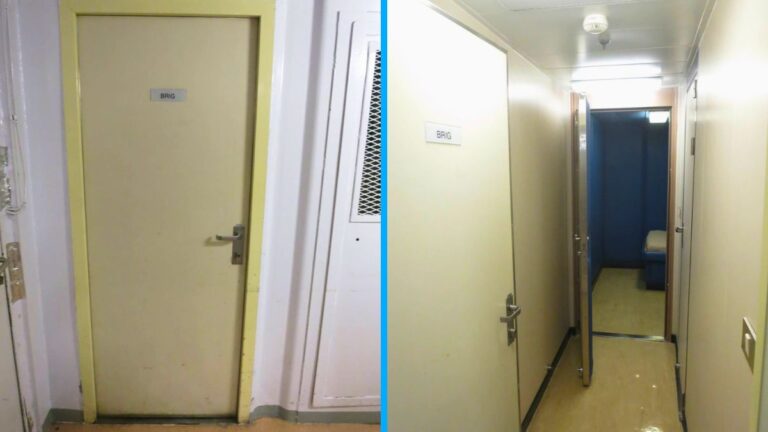
The answer is yes, but it’s not called a jail. A cruise ship will have a small brig near the bottom of the vessel located in a crew-only area. It will be a small room with a single bed. The ship’s security staff will use this room for misbehaving passengers who are a safety risk to others.
Take a look at the photo below which shows the interior of the brig on Carnival Cruise Line:
Inside the Jail (Brig) on Carnival Cruise Line (Photo Copyright: Cruise Hive)
The cruise industry never advertises policies regarding crime or their facilities, but each cruise liner has a plan. This plan may include cabin arrest in the offender’s cabin with posted guards or being locked up in a cell on the cruise ship that only the crew can access.
Larger ships contain padded cells or safe lockup rooms. Smaller ships have other methods of controlling individuals that are a security threat to themselves or others until they can remove the individual from the vessel.
Cruise ships tend to do this as quickly as possible to ensure the safety of all guests. The decision as to whether someone goes into jail or disembarks is up to the cruise ship captain.
Jail on Carnival Cruise Ship (Photo: Copyright Cruise Hive)
What Crimes Happen Most Frequently at Sea?
Most security disturbances involve small cases of intoxication in public. These cases rarely result in criminal prosecution. Every crew member receives training on managing incidents, preventing escalations, and minimizing the impact on other guests.
Most vessels independently report statistics on serious crimes aboard cruise ships. In 2014, an amendment to CVSSA (Cruise Vessel Security and Safety Act) provided FBI reports of eight detailed serious crimes that are mandatory for passenger cruise ships disembarking and embarking from U.S. ports to report.
Photo Credit: Prath / Shutterstock
The most recent reports outline the prevalence of serious crimes committed at sea. The overall numbers are low when compared to the number of passengers. For example, in one year, 13 million passengers were reported aboard cruise ships in U.S. ports. Under 100 serious crimes were reported to the FBI.
Serious crimes that occurred on cruise ships in 2020 were sexual assaults, with 22 incidents reported. In that year, there were no other types of crimes reported.
The FBI reports address any theft over $10,000, and none were reported during this year. There are many reasons for this. It may be due to the security of CCTV, stateroom safes, and electronic key card room access.
Who Investigates Crime?
Cruise ship security officers are the first responders in most cases. Their overall function is to ensure guest safety until law enforcement can handle serious issues. Jurisdiction complicates security. Local authorities have clear jurisdiction if ships are at port when the problem occurs, and this is also true when cruise ships are within the waters of the country.
FBI at Cruise Ship (Photo Credit: RUBEN M RAMOS / Shutterstock)
If the cruise ship is in international waters, jurisdiction resides within the laws of the registered country. An example is if a cruise ship is registered in South America, crimes in international waters are under South American law.
The FBI attempts to investigate when U.S. citizens commit crimes or are the victim of a crime. When a serious crime is confirmed or suspected, they use a global network to ensure the cruise passenger’s safety, then secure a crime scene to conduct a further investigation.
Handling a serious crime involves negotiation between officials from the cruise ship’s registered country, the U.S. government, and authorities in foreign ports.
What Security Measures Are in Place on a Cruise Ship?
All cruise lines contain security measures to ensure the safety of crew members and guests. These include:
Vessels must report any crime committed to relevant authorities
Weapons, drugs, firearms, knives, ammunition, flammable substances, explosives, and most drones are prohibited
Crew requires basic training so they know what to do in a situation and can report and handle all crimes or disturbances
Guests may end up either under cabin arrest or in the brig for several reasons. These include:
Committing Serious Crimes
If someone is suspected of committing a serious crime, like murder or assault, they can be put in the brig until the cruise ship reaches port. Then, local authorities will deal with the individual.
The Person Is a Danger to Themselves or Others
In this case, they can be put in the brig as a last resort. If the person threatened another person or uttered suicidal threats, they can be placed in the brig to keep them out of harm’s way. Cruise lines try to avoid this, but some situations warrant it when there are no other options.
For example, if a guest was drunk and disorderly, they may have to sign a contract promising they will refrain from alcohol for the remainder of their cruise. The consequence is removal from the cruise ship, and vessels have the right to disembark any passenger.
The Person Scammed the Cruise Line
Some people do come on board a vessel to try to scam the cruise line. A fake “trip and slip” can occur with people attempting to secure a free cruise.
Fortunately, ships have CCTV cameras. Acts like these are typically dealt with without needing the brig. However, the brig can be used if a serious crime is committed in the scam.
If you wonder whether cruise ships have jails, the answer is yes. Jails are called brigs on a cruise ship and tend only to be used in serious circumstances when no other options are available. Cabin arrest is typically used before the brig is needed.
Some cruise lines are particular about what you can and cannot take onboard, particularly regarding anything containing alcohol.
There are rules guests need to be aware of before embarking on the cruise ship. Can you take a wine opener on a cruise? Unfortunately, there isn’t a straightforward answer.
Cruise lines make a lot of money from selling alcohol and any drink on board the ship. The prices are significantly marked up, leaving many people wondering whether they can bring their own beverages. The answer depends on the cruise line and the type of beverage.
Mainstream cruise ships that permit you to bring alcohol on board allow primarily champagne or wine. They will confiscate anything else at boarding. There is also a limit to how much you can bring on the ship.
You must present bottles in carry-on bags upon entry. Before boarding, you’ll have to remove them from checked luggage and pass through ship security.
Generally, guests can bring one to two bottles per stateroom on the ship. The cruise line will confiscate anything more than this.
While on the ship, there may be a corkage fee if you consume the alcohol in a public area or dining room.
Bottles must be sealed and unopened. They cannot be in a mouthwash bottle, flask, or any other container.
If you try to sneak in bottles and get caught, the bottles will be stored and returned when you disembark. The same holds true for purchases made in the duty-free shop and at a port.
Wine on Cruise Ship (Photo Credit: photopixel / Shutterstock)
If you want to know whether your cruise line accepts alcohol you bring on board, look at their webpage, as most have a list of prohibited items posted. Don’t be surprised if many cruise lines do not permit you to bring alcohol. Each cruise line has its own policy.
Most cruise lines follow the procedures listed above.Disney Cruise Line permits guests to bring six beers (12 oz or less each) or two bottles of unopened wine or champagne (no larger than 750 ml) at the beginning of the cruise and at each port of call or shore excursion. You must pack all items in a carry-on.
Can I Take a Wine Opener on a Cruise?
The answer to this question is that it depends on two conditions: whether it is a stand-alone corkscrew or part of a Swiss army knife/portable knife set.
Standalone Corkscrew
Some cruise lines will permit you to bring a standalone corkscrew on board, while some may not. Cruise lines view a corkscrew as a potential weapon, but many don’t overtly comment on whether bringing them is acceptable on their websites. However, their policies are worded as if guests ask for corkscrews when necessary.
If you bring a corkscrew, much like alcohol, it must be stored in a carry-on or checked luggage. If you are unsure, ask the room steward for a corkscrew, and they will bring it to you.
As a Part of a Knife Set
Many guests bring a Swiss army knife, which has a corkscrew. They are convenient, small, and easy to pack in your luggage. However, they are prohibited as many cruise lines ban all knives.
Knives are classified as weapons. Although you may just want the corkscrew, cruise lines can confiscate anything they view as a weapon or that can potentially be used as a weapon. Remember, guest safety is the top priority for every cruise line.
Some specify that they will only confiscate knives over four inches long, but some just ban knives completely. You will need to consult with the cruise line on their policies before bringing them on the cruise.
What Should I Do?
If you are unsure about your cruise line’s policy, it is best to contact them directly so they can outline the policies and address any questions you have. Sometimes, the wording can be confusing or contain grey areas. So, it is best to ask directly.
Other options include:
Checking the website before packing. When checking into this topic, first ensure alcohol is permitted and what type is allowed so you don’t end up taking something you can’t use. Then, examine if corkscrews are allowed. Can they be part of a knife set, or do they need to be standalone?
Avoid the hassle and ask the stateroom host to bring you a corkscrew.
Drink your wine in a dining room or designated area. You may have to pay a corkage fee, but it will prevent you from potentially losing your wine.
Cruise lines can differ on what they permit on board, so the rules on what you can take onboard aren’t always clear-cut. The first thing to determine is whether they allow you to bring alcohol and whether you can bring it outside of special occasions.
Wine on Cruise Ship (Photo Credit: SariMe / Shutterstock)
Not all cruise lines permit you to bring alcohol on board. If they do, you are limited by size and the amount you can bring. The amount allowed is rarely enough for the entire trip. You may save some money, but it won’t be significant. You may even end up paying for the privilege of drinking your own alcohol, depending on where you drink it.
However, it may be worth the extra effort if it is a special bottle or a particular vintage you are fond of.
Next is addressing whether you can take a wine opener on a cruise. The answer is maybe. Some cruises view certain types as weapons and will remove them from your possession. They are very particular regarding weaponry and have different policies on this subject.
Some will remove the wine bottle opener if it is part of a Swiss Army knife, as they are considered a weapon, but will allow a standalone corkscrew. Meanwhile, others frown on it altogether and will refer you to the room steward instead. Either way, there will be a corkscrew available to you onboard the ship so you are able to crack open your bottle and enjoy!