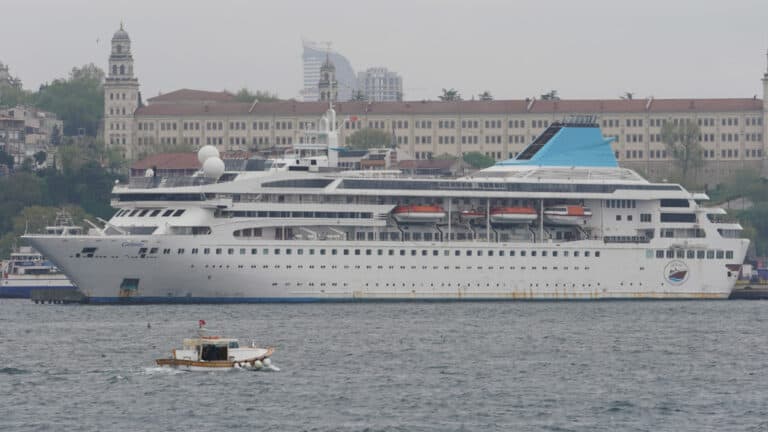
Miray Cruises has announced it will open for bookings for a three-year world cruise on March 1, 2023. The cruise will sail onboard the 1992-built MV Gemini and visit 135 countries on seven continents from November 2023 through the end of 2026.
The fantastic part of the three-year cruise is that the cost for guests can be as little as $2,500 per stateroom per month. This provides an excellent opportunity for those looking to travel while working while having all their daily needs taken care of.
Three Years At Sea
It won’t be something everyone will enjoy, but many will still see the benefits of embarking on a three-year journey that will span 130,000 miles, visit 375 ports of call in 135 different countries, and sail to all seven continents.
Miray Cruises announced it would be opening up bookings for the first-ever three-year world cruise. In essence, the cruise is a variation of the ever-more popular concept of living onboard a ship.
Image Credit: Miray Cruises
Several companies announced new residency ships in the last year, where guests live onboard instead of ashore. The cruise will sail on November 1, 2023, and return in 2026.
MV Gemini‘s journey around the world will begin in November of this year. Most ports of call on the trip will include several days in port, giving guests a chance to fully explore each destination, which includes 13 of the modern and ancient Wonders of the World
The cruise ship will have been fully modernized by the time she sets sail. Currently, she is in use to housing earthquake victims in Turkey and Syria. The cruise line is aimed towards working professionals that want to spend time at sea while being able to carry out their work remotely.
Aiming for Remote Workers
For just $85 per day for a stateroom onboard the MV Gemini, guests will be able to enjoy world-class dining, onboard entertainment, and recreational activities with modern workspace facilities such as a first-of-its-kind business center with meeting rooms, 14 offices, a relaxing lounge, and business library.
“Professionals need connectivity, the right amenities, and the functionality to perform their jobs. There is no other cruise product that offers this sort of flexibility to their customers,”says Mikael Petterson, Managing Director of Life at Sea Cruises.
Image Credit: Miray Cruises
The ship will also include a 24-hour on-call hospital with free medical visits, learning and enrichment classes, and the opportunity to make a positive impact through volunteer and philanthropic initiatives.
“Life at Sea Cruises offers the ultimate bucket list cruise without having to sacrifice the comforts of home,” says Irina Strembitsky, Director of Sales & Marketing of Life at Sea Cruises.“It’s your home at sea with the world as your backyard.”
Prices for the cruise start at $29,999 per year, and the entire voyage is all-inclusive. Cabins range from 130 sq ft for Virtual Inside and Oceanview staterooms to 260 sq ft Balcony Suites.
MV Gemini first sets sail in 1992 as the Crown Jewel for Crown Cruise Line. Since then, the cruise ship has sailed for a long list of owners,including Cunard, Star Cruises, and Celestyal Cruises.
Miray Cruises, a Turkish cruise operator and hotel services provider for the cruise industry, acquired the vessel in 2019. The ship is just 19,093 gross tons and has space for 1,074 guests.
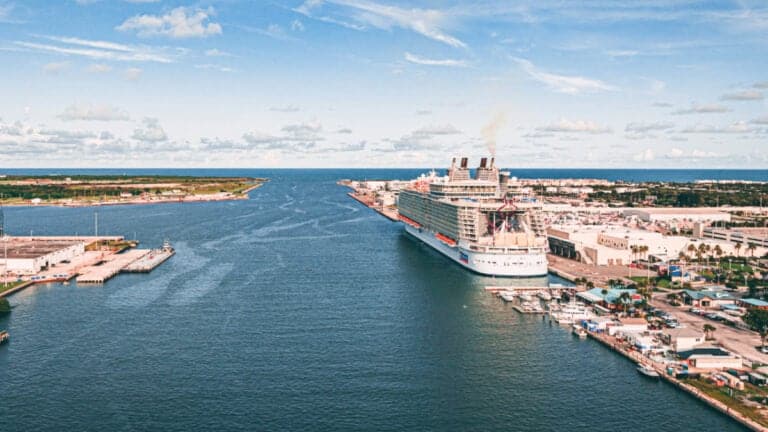
The record has been passed and Port Canaveral has taken over from PortMiami as the world’s busiest passenger cruise port.
The news comes as the 2022 passenger totals have been released from the Florida Ports Council, and Port Canaveral tops out at over 4 million passengers, a slim margin over PortMiami’s impressive numbers.
Busy Year for Port Canaveral
While the year began slowly with cruise lines continuing to limit guest capacity for health and safety restrictions, 2022 quickly gained momentum as cruise travel dramatically rebounded.
Thanks in part to Port Canaveral’s proximity to Orlando and the faster easing of local community restrictions in that part of Florida, compared to more stringent health and safety measures in the more populous communities of South Florida, the cruise port gained a slim lead over PortMiami to become the world’s busiest passenger cruise port.
Photo Credit: JHVEPhoto / Shutterstock
In total, 4,072,396 multi-day cruise guests moved through Port Canaveral, edging out PortMiami’s updated 4,022,544 multi-day guests, an updated number directly from the port rather than 3,988,094 from Florida Ports Council.
“We’ve always aimed to be the best cruise port in the world, but what an achievement to now be known as the busiest,”said Captain John Murray, Port Canaveral CEO.“This historic milestone is testament to the efforts of our team and cruise partners to provide a best in class experience for all cruise guests sailing from Port Canaveral.”
Multi-day cruise guests are those passengers on a voyage lasting more than one day. Single day guests, on the other hand, are sailing on vessels such as casino boats or similar entertainment sailings but do not have overnight stays. Multi-day guests can include both homeport sailings as well as day port visits.
Other Florida Cruise Ports
Florida is home to four additional cruise ship homeports: Port Everglades in Fort Lauderdale just 21 miles (34 kilometers) from Port Miami; Jaxport in Jacksonville in the state’s northeastern corner; Port Tampa Bay on the west coast; and Port of Palm Beach still further north from Miami and Fort Lauderdale.
None of the other homeports comes close to the passenger traffic of either Port Canaveral or PortMiami, though they all serve different cruise lines and offer great vacation options for guests.
Photo Credit: Ruth Peterkin / Shutterstock
Port Everglades saw 1.6 million passengers in 2022, while Jaxport, Port Tampa Bay, and Port of Palm Beach totaled 90,241, 418,200, and 188,235 guests, respectively.
Port of Key West is another popular cruise port in the Sunshine State and saw 198,411 guests, though the port is not used as a homeport, only as a port of call visit.
Totals to Rise Dramatically in Years to Come
It should be noted that all Florida’s multi-day cruise port passengers combined totaled 10.5 million guests. While this is an impressive total for a year when all cruise ships were not sailing the full year and restrictions still limited passengers, it is far below the 2019 total of 17.8 million, before the pandemic shutdown halted the cruise industry.
Florida Ports Council projects that the cruise industry in Florida ports should be close to 2019 levels in 2023, with even higher totals in years to come.
Forecasts for 2027 bring Port Canaveral to 6.4 million passengers that year, with PortMiami projected to host 8.4 million. Of course, port improvements at all Florida homeports will continue in the next few years to accommodate growth, welcome more advanced ships, and provide adequate security and safety for all vessels, crew, and guests who move through the ports.
Which Florida homeports have you sailed from? Do you have a favorite? Share your thoughts cruising from the Sunshine State in the Cruise Hive Boards!
Cruise ship horns have a particularly distinct sound that is very, very loud. However, you shouldn’t mistake a cruise ship’s horn for the same purpose as your car’s horn, for example.
They are an essential part of water navigation and are crucial for the safety of the ship and other ships at sea. They have a unique significance, and different blasts mean different things.
Keep reading to learn the history and significance of a cruise ship horn, and discover the meaning of the different blasts you may hear throughout your cruise.
Standardized international regulations were established to codify important vessel operation procedures. Part of this standardization includes having adequate horns on large vessels, and cruise ships are no exception.
Photo Credit: Darryl Brooks / Shutterstock
These regulations are essential to ensure good communication between all vessels for the safety of all those onboard. The main point of a cruise ship horn is to avoid a collision at all costs.
Cruise Ship Horn – Why Do They Blast Their Horns?
There are various reasons why cruise ships blast their horns, ranging from a simple salutation to other passing ships to a warning of potential danger or an emergency.
For the most part, however, most horn blasts are to communicate with other passing ships what direction the ship plans on going. This is done using various horn signals that all vessels understand.
Why Are Ship Horns So Loud?
You’re on your cruise deck relaxing and trying to get a tan when suddenly you hear the loud blaring of the horn. While this may startle you and even be annoying, there’s an important reason that cruise ship horns are so loud.
Cruise ship horns are so loud because of how big the open sea is. They act as a warning to other boats and vessels at sea. They need to be heard in cases of low visibility and in cases of emergency.
Photo Credit: Halit Sadik / Shutterstock
In general, you can hear cruise ship horns from up to two miles away. Cruise ships are pretty slow to stop and turn due to their enormous size, so this much space is needed as a warning to get out of another ship’s way.
Ship Horn Blasts – What Do They Mean
You may have noticed that cruise ships have several different blasts. But what do they mean? Here’s a quick look into what the horn blasts mean.
One short horn blast: This communicates to another ship that you intend to pass it on your port side.
Two short horn blasts: This communicates to another ship that you intend to pass on your starboard side.
Three short horn blasts: This means that you are operating in reverse, such as backing away from the dock.
One prolonged horn blast: This is the first blast you’ll often hear onboard your cruise, as the blast signals that a vessel is leaving the dock.
Five short horn blasts: This typically signals danger and is the type of blast you are least likely to hear on your ship
Aside from these reasons, your ship might also sound its horn in times of low visibility just to make its presence known.
Wrap-Up
Although cruise ship horns tend to startle and scare people onboard the ship, there’s rarely anything to worry about. In general, the ship’s captain blasts the horn signal only to communicate.
You’re more likely to hear your captain blast the ship’s horn signal for fun than you are to be in an emergency. Either way, you now know what different blasts mean so that you can be prepared for your next cruise.
Mexico has always been a top destination for cruise ships and their guests, and this trend continued throughout 2022. According to Mexico’s Secretary of Tourism, Miguel Torruco, 7.7 million cruise ship passengers arrived at different Mexican ports last year, representing a substantial increase from the previous year.
Cozumel has the busiest cruise port in the world, which proved true again in 2022, with almost 3 million passengers visiting the popular island. However, places such as Costa Maya, Cabo San Lucas, and Ensenada have done equally well in recovering from the hardships experienced in 2020 and 2021.
Busiest Ports in Mexico for Cruise Arrivals in 2022
Cozumel and Costa Maya in Quintana Roo, Ensenada in Baja California, Cabo San Lucas in Baja California Sur, Puerto Vallarta in Jalisco, and Mazatlán in Sinaloa are the top ports that received the highest number of cruise arrivals in Mexico in 2022. These ports alone accounted for 94.6% of the cruise passengers who arrived in Mexico last year.
Cozumel, in particular, saw a significant increase in arrivals, with 1,114 ships and 2.9 million passengers in 2022, a trend it’s continuing this year. Mahahual in Quintana Roo had 462 arrivals, with 1.23 million cruise passengers.
Photo Credit: byvalet / Shutterstock
Ensenada in Baja California received 323 cruise ships and 744,221 passengers, while Cabo San Lucas in Baja California Sur had 227 vessels arrive with a total of 540,773 tourists. Puerto Vallarta in Jalisco received 184 cruise ships with 458,319 passengers, and Mazatlán in Sinaloa had 141 arrivals and 399,926 cruise passengers.
2022 was off to a flying start in Mexico’s cruise tourism industry. By the end of May, 2.9 million cruise passengers had already visited the country—a clear indication of Mexico’s growing popularity and recovery as a cruise destination.
Throughout the year, more than 2500 cruise ship calls were made to one of Mexico’s many cruise ports. These ships arrived in different ports of Mexico, including some lesser-known ports such as Progreso, Huatulco, Acapulco, Manzanillo, and Zihuatanejo.
Mexico is home to more than 12 ports equipped to handle the arrival of cruise ships to its shores. Each port has unique attractions and experiences to offer, making them popular destinations for cruise passengers from around the world.
Some ports, like Cozumel and Puerto Vallarta, offer beautiful beaches and water activities, while others, like Ensenada, are known for their wineries and gastronomy.
Government’s Focus on Developing Tourism Sector
The Mexican government has been working hard to ensure that the country’s ports are equipped to handle the growing number of cruise ships and passengers. Many ports have undergone upgrades in recent years to accommodate larger vessels and provide better services to tourists.
Photo Credit: Melissa Mayntz
The average expenditure of cruise passengers was $76.7, which is an 8.3% increase from the previous year, showing that the focus from the government is paying off.
This spending resulted in a significant economic impact on the region, particularly in the ports that received the most arrivals. The cruise industry generated a foreign exchange income of 542.7 million dollars, significantly boosting Mexico’s economy.
Despite the challenges posed by the global pause in operations during 2020 and 2021, Mexico’s tourism industry has remained resilient. Many visitors have felt confident in traveling to Mexico and enjoying all the country offers.
Miray Cruises’ Gemini will be used as a temporary shelter for refugees after the devastating earthquake that struck Turkey on February 6, 2023.
The vessel has a history of relief work and will be docked at the Port of Iskenderun, Turkey, while housing refugees, many of whom are families with children.
Ship to Serve as Emergency Shelter
Gemini is a 19,093-gross-ton vessel with the capacity for 1,074 guests, which will help tremendously with displaced families who lost their homes in the 7.8 magnitude earthquake that struck south-central Turkey and northern Syria on Monday, February 6, 2023, one of the strongest earthquakes to ever impact the region.
Miray Cruises has offered the vessel for emergency relief to welcome refugees. The cruise line will not only furnish housing onboard the ship, but will also furnish all meals and provide 24-hour medical care to those aboard.
Furthermore, a special schedule of activities for the children aboard will be created to help create a sense of normalcy and relieve anxiety for the youngest guests.
Gemini features 400 cabins as well as several bars and restaurants, lounges, duty-free shopping, a main pool, and a spa area. It is not known how many features will be available for the refugees to use, or whether areas may be temporarily repurposed to better serve the refugees’ needs, such as for extra sleeping quarters, storage space, or an onboard schoolroom.
The ship will be housing refugees until March 15, after which it will begin a planned season of short Greek Island cruises including visits to Santorini, Mykonos, Athens, Rhodes, and other top destinations.
History of Service
Gemini first entered service in 1992 as Crown Jewel, the largest vessel ever built in Spain, for the now-defunct Crown Cruise Line. The ship has been owned and operated by various lines over the past 30 years, including Cunard Line, Star Cruises, and Celestyal Cruises. Miray Cruises acquired the vessel in 2019.
In addition to welcoming cruise travelers with various lines and sailing to various destinations around the world, Gemini also has a history of alternative service and humanitarian aid.
During the London Summer Olympics and Paralympic Games in 2012, the ship was used as housing for security staff, and she has been used several times as accommodations for workers in various locations for different companies.
In 2017, the ship was chartered by FEMA to hose emergency response crews after Hurricane Irma and Hurricane Maria, stationed in St. Thomas in the US Virgin Islands.
Cruise lines often offer vessels for relief support when there is great need. Several ships have been chartered to house Ukrainian refugees, for example, and ships are regularly used after hurricanes and tropical storms.
About the Earthquake
The 7.8 magnitude earthquake struck at approximately 4:17 a.m. local time on February 6, with far-reaching damage and an estimated 47,800 deaths.
This is the strongest recorded earthquake in the region since 1939, which also registered as a 7.8 magnitude. Shaking was felt as far away as Egypt, Israel, Palestine, Lebanon, and Cyprus. More than 2,000 aftershocks followed the main pair of quakes, with severe winter weather causing further complications for rescue and relief efforts.
Total damage is estimated to be $84 billion (USD), making this earthquake the fourth-costliest earthquake in recorded history and the deadliest natural disaster modern Turkey has ever seen.
Cruise Hive’s thoughts are with everyone impacted by this devastating earthquake, including crew members of cruise lines worldwide who have family and friends in Turkey and Syria.
When planning for your next adventure on the high seas, leave an opening in your budget for cruise gratuities. This is an expense that many travelers overlook when tallying the cost of a voyage. Yet, it can add hundreds of dollars to the final numbers and falls into the category of an important item for most passengers.
Cruise gratuities are the tips that each passenger pays during the trip. These are usually calculated on a per person/per day (or night) basis by the cruise lines.
While the exact fees can be determined by the type of cabin you book, they are different than a hotel stay in that every person in the cabin will be assessed the charge. (Children three years old and younger excepted in some instances.)
On your bill, cruise gratuities may be listed in several different ways: tips, service charges, crew appreciation fees, crew incentives and others. These costs are added onto the price of the journey and are often an automatic charge.
The stated reason for the latter (compulsory nature of this fee) is to ensure that all passengers pay their fair share. Although not technically “required,” tips are nonetheless expected.
Charging every passenger an automatic cruise gratuity also assures that crew members who work behind the scenes to deliver an exceptional vacation experience receive a share.
In the years past, cash in envelopes would only benefit the staff who directly interacted with the passengers. This “new” practice of automatic cruise gratuities allows a greater number of the crew to add this important contribution to their income. It is also a simple way for passengers to tip since all the calculations and distributions are handled by the cruise line.
To determine the final total of these costs, simply visit your selected cruise line’s website. All the exact numbers are there to help you plan accordingly for the actual price of your upcoming cruise.
How to Pay Tips on a Cruise Ship
There are three basic ways to pay tips on a cruise vacation. The first is to pre-pay cruise gratuities when you book your reservation. Passengers say that the best benefit to using this method of payment is sticker shock avoidance. While it may not sound like much money when quoted as a per person/per day cost, seeing the total on your final onboard bill can feel expensive.
Additionally, if you pre-pay and the tip amount per person/per day increases before your cruise date, you have saved some money by locking in the lower rates. While raising the tip rates does not often happen, if it did, your cumulative costs for the trip would be higher.
The second option is to allow the charge to be added each day to your onboard account. All expenses accrued (and not included in the price of your trip) will be due at the end of the voyage. For most large lines, cruise gratuities are part of the line items charges along with other “extras” you bought along the way.
Since all purchases on cruise ships are “cashless” (with the possible exception of the casino), it is a good idea to keep an eye on your onboard account. Download the app or check on your cabin’s TV for up-to-date charges.
The third option for tipping is to pay the old-fashioned way – cash. (See below about removing automatic cruise gratuities from your bill.) These cash tips can be given at the time of service or at the conclusion of your trip.
The benefit here is to directly thank specific crew members. However, it is unlikely that you would be able to tip any of the crew members who work out of the public view with this option.
Carnival Cruise Line Crew Members (Photo Copyright: Cruise Hive)
You may also want to create a hybrid method by combining the basic options. For example, you can pre-pay and supplement with cash to those crew members who are above-and-beyond in their service skills.
This is also the suggestion for covering the tips for the personnel who are not in your cruise line’s automatic gratuity group. (See below for who does not get a share.)
NOTE: Most luxury lines fold tips into the price of the cruise. Additionally, some have a “no tipping” policy for their crews. With that said, however, exceptional service may warrant a gratuity offer. On these ships, your offer may be accepted or politely refused.
Who Shares the Automatic Cruise Gratuities
It takes a combined effort of a team of crew members to keep the ship in tip-top shape and create an enjoyable experience for the passengers. While we only interact with certain people in particular positions, they represent dozens of others who work hard at their jobs.
In former times, tips were only given to the crew who had face-to-face interactions with the passengers. This practice favored the front-of-the-house staff while others working behind the scenes had little opportunity to make more money.
Photo Copyright: Cruise Hive
For example, passengers were once assigned a dining table and saw the same wait staff throughout the voyage. Today, we can eat in any number of venues and have a host of different servers.
The newer system of charging cruise gratuities on a per person/per day basis has helped equalize this situation. In addition to the waitstaff and room stewards receiving portions of the fee, the funds are also shared by some cruise lines with crew members in other jobs. For example, food preparation, general housekeeping and maintenance, laundry and other important positions may receive a percentage.
Who Does Not (typically) Get a Share of Cruise Tips
With so many activities and venues to enjoy on a cruise ship, you will interact with a number of other crew members who will most likely not receive a portion of your automatic gratuity fee.
One example of this situation is childcare services. The people working in the areas responsible for the safety and entertainment of your children will (likely) only receive a tip if you offer one!
For some cruise lines, bartenders will have to “earn” their tips during the voyage. If you find a favorite spot at the same bar, chances are quite good that the bartender will learn your name (and maybe even your choice of beverage). Start the cruise with a nice tip upfront, and thank him or her at the end with another.
Cruise Ship Bar (Photo Credit: Ihor Koptilin / Shutterstock)
Similarly, if a waiter (or sommelier) is keeping track of your wine bottles, they are also expecting to receive an appropriate gratuity. And, if you enjoy ordering room service, it is still customary to offer a small tip each time the staff appears at your door with delicious food.
If a visit to the spas or salons onboard will be part of your cruise, keep in mind that these crew members may not be part of the tip-sharing program. After receiving good service, leave a nice tip.
Another circumstance where tipping is recommended beyond the automatic cruise gratuities is during shore excursions. If you have booked a tour with your cruise line at a port of call, your guide should receive a tip at the end.
This is also true for any tours booked with local guides. Look for a tip jar at the front of the bus or van; if you are on an extended tour with other shipmates, passing around an envelope to collect tips may be in order.
Also, anytime you hire transportation onshore, gratuities for the driver are appropriate (public transit excepted). This is often an important part of their income stream.
Tip Jar (Photo Credit: yanishevska / Shutterstock)
The last (and first) person you will likely see is the luggage porter or baggage handler. Just as in other travel situations at airports, hotels and so forth, this person should be on your list to tip. This is particularly true if you are a “heavy” packer!
NOTE: When paying the cost of any of these or other services on the ship, check to see whether an automatic tip has already been included in the bill. This can be quite specific to the activity and the cruise line.
For example, some cruise lines have an automatic gratuity charge per drink or drinks package (including “free drink packages,”) and others add a tip percentage to all spa treatments.
So, if it is unclear, it is acceptable to ask if and which tips have been automatically charged to your bill. This will allow you to add an appropriate gratuity AND avoid double tipping.
How to Remove Cruise Gratuities from Your Bill
The debate continues as to the inclusion of “forced” cruise gratuities on board ship. Depending on your customs, culture or country, this will either seem perfectly fair or an unnecessary expense for services that are “part of the job.” Still others feel that tips should be earned and given in recognition of a “job well done.” Regardless of where passengers stand on the issue, this remains a monetary consideration during the next cruise vacation.
Should the occasion occur that you feel the service on your cruise is consistently below standards, you do have the option to remove the gratuities from your bill. Prior to doing so, however, speak with someone at the front desk (purser’s desk or reception desk) to try to resolve the issues.
If this does not solve the problem, then you can request a refund of all or part of the amount; or, reduce the rate. Depending on the cruise line, this may be removed from your bill or issued as a ship credit. This can only be done on the ship prior to the end of the cruise since all funds will have been distributed to the crew after that point.
If this is your course of action, consider offering a cash tip to those individuals who provided good service during your voyage. It is not often the case that all interactions with all crew members are substandard. So, take this opportunity to recognize the folks who worked hard to make your cruise pleasant.
Additionally, make a list of the employees who provided the best service and send a note of appreciation to the cruise line with their names included.
NOTE: If you are opposed to automatic gratuities and have decided to cancel them regardless, it is a good idea to let your room steward and front desk know that you will be tipping throughout the voyage instead. This is a respectful way to advise the crew ahead of time about your plans.
Also, there are certain cruise lines that do not allow cancellation or alteration of this expense. Read the fine print when you make your reservation.
How to Give Extra Appreciation
Whether you opt for pre-paying cruise gratuities, having them added to your charges during the voyage or passing out tips along the way, bring small bills (lots of them!). Waiting in line to exchange large denominations at guest services can be a hassle.
Also, bring along some envelopes or even a pack of small, printed thank you cards. When you have great service (or need to tip those above who are not part of the gratuity pool), hand the cash, envelope or card directly to the person. And, as the time to disembark approaches, make sure you let the crew members whom you have come to know that you appreciate them.
NOTE: With all the folks depending on tips for their income, the captain, officers, directors, executives and performers (piano bar performers excepted) are not. Do not tip them! Instead, write them a note of appreciation or mention them specifically in any positive reviews of your trip.
Final Note on Cruise Gratuities
While planning for your next voyage, search for cruise lines that are bundling onboard items and selling them at a discounted price. For example, you may be able to secure significant savings by purchasing a WiFi, drink and tips bundle when you book your reservation.
This usually requires deciding and paying in advance. And, the crew will still get their regular share even though you have received a discount on the cost.
Celebrity Cruises is one the most famous and innovative cruise lines around. Celebrity Cruises draws in all types of people, from young adults to families, to enjoy a relaxed luxury cruise without luxury prices. But who owns Celebrity Cruises?
In this article, you’ll learn who owns Celebrity Cruises, the history of this popular cruise line, and what to expect if you choose to take one of their luxury cruises.
Celebrity Cruises is owned by Royal Caribbean Group – the second biggest cruise company after Carnival Corporation. The CEO & President of Celebrity Cruises was Lisa Lutoff-Perlo, but in May 2023, she was promoted to Vice Chair, External Affairs for Royal Caribbean Group.
Currently, Laura Hodges Bethge holds the helm at the cruise line after being promoted from her previous role of executive vice president of shared services operations. The President & CEO of Royal Caribbean Group is Jason Liberty.
Celebrity is one of the three cruise brands the global cruise company owns, the other two being Royal Caribbean International and Silversea Cruises. When a cruise company operates more than one cruise line, people often wonder what makes them different. In this case, what makes the Celebrity Cruises line different?
Celebrity Cruises President & CEO Lisa Lutoff-Perlo
What sets Celebrity Cruises apart from Royal Caribbean Group’s other offerings is it offers a more premium experience. While Celebrity Cruises may be a little more expensive on average, the experience will also be more elevated.
Celebrity Cruises has its headquarters in Miami, along with Royal Caribbean Group’s other brands.
The History of Celebrity Cruises
Celebrity Cruises was founded in 1988 by Chandris Group, a former Greece-based cruise line. Chandris Group initially operated cruises to Bermuda and characterized themselves as an option for the lower-end cruise passenger market.
Here’s how Chandris Group created Celebrity Cruises. In 1988, another large cruise line that operated in Bermuda, Home Lines, was bought out by another large cruise line.
They had a contract for two ships with Bermuda. But the company who bought them decided to withdraw their ships from this service.
Chandris Group was interested in these two new contracts up for grabs, but Bermuda would only award these contracts to upmarket cruise lines, which, as mentioned, Chandris Group was not.
SS Meridian (Photo Credit: Svend Raether)
So they created Celebrity Cruises and negotiated with the Government of Bermuda until they were awarded the contract. Once won, Chandris Group marketed the Celebrity Cruises line as a luxury cruise.
Celebrity Cruises started with one cruise ship, the Meridian, until a second cruise ship, the Horizon, entered service in 1990.
Chandris Group operated six cruise ships under Celebrity Cruises by the end of their run. In 1997, Chandris Group sold Celebrity Cruises to Royal Caribbean Group, which has been operating the cruise line ever since. However, you’ll still see hints of the cruise line’s Greek roots, as the logo contains the Greek letter “chi” for Chandris.
Cruises Offered By Celebrity Cruises
Celebrity Cruises offers cruises all over the world – to all seven continents. This means that there are no limits to where you can go.
Photo Courtesy: Celebrity Cruises
You can visit up to eight destinations on one cruise, with over 300 possible destinations. Here are some of the top destinations that Celebrity Cruises offers:
The Caribbean
Europe
Western Mediterranean
Alaska
Regarding cruise types, Celebrity Cruises also has various packages to choose from, such as all-inclusive cruises and “bucket-list” cruises that include shore excursions with adventures that are on your bucket list.
What Can You Do on a Celebrity Cruise?
Celebrity Cruises is known for its cruise line’s wide range of activities. They operate 15 ships, including the Celebrity Beyond, Celebrity Apex, Celebrity Edge, and Celebrity Summit, each offering unique experiences. Depending on which cruise and destination you’re on, there are a variety of different activities guests can choose from, including:
One activity unique to Celebrity Cruises is its customizable onboard camp – Camp at Sea. This is a great educational activity if you’re traveling with children.
Photo Credit: Melissa Mayntz
The activities range from art to culinary and STEM. This is sure to be a memorable experience for your little ones and also allows you to enjoy some alone time enjoying the cruise yourself!
Final Thoughts
Who owns Celebrity Cruises? Royal Caribbean Group, a trusted cruise line company that offers many cruises. That said, Celebrity Cruises offers guests a unique experience you won’t find on any other line.
If you’re looking for relaxed luxury, interesting activities, and over 300 possible destinations, Celebrity Cruises is worth considering.
After their extraordinary lives sailing passengers all over the world for exquisite cultural experiences, decommissioned cruise ships have to say farewell, too. Where do they go to be dismantled?
Before the pandemic, cruise ships stayed in commission for a lot longer. Larger cruise companies sold their older ships to smaller cruise lines. The smaller companies would refurbish them, change their names, and continue to book cruises full of passengers, significantly extending the ships’ lifespans.
However, when the pandemic hit, the cruise industry took a substantial hit. Smaller companies no longer bought older cruise liners from the large companies because no one was cruising, so there was no way to make the money back on the investment. Larger cruise lines started sending their fleets to ship graveyards and selling their parts for scrap, as there would be no voyages for months.
Carnival Fascination Cruise Ship Before Being Scrapped
Luckily, cruise ship travel is back, guests are happy, and the cruise industry is recovering.
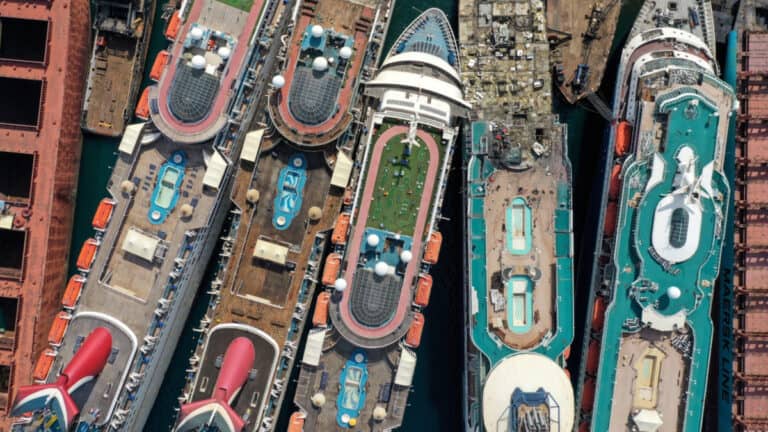
Still, modern cruise ships don’t live forever. Once old cruise ships have lived out their magnificence, power tools and heavy machinery in the ship-breaking yard crunch the hotel rooms, elegant restaurants, and terraces into bits and pieces. These pieces are usually composed of electronics, glass, wood, and other repurposable materials. The components then get carted away to be repurposed.
The meticulous detail required to pull these vessels apart is staggering, from the light bulbs and their fixtures to treadmills from the gyms – and even the pianos. Thankfully, the pianos, artwork, furniture, and exercise equipment can go to worthy new homes.
The Process of Taking Apart A Cruise Ship
The process of disassembling cruise ships necessitates thousands of skilled laborers who are familiar with cruise ship anatomy and how to organize parts of the vessel. It’s dangerous work, and with the process taking anywhere from eight months to a year, the workers do an excellent job of ensuring that there’s nothing left after the job is done.
Photo By: Selçuk Ateş
The first pieces of a cruise ship to be dismantled are usually the communications and navigation equipment, as these are the most valuable pieces on board. Then, the guest furniture and beds are brought out, as they can usually be repurposed.
Where everything inside the ship goes is wide and variable, and there’s no real way of determining who collects it all. But environmentally-friendly cruise lines ensure that these materials are duly repurposed for public benefit.
Benefits and Hazards of Shipbreaking
There are several economic benefits to dismantling cruise ships.
One of the main benefits is the amount of steel recovered. A large part of a cruise ship is made of steel, and by recovering and reusing it, the countries where the ship breaking yards are located do not have to import steel.
Because breaking cruise ships apart in this way allows companies to reuse and recycle many parts of the vessels, it provides a lot of raw materials that can be used to build other cruise ships. Various components, like oil, lubricants, and electrical wiring and equipment, can also be reused.
That said, there are many hazards to the death of a cruise ship. According to the NGO Shipbreaking Platform, it is one of the most dangerous jobs in the world and a job that not many people in the world are very familiar with. There are also significant environmental costs to consider.
Where Are Cruise Ship Scrap Yards Located?
There are ship scrap yards in various places, mostly in south Asia, but they do not all use the same methods. About half of all cruise ships go to a scrapyard in Alang, India. About 30% are sent to scrap yards in Bangladesh, Pakistan, and other scrap yards in India.
The rest go to scrap yards in China and Turkey. In addition to the one in Alang, India, some of the most prominent scrapyards are located in Gadan, Pakistan; Chittagong, Bangladesh; and Aliaga, Turkey.
Photo Courtesy: Carnival Cruise Line
It’s worth pointing out that the pandemic caused a considerable uptick in the number of cruise ships sent to these scrap yards. Since the pandemic, business in the Aliaga shipbreaking yard alone is up by 30%.
Ship dismantling is a long and arduous process, done almost entirely by hand with no automation, which is the primary reason shipbreaking yards are located in countries like India, Pakistan, Turkey, Bangladesh, and China. Labor costs are lower in these parts of the world, and environmental laws are not as strict.
Conclusion
Decommissioning or breaking a cruise ship requires hundreds or thousands of workers and months of work. For the ship-breaking process, ships head to a shipyard and dock.
Workers take them apart piece by piece, hauling steel and furniture, bottles of decadent liquor, and books about ancient seafaring ways off into the distance where the sun sets on the dunes of ship-going fun, leaving room for new vessels to enter the world to delight thousands more eager guests.
Carnival Cruise Line shared a new video message from its President, Christine Duffy, addressing the issue of inappropriate behavior on board its ships, just in time before Spring Break and the Summer Holidays.
The video highlights the steps the cruise line takes to ensure a safe and enjoyable vacation for guests, including updated security procedures, additional crew training, and enhanced guest communications.
Enforcing Security Measures
Carnival Cruise Line will not accept any unruly behavior anymore. After the cruise line implemented several measures last year and reminded guests again earlier this month through email communication.
The company released a video on February 16 where President Christine Duffy clarifies that illegal and disturbing behavior will be met with swift and severe consequences.
You can watch the full video message in the video below:
Carnival Cruise Line has added more security personnel and introduced narcotics sniffing dogs at home ports to screen luggage on both a routine and random basis. Guests may even see dogs on board at home and destination ports to do random searches.
The use of illegal drugs, including marijuana, on cruise ships and in cruise terminals is prohibited. For guests using medical marijuana, it is advised to consult with a physician about an alternative therapy during the cruise.
Christine Duffy, Carnival Cruise Line President:“Illegal drugs, including marijuana, on cruise ships and in the cruise terminals, is prohibited, and in case there’s any confusion, let me remind guests that while marijuana and cannabis products may be legal in some states, we are required to follow federal law irrespective of the law.”
Guests must acknowledge and commit to the code of conduct during the check-in process, which includes consequences for non-compliance, such as fines, confinement to cabins, or removal from the ship and being banned from future sailings.
In addition, Carnival has implemented a youth curfew to ensure the safety and security of all passengers.
Carnival Asks for Mutual Respect and Responsibility
In addition to new signage that has been placed in the terminals and on the ship, Shaquille O’Neal, the Chief Fun Officer, also appears in a series of video messages on stateroom TVs to remind guests of Carnival’s policies and guests’ collective responsibility to have fun and respect each other and the ocean.
Duffy emphasized the importance of mutual respect and responsibility in ensuring the guests’ vacation is safe, fun, and memorable. Carnival Cruise Line prides itself on providing a great cruise experience for its guests and has successfully maintained its reputation as a family-friendly cruise line.
“We know how to show our guests a great cruise experience, and our ships are full of fun-loving guests. That’s why we’re so successful and why guests keep coming back. So please help us make sure your carnival vacation is safe, fun, and memorable by respecting each other, our crew, and the ocean.”
Video Message Does Not Surprise
Today’s video message by Christine Duffy will come as no surprise to many guests. The cruise line has begun sending “Guest Advisory” guidelines to booked passengers ahead of their upcoming cruises, with detailed reminders about behavior guidelines and safety policies onboard every Fun Ship. This after multiple altercations onboard Carnival’s cruise ships last year.
The email explains and reminds guests of the code of conduct, including policies such as smoking, bringing alcohol or non-alcoholic beverages onboard, and general disruptive behavior.
The email clearly outlines the consequences of unruly or disruptive behavior, including fines of up to $500, additional expenses related to confining or disembarking guests, and even being banned from sailing with Carnival in the future.
The video message and email message serve as a reminder that inappropriate behavior will not be tolerated on board Carnival’s ships.
As the world slowly returns to normal, it is important to have a fun and memorable vacation without any incidents. Guests can relax and enjoy their vacation onboard Carnival Cruise Line’s ships by following the rules and regulations.