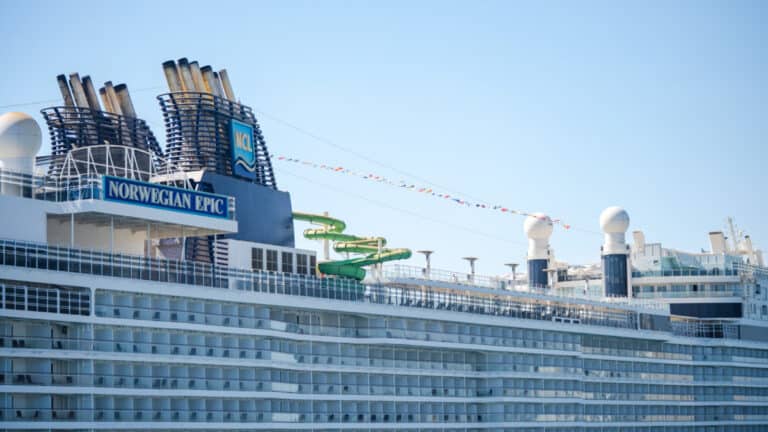
Following a trend of small price hikes and more onboard fees, Norwegian Cruise Line appears to be eliminating the free continental breakfast option from their room service menu, adding a $4.95 (USD) service fee for that menu offering. Guests onboard have confirmed the new fee, though it does not yet appear to be fleet-wide.
New Charge for Room Service Breakfast
Guests onboard Norwegian Cruise Line ships have begun to confirm a new $4.95 service fee for continental breakfast room service. While many cruise lines have rolled out room service fees in recent years, classic continental breakfast offerings have typically remained free of charge.
The continental breakfast menu onboard Norwegian Cruise Line ships includes a selection of fruit, pastries, yogurt, cold cereal, and various beverages, including coffee, tea, hot chocolate, milk, and juice. Several specialty selections are also available, including omelets and French toast.
Guests can pre-order breakfast via a door hanger menu, including selecting the preferred time in 30-minute intervals for breakfast to be delivered. Now, that paper menu also notes that “A $4.95 room service fee will apply.” Previously, there was no charge for the breakfast menu.
Photo Credit: CathyRL / Shutterstock
Norwegian Cruise Line’s online frequently asked questions (FAQ) does state that “Morning coffee, continental breakfast and orders placed by guests sailing in The Haven will not attract a charge,” but that “Prices are subject to change.”
The fee cited in the FAQ is up to $9.95, plus a 20% gratuity and beverage service charge for non-complimentary drinks and special occasion items.
This discrepancy seems to indicate that the new service fee for a room service continental breakfast may not yet be applied fleet-wide, or it is possible the charge is only being tested on select ships for the time being to gauge guest reaction and what affect the fee may have on room service overall.
Food-Related Changes in the Cruise Industry
This new fee is not too surprising, considering many recent changes to room service and other menu offerings across most major cruise brands.
In early September, Carnival Cruise Line updated its room service menu and removed some complimentary items, citing the need to address food waste issues. The continental breakfast menu, however, remains complimentary.
Both Royal Caribbean International and Carnival Cruise Line have adapted their main dining room policies with some surcharges based on the number of entrees ordered.
In recent years, many cruise lines have instituted some type of fee for room service, either a “service fee” that is typically a flat fee for each order, or else a-la-carte pricing for different menu items.
When there are charges for room service, an additional gratuity charge may also be automatically added to each order.
Enjoying Breakfast Onboard
Many cruise travelers enjoy taking advantage of breakfast room service to have a slower, more relaxed start to the day, perhaps enjoying a cup of coffee on their balcony or just gently waking up after a late night of production shows, karaoke, game shows, and other onboard fun.
Scheduling a room service breakfast is also a great way to avoid crowds in the main dining room or at the breakfast buffet, and many parents with young children find it easier to get the day started with breakfast in their cabins.
Yet this new charge is one more fee guests may need to budget for. While it does not appear that each individual menu item will have a separate charge for Norwegian Cruise Line, even one-per-order fees do add up.
Guests can still enjoy a completely free breakfast in each ship’s complimentary dining areas, however, including the all-you-can-eat buffet as well as main dining restaurants.
As a cruise ship passenger, you will see that the Mazatlan cruise port is the northernmost city to visit on the Mexican Riviera. Travelers and adventurers have been landing here since pre-Columbian times.
The modern terminal is staffed with helpful volunteers and, as we shall see, navigating this port of call and the surrounding city is easy. You will be surrounded by an authentic quality. It is a real city that happily welcomes visitors, rather than a place simply built around tourism.
The area surrounding the Mazatlan cruise port is charming and the activities range from the sublime to the adventurous. Miles of beaches, deep culture and scrumptious seafood are the signature qualities of this destination.
Known as a sportfishing mecca around the world, the popular cruise destination is also home to the country’s largest fleet of shrimping boats. So, at the shrimp capital of the world, be sure to taste the huge variety of flavors developed over the centuries.
The culture here dates back hundreds of years. Experience it via the celebrations, food, museums, churches and art located throughout the growing city. Throughout Mazatlan, you will see monuments, dancing fountains and attractions like an animal kingdom, historic observatory and the new Sea of Cortez Aquarium – all celebrating the heritage and history of this important port.
Mazatlan, a colonial beach town known as The Pearl of The Pacific, is truly a cruise destination with “something for everyone.” Here are some tips to guide you during your stop at Mazatlan cruise port.
To enjoy your time in Mazatlan cruise port and beyond, consider these three categories of preparation: clothing, currency and the clock. Our first item is dependent on the weather. During the summer months, expect the occasional rain shower with a possibility of brief yet severe weather in the afternoons.
In the late fall, the temperatures are pleasant and most of the wet weather has passed. During the busy winter months, nighttime temperatures can dip into the 50°s (F) with a high near 80° (F) during the daylight hours.
Mazatlan Cruise Port (Photo Credit: FERNANDO MACIAS ROMO / Shutterstock)
It is a good idea to wear sunscreen and take a hat and sunglasses onshore any time of the year. Traveling around town and exploring the many outdoor locations will include hours in the tropical climate.
Keep in mind that the risk of heatstroke and sunburn are quite high on both sunny and overcast days. Also, remember to stay hydrated. Bring your own water from the ship or buy bottled water since it is not recommended that visitors drink the tap water.
The second item, currency, takes a bit of planning. While the US dollar is welcomed, the official local money is pesos. The latter is accepted at all businesses as well as by the street vendors located throughout the city. When shopping, the prices will be marked with the familiar US dollar sign or (more likely) in pesos. If you are unsure, simply ask.
Stop at the port terminal ATM or authorized money exchange establishments to get some cash. It is not always an option to pay with credit or debit cards. And, you will want some “folding money” for tips.
Carnival Cruise Ship Docked at Mazatlan Port (Photo Credit: Khairil Azhar Junos / Shutterstock)
A final consideration in planning your visit at the Mazatlán port of call is time. There are lots of places to visit, adventures to have and local flavors to taste.
The city is spread out and it might require a bit of travel time to reach the places you want to see. So, transportation might take longer than expected – particularly during the busy seasons. Make sure to leave enough time for the ride back to the port. The cruise ship will leave as scheduled!
Arrival at Port
The first thing you are likely to notice as your ship leaves the Pacific Ocean and enters the Canal de Navigación is El Faro – Spanish for “the lighthouse.” Look left! To the northwest on the way into the Mazatlán cruise port stands a piece of history in seafaring navigation – the highest lighthouse in the Americas. This icon sits 523 feet above high tide on the spot where light has guided ships since 1828.
What first began as a beacon of fire created with wood, coconut chips and whale oil lit in the evenings atop the hill later became a proper lighthouse in 1879. Still operational today, El Faro casts its important light for 30 nautical miles into the ocean.
The second obvious quality at this destination is the unique nature of the Mazatlán cruise port. Unlike some other destinationsalong the Mexican Riviera, this is one of the busiest shipping ports on this side of the ocean. Your vessel will share the waterway with all types of commercial fleets like cargo and container ships.
Royal Caribbean Cruise Ship Docked in Mazatlan (Photo Credit: Alan Freed / Shutterstock)
What this means for you as you step onto the land amidst the hustle and bustle of commerce is a free tram ride to the terminal. These complimentary rides run continuously, so getting to and from the cruise ship is easy to manage.
Once at the terminal, you will find a modern new building. Along with restroom facilities, there are souvenirs and a local craft market here.
You may also find local Tourist Aide Volunteers (easily identifiable by their blue shirts) who are happy to answer your questions, make suggestions for sightseeing and supply you with a map of the area. The port gate is located beside the main thoroughfare and there are vehicles just outside waiting to carry you to the sights.
Getting Around
Once you have left the port, there are multiple options for exploring the scenery, history, eateries and adventures in this popular destination. For a bit of exercise, consider a stroll to the “Old Town” about one mile away.
This retro area has the look and feel of several eras from the 19th Century up to the mid-20th Century. From the terminal, you can follow along a cobblestone path lined in blue color for ease of navigation. There are also “blue shirts” to assist you along the 20- to 30-minute walk.
If you would rather ride, there are several public bus routes in the city. And, the buses are either white or green. The former have no air conditioning and, thus, are cheaper. The green ones are considered “tourist” buses – a bit higher priced, air conditioned and move around the city more quickly. These run on a set schedule from early morning to late evening and are the most economical way to get around (other than walking!).
Overview of Mazatlan (Photo Credit: eskystudio / Shutterstock)
Also, you can hail a taxi for a ride to anywhere in the area. The licensed taxis have either a red or green stripe on the vehicle. There are no meters; you ask the fare ahead of time. This is a good opportunity to use your language skills and negotiate with the drivers. Insider tip: You can arrange for a ride to and from a particular location at the same time. That is, agree upon a better rate by scheduling a pickup time with the same driver.
For a more cultural experience, take a ride in a Pulmonia. These iconic open-air taxis number in the hundreds. They are part of the history of the entrepreneurship of Mazatlan, dating back to the 1960s. Most accommodate four passengers and are a bit more expensive than buses and taxis.
You will see all manner of customized decorations as you ride the streets rich with aromas of local restaurants and Latin music. There is even a monument on the Malecón honoring this unique form of transportation! Simply flag down an empty one and off you go on a fun ride.
Select one of these options at the Mazatlán cruise port and ride to another location for walking the Malecón. This 13-mile-long elevated wall built along the seashore is one of the longest walkways of its kind on the world. The ocean, the beach, stores, restaurants and vendors are found all along the route.
Communicating
Access to WiFi is increasingly easy throughout the Mexican Riviera. Your best option for hopping online will be in cafes, restaurants and at public spaces. Some places offer this for free to their customers; and, other locations will charge a fee.
Photo Credit: eskystudio / Shutterstock
To avoid unwelcome surprises on the bill, check with your cell phone provider before sailing to get the specifics of using the phone, texting or browsing both on the ship and in another country.
Who Docks at Mazatlan Cruise Port
If this port of call in the Mexican Riviera is on your list of places to visit, the following cruise lines have regular itineraries. Some offer multiple arrivals and departures throughout the year, and others only travel here during certain seasons. Regardless of when you plan to travel, there will be many choices of ships to make the journey.
Carnival Cruise Line
Celebrity Cruises
Disney Cruise Line
Holland America
Norwegian Cruise Line
Oceania Cruises
Princess Cruises
Royal Caribbean
Each website for these cruise lines has search options that allow you to include the Mazatlán cruise port in your criteria. Simply select your favorite fleet, sort by ports of call, choose a range of sailing dates and pick the desired type of ship (family, adult, adventure and so forth) for your next cruise.
Where to Go First
Now that we know how to navigate the port and extend our visit into this beautiful city, let’s make our way to the first place we saw upon arrival – El Faro. Grab a ride to the base of Cerro del Creston to begin the climb with your camera at the ready.
The summit is accessed via a somewhat strenuous climb (hiking boots not required) up the 500-foot elevation. At the top, you can walk out “over” the cliff on the glass bottom walkway; have refreshments; and, enjoy the premier view of The Pearl of The Pacific. And, you might even see your cruise ship docked in the harbor. This is the perfect place to launch your adventures in Mazatlán!
If you would like to stay close to port or your time onshore is limited, these are the top recommendations nearby:
Centro Historico (Old Town) – architecture in tropical colors, shops, museums, art galleries, eateries
Plaza Machado – a family-friendly open tree-lined courtyard amidst gorgeous buildings and cafés
Angela Peralta Theatre – tour inside the stunningly restored 1874 landmark or catch a live performance
A Final Note
Much has been said in recent years about the safety of Mazatlán. Advice from travelers and expats alike is that this city is a safe place to visit. Like any trip, stay aware of your surroundings and keep an eye on your valuables.
Avoid showing lots of money (withdraw only small amounts at a time from secure ATMS) or wearing flashy jewelry. Be polite and respectful and, if you see an argument on the street, walk away. These are good practices no matter where you go! In Mazatlán (like in other urban areas), go where the other tourists are going.
For example, the Zona Dorada (Golden Zone), the Malecon, Zona Marina (Marina Zone) and Centro Historico (Old Town) all have security about and very little crime. It is not recommended that you travel too far away from the city.
If you have found places you would like to visit beyond the frequented areas, book a shore excursion with your cruise line. This will be a guided tour with your fellow shipmates, thereby decreasing safety issues. Follow these simple precautions and you can also stay after dark for the nightlife.
Royal Caribbean International’s Quantum of the Seas inadvertently dropped a lifeboat during what appears to have been crew training or tendering operations on Thursday, December 1, 2022.
Video footage and photos shared through social media show the moment of the accident, as well as the subsequent aftermath with a damaged lifeboat.
Lifeboat Goes Overboard
A startling video from Quantum of the Seas shows the ship’s number 12 lifeboat, on the port side of the vessel, detaching from its davits and falling overboard, aft-first, into the water and slowly drifting astern of the cruise ship on the afternoon of Thursday, December 1.
The davits for two other lifeboats were extended, hanging those boats out over the side, but number 12’s davits were still in the vertical position, having only been partially repositioned from their at rest and locked position at the time the lifeboat fell.
As it fell, the rescue craft hit the deck of the cruise ship, before falling over the side and into the water. As it settled into the water, the bow of the lifeboat also struck the side of the cruise ship.
The lifeboat was retrieved, and photos clearly show large dents and cracks on the starboard aft corner of the lifeboat, as well as damage to the fiberglass underside of the lifeboat. The rescue craft was able to be firmly secured in place aboard the cruise ship in its normal position.
No injuries were reported due to the incident, and it is highly unlikely anyone was aboard the rescue craft at the time, which would be a gross violation of safety procedures.
One crew member is visible on deck at the time the lifeboat falls, holding a guide rope of some sort, but quickly releases the rope and backs away as the lifeboat is clearly out of control.
Drill or Tendering?
While cruise ship crew members conduct frequent training and safety drills involving muster stations and lifeboats, this incident does not appear to have been during a training procedure.
There are no groups of crew members assembled on the deck, as there would be if lifeboat procedures were being explained or demonstrated at the time.
Furthermore, because the lifeboat quickly drifts astern rather than bobbing at the position it was dropped, it is clear that Quantum of the Seas is still moving forward, though slowly, at the time the lifeboat detached.
Quantum of the Seas is sailing a 10-night roundtrip South Pacific itinerary from Brisbane, Australia, and was visiting Mystery Island in Vanuatu on the day of the incident.
Quantum of the Seas Cruise Ship (Photo Credit: Mohd Syis Zulkipli / Shutterstock)
Mystery Island is a tender port, meaning that small boats are required to ferry guests from the cruise ship to small docks or piers as they debark the ship to enjoy time ashore.
It is not unusual for cruise ships to use their own lifeboats for this purpose, as many small port communities do not have adequate ferry boats to meet the demand when a large cruise ship visits. To expedite tendering, the lifeboats to be used will often be readied shortly before the ship arrives at anchor for the port of call.
Once the cruise ship is at rest for tendering, the lifeboats would have been fully lowered into the water for guests to board using a gangway between the cruise ship and the lifeboat, which the lifeboat using thrusters and being tied off to maintain a close, safe position for embarkation and debarkation.
Mystery Island is itself uninhabited, and is two-thirds of a mile (one kilometer) south of Aneityum Island, which has a population of just under 1,000 people.
For comparison, the Quantum-class cruise ship can host 4,180 passengers at double occupancy, and as many as 4,905 guests when fully booked, along with the 1,500 officers and crew members on board.
No Delays Reported
Guests onboard Quantum of the Seas report that the lines were a bit longer for tendering to Mystery Island, but there appears to have been no significant delay to the ship’s itinerary.
Since the port time at Mystery Island was to have been 9 a.m. to 7 p.m., that allowed plenty of time for the lifeboat to be retrieved and secured before the cruise ship continued on its way.
Quantum of the Seas will finish out its itinerary with a day at sea on Friday, and overnight call on Port Vila, Vanuatu, from Saturday to Sunday, two addition days at sea, and will return to Brisbane on Wednesday, December 7.
Amusingly (or mortifyingly, depending on where you find yourself on the spectrum), there are not only secret symbols on a cruise line that indicate those who are interested in swinging, but the same principles apply to clothing as well. If you know the meaning behind an upside-down pineapple on a door, you may also want to discover the Pink Flamingo meaning on a cruise.
According to the New York Post, 15 million swingers exist in the United States. They comprise 4.5% of the total population. Swinging isn’t just reserved for group sex or changing partners. It is also wife-swapping as well.
When going on a cruise ship (or even at home), there are certain symbols you will want to avoid if you aren’t into swinging. Some are obvious or becoming more obvious, while others are just beginning to emerge. This doesn’t only extend to a symbol on a door anymore. It also incorporates clothing choices. Items to avoid or use, depending on where you stand, are:
Upside-down pineapples (or any pineapple-related clothing as it means the same thing)
Unicorns (seen as couples looking for other couples to swing with)
Pink flamingos (plastic lawn flamingos and on cruises)
If you aren’t into swinging, you might want to avoid wearing any of these items. For cruisers, as more people are finding out, it doesn’t just extend to symbols displayed on the door, but clothing as well. Here is the truth of the matter.
The Secret Signals Exposed
Swingers display one of these secret symbols to send a message to others who engage in the same lifestyle. This doesn’t just extend to a cabin room but clothing and grocery shopping.
If a symbol is displayed on your cruise cabin door, it means that you are open to the experience and other swingers are welcome. Worn on your clothing (pineapples, pink flamingos, and a black ring), it says that you are “secretly” looking. It acts as a subtle signal most casual glances wouldn’t pick up on.
Image Credit: Julia Pr / Shutterstock
A black ring worn on the right hand, despite being a common way to accessorize, is what a person uses as a conversation starter. It initiates a discussion regarding alternative lifestyles. It is a signal that you are looking to meet other people who are interested in swinging. People will note the ring and may subtly attempt to begin a conversation on swinging.
On a shopping cart, a cabin door, or in the front of a home (white rocks, pink plastic flamingo lawn ornament, and garden gnomes) indicates a swinging party is in progress, or you are looking to attend one. Unicorns are more of an emoji feature, presently, to indicate a swinger, found mostly on dating apps.
Why Do Couples Resort to Secret Signals?
Secret signals are a subtle way of saying “hello” to others interested in this type of experience. It is not something that is “open” publicly, so those interested often resort to signals to attract others looking for similar experiences. If you are unsure what being a “swinger” means, here is a brief history.
Photo Credit: Pixel-Shot / Shutterstock
The History of Swinging
Most people think swinging began in the seventies and died off from there. However, while swinging may have decreased, it is now gaining popularity again. Many people don’t know that it originated in the 1950s when California Air Force officers began swapping their wives. What started as a private, taboo home activity now dominates clubs, websites, and cruises.
Swinging is commonly found in middle-aged couples who have grown bored with their sex life. They thought they could revitalize it by engaging in sexual exploration with other couples. Now, 20- to 30-year-olds are using it to destress after an intense work week. Also, interpretations of monogamy are changing with Millennials and Gen Xers.
What Do Pink Flamingos Mean on a Cruise?
Upside-down pineapples are the most common symbol on a cruise to indicate couples are interested in swinging. However, pink flamingos are another symbol used to indicate the same thing.
Again, it is a series of secret symbols that people should be aware of when planning for their cruise. If you are into swinging, you will know the symbols. However, if you are not, you could find yourself in an awkward situation.
Photo Credit: Flystock / Shutterstock
It is not uncommon for people to decorate their cruise ship doors. While you may think that you are simply decorating your space, you may inadvertently be sending out a secret message. Therefore, cruisers should be aware of these symbols so they don’t unintentionally send a mixed message.
Some may not be aware that vacations on a cruise ship are popular with those in the swinging community. Not every cruise will have those interested in swinging on board (it is unlikely overall), but cruise vacations are ideal for those interested in having fun with new partners.
Secret symbols will be placed on a door or worn to attract those who share the same experience. Pink flamingos are one of them.
The History Behind Pink Flamingo Meaning
A pink flamingo, through the years, has possessed several meanings. Depending on your age, you may know how the symbol has morphed through the decades. You may also not see how the meaning has changed, as it means one thing to you but now has a different connotation. This is when interesting situations can arise.
The pink flamingo was first created in 1957 by Don Featherstone. Union Products hired him to sculpt ducks and pink flamingos. The bird was originally used to brighten tract homes in post-World War II communities. It was a way to make your home stand out from other houses.
Pink Flamingos Lawn Ornament (Photo Credit: David Dea / Shutterstock)
In subsequent decades, their popularity rose and fell. By the late 70s to early 80s, they were part of prank culture and symbolized a joke. Don Featherstone was given the Nobel Art prize for the creation and later became Union Product’s president.
Pink flamingos began as a colorful lawn ornament. People joked about it being a Florida retirement staple. People also put pink plastic flamingos in a yard to indicate someone’s birthday. However, there has been some confusion regarding the meaning – no matter what decade you’re talking about.
What You Need to Know: When Did it Become a Swinging Symbol?
While it is unknown when the beautiful bird with the bright pink feathers became a secret symbol, it may have something to do with the fact it was initially used as a welcoming symbol. It used to be a symbol to show your hospitality and morphed from there.
Today, the pink flamingo meaning is used as an indicator of a swinging lifestyle. This type of symbol is not as common as the others, but it does exist. They may be innocent but can also have other meanings as well. Since they aren’t as prevalent now, sometimes you can innocently get away with wearing or displaying the symbol.
However, avoid getting attached to the symbol, as things have a way of changing over time. While the pink flamingo is a debated sign regarding swinging, it is still known. You may open yourself up to commentary or uncomfortable requests if this isn’t your intention.
Photo Credit: TairA / Shutterstock
Pink flamingo symbolism is a more prevalent sign on cruises (to a lesser extent) and in an RV park. They are not used in online chat rooms or clothing to indicate swinging. This causes a bit of ambiguity in the swinging community because it lacks a direct meaning.
If attracting other swingers is your intention and goal, then you can display them. However, note that it is not a commonly used symbol. If you display a pink flamingo on a cruise, you may want to revert to the upside-down (or right-side-up) pineapple as stronger indicators. Due to the ambiguity, you may not be acknowledged if seen on a cruise, as most people seek the pineapple reference.
This is not to say that it won’t work, as swinging works on subtle signs. It is just more of an unknown sign. If you want to create a stronger “hint,” then most people incorporate the upside-down pineapple (right side up, now) and the pink flamingo as a more obvious cue.
The Flamingo Challenge
When placed on a cruise ship door, as mentioned, there is some ambiguity. Since flamingos are associated with summertime fun or cocktails, the symbol may have a dual meaning.
If seen, people can shrug it off, seeing it as someone being quirky. While this can make it the perfect subtle secret signal, it might be too subtle. Those who don’t know its meaning won’t respond.
Cruise Ship Cabins (Photo Credit: David Samuel / Shutterstock
If you are into swinging, then most experts state that you may have an easier time if you book on a swinger’s cruise rather than advertising using an upside-down pineapple or pink flamingo. However, due to the rise in awareness, you may also be pleasantly surprised.
If you are curious about what the pink flamingo meaning is on a cruise, you might need to examine the connotation closely. It could mean nothing, but it could also be a secret signal.
If you aren’t into swinging, you may want to avoid decorating your door with a pink flamingo, as it may be misleading. If you are interested in swinging, pair it with a pineapple, so the meaning isn’t lost.
A small fire broke out aboard Disney Cruise Line’s Disney Wonder on Wednesday night, November 23. The flames were quickly extinguished, and no injuries were reported. Several areas of the ship on Deck 9 and 10 near the fire were closed temporarily for cleanup and inspection.
Fire Onboard Disney Wonder
Flames were spotted coming from a speaker to the upper right of the ship’s Funnel Vision screen, the outdoor movie screen on Deck 9, on the aft of the forward funnel.
At first, guests reported seeing smoke, but the flames quickly followed and grew in size. The cause has been noted as a short circuit within the speaker.
Emergency crews quickly responded and parts of Deck 9 and 10 were evacuated to ensure complete safety as the fire was extinguished. Inspections were completed to be sure there were no further risks.
Small fire tonight on Disney Wonder – see flames off top right of the screen. Decks 9 and 10 evacuated while crew addresses. pic.twitter.com/mGFl3dKJTw
Where the speaker was mounted is close to Vibe, the exclusive teen club (ages 14-17). On Disney Wonder, Vibe is an open-plan space inside the forward funnel. The impacted speaker was on the outside of the funnel.
While the deck was crowded for the popular themed Pirate Night at the time of the fire, the flames were not near guests, and no injuries were recorded related to the incident.
There have been no delays to Disney Wonder‘s current sailing. The Magic-class, 83,000-gross ton ship is currently on a 7-night Very Merrytime Mexican Riviera cruise roundtrip from San Diego.
The ship set sail on Sunday, November 20, and had already visited Cabo San Lucas and Mazatlan before the fire occurred, with one more port of call planned in Puerto Vallarta. The ship will return to San Diego on Sunday, November 27.
Every cruise traveler is made aware of the risk of fire aboard cruise ships and cautioned about unsafe behaviors such as flicking hot ash overboard if smoking, using heating elements within staterooms, or leaving electronics plugged in when not in the stateroom.
Many objects that could potentially cause fires, either through open flames or the possibility of electrical shorts, are prohibited aboard cruise ships.
On Disney Cruise Line, guests may not bring aboard fireworks, flares, any combustible liquids such as liquid oxygen, candles, electric blankets, electric irons or steamers, hot plates, heating pads, holiday light strings, or other items.
Other Recent Cruise Ship Fires
While any fire onboard a cruise ship is serious and could be very dangerous, this incident is relatively minor compared to other recent fires.
In May, Carnival Freedom had a fire within the ship’s iconic whale tail funnel while docked in Grand Turk, which destroyed the funnel’s structure and caused several cruises to be canceled while repairs were made.
Photo Credit: @AirborneJM
In July, P&O Cruises’ Arvia had two separate fires while the ship was under construction at the Meyer Werft shipyard in Papenburg, Germany. One occurred in a storage room, the other in a stateroom.
While there were no injuries due to the fire on Carnival Freedom, one security guard aboard Arvia was hospitalized due to smoke inhalation.
Carnival Freedom returned to service with a modified funnel – missing the iconic fins – in mid-June, while Arvia will enter service for P&O Cruises on December 23, 2022, after brief delays in finishing the ship, related to supply chain issues.
Most mega-ships contain 6,000 guests and a sizable onboard crew. If everyone consumes an average of half a gallon of drinking water daily, a large volume of freshwater is consumed.
Furthermore, this guesstimation doesn’t include water used for showering, cooking, brushing teeth, etc. This leads people to wonder how cruise ships get fresh water when they’re surrounded by salt water.
It is not surprising to most people to note that cruise ships make their own drinking water. Ships are out at sea, so it makes sense that they would do this when you consider what seawater is composed of.
Most cruise lines use either reverse osmosis processes or steam evaporation to desalinate water (remove the salt content) before adding chlorine and minerals to make it safe for consumption. This method is the same for home filtration systems, only on a larger scale.
Each ship contains large stores used for bringing some water onto each vessel while at port. However, there isn’t enough space available onboard to hold all the water necessary for a cruise.
Water for Guests at Cruise Ship Gangway (Photo Credit: Camera walk / Shutterstock)
It is easier for each vessel to generate potable water at sea rather than sourcing food. When you are floating in the middle of an ocean, the top priority is food storage.
The added minerals are for flavor. Chlorine is only used as a cleaning agent to eliminate unwanted bacteria, but it will not affect the taste. The drinking water won’t taste like you are drinking water from a pool since the amount used is much lower. The amount used is the same amount that is contained in tap water.
Cruise Line Innovation for Sourcing Fresh Water
Royal Caribbean has initiated a Save the Waves program aboard their ships. They have taken the initiative to produce the majority of the clean water they use, producing over 90% of what is consumed by private destinations and operating each vessel.
This works by using a few methods for purifying the water. These include:
Aeration. Aeration involves forcing air through a sink faucet and showerhead. It provides enough water pressure in each bathroom. Air is used for pressure compared to forcing the water out of a showerhead at a high volume. Guests can comfortably shower, and the cruise ship saves water.
Steam Evaporation. Also called steam desalination or flash evaporation, steam evaporation uses heat and steam from a ship’s engine to boil seawater. As water evaporates, the salt remains as a by-product. Freshwater condenses back into distilled purified water.
Reverse Osmosis. Reverse osmosis is the second way cruise ships convert seawater into drinking water. Reverse osmosis utilizes low-energy methods in pushing saltwater through a microscopic membrane. The membranes are so tiny that only clean water will get through. The intake side blocks contaminants and salt, allowing water to pass through. It is then mineralized to add flavor.
Bunkering. This method involves finding fresh water that is locally sourced when at port and storing it on the ship. After collecting it, the crew tests it for any pollutants and treats it to ensure no unwanted components. Ships never use bunkers in places containing water shortages.
Condensing Water. Clean water is conserved or made while on board. Condensation is the most effective way of saving water. Water from air conditioners is reused for laundry and is free since it was previously generated.
The Best Place for Tasty Water on a Ship
If you obtain your water using a dispenser, it tastes better than the tap water found in cabins because it has been filtered a second time. After the second filtration, the water is cooled to a pleasant temperature and used for drinking.
The Amount of Fresh Water Cruise Ships Can Hold
Most ships can store 500,000 gallons of fresh water in massive tanks located in the hold area. After guests have used the water for showering, toilet water, laundry, etc., the crew treats it before releasing it into the ocean.
A cruise ship will bring fresh water onboard when they visit ports. However, this water is not for drinking. This water is used for laundry, as ballast, or to cool the engines. Water used for drinking is usually taken from seawater undergoing a desalination process.
Photo Credit: zlikovec / Shutterstock
River cruise ships have smaller water stores. Fresh water supplies are topped up during each port visit, which isn’t a huge problem since their travels don’t run several days between port visits.
How Clean Is the Water on a Cruise Ship?
The water consumed aboard cruise ships is extremely clean. Using an intensive filtration process, each cruise ship ensures that the water is safe for guests. There are also rules regarding recycling water. The vessel will not reuse water for other guests aboard the ship.
The water used becomes separated into grey water used for showers and laundry. It is also separated from black water used for the toilet before being treated and released into the ocean.
According to the International Maritime Organization, cruise ships must process all water safely away from nearby land.
Is Cruise Ship Water Drinkable?
Unless otherwise indicated, tap water from a cruise ship is safe to drink. All water is chlorinated at appropriate levels and heavily filtered to remove remaining toxins. Minerals are added for a more pleasant taste.
Many ship engineers comment that cruise ship drinking water is healthier than bottled water. While it appears somewhat anecdotal, it is safe to drink tap water unless you hear of any issues, which is a good thing. Bottled water costs extra when you are on a cruise unless you purchase drink packages.
The only water that you should not consume is that found in the shower. This water is grey water and has been used before. The filtration process is not as thorough as for tap water; thus, you can get sick from drinking it.
All ice on board uses the same process as for making drinking water. The ice is handled with the same care as the food standards. Therefore, even if you choose not to drink tap water, the ice cubes found in your drink will not harm you, either.
This process is safer than ice cubes found in some holiday resorts located on land. These resorts sometimes use tap water when making ice, despite it being unsafe.
Additionally, while cruise ship water is safe for consumption, there may be a bit of a different chlorine level compared to ordinary tap water. Therefore, it may not be safe to use it to make baby formula. If you require distilled water for medical reasons, you should also avoid using tap water found on your cruise.
You can discuss it with your cruise line if you need to bring water on board for medical reasons. Most have different policies on the amount of water brought on board. They can also provide bottled water for you and source distilled water if you require it. You may need to pay for this service, but some luxury lines may provide it at no extra cost.
How Do Ships Get Hot Water?
Most cruise ships contain a robust system for delivering hot water where it is needed. Even though ships become temporary homes filled with thousands of people simultaneously, complaints about cold or low-pressure water are rare.
Desalinated fresh water goes into a different pumping system in the ship. It is used for cooking, baths, showers, and drinking. The heating process involves fuel consumption before pumping it around each deck.
The process is no different than a domestic hot water process. It is only done on a much larger scale in addition to more pumping.
What Water Is in Cruise Ship Pools?
Interestingly, pool water is just treated seawater. Chemicals are added to ensure the ocean water is sanitary and safe for swimming. Some cruises will use fresh water, and others will use both. Most modern cruises use freshwater pools, which may indicate that it is easier to filter and maintain.
Photo Credit: Vintagepix / Shutterstock
The salt in seawater damages pumps after enough time has elapsed. Modern ships contain more storage, so they can filter in additional freshwater better than older ships.
Conclusion
How do cruise ships get fresh water? They use many different methods to purify the water through various processes and reuse as much water as possible for other components on the ship. This is a clever way of reducing consumption and keeping everything safe for the environment.
What makes a fun vacation on the high seas and the best way to book a cruise both depend on what type of travel experiences you enjoy. Knowing the answer to each of these will help you navigate the process.
Let’s start with a bit of planning; investigate what affects the price of a cruise; then, dive into the strategies for making your next dream cruise vacation a reality!
Regardless of which of the following ways you decide is best for booking your next cruise, start with a bit of planning. Make a list of where and when you would like to sail.
Then, utilize some helpful digital tools – travel apps. While they all offer some similar selections, the most useful apps let you select cruise regions, ports of call, cruise lines, ships, deck plans, cabin types, prices and even the particulars of weather and document requirements (passports). You make your preferred choices in these categories and the software generates lists of cruise lines and ships with arrival/departure schedules for ports of calls.
Planning a Cruise (Photo Credit: Pixel-Shot / Shutterstock)
Or, hop online to see which cruise lines go to your destinations at the time you are planning your vacation. Once on the various company sites, you can find a whole host of helpful information on ships, cabins, destinations, activities and more. So, to keep from getting lost “down a rabbit hole,” make that (preliminary) list of places and times for sailing before looking through apps and websites.
This step will help you later during the “how to book” process below.
Price
Before delving into the strategies for the best way to book a cruise, let’s briefly visit the overarching topic – money. Here is one point to keep in mind as you are shopping:
The price of a cruise is much like popular hotel destinations: It is all about the occupancy rate. So, when a cruise line “drops” a new itinerary (publishes a cruise schedule), these are often good rates.
Cruise Ship Passengers
As time passes, the prices fluctuate depending on how quickly (or slowly) vacationers commit to booking. If reservations are slow, the cruise line would rather offer a cheaper price than sail with empty cabins. So, they drop the price closer to departure dates. As we shall see below (When to Book), waiting for this to happen can have a downside.
On the topic of price, consider the following strategies for the best way to book a cruise:
Two factors that can decrease the cost of your next cruise vacation are the “shoulder season” and “repositioning cruise.” The first term refers to the times of year that fall outside peak seasons. For example, October in the Caribbean and March in the Mediterranean, along with April and the end of September for Alaska, are all shoulder seasons.
The second term, “repositioning cruise,” is the one-way travel that ships make to follow ideal weather conditions. These can have deeply discounted prices since they are often longer sailing times at sea and, of course, you would have to arrange return transportation to your home port.
Photo Credit: Francisco Blanco / Shutterstock
Another strategy is to check with your employer to see if discounts are available through the company. Many large corporations have standing arrangements with all manner of businesses, including cruise lines. You need only get the information from your place of employment to participate.
Additionally, remember to use other qualifying deals if you are a senior, teacher, first responder, past or present member of the military and even a resident of certain states.
Also, be sure to join the loyalty program of your favorite cruise line and use this membership for each and every booking. Then, when you have friends who are planning on taking a cruise (on your favorite cruise line), they can list you as the person who referred them. This can add up to some significant savings and credits for your next cruise.
How to Book
Travel Agent
Local travel agents rank high on the list of best ways to book a cruise. Why? Because they handle everything for you, and it costs you nothing to use their services. And, they may have access to special discounts that are not available to the general public.
Prior to contacting one, however, you should do a bit of research on your own: What cruise line? When to travel? Where do you want to go (itineraries)? What type of cabin do you want/need during your vacation? This will speed up the process.
Keep in mind that any changes or questions you have after booking must go through the travel agent. They are the point of contact with the cruise line and the only ones who can adjust your plans. For these reasons, this is a recommended option for first time cruisers as well.
Online
Discover some great price discounts by shopping the many competitive online travel sites. They often have lots of options from which to choose, including cruise lines, cabin types, destinations and extra perks.
These companies can offer some of the best travel rates because they pre-reserve large blocks of cabins and pass the savings along to you. The downside to this approach is that you should not expect the personalized services that often come with our other suggestions on the best way to book a cruise.
Directly with the Cruise Line
If you have your favorite cruise line, then booking directly with them might be the way to go. When you directly contact a cruise line to make a reservation, you will be placed with a Personal Cruise Consultant or some variation of this job title, such as Personal Vacation Planner (PVP). This person, while likely very busy, offers the best volume of knowledge about the ship, cabins, ports of call, amenities and other aspects.
Photo Credit: VIAVAL TOURS / Shutterstock
They are also particularly helpful if you are planning group travel or want to arrange special events while on the ship. A bit of price shopping ahead of time will give you a base cost to compare to the price quoted by your consultant.
Or, use this option via the Internet. One of the best ways to book a cruise directly with the cruise line is on their website. This hybrid approach (online and direct) is easy to navigate; and, you might discover some fun activities, extras and benefits not previously thought of by using this approach.
A nice side benefit offered by some cruise lines is the option to also book an airline flight, hotels and/or ground transportation at the same time. This often comes with scheduling flexibility options, no penalties and a lowest fare guarantee.
Talk on the Phone
While it is a good idea to scout around online to see what types of cruises are sailing to your bucket list destinations, making the reservation the good ‘ole fashioned way, on the phone, is still an option. One of the reasons that this is on our list of the best way to book a cruise is because of the personal interaction.
If you have a question, you have a live person to answer it. If you want to hear about specific types of cruises/ships/activities, you have a real person on the line. If you need to make future or last-minute changes, you have a person to handle that for you.
Photo Credit: Alliance Images / Shutterstock
This option can be used to talk directly with the cruise lines, speak to an online booking company representative or discuss your vacation with a travel agent. While on the phone, be sure to ask for a list of what is included in the price of your fare.
For most cruise lines, you should expect the following: meals, activities, entertainment and programs onboard, as well as your cabin. These items, however, may not be included: drinks of all kinds, gratuities, shore excursions, Internet access, laundry, classes, certain restaurants and possibly the taxes and fees. Avoid surprises and get that information when you book.
One other terrific benefit to using the phone is the option of getting “quiet offers.” These unpublished or advance price reductions are part of what you can get when you book via an online agent call, cruise consultant call or a travel agent call.
Once you get your price quote, do a little math and make sure that the cheap fare is actually going to stay cheap. For example, more desirable cabins cost more but may come with extras like a drink package or paid gratuities. This can save you money over the course of your vacation.
When to Book a Cruise
A quick search online will uncover all manner of “tips” about the timing of booking a cruise. Unfortunately, most of these suggestions are only thinly based on data.
For example, one of the most popular ideas is that Thursdays are the top choice for booking the cheapest cruises. If that were true in every scenario, then everyone would wait to make their reservations on that day.
In the alternative, if there is some merit to this claim, then it would likely only apply in certain circumstances. For example, a cruise is not fully booked and departs in the following couple days. Perfect for a quick decision to take an unplanned or day cruise – not so perfect for scheduling family vacations.
Book a Cruise (Photo Credit: Customdesigner / Shutterstock)
Generally speaking, the further away from your departure date that you can make a reservation the better the rate. Fall is usually a popular time to book for the coming Wave Season – January through March. And, if sales were slow, you might pick up some deals for that season after the first of the year. Keep in mind that waiting for better prices can limit your options – particularly a choice of cabins and itineraries to heavily traveled destinations.
Insider tip: If you book months in advance and there happens to be a significant price drop later, you might be able to upgrade your cabin, get onboard credit or other perks at that time. And, another option is to inquire upfront about a standing price adjustment with the cruise line for the same purpose. It certainly would not hurt to ask!
For those who have a favorite line and know they will be traveling again, one of the best times to book a cruise is… while you are on a cruise! There are many benefits to deciding to schedule your next vacation on the ship – onboard credits, reduced deposit amounts and the option of changing your plans (dates and ships) later, to name a few.
Upon making your reservation is also the time to go ahead and reserve your spot for shore excursions. These activities at ports of call are often limited to a certain number of people; and, the popular ones can sell out before the ship departs its home port.
What to Do Next
At the conclusion of booking your next cruise, return to your travel apps. They are immensely helpful now and even during your cruise. Get familiar with the ship, restaurants, activities and even enjoy a “countdown clock” for your departure date! Some apps have virtual tours and others offer live webcams.
Then, while onboard, use the GPS-type apps to find your way around the mega-ships. And, other apps can keep track of your spending – all those items you buy during the cruise that will show up on your credit card at the end of your vacation. This is a great way to avoid delayed sticker shock.
Final Thoughts
A list about the best way to book a cruise would be incomplete without mentioning cruise travel insurance. This should be the final step you take to protect your money and your plans.
However, it can be a bit confusing to know what is and what is NOT covered in the policy. We have several articles to help with this final step before your next cruise vacation.
Known as “The World’s Most Popular Cruise Line,” Carnival Cruise Line was founded in 1972. Millions of guests board its fleet of ships annually.
Carnival Cruise Line is known for its party-like atmosphere that’s fun for people of all ages. We discuss who owns Carnival Cruise Line and how it has developed over the past 50 years.
Carnival Cruise Line is a subsidiary of the British-AmericanCarnival Corporation & PLC and has its headquarters in Doral, Florida. Carnival Corp has over 100 ships in its fleet and operates across ten cruise brands.
It is a “dual-listed” company combining Panama Incorporated, which is the United States Carnival Corp (headquarters) and Carnival PLC (United Kingdom-based).
Who Owns Carnival Cruise Line – History of Carnival Corporation
Carnival Corporation was the entity that began in 1972. The cruise line steadily grew throughout the seventies and eighties. In 1987, it made an initial public offering with the New York Stock Exchange. All capital generated from stocks financed further acquisitions.
From 1989 to 1999, the company did well financially and acquired Windstar Cruises, Holland America Line, Seabourn Cruise Line, Westours, Cunard Line, and Costa Cruises. The name Carnival Corporation was created in 1993 to distinguish between its parent company and its subsidiaries.
Carnival Corporation acquired 50% ownership of Costa Cruises in 1997 and took complete control of the company in 2000. In 1998, it received a 68% stake in Cunard Line and the remaining 32% one year later in Seabourn.
Carnival Miami Offices (Photo Credit: Felix Mizioznikov / Shutterstock)
In 2000, P&O Princess Cruise emerged after the demerger from P&O Group. P&O Group began as Peninsular and Oriental Steam Navigation Company in 1837 in England. They operated the first world commercial cruise ships.
Restructuring during the 20th century led to them being rebranded as P&O Cruises Australia and P&O Cruises. They acquired Princess Cruises in 1974 and AIDA Cruises in 2000.
With Carnival Corporation’s acquisition of P&O Princess Cruises in 2003, it was agreed that P&O Cruises would remain a separate entity on the London Stock Exchange.
In 2003, Carnival Corporation combined with P&O Princess Cruises and Princess Tours. In 2014, the company contained distinct brands in its portfolio, with its cruise operation in North and South America, the U.K., Italy, Germany, Spain, France, and Australia.
How Did Carnival Cruise Line Begin?
Carnival Cruise Line was established in 1972 and began as a Boston-based subsidiary of the American International Travel Service (AITS). Meshulam Riklis and Ted Arison originally owned it. Its first ship was the TSS Mardi Gras, bought initially from Canadian Pacific Line.
However, because of mounting debt, two years later, Riklis sold his shares to Arison for one dollar. With the purchase, Arison assumed the $5 million debt load.
Photo Credit: Oceanhistory
The company continued to grow throughout the years, with Carnival ordering its first ship, the Tropicale, which finished in 1982. It also generated an industry-wide boom in shipbuilding. It created three additional vessels in the 1980s: the Holiday in 1985, Jubilee in 1986, and Celebration in 1987.
Carnival created an initial public offering containing 20% of common stock to the New York Stock Exchange in 1987. This strategic move allowed it to generate $400 million in capital, later using this money to finance further acquisitions.
In 1993, Carnival Cruise Line restructured itself under Carnival Corporation. Carnival Cruise Line was its primary subsidiary.
Carnival Cruise Line contains a 24-ship fleet with more ships on order. The Costa Luminosa was recently transferred from Costa Cruises after being refurbished, and the second Excel class Carnival Celebration joined the fleet in November 2022.
A joint venture between Costa and Carnival will see two additional vessels arrive in 2023 and 2024. A third Excel class named Carnival Jubilee will also arrive in 2023.
Photo Credit: Carnival Cruise Line
Today, Carnival Cruise Line holds a 7.6% share of the cruise industry’s revenue plus 18.2% of its passengers. These cruise ships fly a flag of convenience, with six flying the Bahama flag and 18 flying the Panama flag.
A flag of convenience is when the ship’s owners register their merchant ship to a country outside its location. The cruise ship flies that country’s flag, known as the flag state.
International law requires every merchant ship to be registered to a registry generated by a country. The owners can register it in a foreign country to avoid the owner’s country’s regulations, which are often stricter. It also reduces the company’s operating costs and taxes, and allows them to bypass laws protecting the working conditions and wages of mariners.
Leadership for Carnival Cruise Line
During Carnival Cruise Line’s extensive 50 years in business, it has had five presidents. The company began with Ted Arison from 1973 to 1981, who was one of the founders of the cruise line. He was responsible for the Mardi Gras, Carnivale, and Festivale ships. Arison co-founded Norwegian Cruise Line in 1966 and left to establish Carnival Cruise Line in 1972.
Ted’s son, Micky, took over the company and ran it from 1981 to 1993. He expanded the company, becoming chairman of Carnival Corporation in 1993. He established the Holiday, Tropicale, and Fantasy ships.
Carnival Corporation Chairman, Micky Arison
From 1993 to 2007, the company was led by Robert H. Dickinson, who further expanded the line by strengthening existing relationships with other travel partners. He was responsible for the Carnival Spirit, Fantasy, Destiny, and Conquest ships.
Gerald R. Cahill took over the cruise line from 2007 to 2014, leading through a global recession and many high-profile events in the company’s history. He was responsible for the Carnival Sunshine, Carnival Splendor, and Carnival Dream.
Christine D. Duffy has been the company’s president since 2015. Christine led the effort emphasizing Carnival Cruise Line as being branded “America’s Cruise Line.”
Conclusion
Who owns Carnival Cruise Line? This cruise line received its humble beginnings in 1972 with a brief co-ownership between Meshulam Riklis and Ted Arison. However, due to mounting debt, Riklis sold his shares to Arison, who continued with this venture.
The fleet rapidly grew throughout the years to become the famous cruise industry giant it is today.
Disney Cruise Line has announced that it has indeed purchased the 6,000-passenger, partially finished Global Dream cruise ship. The vessel, currently in the Wismar shipyard in Germany, was formerly owned by the now-bankrupt Genting Cruise Lines.
This confirmation comes following rumors that Disney was interested in taking over the ship’s construction.
Disney Purchases Global Dream Cruise Ship
We finally know the outcome of the much talked aboutGlobal Dream cruise ship, which had a very unclear future for many months. Disney Cruise Line has now confirmed that it has purchased the vessel, which will join the Disney fleet in 2025.
The Global Dream was under construction at the Wismar shipyard for the former Asia-based Genting Cruise Lines. However, in early 2022 the cruise company, owned by Tan Sri Lim Kok Thay, went bankrupt, and the future of the giant cruise ship was unknown.
Speculation not only included the idea of another line purchasing the vessel, but also that the ship might have been scrapped before it was ever completed. Now, the finishing will be completed according to Disney Cruise Line’s specifications.
Her sister ship, also under construction but not nearly as completely finished, is to be scrapped.
Global Dream Cruise Ship
“Our cruise ships give us the unique opportunity to bring Disney magic to fans no matter where they are, and the addition of this ship will make a Disney Cruise Line vacation accessible to more families than ever before,”said Josh D’Amaro, chairman, Disney Parks, Experiences and Products.
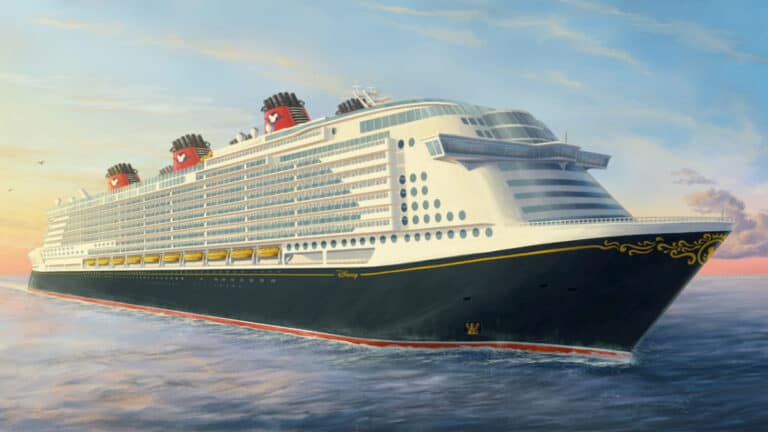
Disney Cruise Line will take over the ship’s construction with the popular Meyer Werft shipbuilding company based in Germany. The vessel construction will be adjusted to have the signature Disney look, along with features and experiences for which the cruise line is well-known.
The ship, which has not yet been named for Disney Cruise Line, will include the iconic Mickey-Mouse-inspired colors and the classic Disney funnels, just like the other five ships in the fleet.
Disney has confirmed that the vessel will be based outside the U.S. market and that further itinerary details will be revealed in the future.
The ship will join the Disney Wish, which debuted in June 2022 and was also constructed by Meyer Werft but at the Papenburg shipyard. Other ships in the fleet include Disney Magic, Disney Wonder, Disney Dream, and Disney Fantasy.
A Bargain for Disney
With Genting falling under earlier this year, the Global Dream has become an attractive option for Disney as it was able to secure the new vessel at a bargain price, though the final price of the purchase has not been revealed.
The purchase also ensures the continued employment of hundreds of workers who were formerly employed by the MV Werften shipyard, which is where the vessel was under construction before being paused.
Photo Credit: MV Werften
Global Dream had an initial construction price of 1.6 billion Euros ($1.66 billion USD) and is already 75% complete.
The ship was originally scheduled to be already sailing in 2022 under Genting’s Dream Cruises brand and as one of the largest cruise ships in the world, rivaling Royal Caribbean’s Oasis-class vessels.
Now under the guidance of Meyer Werft, the vessel is still set to be an impressive 208,000 gross tons, with an approximate guest capacity of 6,000 at double occupancy and as many as 9,500 passengers when fully booked.
If these numbers remain accurate after finishing the vessel for Disney’s specifications, the new ship could easily become the largest ship in the world according to passenger capacity.
Nearly 2,300 international crew members will provide service on the vessel.
She will not be named Global Dream and will adopt a new name that Disney will announce at a later date.
The ship, which will also be the largest for the cruise line, will be fueled with green methanol, among the lowest-emission fuels available.