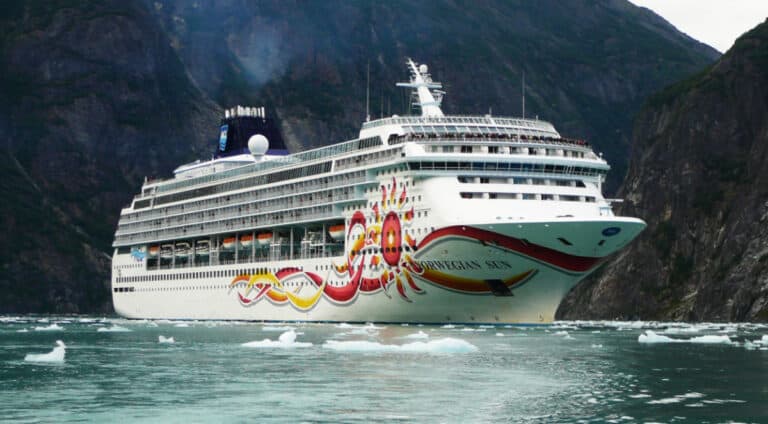
Norwegian Cruise Line has confirmed to Cruise Hive that the Norwegian Sun cruise ship made contact with a small iceberg (growler) due to dense fog during its voyage in Alaska. As a result, the ship has been forced to skip a port of call and head to Juneau to assess the damage.
UPDATE, JUNE 27: The remainder of the Norwegian Sun’s June 21 cruise has now been canceled. Norwegian Cruise Line is sailing guests back to Seattle, Washington and Norwegian Sun will arrive back on Thursday morning. Full details here.
Norwegian Sun Makes Contact With Growler
The 78,309-gross-ton, Sun-class vessel was supposed to be arriving in Skagway, one of the northernmost ports of call on its current 9-night itinerary from Seattle, at 8 a.m. local time on Sunday, June 26, 2022.
As of 4 p.m. local time, however, the ship is still reported much further south of Skagway, south of Juneau, turning toward the state’s capital. Juneau is roughly 100 miles southeast of Skagway. It comes after the Norwegian Sun hit a small iceberg while transiting to Hubbard Glacier, Alaska due to dense fog at the time, on the previous day of Saturday, June 25.
The NORWEGIAN SUN cruise ship hit an iceberg near Hubbard Glacier on Saturday, June 25. The cruise ship docked in Juneau on Monday. pic.twitter.com/e2rTgY4K5g
— GOLDENPROPELLER.COM (@GOLDENPROPELLE1) June 28, 2022
A Norwegian Cruise Line spokesperson stated to Cruise Hive,“On June 25, 2022 while transiting to Hubbard Glacier in Alaska, Norwegian Sun was engulfed by dense fog, limiting visibility and resulting in the ship making contact with a growler.
NCL went on to say, “The ship remains fully operational and is currently on its way to Juneau, Alaska for assessment. Additional information will be provided as appropriate.”
According to tracking data, Norwegian Sun is indeed en route to Juneau at this time, which means the call in Skagway is canceled. The anticipated arrival into Juneau is around 5 p.m. local time. While in Juneau, the cruise line will assess any damage to the ship.
What Happened?
At this time, there has been no official assessment of the damage to Norwegian Sun, but the ship is continuing toward Juneau, albeit at a much slower speed than typical.
Passengers on the vessel reported very heavy fog conditions on Friday, which would have caused the ship to slow significantly as a safety precaution.
Norwegian Sun (Photo Credit: James R. Martin / Shutterstock)
The vessel may have hit the iceberg in such a way to have caused propeller, engine, or hull damage. Growlers – small, low icebergs that may be the size of pianos or trucks – are relatively common in the area.
Passengers on Norwegian Sun have reported shuddering and rattling noises that may have been related to the ice impact confirmed by the cruise line.
Such damage would need inspection before the ship can resume its normal speed. Divers in Juneau may be able to inspect the ship and determine if there is any damage or need for repair.
The Days Ahead
Norwegian Sun was scheduled to call in Juneau on Monday, June 27, 2022, as part of its planned itinerary. Depending on the outcome of a dive inspection, it is possible the ship may be cleared to resume normal operations and continue on to Skagway, but this seems unlikely given the ship’s current speed.
Photo Credit: Debbie Ann Powell / Shutterstock
The remainder of the current itinerary has the ship visiting Ketchikan on Tuesday, June 28, and Victoria, British Columbia, on Wednesday, June 29.
If the ship cannot maintain adequate speed, however, it is possible the call in Ketchikan may also be canceled in order for the ship to make it to Victoria for a reasonable visit. Alternatively, port times in both Ketchikan and Victoria may be shortened if necessary.
Norwegian Sun is scheduled to return to Seattle, Washington on Thursday, June 30, 2022. Stay tuned to Cruise Hive for further updates on this developing story.
Without a cruise ship engine, these vessels would be nothing more than a floating hotel. They would drift aimlessly at sea and would lack any form of propulsion. Looking at the sheer size of these vessels makes one wonder how large an engine needs to be to maneuver the ship successfully in water.
Older cruise ships may still use a diesel reciprocating engine to generate enough power to move them. Power is supplied to the ship through a transmission going to a propeller shaft. The transmission determines the revolution of the propellers.
Modern cruise ships use gas turbines or diesel-electric engines for their power source for propulsion. They also provide power for the ship’s systems as well. Many of the larger vessels depend on two sources of power: propulsion and electrical power.
Diesel engines are the most traditional type of cruise ship engine. In this engine, diesel fuels its crankshaft and pistons. These attach to a propeller, which advances the ship.
Gas turbine engines create heat that transforms mechanical energy into electricity. To achieve this reaction, compressed air fires into a combustion chamber. Hot exhaust is forced over a turbine, which spins to mechanically drive the shaft. Power can then be used to spin generators.
It works the same way in diesel-electric engines. This type of engine provides enough electricity to move the ship’s propellers and power the cruise ship’s appliances, lights, air conditioning, etc. Most ships will contain several engines connected to their generator.
These engines are very efficient, independent of speed. However, a direct drive system is used as opposed to a turbine. Output shafts are used to generate electrical power and are connected to the generators.
Both engines require a great deal of fuel. Larger vessels can consume about 250 tons of fuel daily. This is the equivalent of 80,000 gallons of fuel each day. Medium-sized ships will require 150 tons per day and as size decreases, fuel consumption does as well.
A general rule of thumb is that the larger the vessel is, the more power is required for movement. This comes from fuel and engines.
Passengers will never see the magnitude of a cruise ship’s engine. Cruise ships require the heaviest weight to be placed at the lowest possible point. Therefore, engines are found close to the bottom of the ship. Since engines power ships through water, they can be quite large for mega ships.
How Big Is a Cruise Ship Engine?
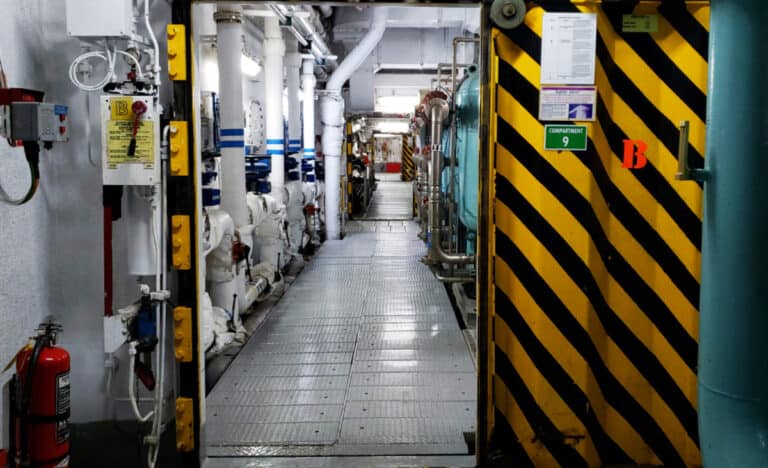
A modern cruise ship doesn’t contain just a single engine. Cruise ships like the Oasis-class (Royal Caribbean) contain six engines, while many others have only four. Engine rooms are very large and can span several decks. Space is needed not just for engines, but for fuel tanks, generators, engine workshops, and the control room.
The number of engines range from five to six, and the power rating for each one is between 9-15 megawatts.
Since they are so large, they are placed in a separate compartment found in the cruise ship’s machinery space. This is known as the DG room. Modern passenger ships contain two DG rooms, which are forward and aft. They are separated by watertight bulkheads.
Each DG room contains its own independent fuel, air, lubrication, and cooling water supply systems. This is for the safety of the ship and for redundancy. It’s insurance for any emergencies like flooding and fire that can occur.
The largest cruise ship, Wonder of the Seas, utilizes six marine-diesel sets, with each composed of three 16-cylinder Wartsila engines.
What Engines Are Used in Larger Ships?
Modern, larger cruise ships use two or three stroke, low speed, crosshead, or medium speed engines. Engines operating at higher speeds tend to be found on smaller vessels. Determining the type of engine that is installed on a new cruise ship involves examining the engine’s size.
Engine Control Room (Photo Credit: AliveGK / Shutterstock)
When it comes to cruise ships, the typical engine is a two 16-cylinder Wartsila 16V 46D which is a common rail engine. They also use three 12-cylinder Wartsila 12V 46D engines to power the ship. Each one of these produces about 19,480 kw of water.
Where Are Engines Located?
In newer cruise ships, engines are found on the lower decks toward the aft. They are not completely to the back of the boat but are found in the mid-aft.
Independent of a cruise ship’s size, engines are extremely loud. Engineers compensate for the noise by incorporating sound reduction technology. They also keep the engine room well-insulated.
Photo Courtesy: Royal Caribbean
Insulation serves a dual purpose. It keeps out noise and reduces the heat generated by fully operating engines. It prevents this heat from escaping to adjacent decks. If it were to escape, guests would be extremely uncomfortable. The design is meant to contain this.
To get an idea of how loud an engine is, it can have a range that exceeds 173 decibels. It is so loud that it is in the range where damage to hearing can quickly occur. However, thanks to proper insulation methods, they don’t appear to be that loud.
How Much Power Is Needed for a Cruise Ship?
These massive vessels can consume power up to about 50,000 horsepower. One horsepower on these ships equals 746 watts. Engines are designed to move large propellers or produce enough diverted electricity to drive the propellers.
Cruise Ship Wake from Propeller (Photo Credit: Gianluca Piccin / Shutterstock)
While cruise ships can move upwards of 34.5 miles per hour (30 knots), most will only travel at 23 miles per hour (20 knots). There are various reasons for speed variations which are outlined in detail in this article.
With So Many Engines, Is It Possible to Experience Engine Failure?
This covers every ship constructed after 2010. It requires full redundancies, which include two engine rooms. If the main engine should ever fail, power to electrical services should still run.
Engine failure can occur, though, in the ship’s main engines, which are responsible for moving the ship. Improper maintenance, mechanical issues, and human error can all be factors in causing engine failure.
What Happens if This Occurs?
If it does happen, the captain consults the chief engineer to diagnose the cause of the malfunction. They will assess the severity and determine whether it is fixable. Modern cruise ships don’t rely on a simple diesel engine.
There are up to six engines in operation. It will be up to the captain and the chief engineer to determine if the vessel can continue if one of their engines isn’t working properly. If the captain feels the cruise ship will not be able to function, they will consider other options. This may involve sending signals for assistance while at sea.
Photo Credit: Ben Molyneux / Shutterstock.com
If the waters are calm, cruise ships are safely towed to a nearby shore. In rougher seas, other options may need to be considered for the safety of those on board.
Abandoning the ship is only done as a last resort because moving guests from one ship to another over open sea can be dangerous. This is especially true if it is done in bad weather. This is the same if passengers are instructed to go into lifeboats.
It is up to the captain to determine the best option. Generally, the safest place to be is your current location at sea. The ship is seen as the lifeboat. The cruise industry guidelines comment that the safest method to returning large numbers of guests to a port is by using the ship itself.
Are Passengers Safe if There Is Engine Failure?
Most of the time, passengers are fully safe. The No. 1 priority of all cruise lines is to keep all their guests completely safe. If the unexpected happens, know that the cruise ship has backup plans. A well-trained crew knows how to properly handle the situation so you are in safe hands.
Generally, engine failure only generates a brief interruption before it’s fixed. In other instances, it may just slow the speed of the vessel. Cruise lines will never jeopardize the safety of guests nor put them at risk if the cruise ship is unsuitable for sailing.
In the event of an emergency, guests can be proactive by paying attention to the mandatory safety exercise.
Photo Credit: Darryl Brooks / Shutterstock.com
This is where crews demonstrate how to safely use life jackets and outline a designated meeting point in the event of an emergency. Be sure you know where your life jacket is in your cabin in the event you should ever require one.
Generally, cruise ship engines run a long time before experiencing any difficulties. Regular maintenance by the chief engineer is conducted to make sure that they are running in top condition and to prevent any mishaps while at sea.
When we examine the sheer size of mega-ships, the fact that engines and engine rooms are built so large is understandable.
It takes numerous engines to move something that is so massive in size and weight. Combine that with the horsepower required to make it move, and you also appreciate the cruise ship’s knots.
Going aboard a cruise ship is a leisurely experience. They do not travel fast like motorboats, for example. These ships contain massive amounts of steel and other components, which contribute to its overall weight. It requires anywhere between five-to-six engines for it to function.
Cruise ship engines are always kept in top functioning order. This is to ensure the safety of the guests. If one goes down, this is not a major concern as there are four to five others that can compensate. The ship may move slower, but passengers will safely return to port.
Carnival Cruise Line has agreed with 46 different attorney generals on a 1.25 million dollar settlement. The settlement stems from a data breach that involved the personal information of approximately 180,000 Carnival employees and customers nationwide.
In August 2020, Carnival reported a data breach in which a person or organization gained access to certain Carnival employee e-mail accounts.
The breach included names, addresses, passport numbers, driver’s license numbers, payment card information, health information, and Social Security Numbers.
Carnival Cruise Line To Pay $1.25 Million Over Data Breach
Carnival cruise line has entered a settlement agreement with 46 different attorney generals throughout the United States. The settlement comes from a data breach widely reported at the time.
The breach included names, addresses, passport numbers, driver’s license numbers, payment card information, health information, and a relatively small number of Social Security Numbers.
In March 2020, Carnival stated that it acted quickly to shut down the intrusion and restore operations. At that time, the company did preventive maintenance work to prevent further unauthorized access, hired a cybersecurity firm to investigate the matter, and notified the relevant authorities.
Photo Credit: Turn_Mug / Shutterstock
As it turns out, the breach happened already before August of 2020, possibly as early as May of 2019, according to a press release from the group of 46 attorney generals:
“Breach notifications sent to attorneys general offices stated that Carnival first became aware of suspicious email activity in late May of 2019 — approximately 10 months before Carnival reported the breach. A multistate investigation ensued, focusing on Carnival’s email security practices and compliance with state breach notification statutes.”
The breach that happened with Carnival Cruise Line and its sister lines was an unstructured data breach. These types of breaches are typically what happens when employees store sensitive information in emails or other unsecured platforms, and this data falls in the wrong hands.
Carnival To Implement Several Security Responses
Besides the $1.25 million dollars fine, Carnival has agreed to a series of provisions designed to strengthen its email security and breach response practices. Those include:
Implementing a breach response plan
Email security training for employees, including training to spot possible phishing attempts
Multi-factor authentication for remote email access;
A review of the password policies within the company
Password policies and procedures requiring the use of strong, complex passwords, password rotation, and secure password storage;
Log and monitor potential security events on the company’s network; and
Undergoing an independent information security assessment.
Photo Courtesy: Carnival Cruise Line
In the last two years, Carnival Cruise Line and Carnival Corporation have come under intense scrutiny following several data breaches, cyberattacks, and ransomware attacks. All of these factors had some impact on the affected cruise lines and cruise ships.
In August of 2020, Carnival Corporation was hit by a ransomware attack. During this attack, several files were encrypted and downloaded. At the time, P&O Cruises and sister line Cunard Line both posted updates of an issue with IT systems and even phone lines.
On December 29, 2020, AIDA Cruises, the German cruise operator owned by Carnival Corporation, went through a cyberattack that brought down the company’s phone lines and several IT systems.
In March of 2021, Carnival Cruise Line suffered another data breach. The breach affected the personal information of some guests, employees, and crew for Carnival Cruise Line, Holland America Line, Princess Cruises, and medical operations.
At worst, a well-placed cyberattack could lead to safety issues for guests, crew, and the vessel itself, especially with ships becoming increasingly dependent on cloud interfacing.
Without the power of a propeller, large cruise ships would drift aimlessly over the sea. The options for power are diesel, electric, or gas turbine engines for propulsion.
The larger the ship, the greater the need for electric power. We discuss how a cruise ship propeller works in moving these mammoth cruise ships through the water.
Older cruise ships may use a reciprocating diesel engine for propulsion. Transmissions influence the propeller’s revolutions in the same manner that transmissions transfer engine RPM to manageable speeds to power a car’s rear wheels.
However, modern cruise ships use either diesel, electric, or gas turbine engines for propulsions. The bigger the cruise ship, the larger the demand for electric power. Some cruise ships may even use two different sources for power, with one for propulsion and the other exclusively for generating electrical power.
Aero Derivative Gas Turbines
These engines create heat that goes from mechanical energy to electrical power. To do this, compressed air becomes ignited in the combustion chamber, while hot exhaust becomes forced over turbines that spin to drive a shaft mechanically. Then, the power is used to spin an electrical generator.
Diesel Electric
These engines operate in the same manner yet utilize a direct drive system rather than a turbine. Their output shafts connect to electrical generators, producing electrical power. The faster pistons located on an engine go up and down, making the propeller shaft turn quicker. The ships then, in turn, move faster.
On mid-sized and smaller vessels, the concept of motion isn’t dramatically altered. They use similar mechanics, but the difference rests in the creation of power.
Steam in these vessels is no longer used to make the pistons move. Instead, fuel ignition generates pressure, pushing the pistons down and up while turning a crankshaft that’s connected to the propeller shaft.
Both types of engines require a great deal of fuel. An example of this is the Queen Elizabeth 2, which uses 433 tons of fuel each day – 18 tons per hour – while traveling at 28.6 knots. It carries adequate amounts of fuel to sail without stopping for 12 days. However, the iconic vessel has since retired from sailing and remains in Dubai.
Cruise ships will fill up with fuel while visiting various ports. They use fueling barges, which are like a floating gas station for cruise ships. A lower-grade diesel fuel is often used that doesn’t burn as cleanly as ones designed for a diesel-powered car. When gas prices rise, these vessels feel the financial pinch.
Photo Credit: Umomos / Shutterstock
One advantage of direct drive diesel systems is being able to use a shaft generator (a device that uses a circular motion of a propeller shaft to create electricity used for hotel services like cooking and lighting).
These are only used when the vessel is moving at a constant speed. If the shaft isn’t moving, then the generator isn’t working, which means no energy is being created.
Liquified Natural Gas (LNG) Powered
Carnival Corporation announced in June 2015 that its contract with Fincantieri was established to create four LNG-powered cruise ships for its largest passenger capacity. The four newly constructed ships created the industry’s first LNG-powered cruise ship in a hybrid engine.
Gas in the ship is consumed and generates all the power necessary while at sea. Its engines are not exclusively composed of this product, but rather follow a dual fuel model that provides natural gas and liquid marine fuels. The design itself was genius in reducing storage space used for fuel.
LNG is 90% methane and 10% ethane. Cooled down to -160°C, it moves from a gas to a liquid. The volume decreases 600 times, making distribution efficient. This gas reduces bad emissions from sulfur oxides and soot. It also reduces fuel costs.
Azipod Propulsion Systems
This contains three components. The propulsion motor drives or produces thrust. The propeller is moved by an electric motor. Supply transformers reference the power created by generators. This is 6,600 KV. A frequency controller changes the frequency of the supplied power. This allows a rotating motor speed to be better controlled.
These types of propulsions combine propulsion and steering systems. They use a two-stroke engine with a shaft, which passes through the stern tube and the shaft tunnel. It then connects to a propeller outside the ship’s hull located in the stern, aft. Steering is done by a rudder.
Since the propulsion is compact and located in the engine room, the saved space is often utilized for cargo.
Propellers in this system turn in a variety of directions. This helps with crash maneuvering, which is significantly better than conventional methods. Propulsion systems are located below a cruise ship’s height for greater efficiency.
Should a ship have a large breadth, two-plus systems that operate independently can provide subtle maneuverability. It also has lower fuel consumption, lower lube oil, lower vibration, and low emissions.
This type of system is commonly used on Royal Caribbean’s Oasis-class ships.
ABB propulsion is used by Crystal cruise ships, which are powered by two units of an Azipod D. Each Star Cruise Global Class contains three of them. This type of system tends to be seen with the designer MV Werften, which is a German shipbuilder. Most of his large-sized vessels, ice-class cargo, and icebreaking ships contain this propulsion type.
What Does a Propeller Do?
Propellers push ships through water. Often called screws, they slice through water and give reverse and forward motion.
Unlike an airplane propeller, which requires a tremendous amount of speed to advance forward, a ship’s propeller isn’t required to turn as quickly.
A ship’s propeller relies on brute power or torque instead of RPM (high speeds) to move. This is what causes them to rarely move over 30 knots.
Cruise Ship Wake from Propeller (Photo Credit: Gianluca Piccin / Shutterstock)
Cutting-edge vessels are now using azimuth thrusters. These are pods that house propellers that can rotate 360°, allowing them to maneuver optimally in the sea. They have replaced rudders and are believed to have benefits over a conventional screw-like propeller system.
The benefits to this are greater fuel efficiency, increased ship safety in bad weather, and decreased distance required for stopping. They can be used for both types of engines.
How Fast Does a Cruise Ship Propeller Spin?
Since its engines turn the crankshaft at exceptionally quick speeds (hundreds or even thousands of revolutions each minute), a ship’s engine connects to propellers through a series of gears. Propellers turn more slowly (250-800 revolutions/minute or less).
Large Cruise Ship Propeller (Photo Credit: Mike Workman / Shutterstock)
Gearing allows an engine to move at a more efficient and faster speed. It allows propellers to move at slower, efficient speeds.
How Large Is a Ship’s Propeller?
The largest cruise ships have propellers up to 20 feet tall. Referred to as azipods, each cruise ship contains three of these propellers to maneuver them through the waters and into ports. These massive propellers spin at 250 revolutions per minute.
Largest Ship Propellers Globally
The following ships have the biggest propellers in the world.
Royal Caribbean Oasis Class – These vessels are the largest in the world. The Allure of the Seas and Ocean of the Seas contain propellers with a diameter of six meters. Propulsion is generated by 26,800 horsepower Azipods.
Queen Elizabeth 2 – This floating hotel was created for Cunard Line. Since 2018, it has been a floating hotel operating in Dubai. Its two large variable pitch propellers have a diameter of 22 feet. Each propeller weighs 43 tons and is fitted using grim wheels. Grim wheels are blades that spin freely, and each is fitted behind a main propeller. They are used for recovering thrust and reducing consumption of fuel.
Carnival Cruise Line Fantasy Class Cruise Ship, Elation – Service speed on this vessel is 22.3 knots. It is the first to use an electric azimuth Azipod system for propulsion. The difference with this system is the cruise ship is pulled rather than pushed using the propeller. This ship has two 14 MW Azipod units for propulsion.
Royal Caribbean’s Spectrum of the Seas Propeller (Photo Courtesy: Royal Caribbean)
Summary
To move a large, weighty cruise ship, the propellers need to be very large. These cruise ship propellers are powered by a variety of fuel sources, ranging from diesel to energy efficient methods or dual fuels.
Dual fuels move toward a cleaner emission and are increasingly environmentally friendly. While there are numerous advantages to this, not all cruise ships have come on board with the notion.
These ships generally use diesel-electric, diesel-electric units, or gas turbines to power the engine and move the propeller. These engines power each of the cruise ship’s components by attaching to the propeller. From there, a crankshaft moves the ship forward. This crankshaft allows them to move at 250-800 revolutions each minute.
Carnival Cruise Line will welcome an additional two Costa cruise ships to its fleet in 2023 and 2024. Costa Venezia will operate from New York and Costa Firenze will sail out of Long Beach, both merging Italian style and ambiance with Carnival Cruise Line’s signature fun.
Costa Vessels to Join Carnival Cruise Line
The Miami-based cruise line is going full Italian style with “COSTA by Carnival” and bringing two Costa cruise ships to the Carnival fleet.
Costa Venezia will join in Spring 2023 and debut out of New York City, while Costa Firenze will join in 2024 and debut under her new cruise brand out of Long Beach, California.
The cruise line is bringing the Italian style of cruising to the U.S. market and guests will get to enjoy the stunning Italian-inspired decor that both the ships offer.
“Costa Venezia and Costa Firenze will bring Carnival’s guests the ambiance and beauty of Italy,”said Christine Duffy, president of Carnival Cruise Line.“We’re going to invite our guests to Choose Fun with Carnival, Italian Style!”
This follows after the recent announcement that Costa Luminosa will be joining the Carnival Cruise Line fleet in November 2022. That ship, however, will be completely rebranded and renamed Carnival Luminosa, while Costa Venezia and Costa Firenze will be retaining their Costa Cruises identities.
Dry Dock Planned
Both ships will undergo dry dock work prior to relocating to the United States, but full details on that work have not yet been released. Because the ships are intended to bring the essence of Italy – the vibe Costa Cruises is known for – to the North American market, it is unlikely they will be completely renovated, or given Carnival Cruise Line’s signature “whale tail” funnel.
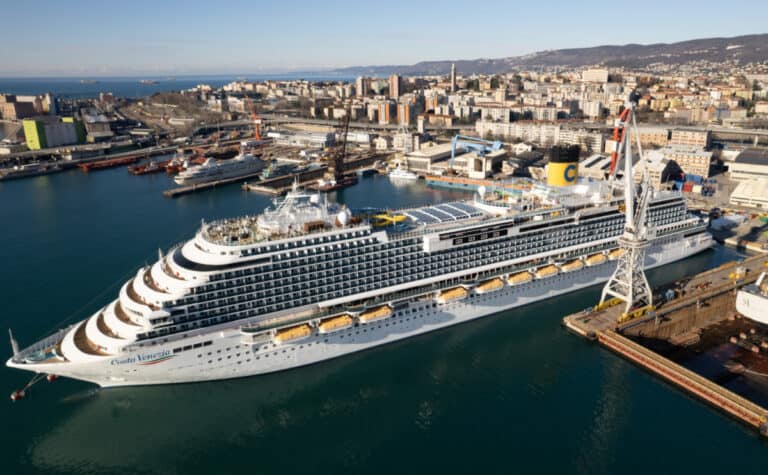
Costa Venezia Cruise Ship
What the ships will bring, however, is a popular class of cruise ship beloved by passengers who have sailed with both Carnival and Costa. Both vessels are modified Vista-class ships, and the only two Vista-class ships sailing with Costa Cruises.
“This is an exciting opportunity for us to operate two additional beautiful Vista class ships in the U.S. and bring a unique experience to those who love the culture, food and vibe of Italy,”said Duffy.
“There are lots of ways we plan to create an immersive fun experience for our guests who choose to sail on these ships, which have beautiful Italian-design elements, dining and retail that will deliver Carnival fun leveraging the spirit of Italy from our sister line Costa Cruises.”
Carnival Cruise Line already operates three Vista-class vessels in the Fun Ship fleet: Carnival Vista, Carnival Horizon, and Carnival Panorama, which joined the line in 2016, 2018, and 2019, respectively.
The two Costa ships are younger sisters in the class, with Costa Venezia having debuted in 2019 and Costa Firenze in 2020.
Costa Firenze Cruise Ship
“We are excited to see these iconic ships make their debut in the U.S. under the leadership and operation of our sister brand,”said Mario Zanetti, president of Costa Cruises.
While there are always slight variations among sister ships, both Costa Venezia and Costa Firenze are very similar, weighing 135,500 gross tons and accommodating up to 5,260 guests.
Itineraries to Be Announced
The exact itineraries for the two ships have not yet been announced but will be forthcoming as details are finalized. With Costa Venezia to be homeported in New York City, it is likely the ship may offer sailings to Bermuda, The Bahamas, New England, and Canada.
From Long Beach, California, Costa Firenze will be perfectly positioned to offer Mexican itineraries or voyages along the California coast, perhaps also including longer sailings to Hawaii.
At the moment, both ships will continue operating their regular Costa itineraries until they are assigned to Carnival, and Costa Cruises is notifying guests impacted by the redeployment plans.
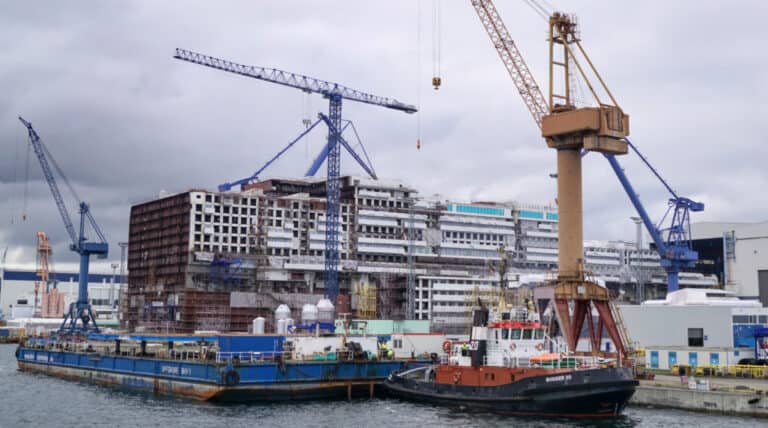
Once destined to be one of the two largest cruise ships in the world, the second new build of the Global-class, the 9,000-passenger cruise ships for Dream Cruises, will be sold as scrap.
Although only the lower hull has been assembled so far, much of the machinery and equipment was already on-site at the dock of the Warnemünde shipyard of MV Werften, in Germany.
This is a sad end to what once caused quite the stir in the cruise industry. As the vessel had been planned for Asia in particular, the vessel’s design does not comply with the strict rules and regulations in Europe.
To retrofit the ship, even when only partially built, would mean a costly re-design, something no company has been interested in performing or paying for.
The Largest Passenger Capacity Class
By passenger occupancy and crew numbers, the Global class of cruise ships was destined to be the largest ever to set sail. Up to 9,500 guests and 2,200 crew members meant a total of 11,700 people onboard at maximum capacity.
However, at least one of the two ships will never set sail. The second Global-class cruise ship, which had its hull set down in 2019, will be sold as scrap metal. This follows the demise of parent companies Genting Hong Kong and Dream Cruises, both of which filed for bankruptcy earlier this year.
Rendering Via: Dream Cruises
Administrator Christoph Morgen announced at a recent press conference that proceedings are now underway to resell some of the equipment and engines.
The half-finished hull will then be disposed of at scrap price.
With scrap prices at an all-time high, scrapping the iconic design was the only choice for the shipyard’s administrator. Because the Global-class had been designed to sail in Asia only, it lacked compliance with the strict rules and regulations and environmental compliance in Europe.
Repurposing the vessel to comply with U.S. or European laws would have been extremely costly. Strangely enough, the nearly finished Global Dream could be facing the same fate.
Will Global Dream Find a New Home?
With one (partial) ship going to the scrapyard, what will happen to the almost-completed Global Dream is anyone’s guess. Global Dream is already floating and would have been sailing with guests by now if it wasn’t for Genting’s bankruptcy.
The ship had been scheduled to debut in early 2021, but was delayed a year due to the pandemic shutdown, which also caused construction delays.
Multiple parties in the cruise industry and elsewhere have expressed interest in the mega cruise ship. The only genuine interest, however, came from family-owned Stena AB from Sweden, which has interests in shipping, real estate, finance, and more. Stena AB wanted to build a cruise product with the three other Genting ships in Asia.
However, Stena AB withdrew their consideration in late May when former Genting owner Lim Kok Thay announced a new cruise brand in Singapore, while China announced no end to its strict travel restrictions.
Photo Courtesy: MV Werften
The ongoing travel restrictions, in particular, have made any financially-reliable cruising unthinkable in large parts of Asia for the time being.
This is being echoed throughout the cruise industry, as different cruise lines have canceled their Asian seasons and planned to reposition ships to less restricted markets. Norwegian Cruise Line, Windstar Cruises, Princess Cruises, Holland America Line, Celebrity Cruises, and more have canceled Asia sailings throughout 2022.
Any parties interested in Global Dream will need to go through the process of buying a ship that is only suitable for Asia and thus either wait for the continent to open up for cruising or redesign the entire vessel.
Such a redesign would include the cabins, decks, and propulsion, as well as other features to comply with port regulations, environmental codes, safety features, and more.
If no serious buyer comes forward, Global Dream will go through a bidding process, with the ship eventually selling to the highest bidder. This will include buyers from shipbreaking yards.
With scrap metal prices at all-time-high levels, it is not unthinkable that Global Dream will end up like her unnamed sister without ever sailing a single nautical mile, and instead the hull would be broken apart to be repurposed or melted down for other projects.
The sale of Genting’s assets has been hitting full speed in recent weeks. This week it became clear that Silversea Cruises had purchased Crystal Endeavour, and additional assets are sure to find new buyers in the months to come as the cruise industry and travel overall continues to rebound.
After years of building anticipation, Disney Wish is being handed over to Disney Cruise Line. The vessel made the transit from Eemshaven, the Netherlands, where the final outfitting was carried out, to Bremerhaven, Germany, where she arrived today around 5 AM local time.
Disney Wish launch date had been scheduled to be June 9, so it is rather fitting that the official handover from the shipyard to the cruise line takes place today. Next month the vessel will sail on her first official cruise from her new homeport, Port Canaveral.
Disney Wish Officially Handed Over
After what has been a busy and long-anticipated couple of years, Disney Cruise Line has finally taken ownership of its newest cruise ship, Disney Wish.
The vessel arrived in Bremerhaven, Germany, around 5 AM this morning on June 9, coming from Eemshaven in the Netherlands, where she underwent final outfitting.
June 9 was the original date that Disney Cruise Line intended to send Disney Wish on her maiden voyage; however, some delays in the build prevented that from happening.
Photo Courtesy: Meyer Werft
After the official handover has been concluded, Disney Wish will prepare for her maiden crossing of the Atlantic Ocean as she sets sail towards her new homeport, Port Canaveral.
“The construction of such complex and large units is an extreme challenge in today’s world. Against this background, we are very pleased that we were able to hand over the Disney Wish with its many innovations for an immersive passenger experience with many loving details and numerous environmentally friendly solutions to the shipping company today,” said Managing Director Jan Meyer.
From Bremerhaven, Disney Wish will sail along the coast of the Netherlands, through the English Channel, and make a call in the Azores on June 13. The LNG-powered, 144,000 gross ton cruise ship will arrive in her new homeport on June 20, between 4 AM and 7 AM at terminals 8 and 10.
Photo Courtesy: Disney Cruise Line
After completing its maiden voyage, which starts July 14, Disney Wish will sail three- and four-night itineraries from Port Canaveral to Nassau in the Bahamas and Disney’s private island, Castaway Cay.
“In a great team effort together with our partner companies, the classification and the crew on board, we have succeeded in completing the Disney Wish in the best possible way and letting the typical Disney magic move in on board,” says project manager Henning Stellermann.
Disney’s fleet of ships now counts five cruise ships
The arrival of Disney Wish means Disney’s fleet of cruise ships has now grown to include five ships. This number will increase again with two sister ships to Disney Wish scheduled for delivery in 2024 and 2025. Disney Cruise Line first announced the Triton-class of cruise ships in 2016.
Construction for the first of three LNG-powered cruise ships started in March 2020, at the onset of the pandemic. Despite Disney ordering the ships in 2016, the keel was not laid down until April 8, 2021.
This delay was mainly due to the effects of COVID-19 in Germany and the effects on global supply chains. Earlier this year, the launch date was pushed back from June 9 to July 14, 2022, due to shipyard delays.
Not Just Another Cruise Ship
Disney Wish is not just another cruise ship. She is one of the most highly-anticipated ships to be launched this year. A lot of this has to do with the marketing campaign Disney Cruise Line developed for the vessel. Over the last years, the cruise line has done its best to slowly reveal details of its newest cruise ship.
One of the highlights onboard will be the 230-meter-long Aqua Mouse water slide. In addition, there is a “Toy Story Splash Zone” for children on the pool deck with six pools, including a water slide, a smoothie bar, and a restaurant.
Photo Credit: MartinLueke / Shutterstock
Other new additions to the Disney fleet are an adults-only area, where adults can have a relaxing day by the pool, go to the Spa or hairdressers, or visit one of the bars and pubs.
Laura Cabo, Walt Disney Imagineering:“With the Disney Wish, we wanted to design an experience that allows our grown-up guests to relax, recharge and reconnect in unique ways that only Disney Cruise Line can create. Not only did we infuse more storytelling and enchantment into the adult-exclusive venues, but we added more variety and made them more accessible than ever before. This ship has truly been designed with adults’ vacation needs in mind.”
Disney Wish also houses the first suite directly in a smokestack. The “Wish Tower Suite” extends over two floors and has a living area of around 180 square meters, offering space for up to eight guests. The suite is located in the forward funnel, which merely serves an aesthetic purpose.
Maybe you’re wondering about the components of a cruise ship beyond the deck where you lounge beside the pool, or maybe you simply appreciate knowing the location of essential items.
Becoming familiar with basic terminology can be helpful if this is your first time sailing on a cruise ship. We outline the different parts of a cruise ship in detail to help you navigate when on board.
Prior to 1920, the purpose of huge passenger steamships in the cruise industry was to transport the affluent and immigrants. Cruising simply for pleasure was unheard of. When new immigration laws changed the industry, shipping lines were forced to market to an entirely different consumer.
Advertisements soon followed, inviting people to enjoy traveling aboard comfortable, stylish cruise ships. Cruise line companies were soon sending guests to picturesque areas all over the world. This enabled people to experience the world like never before, all in luxury.
Today’s cruise ships are much different than historical passenger lines. They contain a complete array of modern amenities like media rooms, fitness areas, and infinity pools.
Yet if you were to examine a cruise ship’s diagram from its golden years, you would discover the same terminology used to describe various areas.
Common Terminology: Words That Have Stuck Around
Here are common words that are still used today to describe cruise ships. Becoming familiar with them will help you effectively navigate the expansive ship.
Photo Copyright: Cruise Hive
Aft: Close to the ship’s stern, found at the back of the ship.
Bow: The front of the ship.
Bridge: Usually found in the bow, this is the area where the captain and their crew manage and control the cruise ship.
Cabin: A private stateroom that’s like a smaller version of a hotel room.
Deck: Cruise ships are arranged in various levels including upper decks, middle decks, and lower decks.
Galley: The kitchen.
Hull: The main body of the ship.
Lido deck: A commonly used phrase indicating the location of the pool and additional amenities like bars, restaurants, and fitness centers.
Starboard: The right side of the cruise ship when facing the bow.
Stern: The extreme back end of the ship.
If you have ever wondered where these terms originated, some go back to the early days. Many of them were used when sailors required a steering oar to be able to control the vessel. Since most were right-handed, steering oars were placed over or through the right side of the stern.
The right side became known as the starboard (steering side), which combines “steor” (steer) and “bord,” meaning the side of the boat.
Cruise Ship Sizes
Cruise ships take people to desirable places around the globe, ranging from the romantic to the dramatic. But not all cruise lines provide the same experience.
Photo Courtesy: Royal Caribbean
The size of a ship can impact the type of adventure. Here are the various sizes and what to expect:
Large – This size of ship carries over 3,500 passengers. It features a variety of entertainment and restaurants. Large ships stop at popular ports all over the world. They are unable to fit into smaller, hidden harbors, so passengers can only go to more popular destinations.
Medium – Medium-sized ships carry 800-2,500 passengers at a time. They provide a mix of well-traveled ports and unique ones. Since these cruise ships carry over 1,000 passengers, the ambiance is similar to that of larger ships.
Small – Small vessels carry no more than 350 guests. They are great for those who are interested in exploring hidden areas and remote islands where only smaller cruise ships can dock. These cruise ships offer a less crowded and intimate experience than larger vessels.
Spaces on a Cruise Ship
There are three types of spaces on a cruise ship. They include:
Public Space – This includes all areas where guests can enjoy themselves, like the fitness center, pool, restaurants, and the library.
Crew Space – A private area designated for cruise ship crew members and staff like housekeepers, the captain, and chefs. Crew members reside on the lower deck with staff inhabiting the upper. The captain and officers reside in private staterooms located close to the bridge.
Stateroom – This is a guest’s private space. It is where you relax, sleep, and prepare for daily activities. The rooms will vary depending on the cruise line. They can be minimalistic or spacious in design.
Additional Terminology
The previously discussed terms were just a part of the basic terms used for navigation and the cruise ship’s areas. When it comes to a cruise line, there are other words that are commonly used to describe items or areas onboard.
Photo Credit :ackats / Shutterstock.com
Cabin Types
There are three distinctive types of staterooms. They include inside rooms, suites, and oceanview rooms. Guests can expect the basics, including bathrooms, closets, phones, televisions, and a bed. Yet each cabin type provides a different experience that should be considered.
Suites: These passenger cabins provide seating areas along with multiple rooms for larger families or groups. They offer more space than other cabins. Suites come with perks like plush bathrobes, flowers, and other items, making them more luxurious.
Inside cabins: Located in the middle of a cruise ship, they do not contain balconies or windows. These are more budget-friendly rooms. They are similarly sized to oceanview rooms and contain similar amenities.
Oceanview rooms: Also known as outside cabins, oceanview rooms line the cruise ship. They feature balconies or windows and allow natural light to pour into your cabin. Guests can watch the scenery from their room in the comfort of their own designated private space.
Itinerary
Itineraries illustrate your daily schedule, including each port of call or destination throughout your journey as well as days at sea. Sea days are when you are in open waters without any scheduled stops. They are as follows:
One-way – This journey begins at a certain departure port and finishes at a different one. One-way trips provide additional time to explore several destinations during a single voyage. It may be referred to as “open-jaw sailing.”
Round trip – This journey leaves from and returns to the same port. It is ideal for those who can drive to their departure port and would like to avoid traveling by air.
Photo Credit: Brookgardener / Shutterstock
Shore Excursion
Shore excursions are organized activities available at each port. They can be booked in advance through your cruise line. While you can explore the ports by yourself, taking tours can provide a memorable experience and be a great way to become immersed in nature, history, or culture.
Final Thoughts
While many people don’t see the value in it, it is wise to know the parts of a cruise ship. In general, individuals cannot recall where the starboard, port, or stern is located. This is common lingo aboard a cruise ship.
Becoming familiar with what different terms mean will allow you to easily locate areas on the cruise ship and find essentials. Acclimating yourself to your environment is never a bad thing.
Whether you are a seasoned cruise planner who’s been around the world or you are planning a cruise for the first time, there are always things to be learned.
Many details go into cruise planning. If you aren’t aware of them, you can get caught off guard. We go through the most common mistakes people make and let you know how to avoid them.
Mistakes happen innocently enough. Sometimes, it is due to inexperience. If this is your first cruise trip, you may not know what to expect or how to go about navigating all the details.
You may not know someone who can guide you through the process to help you make the best decision or to inform you of what pitfalls to avoid.
Even the most experienced travelers still make mistakes. Sometimes, details are forgotten, things are left behind, or items are overlooked. Whether this is your first cruise or your thirtieth, we go over what some of the most common mistakes are, how to avoid them, and how to fix them, if possible.
Selecting the Wrong Cruise Ship
There are over 350 cruise ships and counting for you to choose from each season. It can be overwhelming to find one that is perfect for you and your cruise itinerary.
Cruise ships aren’t a one-size-fits-all type of experience. Before you begin planning your cruise, consider what you want in a cruise ship and what your expectations are.
Photo Credit: EQRoy / Shutterstock.com
For example, a young couple on their honeymoon may not want to be on a family cruise with children running about. They may want something more romantic, secluded, and serene. Noisy children may detract from the romantic experience of sailing on the open seas and watching the sunset with cocktails in hand.
You need to be realistic as to what type of experience you are looking for. With so much variety, there are cruise lines to suit everyone’s needs, and they are continually expanding to suit their clientele better, including uncovering niche markets.
Booking the Wrong Cabin Type
The staterooms on a cruise ship are different from hotel accommodations. They are smaller in size and are created for efficiency rather than opulence. There are ships that offer larger staterooms with additional space, but they tend to cost more.
If you are new to cruising, think about booking an ocean view stateroom, which would allow you a view of outside in the event you become somewhat claustrophobic.
Cruise lines will outline dimensions for their staterooms directly on their website. Some will post images or allow you to take a virtual tour of the space.
Photo Credit: ackats / Shutterstock
You can select your cabin’s location so you can see how far it is from the stairs or elevator. You should also consider booking cabins that are located near activities that you’ll enjoy.
Cabins located on higher decks and those in the middle tend to cost more. If you book a suite for added space, these may still not be as large as those in hotels.
When booking a room, be sure there is ample room for everyone in your group. This is especially true for families. If you are taking your family, be sure to book early so you can get a large enough room. If you are splitting up cabins, make sure you are all in close proximity.
Not Booking Excursions Prior to Boarding
Excursions are a big part of the fun of being on a cruise. They allow you to explore new destinations, experience the culture, have fun, and even learn something new.
While at a port of call, you need to have a plan of where you want to go. This involves booking shore excursions. These often involve adventure experiences like kayaking, snorkeling, city/historic tours, beach breaks, water-based adventures, food tours, and other fun experiences.
Photo Credit: Philip Schubert / Shutterstock
Each cruise line has a list of different activities to participate in while at various ports of call. However, you don’t necessarily need to book with the cruise line. There are other local vendors and third parties that have similar or even better offerings. You’ll probably get a more intimate experience and better pricing this way.
However, this will involve budgeting and planning. If you forget to budget or plan for it, you may end up scrambling for something to do. Therefore, you may not fully enjoy each cruise destination.
Shore excursions, no matter if it is with the cruise line or a third party, should be booked prior to the trip. Waiting too long may mean that you miss out on an experience of a lifetime. The most popular excursions tend to sell out quickly.
You don’t have to book at each cruise port of call, though. You may want to take a self-guided tour, visit a local beach, or relax on the cruise ship.
Waiting Too Long to Make Entertainment/Dining Reservations
Modern cruise lines offer Broadway-caliber shows. They provide a one-of-a-kind experience, containing specialty dining and a variety of other amenities. However, don’t think that just because a cruise line has a lot of great options for dining that you can easily get in.
For larger ships, cruisers will need reservations for some onboard activities and entertainment. There are also dining facilities that quickly book up. Always plan ahead wherever you can so that you don’t miss out.
Photo Copyright: Cruise Hive
Many times, reservations can be booked pre-cruise. Depending on which line you are booking with, reservations can often be made 90-120 days prior to boarding.
Keep in mind that prime times for dining and popular showtimes book up quickly. It is suggested that individuals reserve these times as soon as they are available using the online planner.
This not only goes for entertainment and food but for drinks as well. Purchasing a drink package beforehand may save you money prior to going on your cruise. Even some attractions may require reservations. It is always advisable to be proactive in your planning as much as possible.
Not Knowing What Is Included with Your Cruise
Cruises can offer amazing value for your money. One cruise fare set can provide access to a variety of dining venues, entertainment, fun, and onboard activities. However, you must consider that not everything is included in the price.
Contemporary cruise lines will include a small number of beverages and most dining venues. However, you will need to note that cruise lines like Norwegian Cruise Line and Royal Caribbean International don’t include lattes, soft drinks, or any alcohol in their fares.
There are specialty dining restaurants that have an extra cost on some cruise ships. If you eat at some of these locations, expect to pay extra.
Photo Copyright: Cruise Hive
While many amenities are free of cost, not all of them may be included. Most cruises offer water slides, sports courts, mini-golf, rope courses, and outdoor activities at no additional cost. However, if you want to go on a 3D ride simulator, go bowling, or ride go-karts, there is an additional cost involved.
Spa treatments and thermal suites have fees as well. Signature productions will also cost extra.
Therefore, knowing what is and is not covered in your fee is important. It allows you to plan for activities that are included and budget extra for things you may want to partake in.
There is nothing more disappointing than wanting to do an activity only to discover that you don’t have the money for it after thinking it was included.
Always be sure that you are well-acquainted with what is covered in the original costs. This way, you will never be disappointed.
Forgetting the Online Check-In
While preparing for the cruise, always remember to check in at home. It only takes a few minutes of your time to complete, and it’s easy.
Each cruise line tends to have a smartphone app that allows you to complete the check-in. The paperwork needs to be done up to three days prior to embarkation.
Photo Courtesy: Virgin Voyages
Basic information regarding your traveling party needs to be established, along with an account for any onboard spending. This process assigns you boarding times to regulate the passenger flow upon getting on board the cruise ship.
By completing this step ahead of time, you can avoid the obstacles that happen if you show up without completing it, making for an easier, more streamlined experience.
Not Planning to Arrive a Day Prior to Embarkation
Many people consider taking the first day’s flight the morning of the cruise. It makes sense in a practical way and in terms of budgeting. However, the largest mistake passengers commonly make is not properly arranging transportation to and from your cruise ship.
This is especially true if you are flying from a place where weather may affect your travel plans.
Most experts urge people to fly to the embarkation port a day prior to the cruise and book a hotel stay. The advantage is that you will not be rushing about during the day you are to leave. It also eliminates any chance of missing the ship due to disruptions in travel.
Photo Credit: JHVEPhoto / Shutterstock
If you have ever traveled, you know that you have to expect delays. While we hope there are nothing more than minor blips, sometimes the trips will be rerouted or experience hour-long time gaps. As frustrating as that is, you need to plan for this possibility. Therefore, it is advised to leave early.
This way, even if there are delays, it won’t disrupt your whole trip. You will still reach the ship in plenty of time.
While on paper it may appear wasteful to rent a room for a night, would you rather spend the extra and arrive on time, or be out the money for the cruise ship because you missed it? Cruise ships have a schedule to keep, so they will leave without you.
When leaving the ship, do not book morning flights. Cruise ships are cleared between the hours of 7:00 a.m. and 9:00 a.m. You will need to plan for an hour to get off the ship, plan for time to travel to the airport, and go through security.
These are just the basics when planning a cruise. They are the things that, in the back of our minds, we recognize but may forget about.
There are things that people may not know about, and these tips will come in handy as you plan for your trip. This opportunity should be enjoyable and be flawlessly executed for maximum enjoyment.