Key Aspects:
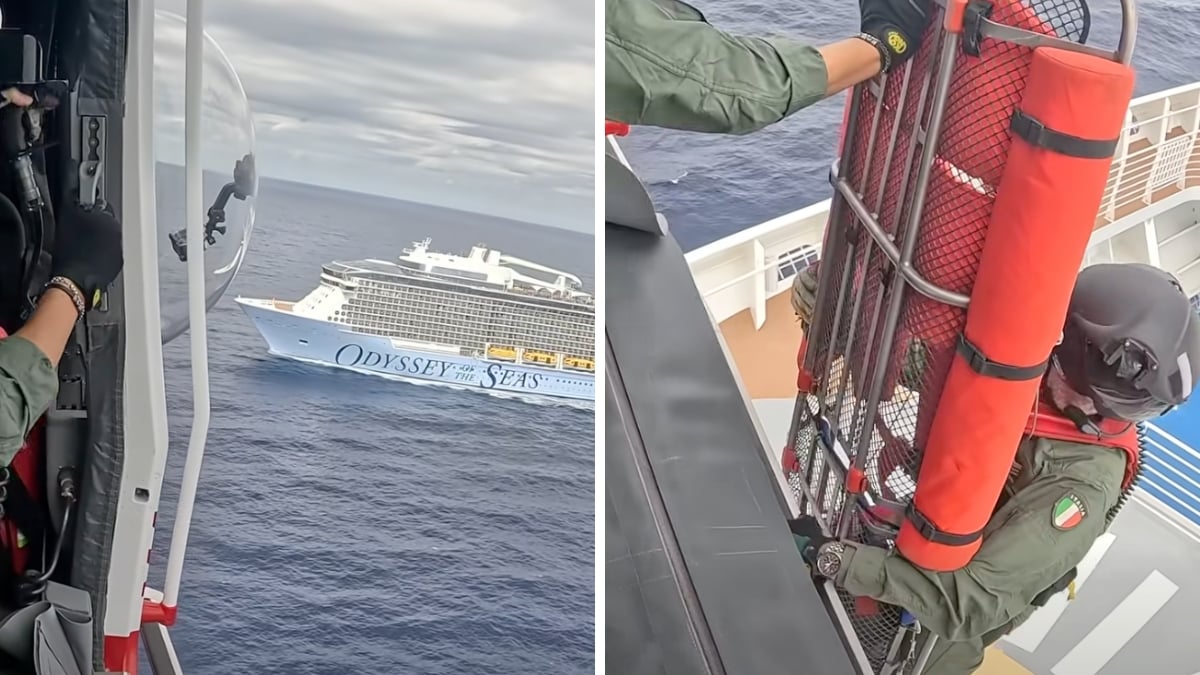
- The Italian Coast Guard posted a video of a medical airlift from Odyssey of the Seas conducted on Friday, October 16, 2026.
- An ill guest was lifted in a litter to the hovering helicopter during 25 mph winds and waves over six feet.
- The guest was successfully evacuated to Cannizzaro Hospital in Catania for treatment, but no details about their condition have been released.
The Italian Coast Guard (Guardia Costiera) recently conducted a precise medical evacuation airlift under tense conditions in the Ionian Sea from Royal Caribbean’s Odyssey of the Seas. The crew of Nemo 10 at the Catania Coast Guard Air Base conducted the operation.
Video of the emergency airlift was posted on Sunday, October 18, 2026, though that does not necessarily indicate the actual date of the evacuation.
A Facebook group for the ship’s October 11 sailing, however, confirmed the airlift took place on Friday, October 16, 2026, at approximately 2 p.m. local time. At that time, Odyssey of the Seas was having a full day at sea, having visited Mykonos on Thursday, October 15, and heading for Naples as the final port visit on Saturday, October 17. The ship was sailing a 7-night Greece and Italy itinerary roundtrip from Civitavecchia.
The brief video is just 30 seconds long, but first shows the rescue helicopter approaching Odyssey of the Seas while the 4,198-guest cruise ship is clearly underway. One of the rescue personnel dropped to the deck of the ship with a passenger litter, and was then brought back up safely with the guest firmly secured to the litter.
Cruise ship crew members on the deck are seen providing tension to a tagline as the litter is guided upward, ensuring stability and helping keep the litter from spinning as the operation is completed.
“Emergency intervention in the Ionian Sea for the crew of Nemo 10 at the Catania Coast Guard Air Base,” the video is captioned. “The AW139 helicopter carried out a complex medical evacuation 120 miles east of the coast, rescuing a 64-year-old passenger who had suffered a serious illness on board a cruise ship.”
The video also notes that the evacuation was conducted during “adverse weather conditions” with waves more than two meters (6.5 feet) high and wind from the north at 22 knots (25 miles per hour).
These conditions would have created excessive motion for both the ship and the helicopter, and it was critical that both be kept synchronized as much as possible so the airlift could be safe and as smooth as possible.
No further details have been released about the passenger or their medical condition. The video caption did confirm the guest was successfully airlifted to Catania, Sicily, and handed over to the care of the medical staff at Cannizzaro Hospital.
It is standard practice not to reveal medical details or updates on evacuated guests in order to safeguard the individual’s privacy, as well as the privacy of their family members, friends, and traveling companions.
Odyssey of the Seas has been at the center of media attention for another emergency recently, when a woman went overboard on Friday, October 9, 2026 and was rescued roughly 20 hours later by the Hellenic Coast Guard.
Could a Helicopter Land?
Many commenters have asked on the Coast Guard’s Facebook post why the rescue helicopter couldn’t land onboard the cruise ship to facilitate the evacuation, an interesting question considering larger ships do appear to have helipads.
The 167,704-gross ton Odyssey of the Seas does indeed have a landing pad on her bow, but not for emergency landings in that way. When a cruise ship is underway, even in calm seas, small swells or wind shifts near the water’s surface could make any landing onto a moving vessel far riskier than a winch transfer.
With highly trained emergency crews, using a winch for a litter evacuation is actually a much safer operation. Furthermore, it can be faster to evacuate a guest via a litter with the helicopter already in the air, able to bring them to advanced medical care more quickly.
Cruise Hive’s thoughts are with the ill guest and their family members and friends, and we are ever grateful for those emergency personnel who are available to assist whenever those at sea need emergency help.