What is truly remarkable about a cruise ship is not the magnitude of its size but how the different parts work together, and we don’t just mean in the engine room.
Many things are going on behind the scenes that guests do not have a clue about. We discuss the areas found on the front part of a ship.
Each part of a cruise ship has a unique function. Guests tend to see only a small part of what is needed to run the cruise ship. Many locations are off-limits to guests and only accessible to crew members, so you probably don’t have a clue about what is going on below deck. But when you look at these components, you’ll be amazed at how a cruise ship operates.
Bow
If you have ever watched Titanic, you are familiar with the epic scene of Rose climbing the front of the ship supported by Jack and stretching her arms out as the wind rushes through her hair. She stands on the bow or the forward part of the ship.
Photo Copyright: Cruise Hive
The bow’s function is to reduce bowing when the cruise ship sails, decreasing water pressure and preventing water from entering the ship.
Port Hand
Theport hand is on the ship’s left side or port side, close to the front. This area is what guests use while embarking and disembarking. It also serves as an area to access the ship for repairs.
Forecastle
The forecastle is at the head of the ship. It holds tools for anchoring, like mooring ropes, bollards, etc.
Open-air Terrace
This beautiful, open terrace area is outside of the ship. The terrace is floor-shaped, covering the front of the passenger ship. It is on the upper deck, just in front of the navigation tool.
Radar
Radar means “Radio Detection and Ranging.” A ship’s radar is a navigational tool that measures and detects objects surrounding the cruise ship. It can also detect other ships’ locations to prevent collisions.
Radar on Cruise Ship (Photo Credit: TheHighestQualityImages / Shutterstock)
Radio Antenna
Ships generally contain a radio known as a marine VHF radio, a method of communication during emergencies and under critical circumstances. The radio includes an antenna on the passenger ship to conduct easier searches during an emergency by sending signals to other vessels or the Search and Rescue (SAR) team.
Sundeck
The sundeck is the preferred location for guests to enjoy the ocean view when on board. The sundeck is commonly used and aptly named: it’s a spot to bask in the sun and relax.
Telecommunication Antenna
Telecommunication is the method of sending wireless information. The telecommunication antennas on a sailing vessel convert electromagnetic signals to electrical ones and capture radio signals.
Captain’s Quarters
Ever wonder where the captain of the cruise ship sleeps? The captain’s quarters are in the captain’s room. The captain’s responsibility is to keep passengers safe and oversee the ship’s operations for the voyage.
Bow Thruster
Bow thrusters are an additional engine that acts as a propulsion device or aids in steering the ship. It’s an auxiliary engine found in the front left of a cruise ship.
Also known as the ship’s bridge, the compass bridge contains a room used for a cruise ship’s steering command. It is also where navigation tools for the captain’s room are and includes a radio that determines the ship’s positioning.
Starboard Hand
Starboard hand refers to a buoy on the starboard side of a cruise ship. It is found either on the hull or outside the right side of a cruise ship.
Anchor-Windlass Room
A windlass system is installed on cruise ships to move anchors and chains. Anchor-windlass can also be known as an anchor machine.
Stem Bulb
In boating terminology, a stem bulb is commonly known as a bulbous bow. It is on the front of the vessel, on the bow, and reduces the cruise ship’s resistance, generates vessel bottom pressure, improves ship trim ortilt angle, and holds the bow.
Conclusion
In terms of functionality, the forward partsteers the ship, navigates through waters, and communicates with other navigational systems.
It is quite a busy and bustling area as guests’ lives may depend on the information received in this area. As a guest, this is the best location to relax on the upper deck and take in the fresh sea air.
MSC Cruises has altered the planned itinerary for MSC Seashore to avoid impacts from Tropical Storm Ian, which is forecast to become a hurricane in the next 24-36 hours.
The ship’s ports of call have been changed and its route altered to avoid the worst expected impact of the storm.
Altered Itinerary With Changed Ports of Call
MSC Seashore, which is departing today – Saturday, September 24 – on a 7-night roundtrip Western Caribbean sailing from Miami, will no longer be making the same port visits as originally planned.
Guests have been notified of the altered itinerary via letters in their staterooms as they boarded the vessel today.
“We regret to inform you that due to forecasted path Tropical Depression Nine (which is forecasted to become Tropical Storm and then Hurricane in the next few days) our scheduled itinerary will need to be adjusted,”the letter read.
“Your comfort and the safety of all our guests and crew is our utmost priority.”
The ship’s original itinerary called for a day at sea, then three of the most popular Caribbean ports of call in quick succession: Ocho Rios, Jamaica; Georgetown, Grand Cayman; and Cozumel, Mexico. After another sea day, MSC Seashore was to visit Ocean Cay MSC Marine Reserve, the cruise line’s private island destination in The Bahamas, before returning to Miami on October 1.
Photo Courtesy: MSC Cruises
Now, everything about the ship’s itinerary has been changed to route the vessel around Tropical Storm Ian and its potential impact.
The Seaside-class MSC Seashore will visit Ocean Cay on Sunday, September 25 as the first port of call rather than the last, and with a shorter visit time of 8 a.m. to 5:30 p.m. rather than the original port time of 8 a.m. to 9 p.m.
On Monday, September 26, the ship will spend the day in Nassau from 8 a.m. to 6 p.m.
One day at sea will follow, then an overnight visit in Puerto Plata, Dominican Republic, from 8 a.m. on Wednesday until 4 p.m. on Thursday. This will give guests plenty of time for multiple shore tours or other experiences at the destination.
After another day at sea, the cruise will conclude in Miami as planned on Saturday, October 1, with no change in the ship’s anticipated arrival time or debarkation.
“I apologize for any inconvenience and thank you for understanding,”the letter, signed by the ship’s captain Giuseppe Galano, reads.“We look forward to welcoming you aboard MSC Seashore.”
Disappointing But Necessary Changes
Many guests will undoubtedly be disappointed by such drastic itinerary changes, especially as the ship will now have just three port visits rather than four.
Pre-paid, pre-booked tours for Ocean Cay are being automatically switched to the new schedule, while tours for Ocho Rios, Georgetown, and Cozumel are being fully refunded. Guests will have opportunities on board to book tours for the new visits in Nassau and Puerto Plata.
Tropical Storm Ian (Image Courtesy: NOAA)
This dramatic itinerary change comes as Tropical Storm Nine has strengthened into Tropical Storm Ian, and is forecast to continue strengthening into a hurricane.
As of Saturday evening, the storm is located due south of Jamaica, with maximum sustained winds of 45 miles per hour (72 kilometers per hour), and is moving west at 16 miles per hour (26 kph).
The storm is forecast to begin a northwest turn on Sunday, which will likely take it between Cuba and the Yucatan Peninsula of Mexico early next week. While there is still great uncertainty about the storm’s eventual strength and exact path, all cruise lines will be watching the storm closely.
Stay tuned to Cruise Hive for further updates on this developing storm and its impact on cruise travel in the region, as Western Caribbean itineraries are very popular and a number of ships on different cruise lines are likely to be affected in the coming days.
Security and passenger safety are high priorities for cruise lines. Cruise ships attempt to minimize passenger disturbances and crime at all costs. Since the onboard jail or brig is secluded from guests, most people wonder if cruise ships have jails and how they handle crime.
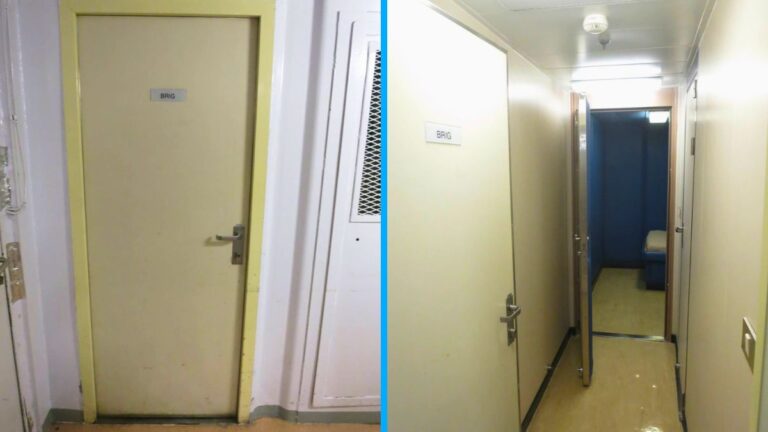
The answer is yes, but it’s not called a jail. A cruise ship will have a small brig near the bottom of the vessel located in a crew-only area. It will be a small room with a single bed. The ship’s security staff will use this room for misbehaving passengers who are a safety risk to others.
Take a look at the photo below which shows the interior of the brig on Carnival Cruise Line:
Inside the Jail (Brig) on Carnival Cruise Line (Photo Copyright: Cruise Hive)
The cruise industry never advertises policies regarding crime or their facilities, but each cruise liner has a plan. This plan may include cabin arrest in the offender’s cabin with posted guards or being locked up in a cell on the cruise ship that only the crew can access.
Larger ships contain padded cells or safe lockup rooms. Smaller ships have other methods of controlling individuals that are a security threat to themselves or others until they can remove the individual from the vessel.
Cruise ships tend to do this as quickly as possible to ensure the safety of all guests. The decision as to whether someone goes into jail or disembarks is up to the cruise ship captain.
Jail on Carnival Cruise Ship (Photo: Copyright Cruise Hive)
What Crimes Happen Most Frequently at Sea?
Most security disturbances involve small cases of intoxication in public. These cases rarely result in criminal prosecution. Every crew member receives training on managing incidents, preventing escalations, and minimizing the impact on other guests.
Most vessels independently report statistics on serious crimes aboard cruise ships. In 2014, an amendment to CVSSA (Cruise Vessel Security and Safety Act) provided FBI reports of eight detailed serious crimes that are mandatory for passenger cruise ships disembarking and embarking from U.S. ports to report.
Photo Credit: Prath / Shutterstock
The most recent reports outline the prevalence of serious crimes committed at sea. The overall numbers are low when compared to the number of passengers. For example, in one year, 13 million passengers were reported aboard cruise ships in U.S. ports. Under 100 serious crimes were reported to the FBI.
Serious crimes that occurred on cruise ships in 2020 were sexual assaults, with 22 incidents reported. In that year, there were no other types of crimes reported.
The FBI reports address any theft over $10,000, and none were reported during this year. There are many reasons for this. It may be due to the security of CCTV, stateroom safes, and electronic key card room access.
Who Investigates Crime?
Cruise ship security officers are the first responders in most cases. Their overall function is to ensure guest safety until law enforcement can handle serious issues. Jurisdiction complicates security. Local authorities have clear jurisdiction if ships are at port when the problem occurs, and this is also true when cruise ships are within the waters of the country.
FBI at Cruise Ship (Photo Credit: RUBEN M RAMOS / Shutterstock)
If the cruise ship is in international waters, jurisdiction resides within the laws of the registered country. An example is if a cruise ship is registered in South America, crimes in international waters are under South American law.
The FBI attempts to investigate when U.S. citizens commit crimes or are the victim of a crime. When a serious crime is confirmed or suspected, they use a global network to ensure the cruise passenger’s safety, then secure a crime scene to conduct a further investigation.
Handling a serious crime involves negotiation between officials from the cruise ship’s registered country, the U.S. government, and authorities in foreign ports.
What Security Measures Are in Place on a Cruise Ship?
All cruise lines contain security measures to ensure the safety of crew members and guests. These include:
Vessels must report any crime committed to relevant authorities
Weapons, drugs, firearms, knives, ammunition, flammable substances, explosives, and most drones are prohibited
Crew requires basic training so they know what to do in a situation and can report and handle all crimes or disturbances
Guests may end up either under cabin arrest or in the brig for several reasons. These include:
Committing Serious Crimes
If someone is suspected of committing a serious crime, like murder or assault, they can be put in the brig until the cruise ship reaches port. Then, local authorities will deal with the individual.
The Person Is a Danger to Themselves or Others
In this case, they can be put in the brig as a last resort. If the person threatened another person or uttered suicidal threats, they can be placed in the brig to keep them out of harm’s way. Cruise lines try to avoid this, but some situations warrant it when there are no other options.
For example, if a guest was drunk and disorderly, they may have to sign a contract promising they will refrain from alcohol for the remainder of their cruise. The consequence is removal from the cruise ship, and vessels have the right to disembark any passenger.
The Person Scammed the Cruise Line
Some people do come on board a vessel to try to scam the cruise line. A fake “trip and slip” can occur with people attempting to secure a free cruise.
Fortunately, ships have CCTV cameras. Acts like these are typically dealt with without needing the brig. However, the brig can be used if a serious crime is committed in the scam.
If you wonder whether cruise ships have jails, the answer is yes. Jails are called brigs on a cruise ship and tend only to be used in serious circumstances when no other options are available. Cabin arrest is typically used before the brig is needed.
Some cruise lines are particular about what you can and cannot take onboard, particularly regarding anything containing alcohol.
There are rules guests need to be aware of before embarking on the cruise ship. Can you take a wine opener on a cruise? Unfortunately, there isn’t a straightforward answer.
Cruise lines make a lot of money from selling alcohol and any drink on board the ship. The prices are significantly marked up, leaving many people wondering whether they can bring their own beverages. The answer depends on the cruise line and the type of beverage.
Mainstream cruise ships that permit you to bring alcohol on board allow primarily champagne or wine. They will confiscate anything else at boarding. There is also a limit to how much you can bring on the ship.
You must present bottles in carry-on bags upon entry. Before boarding, you’ll have to remove them from checked luggage and pass through ship security.
Generally, guests can bring one to two bottles per stateroom on the ship. The cruise line will confiscate anything more than this.
While on the ship, there may be a corkage fee if you consume the alcohol in a public area or dining room.
Bottles must be sealed and unopened. They cannot be in a mouthwash bottle, flask, or any other container.
If you try to sneak in bottles and get caught, the bottles will be stored and returned when you disembark. The same holds true for purchases made in the duty-free shop and at a port.
Wine on Cruise Ship (Photo Credit: photopixel / Shutterstock)
If you want to know whether your cruise line accepts alcohol you bring on board, look at their webpage, as most have a list of prohibited items posted. Don’t be surprised if many cruise lines do not permit you to bring alcohol. Each cruise line has its own policy.
Most cruise lines follow the procedures listed above.Disney Cruise Line permits guests to bring six beers (12 oz or less each) or two bottles of unopened wine or champagne (no larger than 750 ml) at the beginning of the cruise and at each port of call or shore excursion. You must pack all items in a carry-on.
Can I Take a Wine Opener on a Cruise?
The answer to this question is that it depends on two conditions: whether it is a stand-alone corkscrew or part of a Swiss army knife/portable knife set.
Standalone Corkscrew
Some cruise lines will permit you to bring a standalone corkscrew on board, while some may not. Cruise lines view a corkscrew as a potential weapon, but many don’t overtly comment on whether bringing them is acceptable on their websites. However, their policies are worded as if guests ask for corkscrews when necessary.
If you bring a corkscrew, much like alcohol, it must be stored in a carry-on or checked luggage. If you are unsure, ask the room steward for a corkscrew, and they will bring it to you.
As a Part of a Knife Set
Many guests bring a Swiss army knife, which has a corkscrew. They are convenient, small, and easy to pack in your luggage. However, they are prohibited as many cruise lines ban all knives.
Knives are classified as weapons. Although you may just want the corkscrew, cruise lines can confiscate anything they view as a weapon or that can potentially be used as a weapon. Remember, guest safety is the top priority for every cruise line.
Some specify that they will only confiscate knives over four inches long, but some just ban knives completely. You will need to consult with the cruise line on their policies before bringing them on the cruise.
What Should I Do?
If you are unsure about your cruise line’s policy, it is best to contact them directly so they can outline the policies and address any questions you have. Sometimes, the wording can be confusing or contain grey areas. So, it is best to ask directly.
Other options include:
Checking the website before packing. When checking into this topic, first ensure alcohol is permitted and what type is allowed so you don’t end up taking something you can’t use. Then, examine if corkscrews are allowed. Can they be part of a knife set, or do they need to be standalone?
Avoid the hassle and ask the stateroom host to bring you a corkscrew.
Drink your wine in a dining room or designated area. You may have to pay a corkage fee, but it will prevent you from potentially losing your wine.
Cruise lines can differ on what they permit on board, so the rules on what you can take onboard aren’t always clear-cut. The first thing to determine is whether they allow you to bring alcohol and whether you can bring it outside of special occasions.
Wine on Cruise Ship (Photo Credit: SariMe / Shutterstock)
Not all cruise lines permit you to bring alcohol on board. If they do, you are limited by size and the amount you can bring. The amount allowed is rarely enough for the entire trip. You may save some money, but it won’t be significant. You may even end up paying for the privilege of drinking your own alcohol, depending on where you drink it.
However, it may be worth the extra effort if it is a special bottle or a particular vintage you are fond of.
Next is addressing whether you can take a wine opener on a cruise. The answer is maybe. Some cruises view certain types as weapons and will remove them from your possession. They are very particular regarding weaponry and have different policies on this subject.
Some will remove the wine bottle opener if it is part of a Swiss Army knife, as they are considered a weapon, but will allow a standalone corkscrew. Meanwhile, others frown on it altogether and will refer you to the room steward instead. Either way, there will be a corkscrew available to you onboard the ship so you are able to crack open your bottle and enjoy!
Scarlet Lady, the first vessel of the young Virgin Voyages cruise line, has rescued a small group of refugees from a makeshift raft north of Cuba, according to reports from passengers on board.
The cruise ship spotted the vessel in distress, took its occupants onboard, and has reported the incident to the proper authorities.
Scarlet Lady Rescue
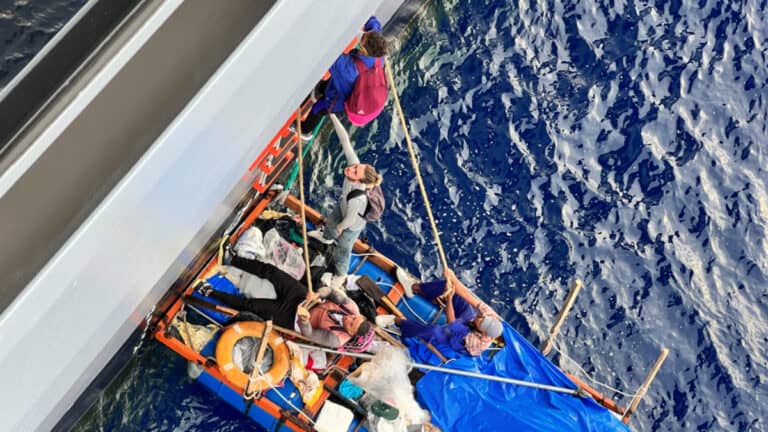
The ship, which was enjoying a day at sea, spotted the small, unsteady craft north of Cuba. The refugees appeared to be aboard a makeshift raft built from water barrels and inner tubes, with a blue plastic tarp or similar plastic sheet for a sail.
Eight individuals were aboard the raft, and while their condition was not known, the raft was obviously not seaworthy for the Straits of Florida, the occasionally rough waters between Cuba and the Florida Keys.
You can watch a video fo the rescue below and listen to the announcement from the ship’s captain:
The refugees were brought aboard the cruise ship with what belongings they could carry, though photos and video show that some materials remained aboard the raft. The small craft was left adrift after it was abandoned.
The incident occurred just before 7 p.m. on Wednesday, September 14, 2022.
After the rescue, tracking data showed Scarlet Lady turning north toward Key West, where it is likely the refugees will be turned over to the United States Coast Guard, the authorities overseeing such rescues.
Photo Credit: Alex Kalogeropoulos
A Coast Guard cutter is most likely dispatched to transfer the refugees, though the cruise ship will adjust its course slightly to meet the authorities more efficiently.
The 110,000-gross-ton cruise ship is currently sailing a 5-night Riviera Maya itinerary, having left Miami on Sunday, September 11. Monday was a day at sea, and the ship visited Cozumel, Mexico on Tuesday. Today was another day at sea.
After releasing the refugees to the proper authorities, Scarlet Lady will resume her voyage, with a planned visit to Bimini in The Bahamas on Thursday before returning back to Miami on Friday, September 16.
Because cruise ships normally use slower, more fuel efficient speeds during sea days, it is unlikely there will be any delay in Scarlet Lady‘s remaining itinerary for this cruise. The ship will simply adjust speed to compensate for the diversion in order to arrive in Bimini as scheduled at 8 a.m.
Scarlet Lady can host as many as 2,770 guests, with 1,160 crew members to provide superior service aboard the luxury vessel. The ship is currently offering 4-5 night itineraries roundtrip from Miami, exploring a variety of Caribbean ports of call.
In October 2021, the vessel came to the rescue of eight migrants 75 miles southwest of Key West, Florida. The ship’s crew helped the migrants onboard after they had been stranded at sea for six days.
Photo Credit: Eric Gilbert Creative / Shutterstock
The young cruise line only has two vessels currently sailing – Scarlet Lady launched in October 2021 after multiple delays due to the COVID-19 pandemic and industry-wide cruise travel shutdown.
Despite the lengthy delays, however, the ship has received wide acclaim for its luxury experiences and adults-only atmosphere, which sets it apart in the cruise industry.
Scarlet Lady was joined by her sister ship, Valiant Lady, in February 2022, and a third vessel for the fleet, to be named Resilient Lady, is scheduled to debut in May 2023, later than initially planned due to supply chain shortages that have impacted her construction timeline.
The fourth ship in the fleet, Brilliant Lady, is also scheduled to debut later in 2023. There has been no announcement about whether this vessel will also be delayed as her sister ships have been.
Without a power source and propellers, cruise ships would drift aimlessly at sea. These mega-ships require engines, fuel, and massive propellers just to move through the water and keep all activities on board the ship running. We describe not only the cruise ship propeller size, but also how it integrates with the rest of the engine.
Older cruise ships use diesel engines for propulsion. The power generated from the engine goes through a transmission and into the propeller shafts.
The transmission determines propeller revolution like the transmission in an engine transfers RPM to a manageable speed to power the rear wheels in a car.
Meanwhile, modern cruise ships use diesel-electric engines or gas turbines to propel the ship through water. The ship’s systems are also used to guide and move the ship through the ocean.
The larger the ship, the higher the demand for electrical power. There are cruise ships that rely on two different sources of power. One is dedicated to electrical power, while the other is for propulsion.
Propellers can be up to 20 feet in height. Often referred to as ABB Azipods XO, modern cruise ships tend to have three of them to properly maneuver the ship and propel it forward in water. They are efficient on fuel compared to a traditional system.
As mentioned, they allow for improved maneuverability, allow the ship to maximize speed, reduce bad emissions, and optimize the overall performance of the cruise ship.
An ABB Azipod system has a large impact on the operating efficiency of a cruise ship. It effectively reduces bad emissions and energy consumption by 20%. This propulsion system resides in the ship’s aft outside of the hull. They can rotate by 360° using a rudder, which provides thrust in any direction. This is not possible with a conventional system.
This type of propeller contains three main components:
Frequency Controller – This is designed to change the supplied power’s frequency, so the rotating motor speed is more easily controlled.
Supply Transformer – The power, which is produced by a generator, is 6,600 KV. This is stepped down to the required voltage used by a supply transformer. Then, it is transferred to the motor located in the pod.
Propulsion Motor – Designed to drive or produce thrust, its rotation is generated using an electric motor.
How Do Propellers Work?
Propellers are required to push a cruise ship through water. Commonly referred to as “screws,” they slice through the water. They also provide a reverse and forward motion. Cruise ship propellers do not need to turn quickly since they rely on brute power or torque instead of high speeds or RPM. This is what causes a ship to move slowly, as these vessels rarely reach 30 knots.
Large Propeller
Cruise ships that are newer and more cutting edge may use azimuth thrusters. These are pods housing propellers, which rotate 360° and provide optimal maneuverability. They were designed to replace rudders and are touted as more beneficial compared to screw-type propeller systems. Benefits include improved fuel efficiency and shorter stopping distance.
These types of propellers allow cruise ships to turn quickly in water when necessary to avoid collisions, which is why more vessels are being equipped with this technology.
How Do Azipods Work Compared to Traditional Propulsion Systems?
The term “Azipod” combines the words “azimuthing” and “pod.” The phrase “Azipod” is a registered trademark of ABB Oy. They work by having the propeller located on the front of its pod. This allows the cruise ship to be pulled through the water rather than being pushed as in a traditional shaft and propeller system.
With a traditional system, its propeller is rotating in water that has been disturbed by the moving of the propeller shaft, brackets, and framing. With the pod system where the propeller is found in the front of its pod, it is turning in water that has been undisturbed. This allows the pod to be 5%-6% more efficient due to improved water flow.
Cruise Ship Azipod
Traditional systems are noisier when maneuvering due to the cavitations of its propellers. This doesn’t occur with pods since they are tractor pods. Tractor pods comparatively pull a ship through surrounding water. Clean, smooth water moves into the blades, thereby decreasing noise.
Pod systems free up additional space in the hull. Traditional systems meant the motors and propeller shafts had to be placed in the hull. Modern cruise ships not containing pods require stern thrusters to maneuver the cruise ship while undocking and docking.
On the other hand, pod systems use the equivalent of a drive motor and propeller shaft, which are found in the pod as opposed to the hull. There is also no need to use stern thrusters.
Many cruise ships contain two pods. Allure of the Seas and Oasis of the Seas contain three pods. Several may be designed using a combination of azimuthing pods and pods which don’t rotate (fixipods) for forward/backward motion.
What Is Propeller Cavitation?
This is the formation and dissolving of vapor bubbles (vapor filled voids) found in liquid mediums. Since the propeller rotates through water at an angle, a suction and pressure side exist on each of the propeller blades. The faster a blade slices through water, the lower the pressure becomes with the suction side.
At a certain speed, the pressure found on the suction side will become so decreased that water running over it will evaporate. When this occurs, voids or vapor bubbles form. It occurs at a normal air pressure (1013.24 hPa) with the water evaporating at 100°C. At higher pressures, evaporation temperature also increases. The opposite happens at lower pressures.
Photo Credit: El Greco 1973 / Shutterstock
When local pressure goes down below vapor pressure, the water will evaporate. Then, a cavitation bubble forms, becomes bigger, and is transported by flowing to an area with higher pressure. The bubble then ceases to grow any further. When local pressure exceeds vapor pressure, the vapor will condense, beginning from the bubble’s wall.
Eventually, the surface breaks down, beginning with the weakest location, thereby causing the bubble to implode. While it is imploding, water fills the space where the void is, causing a pressure surge. This creates pressure waves along with high-pressure peaks.
Should the vapor bubbles be close to or directly on a solid wall surface like the blade of a propeller, the implosion generates a liquid microjet exerting high stress on the surface. This sudden energy release creates pressure loads found on the surface, generating crate-shaped erosion of material in a propeller blade.
The bubble layer pack on a surface of a blade will also make them thicker, thereby increasing resistance moving through water. This impacts the propeller’s performance. Cavitation also generates vibrations and popping noises. This, in turn, affects guests and ships.
What Causes Cavitation?
The primary cause of cavitation is an unevenness in the blade’s leading edge, too much sharpness of the edge, increased curvature of the propeller blade, or poor finishing of the surface of the blade.
Effects of Cavitation on a Cruise Ship’s Propellers
The effects on the propellers are:
Noise
Vibration
Eroding of the blades
Decreased performance
Noise
As cavities collapse, they generate noise and high-frequency vibrations. This can be unpleasant to crew and passengers if they are located at the aft of a cruise ship.
Vibration
Vibration is generated from the unsteady characteristics of cavitation. It is the periodic deflections of the propeller in a horizontal, vertical, or torsional manner.
Vibrations are further reduced by using Schneekluth or Mewis ducts. These are fitted on the hull of the ship, or before the propeller. This provides a uniform wake flow into the propeller thus reducing vibrations.
Erosion
This can be a serious effect. Cavitation bubbles once formed are unable to persist if they move into an area where net pressure goes back to a value which exceeds the water’s vapor pressure. It can happen toward the blade’s trailing edge or as it moves from top to bottom of its circle, thereby gaining hydrostatic pressure.
Cruise Ship Propeller
The way they collapse creates a new phenomenon. Bubbles will then contract to minute sizes prior to disappearing. This causes the entire energy to collapse, causing a change of state to be concentrated into a tiny location.
At the beginning, the damage looks like it has been hit with a tiny hammer, leaving small, circular indentations. If the damage is prolonged, the result is serious pitting in the metal. This looks like a definite crater on the blade’s surface. Continual pitting can erode the entire thickness of the propeller blade, creating a hole.
Performance
When it comes to performance, the impact can be considerable. Cavitation begins at the tips of the blades and gradually consumes the remainder of the blade as propeller loading increases. As cavitation extends to .75 of the radius, there is significant loss in the thrust plus a reduction in torque. There will be a significant increase in revolutions with a given power.
Thrust breakdown will begin quicker than a change in the torque. This can result in a loss of efficiency.
How Is Cavitation Prevented?
The hull of a cruise ship influences the flow going around the propellers since they fully work in a cruise ship’s wake. To avoid this, the follow measures are undertaken:
Reducing revolutions per minute. Since the thrust varies, reducing revolutions decreases cavitation. However, the downside is a loss of speed.
Generate a maximum immersion.
Reduce the blade’s thickness. This is done by utilizing stronger materials, which are resistant to cavitation.
Avoid suction peaks close to the leading edge. This is done by utilizing a suitable amount of camber and a good shape for the entrance.
Design the stern so that it achieves a uniform wakefield.
Avoid high sections on the blade’s backside. This is achieved by using section shapes providing a uniform pressure distribution.
Pitch can be varied over the blade’s length. This diminishes loading in important areas.
Decrease angles of incidence and blade angles by creating a slightly bigger diameter.
Make the total blade area larger. This is done by increasing the propeller’s diameter with a reduction of revolutions or your blade area ratio with a constant diameter.
Which Cruise Ships Have the Largest Propellers?
Royal Caribbean’s Oasis Class
These cruise ships tend to be the largest in the world. Their propellers are designed to have a diameter of six meters. The ship’s propulsion contains three 26,800-horsepower Azipods, which is an electric azimuth thruster.
Photo Courtesy: Royal Caribbean
How Fast do Propellers Spin?
Since a cruise ship’s engines turn their crankshaft at extremely high rates of speed – hundreds or thousands of revolutions per minute – the engine connects to the ship’s propellers using gears. The propellers themselves are created to turn slower, which tends to be around 250 revolutions per minute or less.
Carnival Cruise Line Fantasy Class
This cruise line’s service speed is 22.3 knots. It was the first to use a unique electric azimuth Azipod system for propulsion. This means that the ship is pulled as opposed to pushed by its propeller. The Carnival Elation contains two 14 MW Azipod units.
Photo Credit: Melissa Mayntz
Conclusion
When it comes to a cruise ship propeller size, they can be as large as 20 feet high. This is no surprise when you consider the size of the engines and everything that is necessary to move a ship. Thanks to the introduction of Azipods, cruise ships are better able to navigate around any obstacles they may encounter in the water.
Not only are they better equipped to move around potential hazards, but this improvement in technology also allows them to better move into ports, work more efficiently, and save on fuel costs. With constant pressures to become more environmentally friendly, this may be a good thing for cruise lines.
While they aren’t great for the environment, they aren’t emitting as much pollution as fuel is being conserved. It also makes this natural resource stretch for a longer duration. Ideally, LNG-powered cruise ships can be used to prevent harmful emissions. This is the best method to protect the environment.
However, with the drawbacks of using this fuel type, changing the propulsion technology may be the next-best thing.
Carnival Horizon rendered aid to a small boat adrift north of Cuba, providing supplies to the occupants and permitting the craft to continue on its way, as was the occupants’ choice.
The encounter occurred on Monday, September 12, 2022, with five refugees impacted by the cruise ship’s actions.
Refugee Encounter Near Cuba
Tracking data shows that Carnival Horizon was slowly cruising east along the north coast of Cuba when the small craft was sighted.
Reports from passengers aboard the cruise ship noted that there were five individuals in the boat, which appeared to be drifting. Carnival Horizon rendered aid, providing food and water to the refugees before they continued on their way.
Drifting Boat off Cuba
The cruise ship could have brought the individuals aboard, and they would have been transferred to the proper authorities, likely the United States Coast Guard. The individuals instead opted to remain with their craft and continue on their planned journey.
The cruise ship’s captain reported to guests that the rescue was a success, as aid was appropriately offered and the small boat was deemed safe for the refugees to continue.
The encounter happened at approximately 8 a.m. on September 12, while Carnival Horizon was enjoying a day at sea on its current 6-night Western Caribbean itinerary. After a brief delay to render aid, the cruise ship continued on its route.
There has been no change to Carnival Horizon‘s schedule, and the ship is spending Wednesday, September 13, at Ocho Rios, Jamaica as planned. The vessel departed Miami on Sunday, September 11, and will visit Grand Cayman and Cozumel later this week before returning to Miami on Saturday, September 17.
Carnival Horizon is a Vista-class vessel, weighing in at 133,500 gross tons and with the capacity to host 3,960 guests at double occupancy, and up to 4,977 passengers when fully booked with all berths filled.
Rescues on the Rise
Carnival cruise ships have been involved in a number of refugee rescues near Cuba in recent weeks.
Carnival Paradise rescued six Cuban migrants from a makeshift raft in late August, just three weeks after the same vessel rescued 20 refugees from an overloaded craft on July 31.
Carnival Sunrise performed a similar rescue on July 29, while the cruise line’s flagship, Mardi Gras, has performed three such rescues this year – two in June and one in January – assisting a total of more than 30 refugees.
Other cruise ships have also been involved in similar refugee encounters in 2022, including Celebrity Apex and Norwegian Breakaway.
Photo Courtesy: Vici Sheffield
By law and maritime tradition, cruise ships are bound to help anyone in distress at sea, no matter what the circumstances of those to be assisted. The Safety Of Life At Sea agreements (SOLAS) and the 1982 United Nations Convention of the Law of the Sea states:
“Every State shall require the master of a ship flying its flag, in so far as he can do so without serious damage to the ship, the crew, or the passengers… render assistance to any person found at sea in danger of being lost [and] to proceed with all possible speed to the rescue of persons in distress, if informed of the need of assistance, in so far as such action may reasonably be expected of him.”
During these encounters, the cruise ship’s captain and officers will determine whether a small, drifting craft is in distress, and will offer aid. That aid may be providing food, water, or other supplies, or may include refueling a small vessel.
Photo Courtesy: Carnival Cruise LIne
If a drifting craft is not deemed seaworthy or water conditions are too rough or otherwise unsafe, the refugees may be taken aboard the cruise ship. At that time, they would be offered food, water, shelter, and medical care as necessary.
With each encounter, the proper authorities are notified. If the refugees have been brought aboard the cruise ship, they will be turned over to authorities at the first available opportunity, which may mean a rendezvous with a Coast Guard vessel, or authorities will meet the refugees when the ship docks.
With political and economic turmoil on the rise in many areas, it is sadly not surprising that refugee encounters are becoming more common in recent months.
Whether you are curious about a cruise ship’s engine or simply want to avoid the cabins surrounding this noisy area, an engine room can be an interesting place.
We outline what is contained in the cruise ship engine room, what it does, and how much noise and vibration is generated in this area.
Where Is the Engine Room Located on a Cruise Ship?
On newer cruise ships, engine rooms are found on the aft of the ship and on the lower decks. They are not fully at the back but closer to mid-ship.
Regardless of the ship’s size and type of engine, engines are extremely loud. Engineers compensate for this fact by incorporating sound reduction features and technology to keep the room well insulated, so it is less noisy for guests.
Insulation, in this case, provides a dual purpose. It reduces noise and keeps the heat generated by a fully operating engine from coming out on adjacent decks. On a cruise ship, this is very important, where comfort is one of the cruise line’s top priorities.
How Noisy Is the Engine?
The decibel range for the engine of a standard cruise ship exceeds 173 decibels. This is extremely loud and within a range that can damage hearing in seconds. Thanks to proper insulation and sound-reducing features, it won’t sound that loud.
If you are in the engine room while the engine is running, it will still be very loud regardless of what noise-reducing technology is used. To put it in perspective, those who enter the room are required to wear hearing protection. Otherwise, they can experience hearing damage.
However, guests don’t have to be concerned if their cabins are in this area. The noise level will not damage your hearing because the surrounding cabins are well insulated. However, you may still be able to hear the noise and experience vibrations through the walls and floors.
As mentioned, the engine does make vibrations while it operates. They can be felt in the surrounding areas, including cabins that are adjacent to them. It may cause coat hangers to rattle or other items in the cabin to shift, which may disturb your rest.
How Big Is the Engine?
Modern cruise ships have more than one engine. The largest ships, like the Oasis class from Royal Caribbean, contain six engines. Other ships – like the Carnival Splendor of Carnival Cruise Line – may only be just four, depending on the size of the ship, its age, and the cruise line.
Photo Courtesy: Royal Caribbean
The engine room itself is expansive and covers several decks. Space is needed not only for the massive engines, but for fuel tanks, generators, the engine workshop, and the control room.
How Does Heat Escape from the Engine Room?
The heat from the engines is removed by a series of heat exchangers. This is found on the exhaust path proceeding the turbocharger on the way to the scrubber. Exhaust gas reaches a temperature of 663°F yet is continuously cooled using heat extraction until it reaches 86°F when it comes out of the funnel.
The engines are fuel- and heat-efficient. The recovered heat is used for numerous services, including desalination of saltwater to fresh water and fuel heating (if heavy fuel oil is used). Fresh water can be produced by reverse osmosis to supplement an evaporator.
Where Is Fuel Stored?
Fuel is usually stored in double-bottom tanks. They are distributed across the length of the cruise ship with ballast tanks. The only fuel tanks located in an engine room are service and settling tanks.
Photo Credit: Ihor Koptilin / Shutterstock
What Are the Cabins in this Location Like?
Most people shy away from this area due to the noise. However, there are other reasons why these cabins are less desirable besides the fact that they are noisy.
Cabins near the engine room may be:
Smaller than average cabins
Not contain windows
Receive engine noise
Be prone to vibrations, most notably while docking
These rooms tend to be cramped and small. They are also not priority rooms within the ship’s design. Booking this room may mean you will experience vibrations and noise from the engine. You may hear the crew as they go back and forth to the engine room throughout the day and night.
These cabins are in the lower deck and in the middle of the ship. They tend to be windowless and dark. Rooms located in the center of a ship generally don’t contain the luxury of windows, so it may make people feel claustrophobic.
Are There Any Advantages?
Some people argue that most people don’t spend much time in a cabin – they are too busy exploring the cruise ship. There is plenty to do onboard, and if you enjoy the social scene, you may not spend much time inside the cabin other than to sleep.
The main reason people select an inside cabin on a lower deck is that they are less expensive. Most people book a cruise to have an experience – not to sleep. Additionally, what most people don’t know is that if you book a cabin near the engine room, you may have the option to upgrade.
An option to upgrade doesn’t necessarily mean that more money will be required. It does mean that if a better cabin is available or is vacant, as in the case of last-minute cancellations, you may be upgraded for free. However, this is not guaranteed.
The engine room truly is the heart of the ship. It is where crankshafts, pistons, and hammers rotate to make the ship move forward. The chief engineer and crew work 24/7 to ensure the entire ship operates smoothly. It permits luxuries onboard like electricity, plumbing, and air conditioning to function.
Aside from housing generators and engines, pumps and heat exchangers are located here to cool the engine and stabilize motors and fins, in addition to the bow thruster system. Since equipment depends on electricity, modern ships contain backup generators on the outside of the main engine room in the event of a fire.
Generators power all the vital functions to run a ship, like emergency lights, communications, and navigation systems. If the generator fails, then there are also backup batteries that can be used for short periods of time.
All this machinery is overseen by the Engine Control Room, which contains lights, screens, alarms, and switches where every piece of equipment can be monitored to ensure the cruise ship runs smoothly.
In a one-of-a-kind error, a passenger aboard Royal Caribbean’s Symphony of the Seas was accidentally charged almost $100,000 for a meal at the ship’s specialty eatery, Jamie’s Italian by Jamie Oliver. While the charge was quickly reversed, financial holds and poor communication created a sour taste about the incident.
$100,000 Dinner Charge
After enjoying dinner at Jamie’s Italian – crispy calamari and garlic bread appetizers, followed by penne pomodoro, arugula and parmesan salad, and finished with decadent lemon meringue cheesecake and hot chocolate with vanilla ice cream – Alex and his wife, Alicia, were shocked to discover a charge for $98,638.93 added to their shipboard account.
The couple had already purchased the ship’s “Unlimited Dining Package” which includes multiple entrees and multiple specialty restaurants every night of a sailing, and can be a savings of up to 40% off depending on the venues.
Symphony of the Seas Bill
Jamie’s Italian is a favorite restaurant of the couple’s, who are both big Italian food fans, and this wasn’t even the first time they’d dined at the restaurant on this cruise.
“That Lemon Meringue Cheesecake is probably my favorite restaurant dessert of any restaurant on land or boat,”Alex said to Cruise Hive.
After their meal, the couple – thrilled with the excellent service and delicious dining – authorized an additional gratuity to their account, but never expected the charge to be listed as nearly $100,000.
The incident happened on September 5, while the couple was enjoying a 7-night roundtrip Eastern Caribbean sailing aboard the Oasis-class Symphony of the Seas.
The ship had departed from Fort Lauderdale on Saturday, September 3, and spent both Sunday and Monday at sea before the startling charge appeared.
Jamie’s Italian on Symphony of the Seas (Photo Credit: Solarisys / Shutterstock)
How Can Such an Error Occur?
The charge was an inadvertent error – an ID number was typed into the gratuity box rather than the appropriate dollar amount.
Royal Caribbean did reverse the charge, but the difficulty continued for the guests as the authorization on their American Express card remained, effectively tying up the card and prohibiting its use for the rest of their cruise.
“I have been pretty frustrated because although Royal Caribbean reversed the charge, the authorization on my card remains,”said Alex in exclusive communication with Cruise Hive.
“This has been pretty stressful to deal with while on vacation. We had our card decline while off the boat on an island, presumably because this authorization was locking up the available credit on the card.”
The couple does emphasize, however, this was not the fault of their server, who was hard-working, kind, and attentive during the meal. This is a tech problem and a communication failure, not the fault of the ship’s crew.
Symphony of the Seas Pending Transaction
While onboard, Alex tried to work with Guest Services to have the authorization removed, but was told because the authorization would eventually drop off the account – because the charge had been removed – there was nothing more to be done.
Unfortunately, it can take 5-7 days after the cruise is finished before such an authorization is removed from a credit card, and in the meantime, the affected funds remain locked up and in limbo.
“This was a huge stressor on our vacation which we did not cause,”Alex said.“This wasn’t an accidental $20 or $100 authorization, this is the amount of a small house in some parts of the U.S.”
Alex was not informed as to whether or not anyone from the cruise line reached out to American Express to resolve the situation during the cruise, and there was no communication about any additional steps Royal Caribbean may have taken to have the authorization removed.
After the cruise ended on September 10, Alex spent hours on the phone with Royal Caribbean’s customer service, to no avail, and with no further resolution.
Avoiding Confusing Errors in the Future
The one small good point of this incident is that Alex and Alicia are grateful they had used a credit card rather than a debit card to fund their shipboard purchases.
Had they used a debit card, “real” funds would have been tied up in this error, which could impact other non-cruise charges, such as regular bill payments or other transactions through that account.
Because this occurred through a credit card, the authorization will eventually be dropped, even though it has been stressful and challenging to deal with while on vacation.
Photo Credit: Felix Mizioznikov / Shutterstock
Alex’s frustration comes because there would be an easy way to avoid these types of errors altogether. “I cannot see in any scenario where someone would be dropping $100,000 at Jamie’s Italian, or for that matter, who is leaving a $100,000 tip anywhere on the boat?”he said.
“This would have been an easy technology fix. There should be some verification for numbers over a certain amount of dollars that throws a flag if it seems disproportionate based on the amount of the overall check.”
While this situation is certainly unique because of its scale, all cruise passengers can learn a lesson from the incident. Using a credit card rather than a debit card is a sensible precaution, especially if the card in question is one reserved just for travel and is not associated with any other pre-authorized bills.
Cruisers should also keep a close eye on their shipboard accounts, checking charges throughout each sailing to be sure they are accurate.
Most cruise ships have ATM-like kiosks for checking onboard accounts, or passengers can access their accounts through their stateroom televisions, cruise line apps, or by visiting Guest Services.