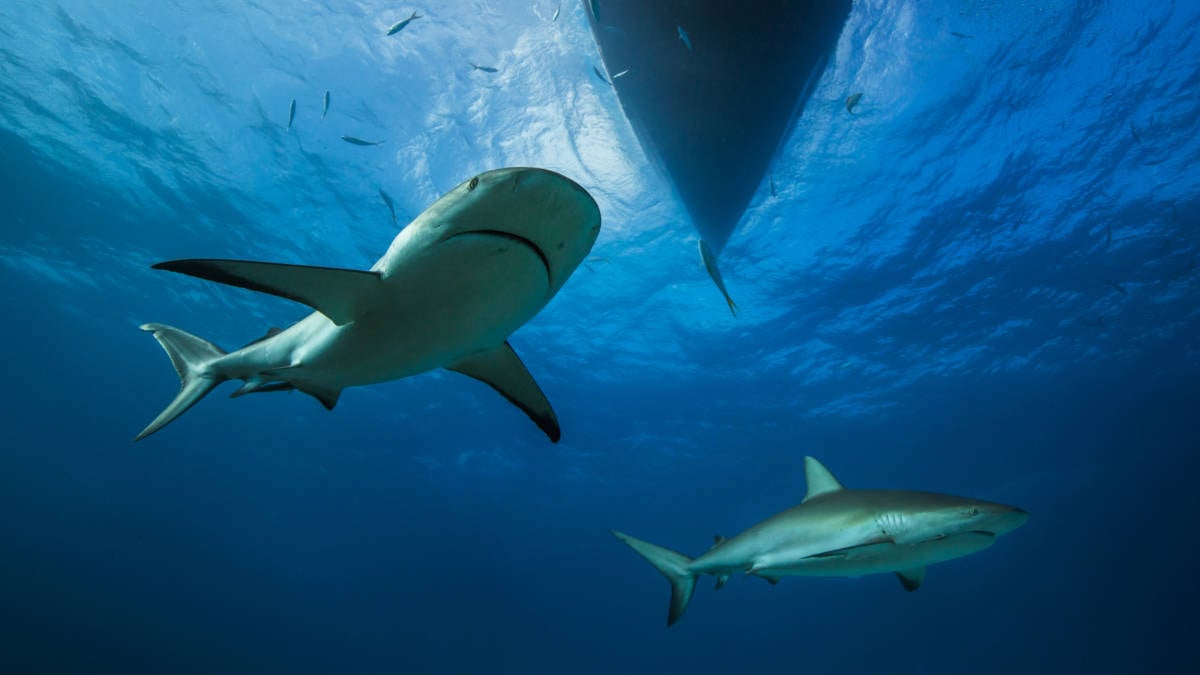
No, sharks do not follow cruise ships, despite that being a common myth. You may rarely see sharks from your cruise ship on occasion, but overall, sharks are not able to keep up pace with a cruise ship’s speed, and there’s little reason why a hungry shark would want to follow a cruise ship anyway.
Here’s what you need to know.
In This Article:
- Why Do People Believe Sharks Follow Cruise Ships?
- The Sharks Don’t Want to Eat You
- Cruise Ships Don’t Leave Behind Enough Food to Attract Sharks
- Any Sharks That You See are Just Coincidences
- What if You Want to See a Shark During Your Next Cruise?
- Sharks and Cruise Ships in the News
- Sharks and Cruises: They Don’t Mix
Why Do People Believe Sharks Follow Cruise Ships?
There are a few reasons people like to believe that sharks follow cruise ships. One, they think that the sharks are after an easy meal, in the form of passengers.
Two, they think that sharks want to eat items thrown overboard. And three, you do hear of people seeing sharks from a cruise ship, from time to time, so that reinforces their reasoning.
However, all of these theories can be addressed, proving this misconception wrong and that sharks don’t follow cruise ships.
The Sharks Don’t Want to Eat You

I get it — there are a lot of reasons why you might expect a shark to follow a cruise ship. We view sharks as these massive ocean predators that are just waiting for a human to chomp down on.
As such, why wouldn’t they follow a cruise ship carrying thousands of passengers, just in case they get lucky enough for one to fall overboard?
However, sharks are like just about any wild animal. They’re just minding their business, looking for food and, if they see something that looks like a food source, they might give it a nibble. But in general, sharks aren’t out to get humans.
Cruise Ships Don’t Leave Behind Enough Food to Attract Sharks

Additionally, even if you don’t think that sharks are following cruise ships for the tasty passengers, you might assume that cruise ships are emitting something into the water that sharks want to eat, kind of like how seagulls flock to the beach to eat up all the leftover snacks from the beachgoers.
Again, though, despite there being a whole Reddit thread dedicated to the idea that sharks follow cruise ships because of all the food passengers toss overboard, cruise ships don’t leave behind enough food to attract sharks.
For one, cruise ships are very strict about not letting passengers throw things overboard, and if they catch you, for example, on camera, doing so, you may be removed from the ship.
Read Also: What Do Cruise Ships Do with Sewage and Waste?
Secondly, while cruise ships do dump food waste into the sea to get rid of it (following strict regulations), they’re not doing so in massive quantities. Cruise lines go to extensive lengths to reduce food waste.
For instance, across its multiple cruise lines, Carnival Corp & PLC employs strategies such as donating unused food in ports, and then they use food waste dehydrators, dryers and grinders to minimize further leftovers.
From there, that food can be bio-digested, offloaded off-shore or released into the water. Any food that does get dumped in the ocean is typically so processed that it’s only attractive to small marine life.
Any Sharks That You See are Just Coincidences

Lastly, as mentioned, you might rarely see sharks from your cruise ship. If you do, though, don’t think that those sharks are actively following you.
Sharks can’t keep pace with a cruise ship, so any multiple sharks you see are a coincidence — not the same shark running behind you, throughout your cruise itinerary.
The average shark swims at a rate of 5–12 mph, and only at their top speeds in short bursts, while the average cruise ship travels at a rate of 20–35 mph.
Worth Reading: What’s on the Bottom of a Cruise Ship?
In addition to sharks not being fast enough to keep pace with a cruise ship, most sharks are going to go where their natural prey is — in shallow water where they can find animals like seals.
In contrast, cruise ships spend the bulk of their time in deep water or in port, where sharks have little incentive to go.
Additionally, cruise ships are loud, and that loud noise and the vibrations can deter a shark as well. Accordingly, even a cruise ship-curious shark is unlikely to come across one naturally.
What if You Want to See a Shark During Your Next Cruise?

But what if you’re reading all of the above and it actually kind of bums you out? You weren’t looking for reassurance that you’d be safe from sharks on your cruise. You actually want to see one!
Well, if you do, there are a few things you can do. One, book a cruise to a destination where these apex predators are most prominent, such as a cruise through the Caribbean or around Hawaii, Mexico or Australia.
Then, two, just book a shark-related excursion. Lots of cruise lines offer them. Carnival Cruise Line and Royal Caribbean both offer a shark encounter and snorkel excursion in Nassau. Norwegian Cruise Line and Disney Cruise Line both offer a shark encounter excursion in Puerto Plata, in the Dominican Republic.
Sharks and Cruise Ships in the News

All of the above facts regarding the unlikelihood of seeing a shark during your cruise, though, haven’t prevented real cruisers from experiencing their own shark encounters on occasion.
Keep in mind, though, that while you may see a cruise ship shark encounter pop up in the media every so often, you may only see a few of these stories per year, if that.
Meanwhile, there are more than 300 cruise ships operating at any given time, with more than 37 million people cruising every year. Again, this all makes any encounters very, very rare.
Here are a few cruise ship shark stories that have popped up in recent years.
Shark Bite Shuts Down Shore Excursion

In 2024, a shore excursion in the Bahamas was shut down following a shark bite. While it’s unclear whether or not the victim, a young boy, was on the excursion as part of a cruise, it was an excursion open to cruisers.
Following the bite, the boy was expected to make a full recovery and was taken back to the States to complete treatment.
Tall Ship Cruisers Spot Basking Shark in Massachusetts
In 2021, a video was posted to TikTok from a tall ship cruise in Massachusetts. There, cruisers can be seen hanging over the side of the ship, gawking at a very large shark.
The good news? It was just a basking shark, so while basking sharks are one of the largest sharks in the world, they’re safe to swim with, as they primarily just eat plankton. In fact, you can take excursions just to see and swim with basking sharks.
Worth Reading: Carnival Guests Worry About Shark Attacks at Celebration Key
Do note, though, that when you’re taking cruises on smaller vessels like this — such as a day tour cruise or dinner sunset cruise that sticks closer to the shore — you may be more likely to glimpse sharks, due to proximity to the shallows, as well as the smaller ship size.
Cruisers Rescue Shark

In 2023, cruisers on Royal Caribbean’s Ovation of the Seas actually helped rescue a shark! While on a cruise around New Zealand, guests on land helped rescue a beached juvenile basking shark.
Again, since basking sharks are very gentle, the cruisers were not at risk as they attempted to help the shark get back into the water.
Royal Caribbean Passenger Dies After Shark Attacks

Unfortunately, one Royal Caribbean cruiser didn’t have quite the same story. In 2022, a cruiser from Royal Caribbean’s Harmony of the Seas was partaking in a snorkeling excursion in the Bahamas.
During the excursion, a bull shark attacked the passenger, and they later passed due to their upper body injuries. The excursion was not ran by the cruise line.
Sharks and Cruises: They Don’t Mix
In short, sharks and cruises don’t really mix. You’re unlikely to encounter a shark on your cruise and, if you do see a shark from the ship, it’ll be a rare sighting and you won’t see the same shark twice. It’s not following you.
Read Also: Can You Fish off a Cruise Ship? (Or Take Fishing Gear)
The only time on a cruise when you might even be slightly in danger of encountering a shark is if you’re on an excursion or beach where sharks are present — or, if you tragically fall overboard.
Even then, if someone does fall overboard on a cruise, they’ve got bigger, more immediate problems to worry about.